

Note: This article focuses on real-world places widely connected with the visual, cultural, architectural, or geographic inspiration behind beloved Disney animated films. Some are direct settings, some are design references, and some are cultural landscapes that helped animators make fantasy feel wonderfully believable.
Disney magic has a funny way of making impossible places feel like somewhere you could reach with a passport, a snack budget, and very comfortable shoes. A castle appears on a hill, a village glows with lanterns, a lion surveys the savanna, and suddenly your brain whispers, “Wait… is that real?” Quite often, the answer is: surprisingly, yes.
Many classic Disney animated films did not emerge from blank paper alone. Artists studied castles, villages, cathedrals, forests, islands, deserts, and historic cities. They borrowed silhouettes, moods, textures, weather, and cultural details, then sprinkled them with the kind of cinematic sparkle that makes stone towers look like they can sing. Below are 12 real places that inspired classic Disney animated films, along with why each location still feels like a doorway into animation history.
1. Neuschwanstein Castle, Germany Sleeping Beauty
High in Bavaria, Neuschwanstein Castle looks like it was built by someone who had never heard the phrase “tone it down.” Its white towers, mountain backdrop, and romantic 19th-century design helped shape the fairy-tale castle language associated with Sleeping Beauty and Disney’s broader castle imagery.
The castle was commissioned by King Ludwig II of Bavaria, who was very committed to the idea that architecture should have drama, height, and a little theatrical flair. Disney artists found in Neuschwanstein the perfect visual vocabulary: graceful turrets, vertical elegance, and a dreamlike setting that seems to float above the landscape. In animation, those traits became shorthand for royalty, enchantment, and “someone important is probably about to prick her finger on something.”
2. Alcázar of Segovia, Spain Snow White and the Seven Dwarfs
The Alcázar of Segovia rises from a rocky ridge like a ship made of stone. With its pointed towers and stern medieval profile, it has long been associated with the Queen’s castle in Snow White and the Seven Dwarfs. The connection makes sense: the film needed a castle that felt beautiful but slightly intimidating, elegant but not exactly the kind of place where you would accept an apple from a stranger.
Disney’s version exaggerates and simplifies the architecture, but the Alcázar’s dramatic cliffside position and fortress-like silhouette gave the animators a believable foundation. That is the trick behind great Disney design: the fantasy works because the bones are real.
3. Alsace, France Beauty and the Beast
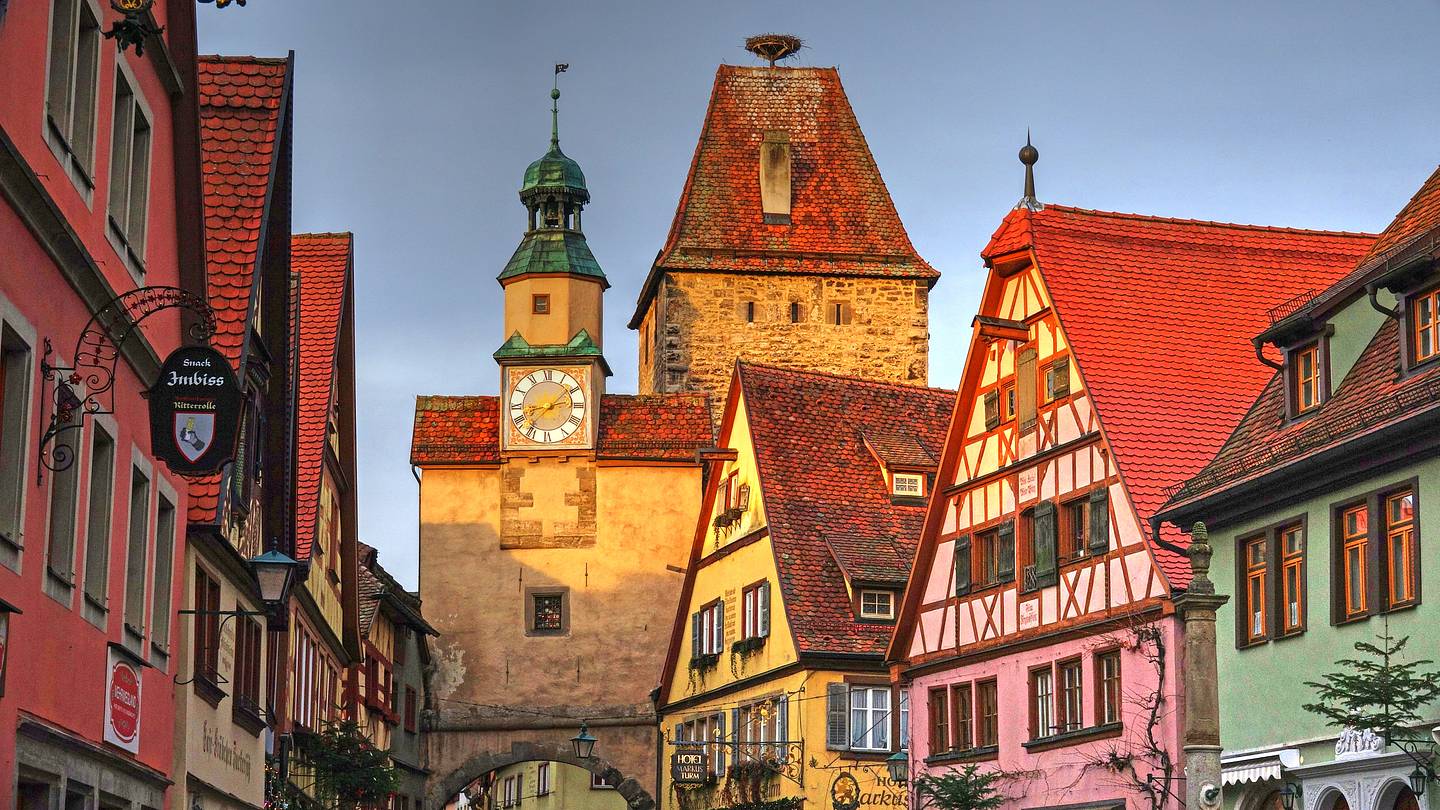
Belle’s village in Beauty and the Beast feels like it was assembled from cobblestones, bookshops, fresh bread, and judgmental townspeople with excellent chorus timing. Its visual charm is often linked to the Alsace region of France, especially storybook towns such as Riquewihr, Ribeauvillé, and Colmar.
Alsace blends French and German architectural influences, which helps explain the film’s half-timbered houses, flower boxes, steep roofs, and cozy village square. The result is a setting that feels old-world without being locked to one exact map pin. Belle’s town is fictional, but walk through Alsace and you can almost hear someone yelling “Bonjour!” with suspicious musical precision.
4. Mont Saint-Michel, France Tangled
In Tangled, the Kingdom of Corona sits like a jewel on an island, surrounded by water and connected to the mainland in a way that makes lantern festivals look unfairly photogenic. Its visual inspiration is widely associated with Mont Saint-Michel in Normandy, France.
Mont Saint-Michel is a tidal island crowned by an abbey, rising dramatically from the bay. That geography is not just pretty; it also supports storytelling. Rapunzel’s royal home needed to feel separate, protected, and almost mythical. Mont Saint-Michel gives that exact feeling in real life. It is the kind of place that makes you understand why animators occasionally look at reality and say, “Honestly, we barely need to add magic.”
5. Notre-Dame Cathedral, Paris The Hunchback of Notre Dame
Some Disney inspirations are subtle. Notre-Dame Cathedral is not one of them. The Hunchback of Notre Dame is inseparable from the Gothic landmark at the heart of Paris. The cathedral is not merely a background; it is practically a character, watching over Quasimodo, Esmeralda, Frollo, and the city below.
Disney artists studied the cathedral’s towers, bells, rose windows, gargoyles, and stone surfaces to create an animated Paris that feels both grand and emotionally heavy. The film takes creative liberties, of course, but the cathedral’s real Gothic power gives the story its soul. Its vertical lines and shadowed spaces communicate isolation, faith, fear, and hope before any character says a word.
6. Taj Mahal, India Aladdin
Aladdin is set in the fictional city of Agrabah, but the Sultan’s palace carries unmistakable echoes of the Taj Mahal in Agra, India. The large central dome, symmetrical grandeur, and white-marble fantasy all point toward one of the world’s most recognizable monuments.
Disney’s palace is not a historically accurate copy. It mixes influences freely, creating a heightened fantasy rather than a documentary setting. Still, the Taj Mahal’s elegant dome and monumental presence helped shape the palace into a symbol of wealth, romance, and royal distance. In other words, it looks exactly like the kind of place where a princess might reasonably own a pet tiger.
7. Hell’s Gate National Park, Kenya The Lion King
The Pride Lands in The Lion King feel vast, sunlit, and ancient. Disney’s creative team studied African landscapes and wildlife, and Hell’s Gate National Park in Kenya is frequently connected with the film’s dramatic rock formations and savanna atmosphere.
The park’s cliffs, gorges, and open terrain helped inspire the visual scale of Simba’s world. While Pride Rock itself is a composite of several natural references, the real Kenyan landscape gave the animators something crucial: authenticity of mood. The sunrise, the dust, the golden grass, and the feeling of life moving in cycles all became part of the film’s emotional design. Even without talking animals, the place already has cinematic confidence.
8. Machu Picchu, Peru The Emperor’s New Groove
The Emperor’s New Groove may be one of Disney’s funniest animated films, but its visual roots are serious business. The film draws from ancient Andean and Inca-inspired architecture, with Machu Picchu often cited as a major real-world reference for the mountainous setting and Pacha’s village atmosphere.
The terraced landscapes, stone structures, high-altitude views, and winding paths all echo Peru’s historic mountain citadel. Disney then turned that visual foundation into a comedy playground for Kuzco, Pacha, Yzma, and Kronk. The result is a rare blend: ancient inspiration, llama chaos, and one of animation’s greatest uses of the phrase “wrong lever.”
9. Château de Chillon, Switzerland The Little Mermaid
Prince Eric’s seaside castle in The Little Mermaid has often been linked to Château de Chillon on Lake Geneva in Switzerland. The real castle sits on a rocky edge beside the water, giving it the same romantic “waves crashing below the royal balcony” energy seen in the film.
Of course, Ariel’s world is oceanic while Chillon sits beside a lake, but animation is not a geography exam. What mattered was the composition: stone walls meeting water, towers rising from a dramatic shoreline, and a palace that feels close enough to the sea for a mermaid to make a very bold life decision involving legs.
10. New Orleans, Louisiana The Princess and the Frog
The Princess and the Frog is deeply tied to New Orleans. The film’s 1920s setting, jazz music, streetcars, wrought-iron balconies, bayou atmosphere, Creole cuisine, and restaurant dreams all draw from the city’s distinctive culture.
New Orleans is not simply a backdrop for Tiana’s story. It shapes her ambition, her food, her music, and her community. The French Quarter’s visual rhythm appears in the film’s architecture, while Louisiana bayou landscapes add mystery and movement. The result is one of Disney’s richest American settings: warm, musical, flavorful, and occasionally interrupted by a trumpet-playing alligator.
11. Norway Frozen
The kingdom of Arendelle in Frozen is fictional, but its visual DNA comes from Norway. Fjords, stave churches, rosemaling folk art, mountain villages, and historic sites such as Akershus Fortress all helped inspire the look and feel of Anna and Elsa’s world.
Norway gave Frozen more than snow. It gave the film texture: carved wood, steep roofs, icy water, folk patterns, dramatic cliffs, and a sense of nature that can be beautiful one minute and extremely emotionally symbolic the next. Arendelle works because it feels designed by people who studied how real cold places look, sound, and survive. Also, it proves that if you add enough fjords, even family trauma becomes visually stunning.
12. Hanapepe and Kauai, Hawaii Lilo & Stitch
Lilo & Stitch is one of Disney’s most grounded animated films, despite the fact that its co-star is a blue alien experiment with the manners of a blender full of bees. The film’s island setting was inspired by Kauai, especially the small-town feeling of Hanapepe.
The watercolor backgrounds, local storefronts, beaches, mountains, and lived-in homes give the movie a tenderness that sets it apart from grand palace stories. Kauai’s influence makes Lilo and Nani’s world feel intimate and real. The setting is not polished into postcard perfection; it has laundry, traffic, surfboards, social workers, and rent problems. That realism makes the word “ohana” land with actual weight.
Why Real Places Make Disney Films Feel More Magical
The secret is contrast. Disney films often tell impossible stories, but they place those stories in environments that borrow from reality. A castle based on a real fortress feels stronger. A village inspired by real architecture feels warmer. A jungle, fjord, bayou, or island shaped by real geography gives the fantasy somewhere to stand.
This is why Disney movie locations are so fascinating for travelers and film fans. They reveal that animation is not just drawing; it is observation. Artists study stone, light, plants, streets, weather, textiles, and human behavior. Then they translate those details into designs that are simplified enough for storytelling but rich enough to feel alive.
That balance is what keeps these films timeless. Viewers may not know the names Neuschwanstein, Segovia, Mont Saint-Michel, or Hanapepe the first time they watch, but they recognize the emotional truth of those places. The castle is lonely. The village is cozy. The bayou is mysterious. The savanna is enormous. The island is home.
Travel Experiences Inspired by These Disney Places
Visiting real places that inspired Disney animated films is not like stepping into a theme park, and that is exactly why it is wonderful. There are no perfectly timed fireworks every evening, no villain monologue echoing through the gift shop, and absolutely no guarantee that woodland animals will help you pack. What you get instead is better: the texture of reality behind the fantasy.
At Neuschwanstein, the first surprise is how steep everything feels. The castle is beautiful in photos, but in person you understand why Disney artists loved its theatrical placement. It does not merely sit on the landscape; it performs. The mountains frame it, the roads climb toward it, and the towers look as if they are waiting for orchestral music. The experience is less “I am in a cartoon” and more “I see how a cartoon learned to dream.”
In Alsace, the Disney connection feels softer but more immersive. You walk past half-timbered houses, bakery windows, old signs, and narrow lanes that curve just enough to make every corner feel staged. The pleasure is not finding one exact Belle landmark. It is realizing how a whole region can create the mood of a film: curious, bookish, colorful, and slightly nosy in the best village tradition.
Mont Saint-Michel delivers the biggest “no way this is real” moment. From a distance, it rises from the water like a kingdom that forgot to be fictional. The tides, the causeway, the abbey steps, and the crowded medieval lanes all create a sense of separation from ordinary life. If you are a Tangled fan, the place makes the lantern scene feel less like fantasy and more like a memory someone animated.
New Orleans offers a different kind of Disney experience. It is not about finding one building and saying, “There it is.” It is about rhythm. Brass music spills into the street, food smells like a persuasive argument, and balconies seem designed for dramatic entrances. Watching The Princess and the Frog after visiting New Orleans makes the film feel fuller, because you understand how much of its energy comes from the city itself.
Kauai and Hanapepe may be the most emotionally powerful for fans of Lilo & Stitch. The island’s beauty is obvious, but the film’s genius lies in its everyday details: local shops, modest homes, surf culture, family pressure, and the strange comedy of trying to hold life together when everything keeps going sideways. Visiting Kauai adds depth to the movie because you see that its magic is not only in aliens and Elvis songs. It is in ordinary love, stubborn sisters, and a place that feels like home even when life is messy.
The best way to experience these Disney-inspired places is to treat them as real destinations first and movie references second. Learn their histories. Respect local communities. Eat the regional food. Walk slowly. Look at the details: rooflines, stonework, doorways, hills, markets, trees, and the way light changes through the day. That is where the real magic hides. Disney borrowed from these places because they already had stories. The films simply helped millions of people notice them.
Conclusion
The real places that inspired classic Disney animated films prove that imagination rarely works alone. It collects. It studies. It travels. From Bavaria’s castles to Kenya’s dramatic cliffs, from Parisian cathedrals to Hawaiian towns, Disney artists transformed real architecture, landscapes, and cultures into animated worlds that still live rent-free in our memories.
For fans, these destinations offer more than photo opportunities. They show how fantasy is built from observation, respect, exaggeration, and a tiny bit of artistic mischief. The next time you watch a Disney classic, look past the songs and sidekicks for a moment. Behind the magic, there may be a real village, castle, bayou, mountain, or island quietly saying, “You’re welcome.”