

Superstitions are humanity’s way of saying, “I have no control over this situation, but maybe knocking on a table will help.” From black cats to lucky socks, weird superstitions have traveled through families, countries, religions, sports locker rooms, theaters, kitchens, and awkward dinner conversations. Some began as warnings. Some grew from ancient beliefs about spirits, luck, death, purity, or protection. Others probably started because one person had a terrible Tuesday and blamed the nearest umbrella.
The funny thing is that superstitions rarely disappear just because people become more educated. We may understand weather forecasts, psychology, medicine, and statistics, yet plenty of us still pause before walking under a ladder. Why? Because superstition is not only about belief. It is about habit, comfort, culture, memory, and the tiny emotional insurance policy we buy when life feels unpredictable.
Below are 20 weird superstitions from the United States and around the world, explained with history, cultural context, and a healthy amount of eyebrow-raising curiosity.
What Makes a Superstition “Weird”?
A superstition is usually a belief or ritual that connects an action, object, number, animal, or event with good or bad luck. It does not need scientific proof to survive. In fact, many superstitions thrive precisely because they live in the fuzzy neighborhood between “I know this is silly” and “I am still not testing it.”
What makes a superstition weird is not always the belief itself. It is the confidence behind it. A person may calmly explain taxes, mortgages, and Wi-Fi routers, then panic because someone put shoes on a table. That contrast is where superstitions become charming, strange, and very human.
20 Weird Superstitions and Their Meanings
1. Breaking a Mirror Brings Seven Years of Bad Luck
This classic bad luck superstition may come from old beliefs that mirrors reflected more than appearance. In many traditions, a reflection was connected to the soul or personal spirit. Breaking a mirror, then, was not just household damage. It was spiritual vandalism with a cleanup fee.
The “seven years” part is often linked to ancient ideas that life renewed itself in cycles. Today, most people understand that a broken mirror mainly means a trip to the store and a careful sweep. Still, when glass cracks, even the most practical person may briefly wonder if the universe just sent an invoice.
2. Black Cats Crossing Your Path Mean Bad Luck
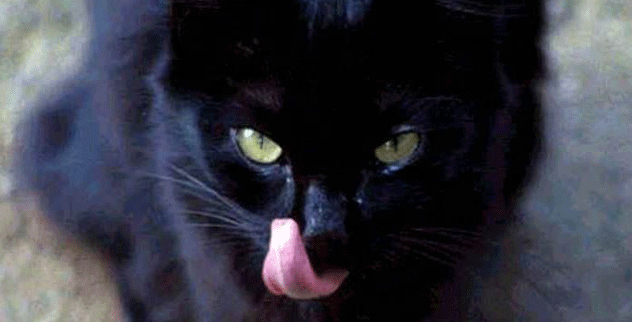
Black cats have had a wildly unfair public relations problem. In some parts of medieval Europe, they became associated with witches, night, mystery, and evil omens. In other cultures, however, black cats are lucky, protective, or simply adorable little shadows with opinions.
This superstition shows how culture changes meaning. One person sees bad luck. Another sees a future Instagram star. The cat, meanwhile, sees a cardboard box and has no interest in your destiny.
3. Walking Under a Ladder Invites Misfortune
This superstition has practical and symbolic roots. Practically, walking under a ladder is a great way to meet falling paint, tools, or an irritated contractor. Symbolically, a ladder leaning against a wall forms a triangle, a shape once associated with sacred ideas in ancient cultures. Passing through it could be interpreted as disrespectful or dangerous.
In modern terms, this is one superstition with a safety lesson hiding inside. The universe may not punish you, but gravity is very punctual.
4. Opening an Umbrella Indoors Brings Bad Luck
Opening an umbrella indoors is considered unlucky in many households. Some explanations connect the belief to ancient sun protection, while others point to basic indoor chaos. Old umbrellas had stiff metal ribs and spring mechanisms. Open one in a small room and suddenly Grandma’s lamp is in danger.
Like many common superstitions, this one may have survived because it teaches manners through drama. “Do not open that indoors” sounds ordinary. “You will bring bad luck” has more flair.
5. Spilling Salt Must Be Fixed by Tossing Salt Over Your Shoulder
Salt was once valuable, useful, and symbolically powerful. Spilling it could be seen as wasteful or unlucky. The remedy, tossing a pinch over the left shoulder, is often explained as a way to blind or repel evil forces lurking nearby.
In today’s kitchen, this ritual mostly results in seasoned flooring. Still, it remains one of the most famous protective superstitions. It is quick, dramatic, and makes everyone at dinner wonder whether you are cooking or conducting a tiny exorcism.
6. Knock on Wood to Avoid Tempting Fate
Many people knock on wood after saying something hopeful, such as “I have never lost my phone.” The idea is to avoid jinxing good fortune. Possible origins include old beliefs that spirits lived in trees or that touching wood offered protection.
Psychologically, this ritual gives people a small sense of control. It says, “I have acknowledged the danger, dear universe. Please do not be petty.” And if no wood is nearby, some people knock on their own head, which is both practical and mildly insulting.
7. Friday the 13th Is an Unlucky Day
Friday the 13th combines two separate anxieties: suspicion of the number 13 and old negative associations with Friday in certain Western traditions. Over time, books, movies, and pop culture turned the date into a full-blown symbol of bad luck.
What is interesting is how powerful a calendar square can become. The date itself does nothing. It does not move furniture, cancel flights, or steal socks from the dryer. Yet people may still feel uneasy when it appears, proving that the human brain is excellent at giving numbers a spooky costume.
8. The Number 13 Is Unlucky
Fear of the number 13 is so common that some buildings skip the 13th floor, even though everyone knows the floor is still there wearing a fake mustache as “14.” The superstition may be connected to religious, historical, and cultural associations, including stories where 13 guests at a table predicted betrayal or death.
This is a perfect example of how symbols influence behavior. A number cannot hurt anyone, but it can affect architecture, travel choices, seating plans, and hotel design.
9. The Number 4 Is Unlucky in Some East Asian Cultures
In Chinese, Japanese, and Korean language contexts, the word for “four” can sound similar to the word for “death.” Because of that, the number 4 is avoided in some buildings, hospitals, phone numbers, and gifts.
This superstition is called tetraphobia. It shows that sound matters in folklore. A number becomes unlucky not because of math, but because language gives it a shadow. Poor number 4 never asked for this career.
10. A Rabbit’s Foot Brings Good Luck
The rabbit’s foot is one of the strangest lucky charms because, frankly, it was not lucky for the rabbit. The belief has roots in several traditions, including European folklore and African American folk magic. Rabbits were often associated with fertility, speed, cleverness, and abundance.
Today, many people prefer symbolic or fake charms rather than real animal parts. The main idea remains the same: carrying a small object can make people feel protected, confident, or connected to tradition.
11. Saying “Rabbit, Rabbit” on the First Day of the Month Brings Luck
In some English-speaking traditions, saying “rabbit, rabbit” immediately after waking on the first day of the month is believed to bring good luck. The exact origin is unclear, which somehow makes it even more charming.
This superstition is harmless, easy, and delightfully odd. It also creates a monthly test of memory. Forget before checking your phone? Too late. The rabbits have clocked out.
12. Horseshoes Over the Door Protect the Home
Horseshoes are widely seen as lucky symbols. Their association with iron, horses, protection, and the crescent shape helped turn them into powerful charms. Some people hang the horseshoe points upward to “hold” luck. Others hang it downward so luck pours over the doorway.
This disagreement proves that even good luck needs installation instructions.
13. Four-Leaf Clovers Bring Good Fortune
Four-leaf clovers are rare compared with the common three-leaf variety, and rarity often becomes magical in human imagination. They are associated with luck, hope, faith, love, and protection.
Part of the superstition’s appeal is the hunt. Finding one feels like nature quietly slipped you a coupon for better odds. Whether luck follows or not, the search itself makes people slow down and look closely at the ground, which is more peaceful than refreshing email.
14. Itchy Palms Mean Money Is Coming or Going
In some traditions, an itchy right palm means money is coming, while an itchy left palm means money is leaving. In others, the meanings are reversed. This is inconvenient because your palm apparently needs a regional settings menu.
The superstition connects the hand with giving, receiving, work, trade, and wealth. While dry skin is the more likely explanation, it is admittedly more exciting to think your hand is predicting your bank account.
15. Do Not Put Shoes on the Table
Putting shoes on a table is considered unlucky in parts of Europe and beyond. Some explanations connect the belief to death rituals, mining accidents, or simple hygiene. Honestly, the hygiene explanation alone is strong enough. Shoes meet sidewalks. Tables meet sandwiches. They do not need to network.
This superstition survives because it combines cultural fear with practical disgust. Even people who do not believe in bad luck may still shout, “Get those off the table!” with ancient authority.
16. Do Not Whistle Indoors
In several cultures, whistling indoors is believed to invite bad luck, poverty, spirits, or storms. Some sailors also had beliefs about whistling and wind. The details vary, but the general message is clear: your cheerful tune may be spiritually expensive.
On a practical level, indoor whistling can annoy everyone nearby. So this superstition may be another example of society turning irritation into folklore. “Please stop” became “You are summoning disaster,” which is harder to argue with.
17. Do Not Stick Chopsticks Upright in Rice
In Japan and some other East Asian cultures, placing chopsticks vertically in a bowl of rice is taboo because it resembles funeral offerings. At the table, it can be seen as disrespectful or ominous.
This is less “random weirdness” and more a cultural etiquette rule with deep symbolic meaning. It reminds us that superstitions are often tied to respect, memory, and the boundary between everyday life and sacred ritual.
18. Eating 12 Grapes at Midnight Brings a Lucky New Year
In Spain and many Latin American communities, people eat 12 grapes at midnight on New Year’s Eve, one for each month of the coming year. Finish them in time, and luck is supposed to follow.
This superstition is festive, delicious, and slightly competitive. It turns the first moments of the year into a tiny fruit-based obstacle course. Nothing says “fresh start” like trying not to choke while aggressively pursuing prosperity.
19. A Purse on the Floor Means Money Will Leave You
In Brazil and other places, placing a purse or wallet on the floor is believed to cause financial loss. The symbolism is easy to understand: money should be respected, protected, and kept away from dirt.
Even without superstition, this is practical advice. Floors are where crumbs, germs, and mysterious sticky spots hold conventions. Your wallet deserves better accommodations.
20. Never Toast With Water
In some cultures, especially parts of Europe, toasting with water is considered bad luck or associated with death. The belief varies by region, but the idea is that celebration should be marked with something more symbolic than plain water.
Of course, staying hydrated is not evil. But at a traditional table, the gesture may feel socially wrong. Like many weird superstitions, it is not only about luck. It is about shared meaning, group habits, and knowing the rules before you raise your glass.
Why Do People Still Believe in Weird Superstitions?
Superstitions continue because they solve an emotional problem, not a logical one. When people face uncertainty, they look for patterns. If wearing a certain shirt during a winning game seems connected to success, that shirt may become “lucky.” If someone had a bad day after breaking a mirror, the mirror gets blamed faster than poor planning, bad timing, or plain randomness.
Psychologists often explain superstition as a way to create a feeling of control. The ritual may not change reality, but it can change confidence, calm nerves, or reduce anxiety. Athletes, performers, students, travelers, and public speakers often develop small rituals before high-pressure moments. The ritual becomes a mental switch: “I have done my thing. Now I am ready.”
Superstitions also connect people to family and culture. A grandmother’s warning, a parent’s habit, or a holiday tradition can feel meaningful even when we do not fully believe it. We repeat the action because it reminds us where we came from. In that sense, superstition is less about magic and more about memory.
Are Superstitions Harmful?
Most weird superstitions are harmless. Saying “rabbit, rabbit,” knocking on wood, avoiding the 13th floor, or hunting for four-leaf clovers will not ruin anyone’s life. In fact, some rituals can be comforting or fun.
Problems begin when superstition replaces good judgment. A lucky charm should not replace medical care, safe driving, financial planning, or honest communication. Tossing salt over your shoulder is fine. Tossing responsibility over your shoulder is where things get messy.
The healthiest way to enjoy superstitions is to treat them as cultural stories, emotional habits, or playful traditions. Keep the charm. Respect the custom. But let reason drive the car.
Personal Experiences and Everyday Stories About Weird Superstitions
Almost everyone has a superstition story, even people who proudly claim they are “too logical” for that sort of thing. The funniest part is that superstitions often appear when we are under pressure. A student may laugh at lucky pencils all semester, then refuse to take an exam without the same mechanical pencil they used on a previous test. Suddenly, that pencil is not stationery. It is an academic bodyguard.
Sports fans are especially vulnerable to superstition. One person wears the same jersey for every game. Another sits in the same chair. Someone else refuses to change snacks during a winning streak. If the team loses, the blame may fall on a changed routine, a washed shirt, or an unlucky comment made during the second quarter. Is this rational? Not really. Is it emotionally satisfying? Absolutely. It gives fans the illusion that their couch behavior has cosmic influence over professional athletes running miles away under stadium lights.
Family superstitions are even more memorable. Many people grow up hearing warnings like “do not sweep someone’s feet,” “do not cut nails at night,” “do not open an umbrella indoors,” or “do not step over someone lying down.” Children may not understand the meaning, but the warning sticks because adults deliver it with such confidence. Years later, the same child becomes an adult who hesitates before doing the forbidden thing. The brain says, “This is nonsense.” The memory says, “But Mom sounded very serious.”
Travel also reveals how superstitions differ from place to place. A gesture that seems normal in one culture may feel unlucky or disrespectful in another. Sticking chopsticks upright in rice, giving certain flowers, whistling indoors, or placing a purse on the floor can carry meanings that visitors may not expect. Learning these beliefs is not about becoming fearful. It is about becoming more aware. Superstitions are cultural shortcuts. They show what a community protects, respects, worries about, or finds sacred.
Then there are personal superstitionsthe tiny rituals people invent for themselves. Maybe someone always checks the door lock three times before a trip, wears a certain bracelet to interviews, or plays the same song before starting an important project. These habits may not control luck, but they can create focus. The ritual becomes a familiar bridge between anxiety and action.
One of the best ways to think about weird superstitions is this: they are stories we perform. Instead of only telling a tale about luck, we act it out. We knock, toss, avoid, wear, count, whisper, or repeat. The action makes the story feel real for a second. And sometimes that second is enough to make us smile, breathe, and keep going.
Conclusion: Weird Superstitions Are Strange, Funny, and Very Human
Weird superstitions may not be scientific, but they are revealing. They show how people handle uncertainty, protect traditions, explain coincidence, and add drama to ordinary life. A mirror breaks, a cat crosses the street, a palm itches, or a ladder leans against a walland suddenly the world feels full of secret messages.
The real magic of superstitions is not that they control destiny. It is that they connect imagination with daily behavior. They make culture visible in small moments. They turn salt, shoes, numbers, grapes, cats, and clovers into symbols. They remind us that humans are not purely logical creatures. We are meaning-making machines with calendars, kitchen tables, and a suspicious relationship with umbrellas.
So go ahead and knock on wood if it makes you feel better. Just do not walk under a ladder while doing it.