

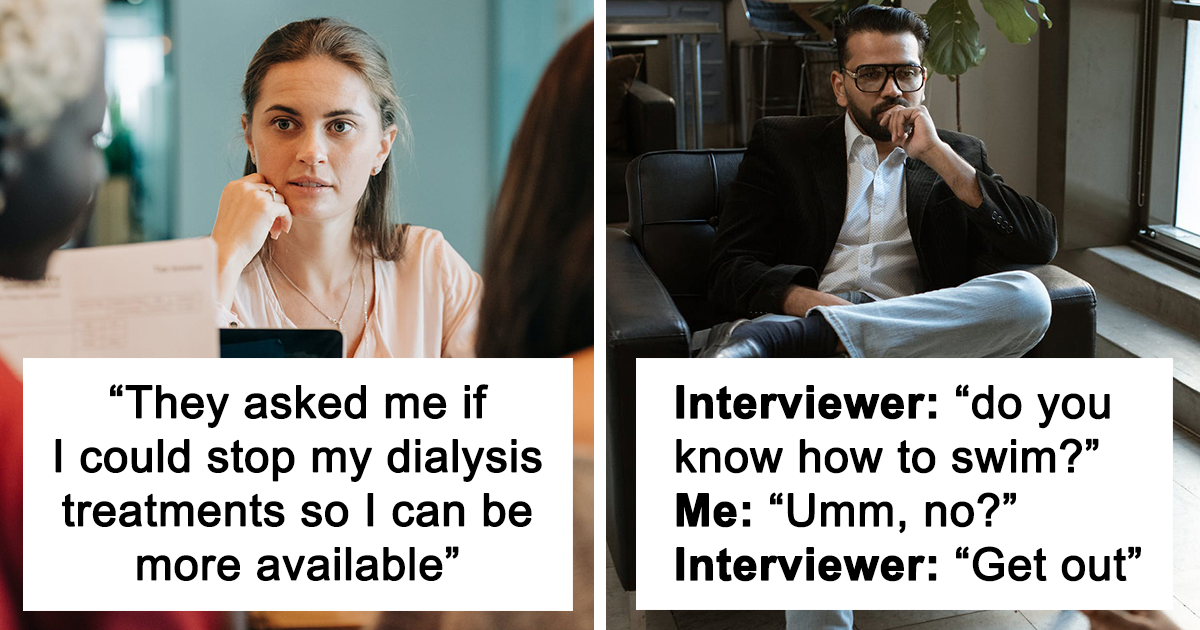
Job interviews arn do the work? Yet some hiring managers apparently arrive with a different missionpart career assessment, part family interrogation, and part late-night personality quiz designed by someone who owns too many motivational mugs.
One candidate is asked about project management. Another is asked whether she plans to become pregnant. Someone else must estimate the number of tennis balls in Texas while pretending this is a perfectly ordinary way to select an accountant.
Unusual questions are not always bad. A thoughtful hypothetical may reveal how a candidate analyzes problems, communicates uncertainty, or makes decisions. The trouble begins when an interviewer wanders into medical history, religion, age, family plans, national origin, sexual orientation, or other personal information that has little to do with job performance.
The Equal Employment Opportunity Commission advises employers to limit pre-employment inquiries to information needed to determine whether someone is qualified. Federal rules also place specific restrictions on pre-offer disability and medical questions, while seemingly casual inquiries about children, pregnancy, religion, or national origin may become evidence of discrimination. State and local protections can go further. llowing accounts are paraphrased composites based on recurring stories shared by candidates, career publications, hiring professionals, and workplace forums. They are not verbatim transcripts, but every scenario represents the sort of interview detour real applicants regularly describe.
When a Job Interview Becomes a Personal Interrogation
1. “Are You Planning to Get Pregnant Soon?”
A woman interviewing for a management role said the conversation was going beautifully until the hiring manager asked whether she intended to have children within the next two years. She redirected the discussion toward her availability and long-term professional goals. The interviewer asked again.
That second attempt transformed an awkward mistake into a flashing red warning light. Employers can ask whether candidates can meet a position’s schedule or travel requirements. They do not need a five-year reproductive forecast.
2. “Who Will Watch Your Children While You Work?”
One parent was asked who would collect her children from school if a meeting ran late. She wondered whether male applicants received the same childcare audit or were simply assumed to possess a magical spouse waiting beside the family minivan.
A job-related version would be simple: “Can you work until 6 p.m. when required?” The candidate’s household arrangements are not the interviewer’s scheduling spreadsheet.
3. “Are You Happily Married?”
A candidate expected questions about software, deadlines, and client relationships. Instead, the interviewer asked whether his marriage was happy and whether his spouse supported his career.
Perhaps the company was hiring a consultant. Perhaps it was secretly casting a reality show called America’s Most Employable Couple. Either way, the candidate politely asked how the question related to the position.
4. “Why Don’t You Have Children?”
After noticing an empty “dependents” field on an outdated application form, an interviewer asked a candidate why she had never had children. There are countless possible answers, many of them painful and none of them necessary for evaluating spreadsheet skills.
Questions about marital status and children are especially risky because they may reveal or support discriminatory assumptions about gender, pregnancy, caregiving, and workplace commitment. ow Old Are You, Exactly?”
An experienced applicant was told that the department had “young energy” and then asked for his exact age. He responded by explaining that he had 18 years of relevant industry experience and was comfortable with the team’s technology.
The interviewer smiled and asked for his birth year instead. Subtle, this was not.
6. “What Year Did You Graduate From High School?”
Sometimes an interviewer does not ask a candidate’s age directly. Instead, the person requests a high school graduation year and performs the subtraction mentally.
The Age Discrimination in Employment Act protects workers age 40 and older from age-based employment discrimination. Although federal law does not automatically make every age-related question unlawful, such questions can become evidence of discriminatory intent, and some states impose tighter restrictions. an You Handle Reporting to Someone Younger?”
A senior candidate was repeatedly asked whether he would feel embarrassed taking instructions from a manager in her twenties. He said he had reported to people of many ages and cared more about clear leadership than birthdays.
The interviewer continued explaining how “some older people struggle with technology.” The candidate continued mentally removing the company from his list.
8. “Where Are You Really From?”
A candidate answered that she was from Ohio. The interviewer clarified that he wanted to know where she was “originally” from. She repeated the name of her hometown. He tried a third time by asking where her parents had been born.
Employers may verify whether someone is authorized to work in the United States. Digging for ethnicity or national origin is a different conversation entirely. Title VII prohibits employment discrimination based on race, color, religion, sex, and national origin. s English Your First Language?”
An applicant who had already completed a presentation, writing test, and hour-long interview was asked whether English was her first language. At that point, the company had enough evidence to evaluate her communication abilities without requesting her linguistic family tree.
A relevant question might address the languages required for the job. A question designed to uncover ethnicity is another matter.
10. “Which Church Do You Attend?”
One candidate mentioned volunteering on weekends. The interviewer immediately asked which church she attended and whether she considered herself “a committed Christian.” The job was not with a religious organization. It involved managing inventory.
The candidate redirected toward her volunteer responsibilities, but the interviewer appeared more interested in theology than logistics.
11. “Will Your Religion Prevent You From Working Weekends?”
An interviewer can explain the required schedule and ask whether a candidate can meet it. What one applicant heard instead was a string of questions about religious services, holidays, and personal beliefs.
The difference is important: evaluate availability, not faith. Employers may also have obligations concerning reasonable religious accommodations.
12. “Are You Gay?”
A candidate mentioned a partner while discussing relocation. The interviewer interrupted to ask whether the partner was a man or a woman. When the candidate hesitated, the interviewer added, “We’re very open-minded here.”
Announcing open-mindedness immediately after demanding personal information is rather like stepping on someone’s foot and praising yourself for wearing soft shoes.
Medical Questions That Made Candidates Diagnose the Workplace
13. “Do You Have Any Disabilities?”
A wheelchair user arrived for an interview and was asked what had “happened” to her before anyone discussed the job. She replied that she could perform the role’s essential functions and offered to explain how she would handle specific tasks.
That is where the employer’s attention should have been from the beginning. Before making an offer, employers generally may ask how an applicant would perform job duties but may not broadly demand disability information. What Prescription Medications Do You Take?”
One applicant was told that the company needed to know whether any medication might affect her “mood.” The interviewer was neither her physician nor auditioning to become one.
Pre-offer medical inquiries are restricted under the Americans with Disabilities Act. A safer interview stays focused on essential duties, performance expectations, and any accommodation the applicant voluntarily requests.
15. “Have You Ever Been Treated for Depression?”
A candidate was asked whether a gap in his résumé involved depression, anxiety, or “some kind of breakdown.” He responded that he was ready and qualified to work and preferred not to discuss private medical information.
The hiring manager described the question as a test of honesty. It was actually a test of boundaries, and the company failed it.
16. “How Many Sick Days Did You Take Last Year?”
An interviewer demanded a detailed accounting of illnesses from the applicant’s previous job. The candidate offered to discuss attendance expectations and confirmed that he could meet the stated schedule.
The interviewer wanted diagnoses. The candidate wanted the nearest exit.
17. “How Much Do You Weigh?”
A sales applicant was asked for her weight because the company wanted employees who looked “energetic.” No lifting requirement, safety standard, uniform measurement, or other job-related reason was provided.
The candidate declined to answer and asked about performance targets instead. The interview ended early, saving everyone from pretending the workplace culture was healthy.
18. “Can You Prove You’re Emotionally Stable?”
After asking how a candidate handled pressure, an interviewer followed up with, “But are you emotionally stable?” The applicant described a successful crisis project and the coping systems she used under tight deadlines.
A behavioral question about workplace pressure can produce useful evidence. An amateur psychological diagnosis produces mostly awkward silence.
Questions From the Department of None of Your Business
19. “Who Did You Vote For?”
A candidate interviewing during an election year was asked to identify his preferred presidential candidate. When he declined, the interviewer explained that the office needed people who “fit the culture.”
Culture fit should not mean ideological cloning. Employers obtain better evidence by asking how applicants collaborate with colleagues who hold different perspectives.
20. “Are You a Republican or a Democrat?”
Another applicant received the direct party-affiliation version. She answered that she kept political activity separate from work and was comfortable serving clients with varied views.
Political affiliation is not uniformly protected under every federal private-sector employment law, but state and local rules vary, and the question remains irrelevant for most jobs. It can also reveal other protected beliefs or associations.
21. “How Much Debt Do You Have?”
A marketing candidate was asked to list credit card balances because the manager believed debt made employees “more motivated.” The applicant briefly considered replying that intrusive interviewers made candidates more motivated to withdraw.
Financial checks are regulated differently across jurisdictions and roles. Whatever screening is lawful and necessary should follow a consistent, transparent processnot a spontaneous personal finance ambush.
22. “Do You Own or Rent Your Home?”
One interviewer moved from commute time to home ownership, mortgage payments, neighborhood prices, and the candidate’s spouse’s income. The candidate repeatedly returned to his ability to arrive on schedule.
A reasonable transportation question asks whether the applicant can reliably reach the workplace. It does not require an appraisal of the applicant’s kitchen backsplash.
23. “How Much Do You Drink?”
A candidate applying to a company known for after-work gatherings was asked how many drinks it took for him to “loosen up.” The interviewer then described mandatory bonding nights.
The question was useful in one unexpected way: it revealed that declining alcohol might be treated as declining membership in the team.
24. “Can We See Your Private Social-Media Account?”
An applicant was asked to unlock her phone and show the interviewer a private profile. She declined and offered links to her public professional portfolio.
Employers may review publicly available information within applicable law, but demanding private access raises obvious concerns about privacy, consistency, and exposure to protected personal information.
25. “What Is the Worst Thing That Has Ever Happened to You?”
A candidate expected a standard question about overcoming a professional challenge. Instead, the interviewer requested the most traumatic event of her life and encouraged her to “go deep.”
She described a difficult project. The interviewer complained that the answer was not personal enough. Career experts have criticized this type of question as intrusive because it pressures candidates to disclose grief, abuse, illness, or other trauma unrelated to the job. Are You Attractive Enough to Meet Our Clients?”
A customer-facing applicant was asked to rate her attractiveness from one to ten. She replied that clients consistently rated her service highly and directed the conversation toward customer retention.
The interviewer wanted a number. She gave him a revenue percentage instead.
27. “Would You Flirt With a Client to Close a Deal?”
A salesperson was asked whether she would use flirting to secure a contract. When she said she relied on product knowledge and relationship building, the manager told her she might be “too serious.”
The candidate later withdrew, having learned more about the sales culture than any employee handbook could have revealed.
Weird Interview Questions That Were Not Necessarily Inappropriate
28. “If You Were an Animal, Which One Would You Be?”
This classic oddball question left one applicant wondering whether the company needed an analyst or a zoo exhibit. She chose an octopus because it was adaptable and good at handling several tasks.
Used sparingly, imaginative questions can create conversation. Used without a scoring purpose, they mostly test whether a candidate has rehearsed an interesting mammal.
29. “How Many Golf Balls Could Fit Inside a School Bus?”
The interviewer did not expect an exact answer. He wanted the candidate to define assumptions, estimate dimensions, account for empty space, and explain the reasoning aloud.
That makes it a problem-solving exercise rather than an invasion of privacy. Still, employers should know what competency they are measuring. Random weirdness is not automatically insight wearing a clever hat.
30. “Would You Break a Rule to Protect the Company?”
A candidate was asked whether she would hide a mistake if reporting it could damage the business. She said she would escalate the issue, protect affected customers, document the facts, and help correct the failure.
The interviewer pushed for a yes-or-no answer. Whether this was an ethics test or a preview of future expectations remained unclear. Either interpretation was educational.
Oddball questions can have legitimate purposes when they are relevant, consistently administered, and evaluated with clear criteria. Structured interviews generally offer stronger comparisons and reduce the temptation to rely on vague “gut feelings.” Google’s hiring guidance emphasizes role-related questions, standardized rubrics, detailed feedback, and interviewer training; Harvard Business Review likewise recommends standardization to reduce bias.
What These Interview Experiences Teach Candidates
An inappropriate question creates a difficult calculation. Candidates may need the job, may not know the law, and may worry that refusing to answer will destroy their chances. There is no single perfect response because the safest choice depends on the question, the interviewer’s intent, the candidate’s comfort level, and whether the conversation still feels worth continuing.
Redirect Toward the Job Requirement
Many candidates successfully answer the legitimate concern without surrendering private information. When asked about children, a candidate might say, “I can meet the schedule and travel requirements described for this role.” When asked about age, the response might be, “I have extensive experience with the systems your team uses and can contribute immediately.”
This approach is calm, professional, and revealing. A reasonable interviewer will accept the job-related answer. Someone who continues digging has shown that the personal informationnot the qualificationwas the real objective.
Ask Why the Information Is Needed
Several candidates report using a simple question: “Could you explain how that relates to the position?” This creates a pause without starting a courtroom drama beside the conference-room ficus.
The interviewer may recognize the mistake and rephrase. For example, “What country are you from?” might become, “Are you legally authorized to work in the United States?” A question about childcare might become, “This position occasionally requires evening work. Can you meet that schedule?”
Set a Direct Boundary
Some questions deserve a clearer response: “I prefer not to discuss my medical history, but I’m happy to explain how I would perform the essential duties.” Another option is, “I keep my political and religious beliefs private at work.”
Career advisers commonly recommend staying composed, declining respectfully, and redirecting toward qualifications. Candidates are not required to transform an interviewer’s inappropriate curiosity into a personal confession. e What the Question Reveals
Interviews run in both directions. An applicant is evaluating the employer’s judgment, training, culture, and respect for boundaries. A single poorly phrased question may be an honest mistake. A series of invasive questionsespecially after polite redirectionsuggests something more systemic.
SHRM reported that 24% of recruiters surveyed considered inappropriate questions somewhat or very common among hiring managers. CareerBuilder has also reported that some hiring managers learned only afterward that a question they asked was legally problematic. Better training and structured interviews reduce this improvisational risk. ent the Experience
After a troubling interview, candidates may write down the date, participants, exact questions, responses, and any follow-up communication. They may contact the recruiter or human-resources department, particularly when the interviewer is not the person responsible for the overall hiring process.
Depending on the circumstances, candidates may also seek advice from an employment attorney or an appropriate government agency. Laws differ by location, employer size, role, and protected category, so an uncomfortable question should not automatically be labeled illegal without examining the facts.
Remember That Walking Away Is an Answer
One of the strongest themes in candidate stories is relief after withdrawing from a questionable hiring process. Applicants often worry that leaving means losing an opportunity. Sometimes it means avoiding a manager who ignores boundaries, a culture built around exclusion, or a company that treats interviews as loyalty tests.
A candidate does not have to end every awkward interview dramatically. A polite “Thank you for your time, but I don’t believe this opportunity is the right fit” is enough. No microphone drop is required, although mentally lowering one onto the conference table is entirely understandable.
Conclusion: The Question Is Also an Answer
The strangest job interview questions are memorable because they reverse the normal evaluation process. The candidate may have entered the room hoping to demonstrate competence, but an intrusive question suddenly demonstrates something about the employer instead.
Useful interviews focus on skills, experience, judgment, availability, and the essential functions of the role. Even creative questions should have a defined purpose. When an interviewer starts investigating pregnancy plans, medical treatment, religion, age, politics, debt, relationships, or trauma, the discussion has drifted far beyond professional qualifications.
Candidates can redirect, ask for relevance, establish a boundary, document the exchange, or leave. Employers can prevent these situations through structured questions, consistent scoring, legal training, and the revolutionary hiring strategy of reading the résumé before the interview.
Ultimately, every interview question provides information. Some reveal how a candidate solves problems. Others reveal that the candidate should solve one immediate problem by applying somewhere else.