

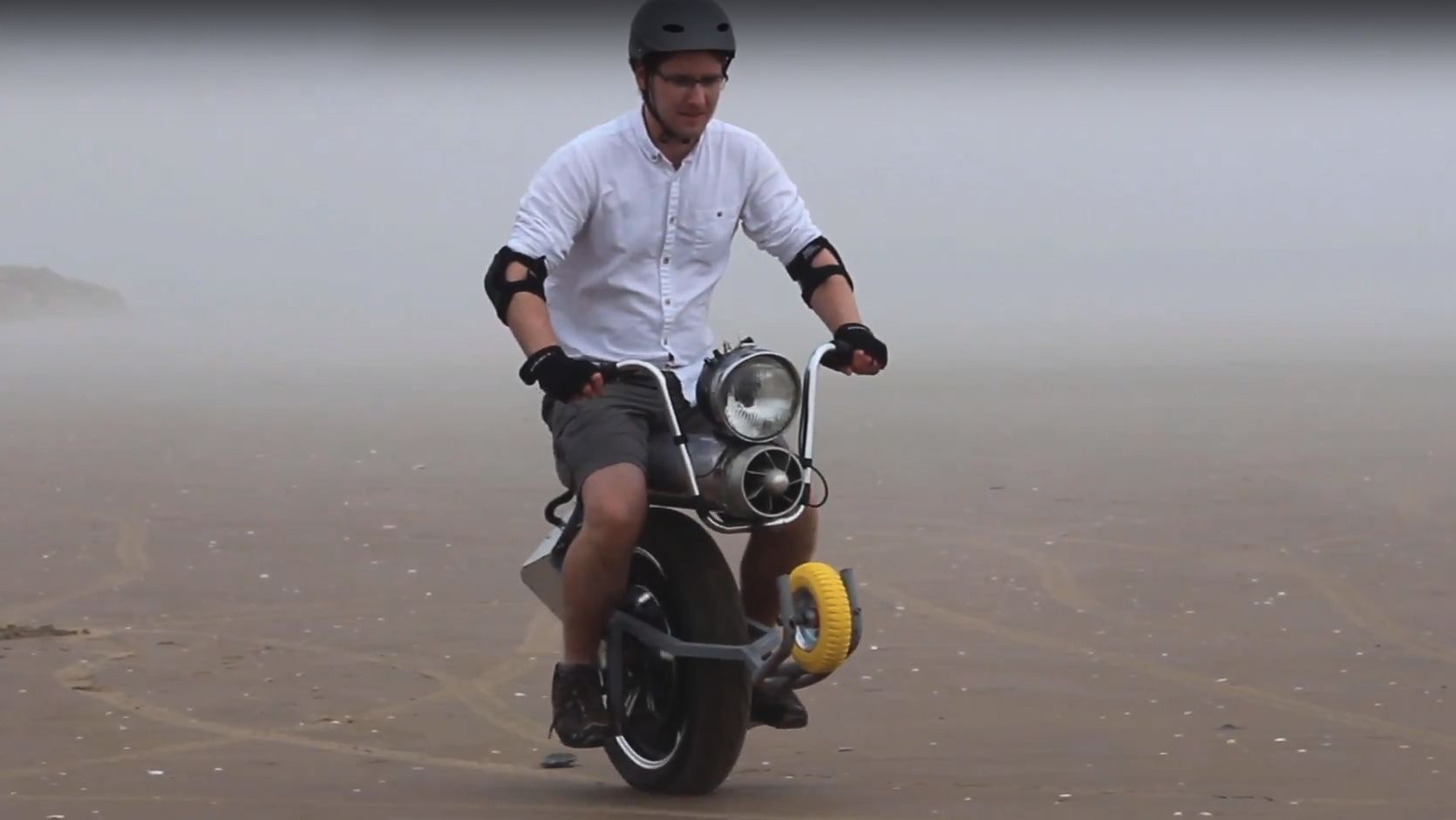
There are vehicles that whisper, “I am practical transportation.” Then there are vehicles that kick open the garage door, slap on a fighter-pilot grin, and ask whether your health insurance is feeling optimistic today. The 3000W electric unicycle belongs very much to the second category.
The phrase “only limitation is personal courage” sounds like something a superhero says before launching into a questionable life choice. But in the world of high-powered electric unicycles, it is weirdly accurate. A modern 3000W EUC is not underpowered, underbuilt, or underambitious. If anything, it is overqualified. These machines have enough torque to climb, enough battery to roam, enough electronics to self-balance at serious speed, and enough suspension to turn ugly pavement into a mild suggestion. What usually runs out first is not voltage. It is nerve.
That is what makes the 3000W electric unicycle such a fascinating piece of modern micromobility. It lives in the blurry space between commuter gadget, engineering flex, and personal dare. It is part transportation, part sport, part social experiment, and part rolling announcement that you have either excellent balance or a very trusting relationship with gravity.
From Mad-Scientist Prototype to Serious Machine
The now-famous line traces back to a Hackaday feature on John Dingley’s self-balancing 3000W unicycle, a wonderfully theatrical build that looked like it had rolled out of an alternate-history airfield. The machine used a 3000-watt brushless hub motor intended for an electric motorcycle, voice feedback, surplus aircraft and motorcycle parts, and a control setup refined enough to make the whole thing rideable instead of merely terrifying. In testing, Dingley reportedly never pushed it above 20 percent power. The limitation, he said, was personal courage.
That quote stuck because it captured something important: power on a unicycle feels different than power on almost anything else. On a bike, extra watts can feel reassuring. On a scooter, they feel zippy. On a one-wheeled self-balancing machine with no handlebar safety net and a learning curve that humbles grown adults in public, extra watts feel like a direct question from the universe: Are you absolutely sure?
What has changed since those early garage-built days is that 3000W is no longer a fringe fantasy number. It is now solidly inside the commercial performance class. Models such as the King Song S16 Pro, Leaperkim Patton-S, and other premium wheels prove that 3,000 watts is not a weird science experiment anymore. It is a category.
What 3000W Actually Means on an Electric Unicycle
It is not just about top speed
People hear “3000W electric unicycle” and immediately imagine one thing: speed. Fair enough. That is the flashy part. But on an EUC, raw wattage is really about headroom. It gives the wheel more authority when accelerating, more confidence on steep grades, and more reserve when the rider makes sudden inputs or the terrain gets rude.
That reserve matters because a self-balancing vehicle is constantly correcting itself. Unlike a bicycle, which can coast along with passive stability once moving, an electric unicycle is always doing tiny acts of digital heroism. More power gives the machine a larger cushion for those corrections. In plain English: 3,000 watts is not just for going fast enough to see your life choices in reverse. It is also for staying upright when the pavement becomes philosophical.
Today’s production wheels illustrate that well. The King Song S16 Pro pairs a 3000W motor with an 84V, 1480Wh battery pack, around 85mm of suspension travel, and speeds around the upper-30-mph range. The Leaperkim Patton-S builds its reputation on torque, durability, Smart BMS monitoring, and serious trail-and-commute credibility. Meanwhile, machines just above this class, like the INMOTION V14, show where the arms race goes next: bigger power, more torque, larger battery capacity, stronger climbing, and even more “this is definitely not a toy” energy.
Battery and controller matter just as much
A 3000W badge means very little without the electronics to back it up. Modern EUCs increasingly emphasize battery management systems, temperature monitoring, controller upgrades, and hall-less operation or similar fail-safe refinements. That may sound boring compared with “goes absurdly fast,” but it is the boring stuff that keeps a high-power wheel from becoming an expensive lesson in momentum.
Battery sizes in this class often land in the “you could commute, trail ride, and still talk about it afterward” zone. A smaller 3000W wheel may focus on agility and urban use, while a bigger one leans into long-range performance and steep terrain. Suspension has also become a defining feature. Once upon a time, riders accepted that their knees were the suspension. Now many premium wheels politely disagree.
Why the Real Limiter Is Still Courage
Because one wheel changes your relationship with risk
A 40-plus-mph number on paper already sounds spicy. On one wheel, standing upright, with your body functioning as both pilot and crash structure, that number develops a personality. You do not merely ride an EUC. You negotiate with it.
This is why the courage line remains so good. A powerful unicycle may have more capability left in the tank, but the rider has to decide how much of that capability they are emotionally prepared to access. Most people discover this somewhere between “Wow, I’m getting the hang of it” and “I would prefer not to meet the asphalt face-first today.”
The learning curve is brutally honest
Electric unicycles are often described as intuitive once they click. That is true, but it skips over the deeply humbling pre-click era. The Verge once described a self-balancing unicycle learning process that involved trial and error, concentration, and more than one painful fall before the machine started to feel natural. That experience is common. EUCs can be easy later, but they are rarely easy at first.
And this is the thing that marketing copy can never fully capture: high-end EUCs are not difficult because they are badly designed. They are difficult because they ask your body to learn a new language. Your feet, calves, hips, and shoulders become control inputs. Your posture becomes throttle, brake, and steering suggestion. The first few sessions can feel like trying to negotiate with a very judgmental shopping bag full of gyroscopes.
Speed on a unicycle feels bigger than speed on paper
Even experienced riders will tell you that EUC speed is not just about miles per hour. It is about contact patch, stance, leverage, and commitment. On a bike, you sit or lean into a familiar geometry. On an EUC, you are balanced above a single wheel, making constant micro-adjustments. That makes every bump, crack, dip, and panic-brake moment feel more direct. It is thrilling in the best way and sobering in the most educational way.
So Are 3000W Unicycles Practical or Just Gloriously Unhinged?
Annoyingly, the answer is both.
Electric unicycles have matured into credible last-mile and even full-commute vehicles. Electrek has argued that they are more serious transportation alternatives than many people assume, and that makes sense. They are narrow, portable compared with e-bikes, easier to store than many scooters, and absurdly convenient if your daily route includes trains, elevators, offices, and places where parking is basically a competitive blood sport.
A good EUC can slip through urban life with sneaky elegance. You do not need a bike rack. You do not need a trunk. You often do not even need to lock it outside for long because many riders simply wheel it indoors like a carry-on suitcase from a very strange future.
And then there is the fun factor, which is not a minor footnote. It is the whole salsa on the taco. Many forms of transportation are useful. Very few make adults feel like they have secretly joined a sci-fi stunt team on the way to buy coffee.
For commuting
Smaller and mid-size performance wheels can make real sense for daily travel. They are compact, capable, and increasingly feature-rich, with lights, displays, app controls, USB ports, and customizable ride modes. Even newer, more approachable models are now being marketed with air suspension, improved safety features, and certification-minded messaging instead of pure chaos energy.
For trails and adventure
This is where the 3000W class really starts flexing. High torque, wide tires, and modern suspension make trail riding viable rather than masochistic. Recent coverage has highlighted off-road EUC racing and desert events where riders take one-wheeled machines down rocky terrain with an amount of confidence best described as “aggressively earned.” The scene has moved well beyond mall parking lots and tech-demo novelty.
The Safety Conversation You Cannot Skip
Now for the portion of the article where the cool music lowers and the responsible adult enters the room.
High-powered electric unicycles are fun. They are also fast, battery-powered micromobility devices, which means the safety conversation is not optional. U.S. consumer-safety agencies and fire-safety organizations have spent the last few years warning about lithium-ion battery fires across the broader micromobility world. Their advice is not anti-fun. It is anti-house-fire.
Basic rules are gloriously unsexy and absolutely worth following: use the recommended charger, follow manufacturer instructions, and do not charge the device while sleeping or away from home. Certification also matters. UL standards such as UL 2272 and related battery standards have become part of the modern safety vocabulary for personal e-mobility devices, especially as cities and regulators respond to battery-fire risks. In other words, “sick wheel, bro” should be followed immediately by “what is the charging setup and certification story?”
It is also worth being honest about crash risk. A powerful EUC is not something you casually hop onto because you once rode a Razor scooter at age twelve and felt chosen. Wrist protection, a proper helmet, and sensible progression are not signs of weakness. They are signs that you would like your body to continue functioning in its current arrangement.
The Culture of EUCs: Equal Parts Engineering and Audacity
One reason 3000W unicycles inspire such fascination is that they sit at the intersection of hacker culture and rider culture. The original spirit of the category was full of builders, tinkerers, firmware tweakers, and people who looked at ordinary transportation and thought, “Yes, but what if fewer wheels and more adrenaline?” That DNA is still here.
At the same time, the market has become unexpectedly polished. Modern wheels now show up with bright headlights, Bluetooth speakers, app dashboards, smart battery management, adjustable pedal settings, upgraded suspensions, and prices that firmly establish them as premium machines rather than quirky gadgets. The image may still say “mad inventor,” but the product sheets increasingly say “serious mobility platform.”
That contrast is part of the charm. A 3000W EUC can look ridiculous to outsiders and deeply logical to the people who ride them. That is usually a sign that a category has stopped being a novelty and started becoming a subculture.
Who Is a 3000W Electric Unicycle Actually For?
Not beginners. At least, not sane beginners.
A 3000W wheel makes sense for riders who already understand the basics, want stronger torque, need more hill-climbing confidence, or plan to mix commuting with aggressive recreational riding. It also makes sense for the kind of person who values compactness but refuses to accept weak performance as the price of portability.
It makes less sense for someone who wants a casual first micromobility device, dislikes practicing, or hopes the machine will somehow erase the physics of being a person balanced over one very determined wheel.
That may sound harsh, but it is actually respectful. These machines reward skill. They reward patience. They reward judgment. And when they are treated with the seriousness they deserve, they can be astonishingly capable.
Final Verdict
The 3000W electric unicycle represents a funny, wonderful truth about modern transportation: the future is not always tidy. Sometimes it arrives as a sleek commuter product. Sometimes it arrives as a one-wheeled torque missile that looks faintly illegal even when it is parked.
But the appeal is obvious. A good 3000W EUC is compact, powerful, surprisingly versatile, and wildly engaging. It can commute, climb, trail-ride, and spark conversations with strangers who are trying to figure out whether you are a genius, a maniac, or both. Usually both.
And that is why the old line still lands. The machine usually has more to give. The question is whether the rider does. At this level, the battery is not the bottleneck. The motor is not the bottleneck. The controller is not the bottleneck. The bottleneck is the small voice in your head that says, “Maybe 60 percent power is enough for today.”
Honestly, that voice has a point.
Experience Section: What a 3000W EUC Actually Feels Like
The first experience of standing on a 3000W electric unicycle is not speed. It is suspicion. You look at the wheel. The wheel looks back, spiritually speaking. You know it is packed with sensors, battery cells, software, and enough torque to turn your confidence into a weather event. But your brain still says, “This is one wheel. Human beings were not fully consulted.”
Then you step on.
At low speed, the feeling is surprisingly civilized. The wheel hums, balances, and seems eager to help. That is the first trick it plays on you. It behaves like a patient teacher for about ten seconds, and then it reveals that smoothness and intensity can live in the same machine. A small forward lean produces a clean, immediate response. Not jerky. Not chaotic. Just direct. It feels less like revving an engine and more like giving a well-trained animal a quiet command.
Once you start rolling, the experience becomes weirdly elegant. You are not sitting in the machine or holding onto a cockpit. You are simply part of the system. Your ankles make edits. Your calves apply pressure. Your hips vote on direction. Your shoulders deliver tiny amendments. The wheel translates all of that into motion so quickly that after a while you stop thinking, “I am controlling a device,” and start thinking, “I guess this is just how I move now.”
Then comes the first real acceleration, and your internal monologue gets much louder.
A 3000W wheel does not always explode forward dramatically. Often it just gathers speed with such confidence that you realize the machine is not remotely stressed, while you are already reconsidering your life plan. That mismatch is hilarious. The EUC feels calm, planted, and capable. You feel like a biological attachment with opinions.
What really stands out is how vivid the terrain becomes. Pavement stops being background scenery and becomes active information. You notice cambers, cracks, painted lines, gravel, expansion joints, and every patch of road repair a city has ever regretted. The suspension helps, of course, but the one-wheel format keeps you honest. A bicycle can forgive. A big EUC prefers to educate.
And yet, once the fear settles into focus, there is a unique kind of flow. Tight turns feel almost magical. Gliding past traffic feels mildly illegal even when it is not. Rolling silently through a city at sunset on a single wheel feels like borrowing a piece of tomorrow before it has finished the paperwork. People stare. Kids point. Drivers do double-takes. You become an accidental parade float for personal mobility.
The funniest part is that the experience keeps changing with skill. At first, courage means simply mounting and moving. Later, courage means trusting the machine at speed, on hills, through corners, over rough surfaces, and in the moments when instinct says tense up but experience says relax. You do not conquer a 3000W EUC all at once. You make peace with it in stages.
That is why riders talk about these machines with a mix of affection and respect. They are thrilling, but they are also strangely intimate. A powerful electric unicycle does not let you hide behind steering wheels, seats, or passive habits. It asks you to be present. It asks you to improve. It asks whether you are paying attention. And on the best rides, when the surface is smooth, the battery is full, and your balance is locked in, the answer is yes. Absolutely yes.