

Note: This guide follows APA 7th edition conventions for dictionary references. Individual instructors, departments, and publishers may have small preferences, so always check your assignment rubric before treating punctuation like a high-stakes courtroom drama.
A dictionary may look harmless. It is just a word, a definition, perhaps a pronunciation guide, and a tiny reminder that “definitely” does not have an “a” in it. But when you use a dictionary definition in an academic paper, APA Style expects you to cite it correctly.
The good news is that citing a dictionary in APA is not difficult once you identify what kind of dictionary you used. The important question is not simply, “Did I use a dictionary?” It is, “Was it an online dictionary that changes regularly, a dated online reference work, a print dictionary, or a signed entry written by a named author?”
This article explains four practical ways to cite a dictionary in APA Style, including reference-list templates, in-text citation examples, formatting advice, common mistakes, and real-world lessons that can keep your bibliography from looking like it escaped from a punctuation factory.
Why Dictionary Citations Matter in APA Style
Dictionary citations are useful when a definition is central to your argument. You might define a psychological term, explain a legal phrase, clarify specialized vocabulary, compare meanings over time, or establish how a word is commonly understood before challenging that understanding with research.
For example, a paper about workplace burnout may begin by defining the term. A linguistics paper may compare the historical and modern meanings of a word. A business paper may explain “stakeholder,” “liquidity,” or “sustainability” before moving into more advanced analysis.
APA citations help readers locate the same definition you used. They also reveal whether your definition came from a broad online dictionary, a specialized academic reference work, or a print edition published years ago. That distinction matters because online definitions can change, while print editions tend to stay put like a cat that has decided your keyboard is its new bed.
The Basic Parts of an APA Dictionary Citation
Most APA dictionary references include several familiar pieces:
- The author or organization responsible for the dictionary
- The publication year, or n.d. when no date is available
- The word or entry being cited
- The title of the dictionary
- The edition and page number for print dictionaries when available
- A retrieval date for online dictionaries that change frequently
- The direct URL for online entries
In APA Style, the dictionary publisher or organization often appears in the author position. This is common with sources such as Merriam-Webster, Collins, Oxford University Press, or the American Psychological Association.
Quick Decision Guide: Which Dictionary Citation Do You Need?
Use this simple guide before building your reference:
- Use Way 1 when you cite a frequently updated online dictionary.
- Use Way 2 when you cite an online dictionary entry with a stable publication date or archived version.
- Use Way 3 when you cite an entry in a print dictionary with no individual entry author.
- Use Way 4 when the dictionary entry has a named author, editor, or contributor.
1. Cite a Frequently Updated Online Dictionary
This is the most common situation for students. You search a word in an online dictionary, find a definition, and use it in your paper. Many online dictionaries update definitions, examples, usage notes, pronunciations, and related language information over time.
Because the page can change, APA Style generally uses n.d., meaning “no date,” along with a retrieval date. The retrieval date tells readers when you viewed that specific definition.
APA Format for a Continuously Updated Online Dictionary
Organization Name. (n.d.). Entry title. In Title of dictionary. Retrieved Month Day, Year, from URL
APA Reference Example
Merriam-Webster. (n.d.). Serendipity. In Merriam-Webster.com dictionary. Retrieved July 2, 2026, from https://www.merriam-webster.com/dictionary/serendipity
In-Text Citation Examples
Parenthetical citation: The word “serendipity” refers to a fortunate discovery made unexpectedly (Merriam-Webster, n.d.).
Narrative citation: Merriam-Webster (n.d.) defines “serendipity” as a fortunate discovery that happens unexpectedly.
When to Use This Format
Use this version when the dictionary page does not provide a clear publication date or when the source is regularly updated. General online dictionaries are often living resources. Their definitions may gain new senses, cultural notes, examples, slang meanings, or revised usage labels over time.
In other words, the definition you saw today may not be exactly the one another researcher sees two years from now. The retrieval date acts like a tiny academic timestamp that says, “This is what the page looked like when I consulted it.”
2. Cite an Online Dictionary With a Publication Date or Stable Version
Not every online dictionary entry is constantly revised. Some digital dictionaries, academic databases, and reference platforms provide a clear publication year, edition date, or stable archived version. When the version is fixed or dated, you usually do not need a retrieval date.
The major difference is simple: if the page is stable, use the publication date provided. If it changes regularly and does not offer a stable version, use n.d. and include the date you retrieved it.
APA Format for a Dated Online Dictionary Entry
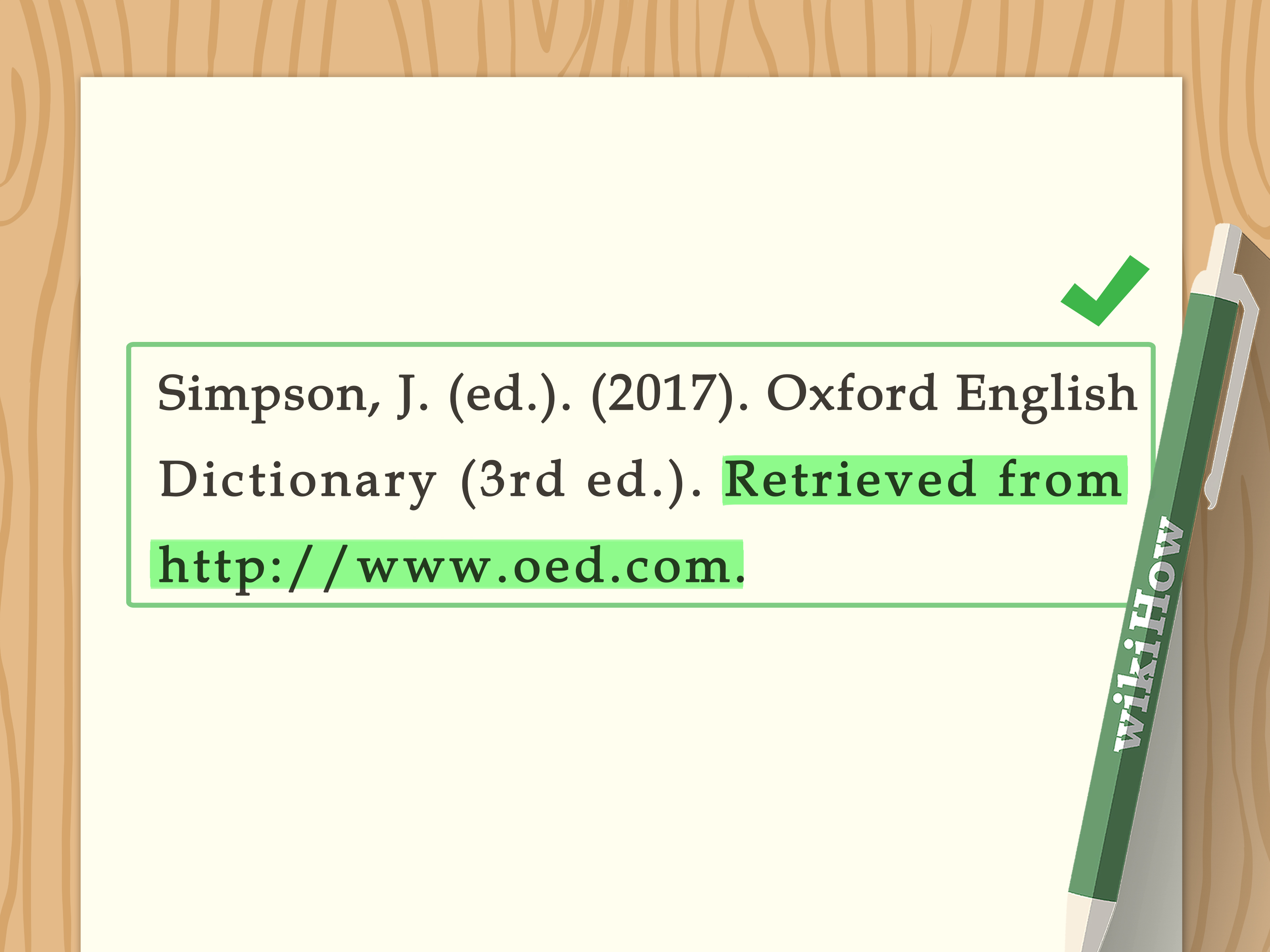
Organization Name. (Year). Entry title. In Title of dictionary. URL
APA Template Example
Dictionary Publisher. (2024). Resilience. In Title of online dictionary. https://www.exampledictionary.com/resilience
In-Text Citation Examples
Parenthetical citation: Resilience can refer to the ability to recover after adversity (Dictionary Publisher, 2024).
Narrative citation: Dictionary Publisher (2024) describes resilience as the capacity to adapt after difficulty.
How to Tell Whether a Dictionary Entry Is Stable
Look for clues on the entry page. A stable source may list a publication year, edition number, copyright information tied to a specific release, or an archive link. A continuously changing source may have no publication date and may regularly add new content.
Do not automatically add a retrieval date to every website citation. In APA Style, retrieval dates are most useful when the content is designed to change over time. A stable digital edition does not need the extra date simply because it happens to live online.
Think of it this way: a fixed online dictionary edition is like a published book wearing digital pajamas. A continuously updated dictionary is more like a whiteboard in a busy office: useful, current, and potentially different next week.
3. Cite a Print Dictionary With No Individual Entry Author
Print dictionaries are cited differently because they are tied to a particular edition and publication year. Unlike online entries, a printed definition is not likely to change overnight. It may gather dust, coffee stains, or a mysterious sticky note, but the wording remains stable.
For most print dictionaries, the dictionary publisher or organization appears as the author. Include the dictionary title in italics, the edition number if available, and the page number or page range where the entry appears.
APA Format for a Print Dictionary Entry
Organization Name. (Year). Entry title. In Title of dictionary (Edition, p. Page number). Publisher.
APA Reference Example
Merriam-Webster, Incorporated. (1997). Goat. In Merriam-Webster’s collegiate dictionary (10th ed., pp. 499–500).
In-Text Citation Examples
Parenthetical citation: The term “goat” has several literal and figurative meanings in English usage (Merriam-Webster, Incorporated, 1997).
Narrative citation: Merriam-Webster, Incorporated (1997) includes several meanings for the term “goat.”
Do You Need the Publisher Twice?
Usually, no. When the author and publisher are the same organization, APA Style does not require you to repeat the publisher name at the end of the reference. Repeating it would be a little like introducing yourself by saying, “Hello, I am Alex from Alex’s house, owned by Alex.” Technically possible, but not especially elegant.
When Print Dictionary Citations Are Especially Useful
Print dictionary citations are valuable when you are studying historical language, comparing editions, analyzing older terminology, or working with a source your instructor specifically assigned. They are also useful when a word’s meaning may have shifted over time.
For instance, a paper about cultural change may compare how a term was defined in a dictionary from the 1990s with how it appears in a modern online dictionary. In that case, the edition and year become part of the evidence, not just bibliography furniture.
4. Cite a Signed Dictionary Entry Written by an Individual Author
Some specialized dictionaries, encyclopedias, professional handbooks, and academic reference works identify the person who wrote a specific entry. This is common in subject-specific sources covering psychology, medicine, law, business, history, religion, literature, or technology.
When the entry has a named author, cite that individual as the author of the reference. Then include the editor, dictionary title, edition, page range, publisher, and URL or DOI when relevant.
APA Format for a Signed Dictionary Entry
Author, A. A. (Year). Title of entry. In E. E. Editor (Ed.), Title of dictionary (Edition, pp. xx–xx). Publisher. URL
APA Reference Example
Tatum, S. R. (2009). Spirituality and religion in hip hop literature and culture. In T. L. Stanley (Ed.), Encyclopedia of hip hop literature (pp. 250–252). Greenwood.
In-Text Citation Examples
Parenthetical citation: Spirituality appears frequently in discussions of hip hop literature and culture (Tatum, 2009).
Narrative citation: Tatum (2009) explains how spirituality and religion appear in hip hop literature and culture.
Why This Format Matters
A signed entry represents the work of a specific contributor. The individual author deserves credit because they wrote the entry, even though the larger dictionary or encyclopedia may have been edited by someone else.
This type of citation is particularly important in advanced research. A specialized dictionary entry may be more authoritative than a general dictionary because it is written by an expert in the field. For example, a psychology dictionary may provide a more precise definition of “cognitive dissonance” than a general English dictionary.
How to Cite Dictionary Definitions in the Text
Your reference list entry and your in-text citation work together. The reference list gives readers the full source details. The in-text citation shows where the definition influenced your writing.
Paraphrasing a Definition
When you explain a definition in your own words, include the author or organization and year.
Example: Motivation can be described as the process that encourages a person to act toward a goal (American Psychological Association, n.d.).
Quoting a Definition Directly
When you quote the dictionary wording exactly, use quotation marks and include an in-text citation. For print sources, add a page number. For online sources, include a locator when the source provides one, such as a numbered sense, paragraph number, or section heading.
Example: The word may be defined as “a feeling of deep affection” (Dictionary Publisher, 2024, Definition 1).
Do not invent a page number for an online dictionary entry. A fake locator is worse than no locator because it gives readers a treasure map to a treasure that does not exist.
Common APA Dictionary Citation Mistakes to Avoid
Using the Word as the Author
Do not start a reference with the word you looked up unless the source has no author and APA rules clearly require the title to move into the author position. Most dictionary citations use the publisher, organization, or entry author first.
Forgetting the Retrieval Date for a Changing Online Dictionary
When an online dictionary is continuously updated and has no stable publication date, include a retrieval date. This is one of the most common APA dictionary citation mistakes.
Adding a Retrieval Date to Every Web Citation
Retrieval dates are not mandatory for every online source. Use them when the content is designed to change over time, such as a frequently revised dictionary entry.
Ignoring the Edition Number in Print Dictionaries
Edition numbers matter because definitions and usage notes may change between editions. Include the edition when the dictionary identifies one.
Skipping Italics for the Dictionary Title
The title of the dictionary should be italicized in the reference list. The individual entry title usually is not italicized.
Using a Homepage Instead of the Exact Entry URL
For an online dictionary citation, link to the specific word entry whenever possible. Sending readers to a homepage forces them to search for the definition again, which is academically less helpful and emotionally similar to telling someone, “The answer is somewhere on the internet.”
A Simple APA Dictionary Citation Checklist
- Identify whether the source is online, print, stable, or continuously updated.
- Use the organization, publisher, or individual entry author in the author position.
- Use n.d. when no publication date is available.
- Add a retrieval date for dictionary pages that change frequently.
- Italicize the dictionary title.
- Add edition and page information for print dictionaries.
- Use the specific dictionary-entry URL when citing an online source.
- Match every in-text citation to a full reference-list entry.
Practical Experiences and Lessons From Citing Dictionaries in APA
Dictionary citations often seem easy until a writer tries to format one while juggling an assignment deadline, a half-finished reference page, and a browser tab collection that looks like it has achieved sentience. In real academic writing, the most common challenge is not punctuation. It is identifying what kind of dictionary source you actually used.
Many students copy a definition from an online dictionary and assume it should be cited like an ordinary webpage. Sometimes that works poorly because dictionaries are reference works with their own structure. A dictionary entry has a word title, a larger dictionary title, a publisher or organization, and often a changing definition. Treating it like a regular blog post can leave out important information, especially the retrieval date for a frequently updated source.
Another common experience involves the missing date problem. A writer opens a dictionary page, searches for the publication date, finds nothing useful, and begins wondering whether the website is hiding information in a secret underground citation bunker. Usually, the answer is simpler: use n.d. and include the date you retrieved the entry if the page changes regularly.
Print dictionaries create a different kind of confusion. Writers may assume that an old book does not need a citation because it feels like common knowledge. But if the definition supports a claim, especially one involving specialized or historical language, it still deserves a reference. The edition and page number become important because definitions can change between editions. A word that carried one meaning in 1997 may have gained slang, technical, cultural, or political meanings by 2026.
Specialized dictionaries are where citation skills become especially valuable. A medical, legal, psychological, or business dictionary may contain definitions written by named experts. In these cases, citing the individual author rather than only the dictionary title shows stronger attention to academic detail. It also helps readers understand that the definition is not merely a casual explanation but part of an expert reference work.
Writers also learn that citation generators are useful assistants, not magical citation goblins. A citation tool can build a reference quickly, but it may not always recognize whether an online dictionary is continuously updated or whether the page has a stable publication date. Before copying a generated citation into your paper, compare it with the actual source page. Check the author, date, dictionary title, retrieval date, and URL.
The most reliable habit is to record citation details as soon as you use the definition. Save the entry URL, note the dictionary title, write down the access date, and identify whether a named author appears. Doing this early takes less than a minute. Trying to reconstruct citation details at 1:14 a.m. while your paper is due at midnight somehow takes three business days.
Ultimately, citing a dictionary in APA is a small task with a big payoff. It strengthens academic credibility, helps readers verify your definitions, and keeps your reference list consistent. Once you know the four main formats, dictionary citations stop feeling intimidating and start feeling like what they really are: a tidy way to show where your words got their homework done.
Final Thoughts
APA dictionary citations become much easier when you focus on the source type first. A frequently updated online dictionary needs n.d. and a retrieval date. A stable online version uses its publication date. A print dictionary needs edition and page details. A signed reference entry gives credit to its individual author.
The key is consistency. Use the correct format, include the right details, and make sure your in-text citation matches the full reference entry. Once you understand the pattern, citing a dictionary becomes less of a grammar maze and more of a quick, repeatable academic habit.