

Some movie endings are truly mysterious. Others are only mysterious because the internet got bored, brewed a gallon of coffee, paused the final frame, zoomed in 900 percent, and declared, “Aha! The lamp means he was dead the whole time.” Cinema fans love ambiguous movie endings, and honestly, who can blame them? A good unresolved finale gives us something to argue about after the credits, on the drive home, and, if we are feeling especially dramatic, at Thanksgiving dinner.
But not every famous “open ending” is as open as people think. Sometimes the director has already explained the point. Sometimes a later cut adds a very large clue with the subtlety of a neon sign. Sometimes the movie’s own internal logic quietly closes the case while everyone is still staring at the spinning top, the café table, or the suspiciously clean apartment.
This article looks at five movie endings people think are ambiguous but are actually far more settled than their reputations suggest. We are not here to ruin the fun. We are here to rescue these films from over-theorying, which is what happens when smart viewers bring detective-level energy to endings that already left the answer under the couch cushion.
Why Audiences Love “Ambiguous” Movie Endings
Ambiguous movie endings work because they give the audience a job. Instead of wrapping everything in a bow, they hand viewers a puzzle box and say, “Good luck, professor.” That can be thrilling, especially when a film has been built around unreliable memory, dream logic, identity, guilt, or moral collapse.
The problem begins when every unclear feeling is mistaken for an unclear plot. A movie can be emotionally complex without being factually undecided. A character can be at peace while the audience is anxious. A final image can be symbolic without being a riddle. The five endings below are famous because they invite interpretation, but the core answers are hiding in plain sight.
1. Inception: Cobb’s Ending Is Not Really About the Top
The supposed ambiguity: Is Cobb still dreaming?
Christopher Nolan’s Inception may be the reigning champion of “wait, what just happened?” endings. Dom Cobb returns home, spins the top, sees his children, and walks away before checking whether the top falls. The camera lingers. The top wobbles. Cut to black. Somewhere, a dorm room in 2010 immediately became a courtroom.
The popular question is simple: is Cobb in reality, or is he still trapped in a dream? Viewers have spent years treating the spinning top like a tiny metal judge. If it falls, reality. If it spins forever, dream. Since the film cuts away before the result, the ending is often treated as permanently ambiguous.
Why it is clearer than people think
The important detail is that Cobb stops caring. Earlier in the film, his obsession with determining what is real keeps him emotionally imprisoned. At the end, he sees his children and turns away from the top. That choice is the ending. The final shot is not asking us to solve a physics problem; it is showing that Cobb has accepted the life in front of him.
There is also a widely discussed practical clue: Michael Caine, who plays Miles, has said that Nolan explained the rules to him in a very actor-friendly way. When Caine’s character appears in a scene, that scene is reality. Miles is present in the final sequence, which strongly supports the reading that Cobb really made it home.
Even if you ignore that outside comment, the emotional structure is clear. Cobb has confronted his guilt over Mal, completed the mission, passed through airport security, and finally stopped outsourcing his sanity to a toy. The top is the distraction. The real ending is Cobb choosing his children over his obsession.
So yes, Inception is still a movie about dreams, perception, and reality. But the ending is not a trick question. It is a character ending disguised as a puzzle ending. Very Nolan. Very tidy. Very likely to start arguments anyway.
2. The Dark Knight Rises: Alfred Is Not Dreaming Bruce
The supposed ambiguity: Did Bruce Wayne die?
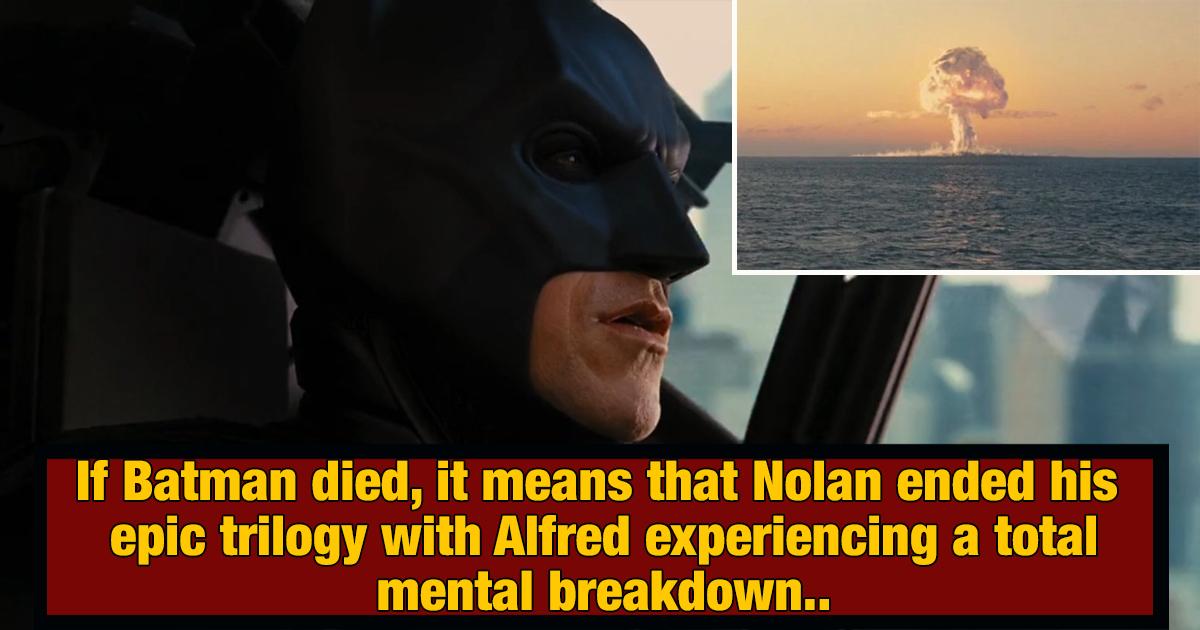
At the end of The Dark Knight Rises, Batman appears to sacrifice himself by flying a nuclear bomb away from Gotham. Gotham mourns him. Bruce Wayne is presumed dead. Alfred grieves at the Wayne family graves. Then, in Florence, Alfred looks across a café and sees Bruce sitting with Selina Kyle. Bruce nods. Alfred smiles. No words are exchanged.
Because Christopher Nolan enjoys making audiences work for their snacks, some viewers decided the scene might be Alfred’s fantasy. Maybe Bruce died, and Alfred imagines the happy ending he always wanted for the boy he raised. It is a lovely theory. It is also not what the movie is doing.
Why Bruce is alive
The film spends its final stretch planting practical evidence that Bruce survived. Lucius Fox learns that the Bat’s autopilot had been fixed months earlier. Bruce leaves the Batcave coordinates to John Blake. Selina has the missing pearls. Alfred’s café fantasy was set up earlier as a very specific wish: he wanted to see Bruce alive, happy, and free from Batman.
Most importantly, the scene functions as fulfillment, not denial. Nolan’s Batman trilogy is about transforming pain into purpose, but it is also about the danger of becoming trapped inside a symbol. Bruce wins because he saves Gotham and escapes the machine that consumed him. If Alfred merely imagined him, the ending would undo the trilogy’s hard-earned emotional release.
Michael Caine has been blunt about it: Alfred really sees Bruce. Later comments from people involved in shaping the story also support the same conclusion. The café scene is not a dream, hallucination, or grief-induced espresso vision. It is Bruce Wayne doing the one thing he was never able to do before: live.
That is why the nod matters. Bruce does not need a speech. Alfred does not need proof. The gesture says, “I made it.” For a trilogy full of masks, theatricality, and speeches about symbols, the ending is beautifully plain. Batman dies as an identity. Bruce Wayne survives as a person.
3. Shutter Island: Teddy Knows Who He Is
The supposed ambiguity: Is Teddy delusional or choosing lobotomy?
Martin Scorsese’s Shutter Island is a master class in paranoia, fog, cigarettes, and Leonardo DiCaprio looking like he has not slept since 1952. For much of the film, U.S. Marshal Teddy Daniels investigates a missing patient at Ashecliffe Hospital. Then the twist lands: Teddy is actually Andrew Laeddis, a patient who invented the Teddy persona to escape the truth that he killed his wife after she drowned their children.
The ending creates the famous question. After apparently accepting the truth, Andrew seems to relapse and calls Dr. Sheehan “Chuck” again. As he is led away for a lobotomy, he asks whether it is worse to live as a monster or die as a good man. That final line makes viewers wonder: has he truly regressed, or is he sane and choosing to erase himself?
Why the final line solves the mystery
The wording gives Andrew away. A fully delusional Teddy would not ask that question. He would still believe he is a righteous marshal uncovering a conspiracy. The line shows self-awareness. He knows he is Andrew. He knows what he did. He also knows he cannot bear living with it.
This turns the ending from a simple twist into a tragedy. Andrew is not confused in the final moment; he is making a devastating choice. The doctors hoped their elaborate role-play would bring him back to reality and prevent a lobotomy. It works, but reality is too painful. So Andrew performs one last act of control by pretending to relapse.
The ambiguity people feel comes from the sadness of the choice, not from the facts of the plot. Scorsese lets the moment breathe, and DiCaprio plays it quietly, which gives the scene its haunting power. But the movie has already told us the truth: Teddy Daniels is a construction, Andrew Laeddis is real, and the final question reveals that Andrew understands exactly what is happening.
In other words, Shutter Island is not asking, “Who is this man?” It is asking, “What does a guilty man do when the truth finally catches him?” The answer is brutal: he walks toward oblivion with his eyes open.
4. American Psycho: It Was Not All in Patrick Bateman’s Head
The supposed ambiguity: Did Bateman actually kill anyone?
The ending of American Psycho has confused viewers for decades, which is fitting because Patrick Bateman is basically a skincare routine wrapped around a black hole. After committing a series of increasingly grotesque murders, Bateman confesses to his lawyer. The lawyer laughs it off and says Paul Allen is alive because he had lunch with him in London. Later, Paul’s apartment has been cleaned and put up for sale. Bateman appears trapped in a world where even his confession cannot make him visible.
Many viewers take this to mean that none of the murders happened. Maybe Bateman hallucinated everything. Maybe the notebook drawings are the only real evidence of his violent fantasies. Maybe the ATM asking for a stray cat is where reality officially leaves the building.
Why the “all a dream” reading misses the satire
The key is that American Psycho is not a murder mystery. It is a satire of a culture so empty, interchangeable, and status-drunk that a killer can hide in plain sight. Bateman’s world is full of men who look the same, wear the same suits, obsess over the same reservations, and constantly mistake one another for someone else. The lawyer saying he had lunch with Paul Allen is not proof Paul is alive; it is proof that nobody in this world knows or cares who anyone really is.
Director Mary Harron and co-writer Guinevere Turner have both pushed back against the idea that the whole film is merely fantasy. Some moments become surreal, especially near the end, but the intended point is not “Patrick imagined everything.” The point is worse: Patrick may be guilty, but the society around him is too shallow and self-protective to notice.
That is why the final line, “This confession has meant nothing,” lands so hard. Bateman wants consequence, recognition, maybe even punishment. Instead, he gets absorbed back into the glossy wallpaper of elite Manhattan. His violence does not expose the system. It blends into it.
The ending is disturbing because it refuses to give viewers the comfort of a clean solution. But the stronger reading is not that Bateman did nothing. It is that he did terrible things in a world designed to look away. That is much scarier than a dream sequence, and far better satire.
5. Blade Runner: The Final Cut Makes Deckard’s Secret Much Less Secret
The supposed ambiguity: Is Deckard a replicant?
Blade Runner has one of the most famous identity debates in science fiction: is Rick Deckard human, or is he a replicant? The original theatrical version left the question murkier, partly because the film had been altered with narration and a more conventional ending. Later versions, especially Blade Runner: The Final Cut, sharpen the clues.
The biggest clue is the unicorn. Deckard dreams or daydreams of a unicorn. At the end, he finds an origami unicorn left by Gaff outside his apartment. On the surface, it means Gaff has been there and spared Rachael. But if Gaff knows about Deckard’s private unicorn image, the implication is much bigger: Deckard’s memories or inner life may not be private at all.
Why the Final Cut tips the answer
Ridley Scott has repeatedly supported the view that Deckard is a replicant, and the Final Cut aligns the movie with that interpretation. The origami unicorn is not random decoration. Gaff’s paper figures comment on Deckard throughout the film, and the unicorn becomes the final, elegant clue that Deckard’s identity is not what he assumes.
Yes, some people involved with the film have disagreed over the years, and many viewers prefer Deckard as human because it makes his empathy toward replicants feel like a human moral awakening. That interpretation has emotional appeal. But when discussing the director’s preferred cut, the answer is far less open than the debate suggests.
The ending works because it is not merely about biology. Whether Deckard is made or born, he chooses to run with Rachael. He rejects his assigned role as hunter. The unicorn tells him that Gaff knows the truth and is letting them go anyway. It is a warning, a mercy, and a revelation folded into one tiny paper animal. Not bad for office supplies.
So is the ending still rich? Absolutely. Is the central clue meaningless? Not at all. Blade Runner remains philosophically complex, but in the Final Cut, the film is strongly pointing toward Deckard being a replicant who has finally begun to understand the humanity of other artificial beings.
What These “Ambiguous” Endings Have in Common
These five films are often discussed as if they are unsolved cases, but their endings are more guided than random. Inception is about Cobb’s emotional release, not just the top. The Dark Knight Rises shows Bruce surviving because the trilogy is about escaping the prison of Batman. Shutter Island reveals Andrew’s lucidity through his final question. American Psycho critiques a society that cannot recognize guilt even when it confesses. Blade Runner: The Final Cut uses the unicorn to push Deckard’s identity toward a clear answer.
The confusion comes from a common habit: audiences often treat symbolism like a locked door. But symbolism is not always meant to hide information. Sometimes it clarifies the emotional truth in a more memorable way than plain dialogue ever could. A wobbling top, a café nod, a final question, a meaningless confession, and an origami unicorn all do the same thing: they invite interpretation while still pointing us toward a conclusion.
Experience Section: Watching These Endings With Other People
There is a special kind of movie-night silence that happens after one of these endings. Nobody moves. Someone reaches for the remote, pauses the credits, and says, “Okay, so what actually happened?” That is usually when the living room transforms into a low-budget law school. One person becomes the prosecutor. Another becomes the defense. Someone who missed twenty minutes because they were making popcorn suddenly has the strongest opinion.
The first time I watched Inception with a group, the entire conversation became about the top. People leaned toward the television as if we could bully it into falling. But the more we talked, the more obvious it became that the top was not the emotional center. Cobb walking away was. That changed the discussion. Instead of arguing about dream mechanics, we started talking about grief, guilt, and whether happiness still matters if certainty is impossible. That is when the ending felt less like a trick and more like a small act of freedom.
The Dark Knight Rises created a different reaction. Some viewers wanted Bruce to be dead because sacrifice felt more mythic. Others wanted him alive because Alfred had suffered enough, and frankly, so had we. The survival clues made the answer clear, but the debate revealed something interesting: people often confuse “emotionally surprising” with “ambiguous.” Bruce living is not a cheap escape. It is the hardest thing for him to do. Dying as Batman would be dramatic. Living as Bruce requires healing.
Shutter Island is the ending that tends to make a room quiet in a heavier way. Once Andrew asks that final question, the twist stops being clever and becomes painful. The experience of watching it is not about solving the plot anymore. It is about realizing that the solution does not save him. That is a rare kind of movie sadness: the truth arrives, and it is not enough.
American Psycho usually produces nervous laughter, because its ending is both absurd and horrifying. People want a clean answer because clean answers feel safe. But the film’s real nightmare is social emptiness. Bateman confesses, and nothing happens. That idea sticks because it feels exaggerated and familiar at the same time.
With Blade Runner, the experience is more reflective. The unicorn does not shout. It waits. When viewers notice what it implies, the ending becomes less about a yes-or-no identity test and more about empathy. If Deckard is a replicant, then his journey mirrors the beings he was trained to destroy. If he is human, he still learns from them. Either way, the film asks what makes a life real enough to matter.
That is the joy of these endings. They are not empty puzzles. They are conversation machines. The facts may be clearer than their reputations suggest, but the feelings remain wonderfully complicated. And that is exactly why people keep talking about them years later.
Conclusion
The best so-called ambiguous movie endings do not survive because nobody can understand them. They survive because they reward a second look. They give viewers enough mystery to feel involved and enough structure to avoid collapsing into nonsense. That balance is difficult, which is why these five endings still dominate movie discussions.
When people say these endings are ambiguous, they are usually responding to emotional uncertainty rather than missing plot information. Cobb’s top, Alfred’s café, Andrew’s final question, Bateman’s ignored confession, and Deckard’s unicorn all leave a little ache behind. But an ache is not the same as an unanswered question. Sometimes a film tells us the answer and then trusts us to sit with what it means.
So the next time someone says, “Nobody knows what that ending means,” politely offer them a snack, dim the lights, and start the movie again. The clues are already there. The fun is noticing how gracefully they were hiding in plain sight.