

Note: This article discusses body shaming, weight stigma, significant weight loss, and body-image struggles. It is intended for informational and
Losing 100 pounds sounds, in the language of transformation culture, like the moment when the triumphant music starts playing. Cue the dramatic before-and-after photos, a flood of heart emojis, and at least one person asking for “the secret” as though a human body were a locked level in a video game.
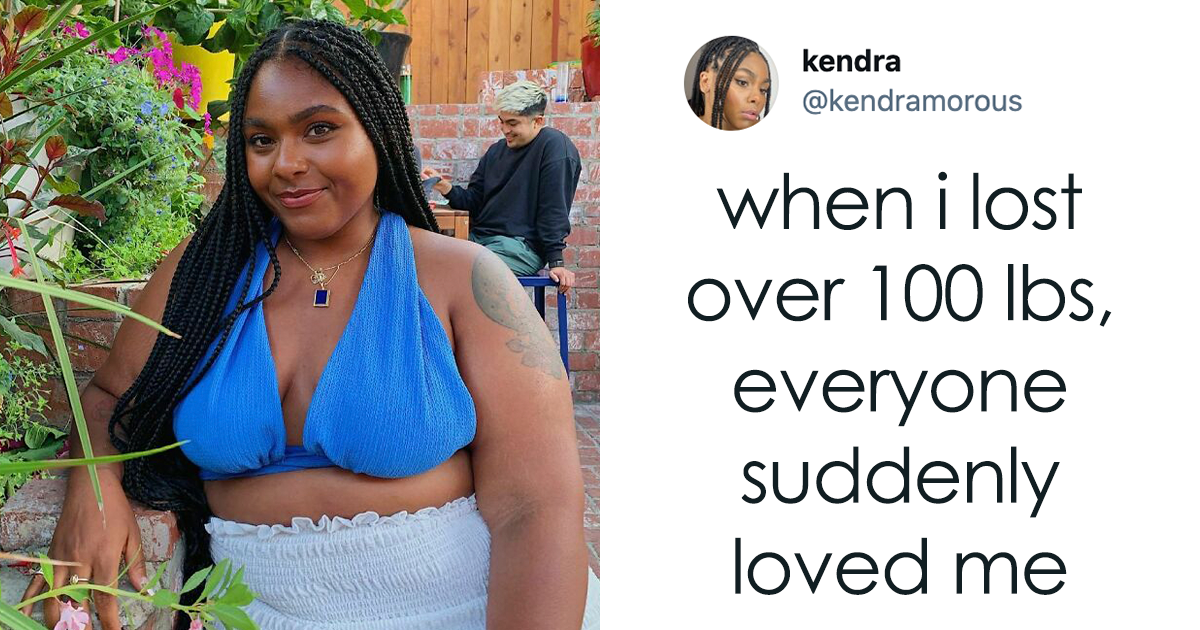
For curve model, activist, and content creator Kendra Austin, however, a major change in body size raised a far more uncomfortable question: Why did the world seem to value her differently after she became smaller?
Austin publicly reflected on the way people responded after she lost about 100 pounds. The praise, attention, and changed treatment did not simply feel like recognition of a personal milestone. To her, they also seemed to confirm an old fear many people in larger bodies know all too well: that thinness can function as a kind of social currency.
Her experience helped spark a wider conversation about body shaming, fatphobia, weight-loss compliments, beauty standards, and the complicated emotional reality of changing bodies. It also exposed a contradiction hiding in plain sight. Society often tells people to love themselves, while simultaneously rewarding them more enthusiastically when they occupy less physical space.
That is a lot of baggage to place on a bathroom scale.
What Kendra Austin’s 100-Pound Weight Loss Revealed
Austin’s story resonated because it challenged the neat, cheerful script usually attached to major weight loss. In that script, the person becomes thinner, everyone celebrates, confidence arrives by overnight delivery, and the credits roll.
Real life is considerably messier.
After her weight changed, Austin described receiving more approval and a noticeably different kind of attention. Instead of experiencing every compliment as uncomplicated encouragement, she found herself examining what those reactions implied about the person she had been before.
Had she suddenly become funnier? Kinder? More intelligent? More talented? Had her personality received a surprise software update?
Of course not.
Yet when people appear warmer, more interested, or more complimentary after someone loses weight, the person receiving that attention may wonder whether their former body had been treated as a barrier to respect. The celebration of a smaller body can unintentionally sound like criticism of the larger one that came before it.
That does not mean every congratulation is cruel. Friends and relatives may genuinely believe they are being supportive, particularly when they know someone intentionally pursued a personal goal. The problem is that weight loss does not come with a public explanation label. A person may lose weight because of a deliberate lifestyle change, stress, grief, illness, medication, financial hardship, an eating disorder, or circumstances they would rather not discuss.
Looking at a body tells you very little about the story behind it.
The Strange Social Experience of Being Treated Differently
One of the most unsettling parts of a major physical transformation can be discovering that other people have changed even though, internally, you still feel like yourself.
Someone who once felt ignored may suddenly receive romantic attention. A person who was rarely complimented may start hearing glowing observations from coworkers and strangers. Clothing salespeople may become more attentive. Social interactions may seem easier. Even ordinary politeness can feel different enough to make a person question what was happening before.
This is where discussions of weight stigma and so-called thin privilege become relevant. Weight stigma refers to negative stereotypes, judgment, discrimination, or unequal treatment connected to body size. It can appear in workplaces, schools, entertainment, dating, family relationships, medical settings, and casual conversations.
For someone who loses a significant amount of weight, the contrast can become impossible to ignore.
The emotional reaction may be surprisingly complex. There can be pride in accomplishing a goal and anger about receiving better treatment. There can be greater physical comfort alongside grief for the former self who deserved the same dignity. There can be happiness, suspicion, confidence, resentment, and confusionall before breakfast.
Human beings, annoyingly, are capable of feeling several contradictory things at once.
Why “You Look So Much Better” May Not Feel Like a Compliment
Weight-loss praise often comes wrapped in good intentions. But wording matters.
Statements such as “You look so much better now,” “You’ve finally taken care of yourself,” or “Don’t ever go back to your old size” can carry an uncomfortable hidden message. They may imply that the person looked bad before, was irresponsible before, or would lose approval if their weight changed again.
That pressure can be particularly difficult because bodies are not static objects. Weight can fluctuate throughout adulthood for countless reasons. Aging, pregnancy, medical conditions, medications, stress, hormonal changes, injury, changes in income, sleep, and daily routines can all affect a person’s body.
When social acceptance appears connected to maintaining a particular size, weight regain may start to feel less like a physical change and more like a social failure.
That is why many body-image advocates encourage people to be thoughtful before commenting on someone else’s weight. A safer approach is to follow the person’s lead. When someone enthusiastically tells you about a goal they intentionally achieved, celebrating their effort may be welcome. When you know nothing about why their body changed, a neutral compliment about their energy, style, creativity, or accomplishments may be kinder.
“You seem really happy lately” leaves much less emotional wreckage than conducting an unsolicited press conference about someone’s waistline.
Body Shaming Is Not a Health Strategy
Body shaming is sometimes defended as concern. The argument usually goes something like this: criticizing people about their size will motivate them to become healthier.
Research and clinical discussions of weight stigma paint a much more complicated picture. Shame can contribute to psychological distress, lower self-esteem, body dissatisfaction, social withdrawal, unhealthy eating patterns, and avoidance of health care. People who expect judgment in a medical setting may delay appointments or feel reluctant to raise concerns.
Shaming also reduces a complicated human being to a visible characteristic.
Health is influenced by behavior, biology, genetics, environment, socioeconomic circumstances, sleep, stress, access to medical care, medications, and many other factors. Body size may be medically relevant in some situations, but it is not a complete diagnostic report floating above someone’s head.
It is possible to discuss health without humiliation. In fact, respectful communication is likely to make honest conversations easier.
Concern and cruelty are not the same thing
A person can care about health without believing that larger people should be mocked. Someone can pursue weight loss without declaring war on everyone who wears a bigger size. A person can celebrate changes in their own body while respecting a friend whose goals are completely different.
These ideas are not mutually exclusive.
The cultural debate often becomes unnecessarily polarized, as though everyone must choose between caring about health and treating people with dignity. In reality, dignity should not be a reward handed out after someone reaches a socially approved number.
When Weight Loss Changes the Body but Not the Inner Voice
Another important lesson from stories like Austin’s is that changing the body does not automatically rewrite years of internalized beliefs.
A person who has spent childhood, adolescence, or adulthood feeling ashamed of their size may continue carrying those thoughts after major weight loss. The mirror changes faster than a deeply established self-image. Compliments may temporarily boost confidence, but they can also strengthen the belief that appearance determines worth.
This creates a difficult psychological trap.
When praise becomes attached to becoming smaller, the person may fear losing not only the weight but also the approval. Maintaining a specific body can start to feel like maintaining membership in a club that might revoke the card at any moment.
For some people, developing a healthier body image involves moving beyond the goal of loving every inch of their appearance every minute of every day. That expectation can become another impossible standard. The concept of body neutrality offers a different approach: a body does not have to be aesthetically adored at all times to deserve care, food, movement, medical attention, comfortable clothing, pleasure, and respect.
Some mornings, “My body carries me through my life” may be more realistic than “I am obsessed with every angle of myself.” Frankly, most of us are not even obsessed with every angle of our living rooms.
Why Austin’s Message About the Word “Fat” Matters
Austin has also spoken about the way the word “fat” is treated as automatically insulting. Within body-acceptance activism, some people use the word descriptively rather than as a moral judgment.
The important point is not that everyone must adopt the same label for themselves. Personal preference matters. The larger issue is why a body-size descriptor is so often treated as the worst thing one person can call another.
When people respond to the possibility of being fat with horror“No, no, you’re not fat! You’re beautiful!”they may unintentionally suggest that fatness and beauty cannot exist together. The attempted reassurance preserves the very hierarchy it is supposed to challenge.
A better cultural goal is not to force everyone to feel attractive at every moment. It is to disconnect basic human worth from passing beauty standards.
People are allowed to be beautiful. They are also allowed to have days when beauty is nowhere near the top of their priority list. Nobody should have to win a national attractiveness competition before being permitted to exist in public without ridicule.
The Fashion Industry’s Complicated Relationship With Curves
Austin’s work as a curve model adds another layer to the discussion. Fashion has expanded its visual vocabulary over the years, but size inclusivity remains inconsistent. A campaign may feature a wider range of bodies while the actual clothing line offers limited sizes. A brand may celebrate “real bodies” for one season and quietly return to a narrow ideal the next.
Even the terms curve model and plus-size model reveal how unusual the industry still considers bodies outside its traditional sample sizes. In everyday life, a woman may wear a commonly available size and still be categorized as unusually large within fashion.
Models in larger bodies can also face an exhausting contradiction. When they remain larger, critics may accuse them of “promoting obesity.” When they lose weight, some followers may accuse them of betraying body positivity. Their bodies become public property in a debate they never agreed to host.
The same pattern has affected other well-known models and public figures: show a roll, and someone complains; appear thinner in a photograph, and someone else complains. Apparently, the internet would like women to maintain one universally approved body forever, while also aging backward and never needing lunch.
No pressure.
Social Media Can Amplify Both Shame and Support
Social platforms helped Austin’s message reach a large audience because many people recognized themselves in it. That is one of social media’s genuine strengths: an experience that once felt private can suddenly become part of a shared conversation.
At the same time, image-centered platforms can intensify appearance comparison. Filters, editing tools, flattering angles, carefully selected photographs, and algorithmically amplified beauty trends create a visual environment that is not exactly famous for moderation.
Users may compare an ordinary Tuesday morning in their own body with someone else’s professionally lit, edited, carefully posed best second of the month.
That is not a particularly fair contest.
Curating a healthier social-media environment can help. That might mean unfollowing accounts that consistently create shame, following creators with more diverse bodies and perspectives, reducing screen time, or simply remembering that a feed is not a neutral sample of humanity.
Algorithms are designed to hold attention. They are not licensed therapists, personal trainers, dietitians, or wise grandmothers.
What We Can Learn From a 100-Pound Transformation
The most valuable lesson in Austin’s story may be that a major weight change can reveal something not only about one person, but also about the people surrounding them.
Who receives attention? Who gets assumed to be disciplined? Which bodies are photographed, hired, desired, accommodated, or praised? Which people are told to wait until they become smaller before buying the outfit, taking the vacation, dating, swimming, dancing, or appearing in family photographs?
Body shame often steals time long before it changes behavior. People postpone joy because they believe their current body is merely a waiting room for a future, supposedly more acceptable version of themselves.
That future body may arrive. It may not. It may arrive and later change again.
Life, meanwhile, continues moving.
Better ways to support someone whose body has changed
Supporting another person does not require pretending not to notice them. It requires respecting their ownership of the story.
Instead of immediately evaluating a physical change, consider listening first. If a friend says, “I worked toward this goal and I feel fantastic,” celebrate with them. If they seem uncomfortable discussing their body, change the subject. If you do not know why their weight changed, avoid assuming it is good news or bad news.
Compliments can focus on the whole person:
- “You seem confident and happy.”
- “That outfit looks fantastic.”
- “I’m proud of how committed you’ve been to your goal.”
- “It’s great to see you doing something that makes you feel good.”
- “You have such a strong presence.”
Most importantly, do not make continued affection conditional on maintaining a certain appearance.
More Experiences Behind Body Shaming: What the Before-and-After Photo Cannot Show
The familiar before-and-after photograph is powerful because it compresses a long story into two images. Unfortunately, it can also erase almost everything that happened between them.
Imagine a woman who has lived for years in a larger body. At family gatherings, relatives monitor what she puts on her plate. Strangers offer diet advice she did not request. Clothing stores turn shopping into a scavenger hunt. A doctor occasionally mentions weight before she has finished explaining the reason for her appointment. She learns to laugh first when someone makes a joke because pretending not to be hurt feels safer than admitting that she is.
Then her body changes dramatically.
People who rarely commented on her appearance suddenly tell her she looks “amazing.” Old acquaintances become curious about her routine. Someone asks whether she is dating more now. A coworker says, with apparently no awareness of the implication, “You must feel like a completely different person.”
But she does not.
She remembers being the person everyone is indirectly insulting when they praise the transformation too aggressively. She remembers the version of herself who went to work, cared for friends, survived difficult days, told terrible jokes, paid bills, made plans, and deserved affection before a single pound disappeared.
This is one of the most complicated experiences associated with body shaming after weight loss: praise can create grief.
A person may grieve the realization that some people really were judging them. They may replay past relationships and wonder whether opportunities were affected by appearance. They may become suspicious of new romantic attention. They may ask themselves, “Would this person have noticed me two years ago?”
There is no universal answer, and that uncertainty can be painful.
Another common experience is fear. When a person receives enormous social reinforcement for losing weight, the possibility of regaining it may become emotionally loaded. A normal fluctuation can feel like the beginning of a public reversal. Clothes becoming tighter may trigger not just frustration but memories of how differently the person was once treated.
Then there is identity.
People sometimes assume significant weight loss automatically produces a brand-new personality. Yet the person may still instinctively avoid certain chairs, hesitate before entering a boutique, hide from cameras, or feel uncomfortable eating in public. Habits built from years of anticipating judgment do not necessarily disappear when measurements change.
Some people also experience an unexpected tension with communities that once gave them belonging. A person who found support in body-positive spaces may worry that losing weight will be interpreted as rejection of those values. Conversely, people in weight-loss communities may expect the person to criticize their former body as proof that the transformation was worthwhile.
Neither demand leaves much room for complexity.
A person should be able to say, “I wanted to change my body,” without declaring that everyone with their former body should do the same. They should also be able to say, “I deserved respect before,” without being accused of regretting their current body.
Those statements can coexist.
Perhaps the most useful lesson from these experiences is that body autonomy works in every direction. Adults may pursue changes in their appearance or health for deeply personal reasons. They may also decide not to pursue weight loss. Respecting autonomy means resisting the urge to turn one person’s body into a universal instruction manual.
Kendra Austin’s story became meaningful because it interrupted the easy transformation narrative. Losing 100 pounds did not simply create a smaller body. It revealed a social environment in which size can influence attention, assumptions, and approval. It opened questions about whether compliments can carry old prejudices, whether beauty and thinness have been incorrectly treated as synonyms, and how much life people lose while waiting to feel “acceptable.”
For anyone who has experienced body shaming, that recognition can be both painful and freeing. Painful, because unfair treatment becomes harder to dismiss. Freeing, because the shame may never have belonged to the body in the first place.
The body was simply where society decided to place it.
Conclusion: A Person’s Worth Should Not Shrink or Grow With Their Body
Austin’s reflections on losing 100 pounds offer a valuable challenge to the way we talk about bodies. Significant weight loss can be meaningful, difficult, positive, complicated, medically relevant, emotionally confusing, or several of those things at the same time. What it should never become is proof that a person has finally earned kindness.
Body shaming does not become harmless because it is disguised as motivation. Nor does a compliment automatically become supportive simply because the speaker intended it that way. The better approach is curiosity without intrusion, encouragement without judgment, and respect that does not depend on a clothing label or number on a scale.
People change. Bodies change. Beauty standards change with such enthusiasm that keeping up with them could qualify as a full-time job.
Human dignity should be considerably more stable.