

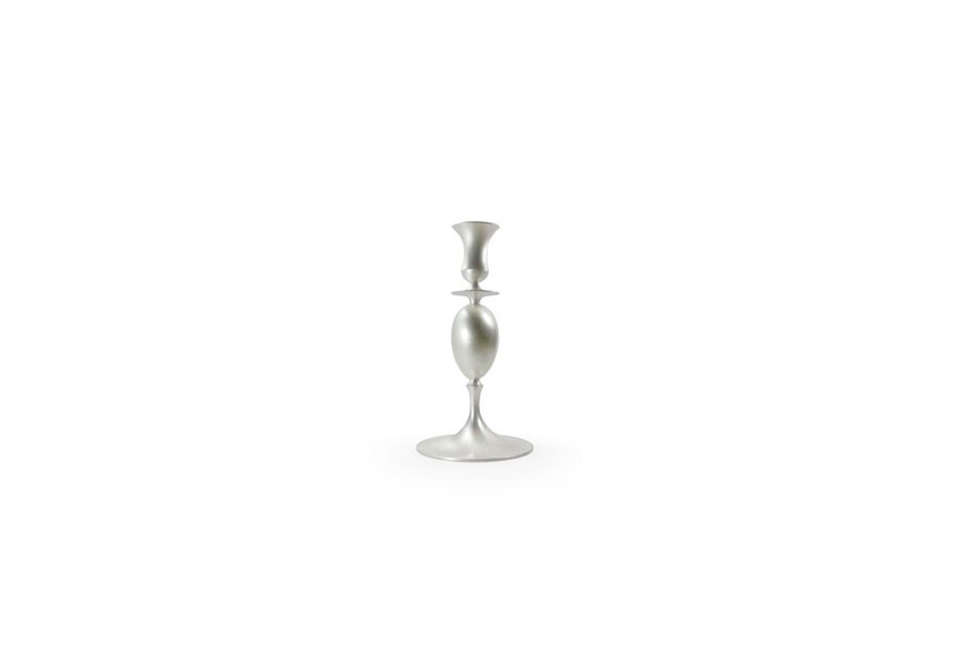
Some home accessories whisper. Others enter the room wearing a tiny tuxedo and quietly take over the conversation. The E.R. Butler Biedermeier Candlesticks in satin silver belong firmly in the second category.
Designed by Ted Muehling for E.R. Butler & Co., these sculptural candleholders turn a familiar household object into a study in proportion, material, and restraint. Their appeal is not about glittery drama or chandelier-level excess. It is about the satisfying tension between historic European inspiration and crisp contemporary craftsmanship. In other words, they are what happens when a candleholder goes to finishing school, studies architecture, and develops excellent posture.
For collectors, interior designers, and homeowners who appreciate decorative objects with genuine presence, satin silver Biedermeier candlesticks offer more than mood lighting. They provide a flexible design language: formal enough for a dining table, sculptural enough for a mantel, and understated enough to live happily beside modern art, antiques, books, ceramics, or the occasional suspiciously expensive stack of coffee-table books.
What Makes E.R. Butler Biedermeier Candlesticks Special?
The Biedermeier candlestick collection is built around a deceptively simple visual formula. Ted Muehling drew inspiration from the precision of nineteenth-century lathe work and developed the designs from three recurring shapes: the egg, the attenuated rod, and the trumpet form. Those elements may sound modest on paper, but their combinations create a family of candleholders with remarkably different personalities.
Some forms feel compact and architectural, with a low, grounded stance that works beautifully on a console or cocktail table. Others rise taller and more ceremonially, creating an elegant vertical rhythm on a dining table or fireplace mantel. The collection includes numerous forms that can stand alone, appear in symmetrical pairs, or be arranged in groups of three or more.
This flexibility is one reason the collection has lasting appeal. Rather than purchasing a matching set and committing to a single visual mood forever, owners can build a composition gradually. A small satin silver candlestick may begin life on a bedside table, then migrate to a dinner setting, then join a larger grouping when the urge to rearrange the room strikes. Decorative objects should be allowed to travel. It keeps them from getting bored, and more importantly, it keeps the room from looking like a furniture showroom.
A Modern Interpretation of Biedermeier Design
Biedermeier design is often associated with early nineteenth-century Central Europe, especially its emphasis on clarity, warmth, domestic comfort, and well-balanced forms. Unlike heavily ornamented styles that demand a drumroll before entering the room, Biedermeier design can feel refined without becoming fussy.
That spirit appears clearly in these candlesticks. Their silhouettes are polished, but not overly decorated. Their references are historical, but they do not feel trapped in a period room. The result is a collection that can sit comfortably in a traditional townhouse, a modern apartment, a Scandinavian-inspired interior, or a room that mixes heirloom furniture with clean-lined contemporary pieces.
The Appeal of a Satin Silver Finish
Satin silver gives these candlesticks a softer, more livable presence than a high-polish mirror finish. Instead of bouncing every lamp, window, and questionable late-night snack reflection around the room, the surface diffuses light gently. It has a quiet glow rather than a shout.
Retailers may describe certain low-luster silver versions as satin silver, while E.R. Butler collection information also refers to pumiced sterling silver plate among the available finishes. Because finish descriptions can vary by retailer and specific model, buyers should confirm the exact material and surface treatment before placing an order.
Visually, satin silver is especially useful because it bridges styles. It can cool down a room filled with warm woods, soften the contrast of black stone or dark lacquer, and add a refined metallic element without turning the space into a jewelry display case. The finish also tends to reveal shape more clearly than a highly reflective surface, allowing the curves, rods, and trumpet-like transitions to do the real work.
How the Satin Silver Candlesticks Work in a Room
On a Dining Table
A pair of matching candlesticks creates a formal but welcoming center line for a dining table. For longer tables, a mixed-height arrangement works better than lining up identical pieces like tiny silver soldiers. Try one taller candlestick near the center, two medium forms placed slightly off-axis, and smaller pieces near the ends. Keep enough space for serving dishes, flowers, and the essential human right to see the person across the table.
White, ivory, pale gray, soft charcoal, and muted taupe taper candles work naturally with satin silver. For holiday settings, deep burgundy, forest green, midnight blue, or black tapers can create a more dramatic scene without making the arrangement feel theatrical.
On a Fireplace Mantel
On a mantel, asymmetry can make the collection feel more relaxed. Place one larger candlestick at one end and cluster two or three shorter pieces at the other. Add a framed artwork, small sculpture, or ceramic vessel in the center, leaving a little breathing room between objects. These candlesticks have enough personality to hold their own; they do not need to be packed shoulder-to-shoulder with every souvenir the household has ever acquired.
On a Console or Entry Table
An entry table is a perfect setting for a smaller satin silver Biedermeier candlestick because it creates an immediate focal point without requiring much space. Pair it with a tray for keys, a small lamp, and a bowl or box with a contrasting material such as walnut, leather, marble, or lacquer.
The goal is contrast. Satin silver looks particularly good beside materials with visible grain, depth, or texture. A smooth metallic surface becomes more interesting when placed near a veined stone, woven linen, aged oak, or hand-thrown ceramic.
In a Library or Study
Bookshelves and desks often benefit from an object that is neither strictly practical nor completely decorative. A Biedermeier candlestick fills that gap beautifully. It can sit beside a stack of art books, on top of a cabinet, or near a reading chair where candlelight can transform an ordinary evening into something that feels marginally more intelligent.
For a study with dark wood furniture, satin silver provides visual relief. Its cool tone prevents the room from becoming too heavy while still respecting the seriousness of a library. It is the design equivalent of opening a window without letting the papers blow everywhere.
Choosing the Right Candlestick Configuration
Think About Height Before Quantity
One tall candlestick can make a stronger impression than four small ones, especially in rooms with low visual contrast. Taller forms are ideal for mantels, dining tables with generous depth, and open shelving. Shorter forms are better for bedside tables, coffee tables, and narrow consoles where height could interfere with sightlines.
Before buying, measure the intended surface and consider nearby objects. A candlestick should feel deliberate, not crowded. If a lamp, mirror, vase, and sculpture already occupy the table, a compact form may be the better choice.
Use Groups of Odd Numbers
Three candlesticks of varying heights often create the most natural composition. The eye moves through the arrangement rather than stopping at a rigid pair. A grouping of three can also make a room look collected over time, even when it was planned in one confident afternoon.
For a more traditional look, use matching pairs. For a more layered interior, combine related shapes in different heights. The shared satin silver finish keeps the group cohesive even when the silhouettes differ.
Consider Egg Accents Carefully
Some Biedermeier candlestick variations feature egg-shaped accents in materials such as natural stone, enamel, horn, or other decorative treatments. An amethyst egg, for example, introduces a subtle jewel tone while preserving the collection’s restrained overall character.
Natural stone variations should be expected. That is not a flaw; it is part of the object’s individuality. Two amethyst accents may not match perfectly, and they should not be expected to behave like factory-produced purple buttons. Their tonal differences can make a grouping feel richer and more collected.
Practical Candle and Care Considerations
E.R. Butler Biedermeier candlesticks are designed for half-inch diameter taper candles. Using the correct taper size matters. A candle that is too narrow can wobble, while one that is too wide may damage the holder or require force to insert. Neither scenario is ideal, especially when the object in question costs more than a casual impulse buy at the grocery store.
Choose unscented tapers when the candlesticks are used at the dining table. Strongly scented candles can compete with food and make a carefully planned dinner smell like a department-store lobby. In a sitting room or entryway, lightly scented candles may be appropriate, but clean-burning, drip-resistant tapers are usually the safer route.
How to Remove Wax Safely
Never attack hardened wax with a knife, metal scraper, or anything that could scratch the silver surface. A safer approach is to allow the wax to harden fully, chill the candlestick briefly if appropriate, and gently lift the wax away with a fingernail or a nonabrasive tool. Follow the manufacturer’s care recommendations for the exact finish, especially for plated or satin-treated surfaces.
How to Preserve the Satin Finish
Use a soft, dry microfiber cloth for routine dusting. Avoid aggressive polishing compounds unless the manufacturer or an experienced silver-care professional recommends them for that specific finish. Over-polishing can change the surface character that makes satin silver appealing in the first place.
When the candlesticks are not in use, store them in a dry place away from harsh chemicals, rubber bands, damp paper, and other materials that may contribute to tarnish or surface damage. A little prevention is much easier than trying to restore elegance after an unfortunate cleaning experiment.
Buying E.R. Butler Biedermeier Candlesticks
These pieces are luxury decorative objects, and they are often offered through design retailers, showrooms, and special-order programs rather than in ordinary home décor aisles. Lead times, finishes, configurations, and availability can vary. Buyers should confirm the exact model number, height, finish, accent material, candle diameter, and shipping timeline before ordering.
It is also worth asking whether the listing refers to polished silver, satin silver, pumiced silver, or another silver-toned finish. The names may sound similar, but the visual result can be quite different in a home with bright windows, warm lighting, or highly reflective surfaces.
For collectors, the best strategy is often to begin with one or two versatile forms and add to the group gradually. The collection is designed to work in combinations, so there is no need to buy every variation at once unless the budget, storage space, and enthusiasm all arrive at the same dinner party.
Why These Candlesticks Continue to Feel Relevant
The E.R. Butler Biedermeier Candlesticks in satin silver succeed because they balance opposites: old and new, ornament and restraint, utility and sculpture. They are functional enough to hold a candle securely, yet distinctive enough to remain interesting when the candles are not lit.
In an era when many decorative accessories are designed to be photographed quickly and forgotten even faster, these candlesticks reward slower looking. Their proportions reveal themselves over time. Their finish changes with daylight and candlelight. Their forms become more expressive when arranged in a group. That is a rare quality in home décor, and it is why they feel less like seasonal accessories and more like objects worth keeping.
The Experience of Living With E.R. Butler Satin Silver Candlesticks
Living with E.R. Butler Biedermeier Candlesticks in satin silver is less about owning a single decorative object and more about learning how a well-designed object changes the mood of a room. During the day, the candlesticks may appear almost quiet. Their satin finish catches light softly, revealing curved edges and crisp transitions without demanding attention from across the room. They are present, but not needy. They do not wave their arms and yell, “Look at me, I am expensive!” They simply sit there, composed and confident.
In the evening, the experience changes. Once taper candles are lit, the silver surface begins to respond to the flame. Instead of acting like a mirror, satin silver creates a gentle halo around the candlelight. The room feels warmer without becoming overly golden or theatrical. On a dining table, this effect can make even an ordinary weekday meal feel intentional. Pasta, salad, and a candleholder with serious design credentials can be a surprisingly convincing argument for putting the phone away.
These candlesticks also encourage better styling habits. Because their forms are so precise, they make nearby clutter more obvious. A stack of unopened mail, three remote controls, and a plastic bottle of hand sanitizer may suddenly look like they have crashed an elegant dinner party. This is not necessarily a bad thing. A beautiful object can gently persuade a room to become more organized.
Another enjoyable part of the experience is rearrangement. A smaller candlestick may look perfect beside a bedside lamp one week, then become part of a three-piece mantel arrangement the next. A taller form may move from the dining room to an entry console during the holidays. The satin silver finish makes these transitions easy because it works with many colors and materials. It can sit next to oak in one room, marble in another, and black lacquer in a third without looking confused.
For people who enjoy entertaining, the candlesticks become reliable supporting characters. They help set the table without dominating it. They add height without blocking conversation. They create a sense of occasion without requiring floral arrangements the size of a small shrub. Even when guests do not know the designer or the history behind the forms, they tend to notice that the table feels considered.
Over time, the objects can become part of household rituals. Lighting them for birthdays, long dinners, quiet winter evenings, or holiday gatherings gives them emotional value beyond their materials. They stop being merely satin silver candleholders and become markers of moments. That is the real luxury of a well-made decorative object: not that it looks good in a photograph, but that it makes ordinary life feel a little more deliberate, more beautiful, and slightly less rushed.