

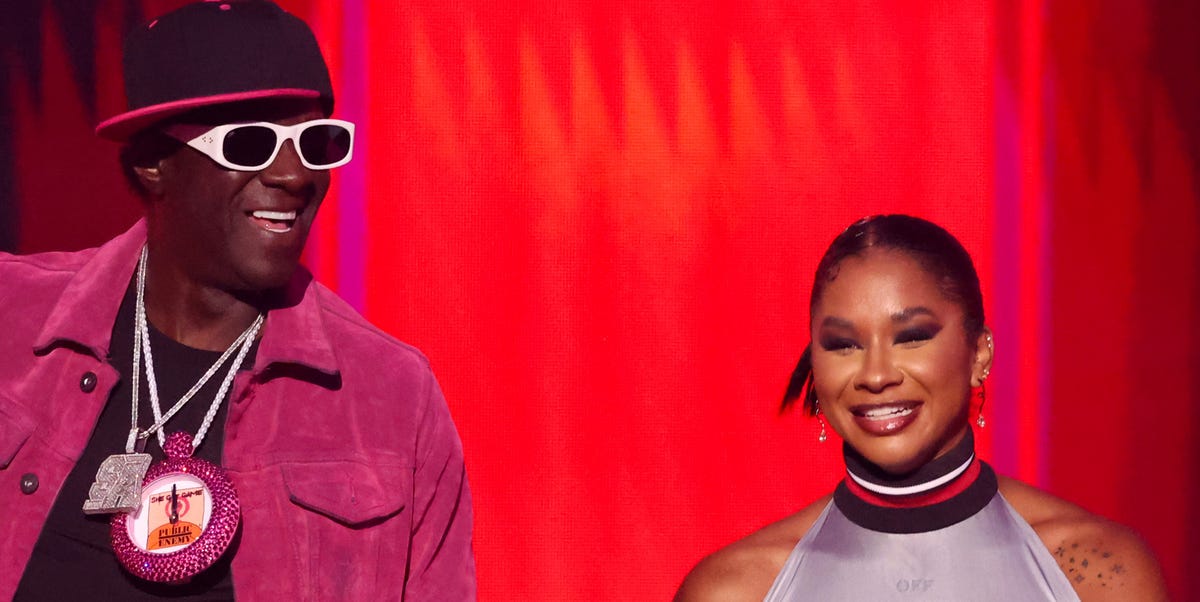
The 2024 MTV Video Mu, and enough celebrity cameos to overload a group chat. Yet one of the night’s most memorable moments belonged to Olympic gymnast Jordan Chiles and Public Enemy icon Flavor Flav. Onstage, Flav surprised Chiles with a custom bronze clock necklace after the disputed removal of her Paris Olympics floor-exercise medal. The gift was playful, personal, and unmistakably Flavbut it also carried a serious message about recognition, athlete support, and the human cost of sports bureaucracy.
A VMA Surprise That Felt Bigger Than an Award Show
On September 11, 2024, Jordan Chiles joined Flavor Flav onstage at the MTV Video Music Awards at UBS Arena in Elmont, New York. The pair were there to present Best Collaboration, but Flav briefly turned the music ceremony into what he called an Olympic moment. Before the category winner was announced, he placed a large, sparkling bronze clock necklace around Chiles’ neck.
The accessory was created in the style of the oversized clocks that have been part of Flavor Flav’s public image for decades. This one, however, was customized for Chiles and covered in bronze-toned stones. It was not intended to imitate an official Olympic medal. It was something more personal: a public sign that her achievement mattered even while judges, federations, lawyers, and timing rules argued over the official record.
Flav also said he would provide the prize money associated with a bronze-medal finish. Chiles appeared genuinely surprised, which gave the segment a warmth that carefully rehearsed award-show moments rarely achieve. In a room full of moon-shaped trophies, designer outfits, and precisely timed camera cuts, a clock became the emotional centerpiece. That is very Flavor Flav: arrive with a giant timepiece and somehow make everyone pause.
Entertainment coverage quickly highlighted the exchange as one of the most touching scenes of the night. The reaction crossed the usual boundaries between hip-hop fans, gymnastics followers, Olympic viewers, and people who simply enjoy seeing someone keep a generous promise. n>
Why Jordan Chiles’ Bronze Medal Became So Controversial
To understand why the gift resonated, it helps to revisit the unusually complicated women’s floor final at the Paris 2024 Olympics. Chiles initially received a score of 13.666, placing her fifth. Her coach, Cecile Landi, submitted an inquiry arguing that the difficulty value of one element had not been fully credited. Officials accepted the inquiry and raised Chiles’ score by one-tenth to 13.766, moving her into third place behind Brazil’s Rebeca Andrade and U.S. teammate Simone Biles.
That revision created a historic podium featuring three Black gymnasts. The image of Chiles and Biles bowing to Andrade became one of the Games’ most widely celebrated displays of sportsmanship. Then the standings changed again.
The Four-Second Dispute
Romanian officials challenged the timing of the U.S. inquiry. Under the rules applied to the final gymnast in the rotation, the inquiry had to be made within one minute. The Court of Arbitration for Sport ruled that the request had been submitted four seconds late. Chiles’ original score was restored, and Romanian gymnast Ana Bărbosu moved into the bronze-medal position.
USA Gymnastics later said time-stamped video showed Landi beginning the inquiry 47 seconds after the score appeared and repeating it at 55 seconds. The organization attempted to submit that material, but the original ruling was not reopened at that stage. Chiles was asked to return the medal, while the U.S. Olympic and Paralympic community continued supporting her challenge. he Emotional Cost Was Not a Technicality
The public debate often focused on fractions of a point and seconds on a clock, but Chiles experienced something far more personal. She had celebrated on the podium, received the medal, and returned home as an Olympic bronze medalist before being told the result would be reversed. She also faced abusive and racially charged messages online, adding cruelty to an already confusing process.
That context changed the meaning of Flavor Flav’s gift. He was not pretending jewelry could settle an arbitration case. He was telling Chiles that recognition does not have to disappear because an institution changes a line in the standings. The bronze clock could not replace the official medal, but it could challenge the idea that her Olympic performance had somehow become less worthy of respect. n>
Flavor Flav Had Already Become an Unexpected Olympic Hero
For viewers who followed the Paris Games closely, Flav’s support did not come out of nowhere. He had become one of Team USA’s most visible cheerleaders, especially for women’s water polo. After learning that some players worked multiple jobs to afford elite competition, he entered a sponsorship agreement and embraced the role of official hype man.
His Olympic involvement mixed financial help, enthusiastic promotion, and the sort of courtside energy normally associated with someone who has consumed three espressos and discovered a working microphone. He attended events, praised athletes publicly, and helped draw attention to the financial strain many Olympians face outside the brief window when the world is watching.
Flav also helped U.S. discus thrower Veronica Fraley with rent after she posted about financial stress shortly before competing. These gestures made the Jordan Chiles gift feel like part of a pattern rather than a convenient awards-show stunt. He repeatedly used his celebrity to make athletes feel seen and, when possible, to solve an immediate problem.
The Los Angeles Times, Entertainment Weekly, People, NBC-owned outlets, Variety, and other U.S. publications documented the clock promise and its delivery. Across that coverage, the same theme emerged: Flavor Flav had found a vivid, distinctly personal way to support an athlete during a painful public dispute. n>
Why the Bronze Clock Necklace Worked So Well
It Was Symbolic Without Pretending to Be Official
The necklace did not claim to resolve who should hold the Olympic bronze. It acknowledged that the official process was larger and more complicated than one celebrity gesture. At the same time, it offered Chiles something the public could immediately understand: a one-of-a-kind object representing support, achievement, and resilience.
It Was Personal to Both People
A generic trophy would have felt like a prop. A Flavor Flav clock, by contrast, is part of his identity. Giving Chiles a custom version meant sharing his own visual signature with her. The gift connected his career in hip-hop with her career in gymnastics, producing a pop-culture crossover that did not feel forced.
He Followed Through
Flav first offered to make the clock publicly in August 2024. He then revealed that it had been created and later presented it to Chiles in person at the VMAs. That sequence mattered. Social media is full of promises that vanish faster than a disappearing Instagram story. Flav made his promise tangible, sparkly, and difficult to misplace unless your jewelry drawer is the size of a studio apartment.
It Returned Joy to Chiles’ Story
For weeks, headlines about Jordan Chiles centered on hearings, deadlines, appeals, and the removal of a medal. The VMAs moment changed the emotional frame. She was no longer shown only as the athlete caught in a procedural battle. She was a celebrated Olympian standing on a major stage while a music legend told her she deserved recognition.
Chiles later said she kept the bronze clock in a trophy case at home alongside her world and Olympic medals, describing it as highly valued. That detail confirms what fans sensed during the presentation: the necklace was not merely a television gag. It became part of the physical record of her career. n>
What the Moment Said About Athlete Support
The popularity of the Flavor Flav and Jordan Chiles VMAs moment reflects a broader truth about elite sports: applause during competition is important, but support after disappointment may matter even more. Athletes train for years, yet a ruling, injury, funding problem, or scoring decision can reshape their lives in minutes.
Fans often imagine Olympians as fully funded professionals surrounded by sponsors and experts. In reality, many athletes manage travel costs, training bills, housing expenses, school, work, and mental pressure while competing at the highest level. Celebrity supporters cannot repair every structural weakness, but they can direct attention and resources toward people whose needs are otherwise hidden behind patriotic broadcasts and medal counts.
Flav’s gift also demonstrated the value of public encouragement that does not speak over the athlete. He did not ask Chiles to relive every detail of the controversy onstage. He created a celebratory moment, honored her performance, and allowed her reaction to carry the scene. The result was supportive rather than exploitative.
The Medal Fight Continued Beyond the 2024 VMAs
The legal dispute did not end with the award show. Chiles challenged the arbitration outcome in Switzerland, arguing that important video evidence supported the claim that the inquiry was made within the permitted time. In January 2026, the Swiss Federal Supreme Court accepted requests for revision from Chiles and USA Gymnastics, opening the door for the evidence to be reconsidered.
That later development did not retroactively change what happened at the VMAs, but it reinforced the reason the clock carried such weight. The sports process was still moving through legal channels long after the Olympic flame went out. Flavor Flav’s gesture offered something immediate during a dispute that demanded patience: recognition now, while the institutions continued arguing about what the record should say. n>
Experience Takeaways: What Fans, Brands, and Public Figures Can Learn
The most useful way to experience a story like this is to look beyond the famous names and ask why the exchange felt authentic. The answer begins with attention. Flavor Flav followed the Olympics closely enough to understand what Chiles had lost, what the dispute meant emotionally, and why a bronze-themed gift would connect with her experience. Good support starts by noticing the person, not merely spotting a trending topic.
For fans, the lesson is simple: encouragement has more value when an athlete is struggling than when the podium ceremony is easy and triumphant. Posting congratulations after a victory takes seconds. Remaining respectful during controversy requires more care. Fans can support athletes without attacking their competitors, judges, or other nations. Jordan Chiles and Ana Bărbosu were both placed in an unfair emotional position by a confusing process; neither needed strangers turning the situation into an online cage match.
For brands, the moment offers a practical lesson in relevance. A meaningful partnership should solve a real problem or honor a real part of someone’s story. Sending a generic gift basket would not have created the same response. The bronze clock worked because it joined Flav’s identity, Chiles’ experience, and the public conversation in one memorable object. It was recognizable in a photograph, understandable without a lengthy explanation, and personal enough to avoid feeling like corporate confetti.
Public figures can also learn from the way Flav followed through. He made the offer, had the piece produced, delivered it personally, and added financial support. Each step increased the credibility of the gesture. The experience would have felt very different had he posted once, collected praise, and quietly moved on. Consistency turned a viral promise into a relationship-building act.
There is also a lesson for event producers. Award shows are often remembered less for their official categories than for unscripted human moments. The VMAs gave Flav and Chiles enough room to create a scene that connected music, sports, generosity, and humor. Audiences can tell when every emotion has been sanded smooth by rehearsal. Chiles’ surprise made the segment work because it felt like something happening to a person, not content being delivered to a demographic.
Finally, the experience reminds viewers that symbolic gifts can matter even when they do not fix the original problem. The clock did not alter an Olympic ruling. It did not erase online abuse or return the exact podium moment Chiles experienced in Paris. What it did was preserve dignity. It told her that another person had witnessed what happened and wanted to mark her accomplishment in a lasting way.
That may be why Olympics fans applauded Flavor Flav so enthusiastically. The gesture combined fun and seriousness without confusing one for the other. It was loud, oversized, glittering, and slightly ridiculousbecause of course it was a Flavor Flav clock. It was also thoughtful, timely, and rooted in genuine support. In an age when celebrity kindness can look suspiciously like a campaign rollout, this one felt human.
Conclusion
Flavor Flav’s gift to Jordan Chiles at the 2024 VMAs became more than a memorable celebrity exchange. The custom bronze clock necklace recognized an Olympic performance that had become buried beneath rules, appeals, and public argument. By pairing the gift with promised prize money and delivering it personally, Flav transformed support from a social media statement into action.
The scene also gave Chiles something the medal controversy had repeatedly taken away: a joyful public moment on her own terms. No necklace can replace an official Olympic medal, but recognition is not limited to what appears in a results database. Sometimes it arrives beneath stage lights, hangs from an enormous chain, and comes from a hip-hop legend who understands that being on time is importantespecially when four seconds are involved.