

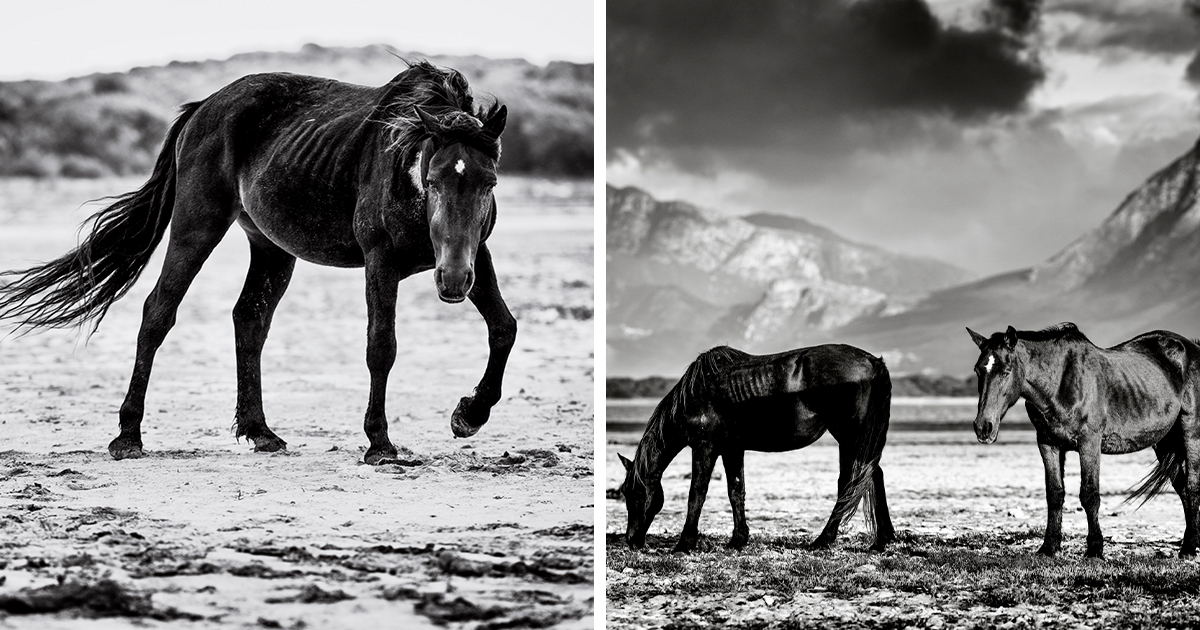
Note: This is an original editorial feature inspired by the published photographic collection associated with wildlife photographer Peter Delaney. The headline preserves the collection’s title; this article does not claim that the publisher or writer created the photographs.
There are photographs that make you stop scrolling. Then there are photographs that make you briefly forget you own a phone, have emails to answer, or once promised yourself you would finally organize the garage. Black-and-white portraits of South Africa’s free-roaming horses belong firmly in the second category.
In the wetlands near Kleinmond and Rooisand in South Africa’s Western Cape, a small population of feral horses moves through reeds, dunes, mist, and open coastal grassland with the confidence of animals that have never received a calendar invite. Their dark silhouettes against bright skies and pale water make them ideal subjects for monochrome photography. Remove color, and suddenly every windblown mane, hoofprint, wetland reflection, and watchful eye becomes part of the story.
This 30-image photographic concept is not simply about handsome horses posing dramatically for the camera. It is about place, survival, patience, and the strange magic that happens when a living animal becomes part of a landscape rather than a decorative object dropped into it. The photographs invite viewers to see South Africa’s wild horses not as props in a postcard, but as free-roaming inhabitants of a fragile wetland world.
The Horses Behind the Images
South Africa has several well-known populations of free-roaming horses, but the Rooisand and Kleinmond horses are especially striking because of their wetland habitat. These animals are often called wild horses in everyday conversation, although “feral” is the more precise term. Their distant ancestors were domesticated horses that eventually lived independently in the landscape for generations.
That distinction matters, but it does not make them any less fascinating. A feral horse can be every bit as alert, powerful, unpredictable, and deeply adapted to its surroundings as an animal that has never known a saddle. These horses are not waiting politely for a person with a halter and a handful of carrots. They live in family groups, find food and water, protect young animals, negotiate dominance, and respond to weather, noise, dogs, traffic, and human activity in real time.
Their origins have inspired plenty of local stories. Some accounts connect them to old farming and wagon horses, while other legends involve wartime animals or shipwrecks. The most practical explanation is usually the least cinematic: horses connected to farming life survived after agriculture and transport changed. Still, practicality does not erase wonder. A working horse that becomes part of a wetland landscape over generations acquires a story no novelist could improve without accidentally making it ridiculous.
A Small Herd With a Big Presence
The Rooisand horses have long been described as a small, fluctuating population rather than a vast herd sweeping across an endless plain. That limited number makes every animal more visible and every loss more significant. The horses share the broader estuarine landscape with wetland birds, coastal vegetation, shallow channels, dunes, and nearby communities. Their presence gives the environment a sense of movement, but it also highlights how easily a habitat can become pressured by development, roads, fences, and human disturbance.
That is why these photographs work best when they show more than muscle and mane. The surrounding grass, water, sand, and cloud cover are not empty backgrounds. They are evidence. A horse standing in a patch of wind-flattened reeds tells a different story than a horse photographed in a fenced paddock. One feels arranged. The other feels like the viewer has stumbled into a moment that was already happening long before the camera arrived.
Why Black And White Makes These Horses Feel Even More Majestic
Color photography can be beautiful, especially in South Africa, where coastal light, fynbos vegetation, and dramatic skies are not exactly shy. But black-and-white photography performs a useful act of visual mischief: it takes away the obvious distractions and asks the viewer to pay attention to shape, contrast, texture, and mood.
In monochrome, a black horse against a bright horizon becomes almost sculptural. A pale gray horse in fog can look as though it has stepped out of a nineteenth-century folktale. A muddy hoofprint becomes a graphic mark. A mane tossed by wind becomes a brushstroke. Even the simple act of grazing can feel cinematic when the grass catches the light and the animal’s body creates a bold shadow against the open land.
Black-and-white wildlife photography also rewards restraint. Not every image needs thunderclouds, galloping hooves, or a horse rearing like it has just been offered a leading role in an action movie. A quiet image can carry equal power: one horse standing apart from the herd, ears forward, framed by a low fogbank; a mare and foal moving through shallow water; or several animals reduced to dark shapes on a dune ridge.
Light, Texture, and the Drama of Simplicity
Monochrome images succeed when the photographer thinks in tones rather than colors. Bright water can become clean white space. Dense storm clouds can become charcoal. The horse’s coat may hold subtle layers of silver, black, and gray that are easy to miss in a color image. A photographer can use those tonal differences to separate the horse from the scene without making the image look overprocessed or theatrical.
For example, a high-key image with a bright sky and pale wetland can make a dark horse appear isolated and almost weightless. A low-key composition can do the opposite, allowing the horse to emerge gradually from deep shadows and dark reeds. Neither approach is automatically better. The right choice depends on the feeling the image needs to carry: calm, tension, mystery, solitude, movement, or the slightly unnerving realization that the horse noticed you before you noticed it.
Texture is another major player. Wet coats, tangled manes, weathered faces, rippling water, long grass, and drifting sand give black-and-white images a tactile quality. You can almost feel the damp air and hear the soft pull of hooves through the ground. That is the goal of a strong wildlife photograph: not simply to prove an animal was there, but to make the viewer feel the atmosphere around it.
Thirty Photographs Can Become One Larger Story
A single striking horse portrait can be memorable. A sequence of 30 photographs can become something richer: a visual essay. The strongest collections avoid repeating the same composition with minor variations, no matter how handsome the horse may be. Thirty identical horse headshots would be like serving thirty slices of the same cake. Delicious at first, perhaps, but eventually somebody starts looking for coffee.
A thoughtful series can move between wide landscapes, close portraits, herd interactions, environmental details, weather, motion, and stillness. One photograph may establish the scale of the wetland. Another may focus on the intelligent shape of an eye. A third might show horses crossing a shallow channel. A fourth could reduce the herd to silhouettes beneath a wide sky. Together, the photographs create rhythm.
This is especially important for documenting free-roaming animals. Their lives are not made only of dramatic moments. They graze, wait, move, rest, watch, follow, challenge, and disappear behind reeds. A photo essay that includes ordinary behavior feels more truthful than one built entirely from spectacle. The quiet frames are often the images that make the action frames believable.
From “Beautiful Animal” to “Living Landscape”
The best images of the Cape horses do not merely say, “Look at this beautiful animal.” They say, “Look at this animal in this exact place, at this exact moment, under this weather, within this fragile ecosystem.” That shift is crucial.
It turns the horse from a symbol of generic freedom into an individual presence with a relationship to land and habitat. It also introduces a harder truth: free-roaming horses are not immune to the pressures facing the landscapes around them. Habitat fragmentation, road traffic, human encroachment, and careless interaction can change the future of a small herd quickly.
Photography can help by creating attention without turning wildlife into entertainment. A meaningful image does not need to shout. Sometimes it simply asks viewers to notice what is already there before it becomes difficult to find.
How to Photograph Wild Horses Without Becoming the Problem
Wildlife photography should never be a contest to see who can stand closest to an animal while making questionable life choices. A long lens, patience, and a willingness to accept that the horse may walk away are far more useful than trying to force a “perfect” encounter.
Free-roaming horses should be treated as wild animals, not oversized petting-zoo mascots. They can kick, bite, charge, spook, or change direction suddenly. More importantly, repeated human pressure can alter their natural behavior. A photograph is not worth making an animal abandon grazing, separate from a foal, or move into a dangerous area.
- Use a telephoto lens and keep enough distance that the horse continues behaving normally.
- Never feed, touch, lure, chase, whistle at, or block the path of a horse.
- Do not use drones near horses or sensitive wetland wildlife unless local authorities specifically permit it.
- Stay on permitted paths and avoid trampling reeds, nesting areas, and fragile dune vegetation.
- Work with the weather instead of trying to control the animals. Fog, rain, wind, and distance often make better photographs anyway.
The most ethical image is usually the one that requires the least interference. A horse that does not react to you gives you something more valuable than a close-up: a glimpse of its real life.
Why These South African Horse Photographs Stay With Us
There is a reason black-and-white photographs of horses feel timeless. Horses already carry centuries of symbolism: freedom, labor, war, travel, companionship, strength, and speed. Place them in a wetland under a stormy sky, remove color, and they begin to feel almost mythic.
But the real power of these images is not myth. It is specificity. These are not imaginary horses running through a vague “African wilderness.” They belong to a particular region, a particular ecological setting, and a small population whose future depends on people respecting the space around them.
The 30 photographs become more than fine-art wildlife images when they make viewers curious about the landscape, the herd, and the responsibility that comes with admiration. Beauty gets attention. Context gives beauty a purpose. And sometimes a horse standing quietly in silver grass can say more about conservation than a paragraph full of alarming statistics.
An Extended Field Experience: Learning to Wait for Free-Roaming Horses
The experience of photographing free-roaming horses begins long before the first photograph. It begins with waiting. You arrive when the light is uncertain and the landscape is still deciding whether it wants to be foggy, windy, rainy, or all three before breakfast. Wetlands are not studios. They do not care about your schedule, your battery percentage, or the fact that you told your friends you would be back “in an hour or so.”
At first, the human instinct is to search aggressively. You scan the horizon, inspect every dark shape, and briefly convince yourself that a suspiciously horse-shaped bush has an excellent mane. Then the landscape slows you down. You begin noticing reeds bending in the wind, a bird calling from the water, hoofprints pressed into damp sand, and the faint movement of grass where something larger may be grazing.
When the horses finally appear, the best response is not to rush closer. It is to pause. A distant herd can be more powerful than a close portrait because distance shows the relationship between animal and habitat. The horses become part of the horizon, moving through it rather than posing in front of it. A telephoto lens can bring the scene nearer without forcing your presence into their day.
There is also a lesson in accepting imperfect conditions. A horse may turn its head the wrong way. A cloud may cover the sun. A reed may drift across the frame at exactly the moment everything looks perfect. These are not failures. They are reminders that wildlife photography is a collaboration in which the photographer has the least authority. The horse has not signed a release form, checked your mood board, or agreed to be your dramatic leading actor.
Black-and-white photography makes this uncertainty more interesting. Instead of worrying whether the grass is too green or the sky is too blue, you watch the contrast. You look for the bright strip of water behind a dark shoulder, the pale fog around a black mane, or the way hoofprints create a repeating pattern in wet sand. The world becomes a map of tones, shapes, and movement.
The most memorable moment may not be a gallop. It may be a quiet pause when one horse raises its head, listens, and then returns to grazing because you have stayed far enough away to remain irrelevant. That tiny act of indifference is a compliment. It means the animal has not been made uneasy by your presence.
When the horses eventually move out of sight, the experience does not feel unfinished. It feels complete in the way good wildlife encounters should: the animals continue their lives, the wetland remains more important than the photograph, and you leave with a few images, a muddy pair of shoes, and a much better understanding of why patience is the most underrated piece of camera equipment.
Conclusion
South Africa’s majestic wetland horses are compelling because they exist at the meeting point of history, ecology, and visual poetry. A black-and-white photographic series can reveal their strength without stripping away their vulnerability, their beauty without turning them into ornaments, and their freedom without pretending that freedom survives without care.
The most successful photographs do not ask viewers merely to admire the horses. They ask viewers to respect the land beneath their hooves, the space around their bodies, and the quiet lives that continue after the camera is packed away.