

A child swipes a colorful animal card through a plastic reader, the device chirps, growls, or squawks, and everyone continues with the important business of collecting more cards. A reverse engineer hears something else: the tiny, irresistible click of a mystery waiting to be opened.
The Super Animal Cards project became a delightful example of hardware reverse engineering because the system looked magical while relying on wonderfully simple ideas. Each collectible card carried an optical barcode. The reader detected the pattern, converted it into a number, and played an audio clip stored inside the toy.
By comparing cards, testing hand-drawn codes, writing a barcode generator, and eventually using an Arduino to imitate card swipes, experimenters uncovered the reader’s basic protocol. They also discovered what happened when the device received valid card numbers that had never appeared in the original collection.
This was not a mission to defeat military encryption with a paper clip. It was a practical lesson in binary numbers, parity bits, infrared light, embedded hardware, experimental design, and the scientific value of asking, “What happens if we change this?”
What Were Super Animal Cards?
The documented promotion began with a collection of 108 animal cards. Each card displayed an animal and carried a unique barcode on the back. When the card was pulled through a companion sound reader, the device played a corresponding animal noise.
The card did not actually contain the recording. Instead, it worked like a numbered key. The barcode identified an entry in an audio table stored inside the reader. Swipe a valid card, decode its numerical ID, find the associated sound in memory, and send that sound to the speaker.
Once that architecture was understood, an obvious question appeared: how many possible identifiers could the barcode represent? If the coding system supported more than 108 values, the unused numbers might point to expansion cards, duplicate sounds, manufacturing tests, promotional messages, or developer Easter eggs.
In other words, the toy might have had a much larger menu than the manufacturer initially served.
Turning the Barcode Into Binary Data
Finding the Card ID
The investigation began by placing several cards side by side and comparing their barcode patterns. Black and white regions could be transcribed as binary values, allowing every card to be represented as a sequence of zeros and ones.
Inspection revealed a 13-bit pattern. Ten positions behaved like a straightforward numerical identifier. Card 1 used the binary value for 1, card 2 used the value for 2, and the sequence continued in the expected order.
A 10-bit field can represent 1,024 values, including zero. That was dramatically more capacity than the 108 cards in the first set required. The discovery suggested that the reader could theoretically recognize IDs from 1 through 1,023 without changing its physical design.
The cards were therefore not using ordinary retail UPC barcodes. They were speaking a compact, custom language created specifically for the toy.
Why a Homemade Card Failed
The first attempt to generate an unused number did not work. The identifier had been converted to binary, but the three remaining bits were copied from another card without understanding their purpose. The reader responded with silencethe electronic equivalent of raising one eyebrow.
A second test used the same method to reproduce a known card that was missing from the children’s collection. That card worked and produced the expected bird sound.
The contrasting results showed that the 10-bit ID was necessary but not sufficient. The final three bits were helping the reader determine whether a barcode was valid.
This is one reason failed experiments are valuable. A failure that rules out a theory is often more informative than a success produced by luck.
Decoding the Parity and Stop Bits
The three unexplained positions appeared in only two combinations across the photographed cards. A small checksum or cyclic redundancy check initially seemed possible, but such a calculation would normally produce more than two recurring values.
The simpler answer was framing and parity. One bit appeared to function as a stop bit, while the other two changed according to whether the 10-bit identifier contained an even or odd number of ones. The two parity positions were complementary: when one was set, the other was clear.
Parity is a basic form of error detection. It cannot detect every possible corruption, and it does not repair damaged data. However, it gives a small controller a fast and inexpensive way to reject many malformed swipes.
That is useful in a children’s toy. Cards may be pulled too quickly, too slowly, backward, sideways, or with the delicate precision of someone trying to start a lawn mower. A small amount of validation prevents many accidental patterns from triggering random sounds.
A conceptual barcode generator looks like this:
The actual printed order depends on which edge enters the reader first. Anyone recreating the experiment should mark the swipe direction carefully. Computers remain stubbornly unwilling to accept “You know what I meant” as a valid protocol.
Confirming the Theory With C++ and Qt
A convincing reverse-engineering theory must explain all known examples and predict new ones. The observed card patterns were therefore entered into a table and compared with values generated by a small C++ program.
The calculated parity combinations matched the photographed cards. That agreement turned a plausible theory into a working model.
A Qt application was then developed to render new barcode patterns into printable PDF documents. Instead of drawing every bar by hand, the software could accept a number, convert it to ten binary ID bits, calculate the validation bits, and produce a consistently sized barcode.
Cards numbered 109 through 117 reportedly worked when printed and swiped through the reader. That result demonstrated that the reader recognized identifiers beyond the original 108-card collection.
It also suggested that additional audio had already been stored in the device. The reader did not need to download anything or connect to a computer. The extra content had been sitting inside the toy, quietly waiting for the right number.
How the Super Animal Card Reader Worked
An Infrared Optical Scanner
Opening the reader revealed an infrared LED and an optical sensor positioned beside the card slot. A mechanical switch detected when a card entered and started the reading process.
As the card moved through the slot, pale areas reflected more infrared light toward the sensor. Dark barcode marks reflected less. Those changes in reflected light became an electrical signal that the controller interpreted as a stream of bits.
This was an economical design. The individual cards required no battery, chip, RFID antenna, magnetic stripe, or electronic memory. They could be printed cheaply while the reader contained the sensor, controller, audio storage, amplifier, and speaker.
The teardown also produced an instructive correction. A visible Macronix 25L1605D component was initially mistaken for the main microcontroller. It was actually serial flash memory. The controller itself was mounted directly on the circuit board beneath a black epoxy blob, a construction technique known as chip-on-board packaging.
The flash chip likely held the audio assets, while the hidden controller handled barcode interpretation, validation, lookup, and playback.
Why Swipe Speed Did Not Need to Be Perfect
Children do not swipe cards at laboratory-controlled speeds. The reader therefore had to recognize the relative sequence of dark and light areas rather than depend on one exact duration.
Consistent bar widths, strong contrast, correct orientation, and a reasonably smooth swipe were still important. A hand-drawn card could work, but a ruler was more valuable than artistic talent. The reader was measuring geometry, not judging an illustration contest.
Replacing Paper Cards With an Arduino
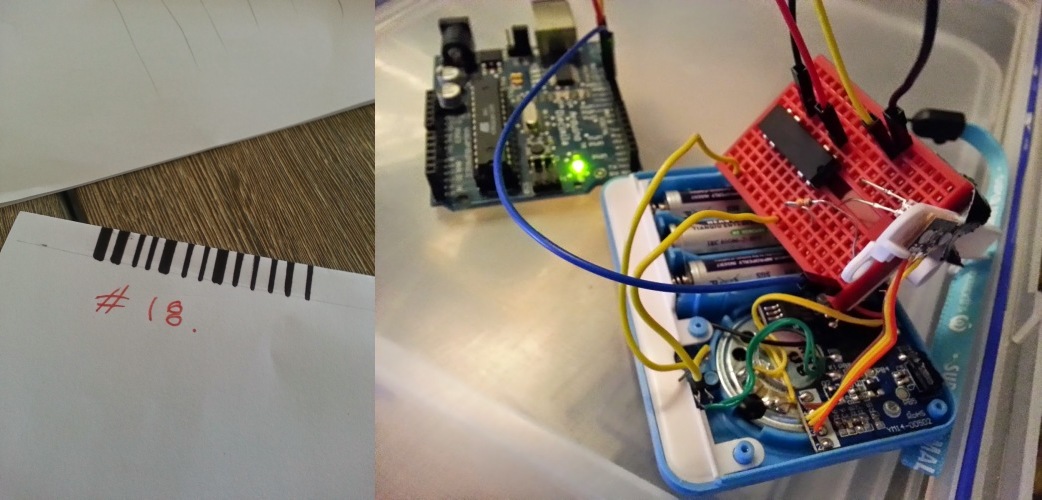
Printing hundreds of candidate cards would have consumed paper, ink, and possibly the final scraps of household patience. The next stage replaced the physical barcode with an infrared LED controlled by an Arduino.
The Arduino blinked the LED in the sequence the reader’s sensor would normally observe during a card swipe. Early testing used a visible LED so the timing could be seen directly. Once the sequence appeared correct, an infrared LED was substituted.
A relay was also connected across the reader’s card-detection switch. The Arduino could activate the switch, wait for the reader to enter scanning mode, transmit a barcode pattern, and then move to the next ID.
The program cycled through the possible values from 1 to 1,023. For each number, it generated the proper parity information and presented the resulting pattern to the optical sensor.
This changed the experiment from a manual search into a repeatable brute-force scan. Instead of printing and swiping hundreds of cards, the investigator could listen, record the result, and allow the microcontroller to advance automatically.
A modern recreation should include proper circuit protection. An electromechanical relay coil can create a voltage spike when switched off, so a flyback diode or an appropriately designed driver should be used. An optocoupler, transistor, or suitable solid-state switching circuit may also provide a cleaner interface.
What the Automated Search Discovered
The scan found additional animal sounds beyond the original collection. That discovery gained context when another 72-card Christmas-themed expansion was announced. The large numerical address space had allowed future cards to be supported without redesigning the reader.
The most memorable result appeared at ID 191. Instead of an animal, the reader played a spoken message: “Better luck next time.”
Other unexpected results reportedly included a beep and a sound resembling a camera shutter. They may have been promotional tracks, factory-test assets, unused effects, or material prepared for another campaign.
Without internal documentation from the manufacturer, their purpose cannot be established with certainty. Reverse engineering can reveal what a device does, but it does not always reveal why its developers made a particular choice.
That distinction separates careful technical analysis from an entertaining guess wearing a lab coat.
A Repeatable Reverse-Engineering Workflow
Preserve and Compare the Evidence
Photograph several original cards before modifying anything. Record the printed number, barcode orientation, swipe direction, bar spacing, and any unusual visual features. Select cards with different binary patterns so parity theories can be tested against varied data.
Identify Constant and Variable Fields
Translate each pattern into a consistent binary string. Align the strings and compare them with the numerical card IDs. Mark positions that remain constant, positions that follow the ID, and positions that change according to another property such as the number of set bits.
Test Known Values First
Before exploring hidden IDs, reproduce a card that is already known to work. Then generate another known card entirely from the proposed rules. This helps separate printing, orientation, and timing problems from mistakes in the protocol model.
Change One Variable at a Time
Keep bar width, card size, orientation, and swipe speed consistent while changing the identifier. When hardware simulation begins, adjust timing gradually instead of rewriting several parts of the program simultaneously.
Log Every Result
Record each tested ID and classify the response as an animal, spoken message, sound effect, duplicate, or no response. Automation without documentation merely allows confusion to occur at microcontroller speed.
Repeat Surprising Findings
Unexpected sounds should be triggered several times and compared with neighboring IDs. A repeatable surprise is a finding. A single chirp may be a loose wire enjoying its brief career in show business.
Lessons About Embedded Product Design
The Super Animal Cards reader demonstrates how simple subsystems can combine to create an experience that feels magical. The card carries an identifier. The optical sensor converts patterns into signals. The controller validates the code. Flash memory stores the sounds. A lookup table connects the ID to an audio address.
No individual component understands that a particular card represents a tiger or a bird. Meaning appears only when the complete system connects the printed pattern to the correct recording.
The project also explains why embedded designers often reserve more address space than a product initially requires. Ten bits provided room for expansions, regional editions, test entries, promotional messages, and future content. Reducing the field to fit exactly 108 cards would have saved little while making later additions far more awkward.
Finally, the reader used several modest safeguards instead of one sophisticated mechanism. Mechanical activation indicated that a card was present. Optical transitions carried the identifier. A stop bit framed the code. Parity rejected many invalid patterns. Together, these inexpensive measures created a toy robust enough for enthusiastic young users.
Ethical, Legal, and Safety Considerations
Studying a toy you own for education, repair, preservation, or interoperability is different from selling counterfeit cards, extracting and distributing copyrighted recordings, manipulating a commercial promotion, or tampering with equipment belonging to someone else.
United States law involving reverse engineering, copyright, contracts, and technological access controls can be complicated. Certain reverse-engineering activities may qualify for fair use or statutory exceptions, particularly when conducted for interoperability, but the details depend on the circumstances. This article is educational information, not legal advice.
Use your own hardware, preserve the original device when possible, and publish technical observations rather than copyrighted audio assets. Disconnect power before opening electronics, limit LED current with a suitable resistor, protect relay-driving circuits, and keep experiments confined to low-voltage equipment.
Hands-On Experience: What the Project Feels Like
A typical Super Animal Cards reverse-engineering session begins with confidence that lasts approximately seven minutes. You place two cards next to each other, notice that several bars change, and conclude that the protocol is practically solved. Then the first homemade card produces absolute silence. The reader stares back with the emotional range of a stapler.
That failure is where the useful work begins. You check the swipe direction. You wonder whether black represents one or zero. You measure the bars again. You compare the pattern with a known card and discover that most of it follows the printed card number. Three stubborn bits still refuse to explain themselves.
At that point, casual tinkering becomes a miniature investigation. Every card is evidence. Every repeated pattern is a clue. Every assumption receives a polite but firm interrogation.
Working with a child or beginner improves the project. Explaining binary as place valuesones, twos, fours, eights, and so onforces the adult to stop hiding behind technical vocabulary. A child does not care whether a theory sounds sophisticated. The card either makes the bird chirp or it does not.
That immediate response transforms an abstract computing lesson into something physical. Marks on paper become bits. The bits become a number. The number becomes a command. The command becomes a noise from a plastic box.
The first successful handmade barcode is disproportionately satisfying. It proves that the reader’s private language has become understandable. The toy stops feeling like a sealed magical object and begins to look like a series of design choices. The wonder does not disappear; it changes flavor. Understanding the trick makes the engineering more impressive, not less.
Moving from paper to software creates a new set of lessons. A barcode generator requires accurate widths, margins, orientation, and pagination. One wrong assumption can produce an entire PDF filled with beautifully consistent nonsense. Testing known values before printing hundreds of experimental cards becomes a memorable argument for validation.
The Arduino stage introduces hardware timing. A visible LED may blink perfectly on the desk, yet the reader refuses to react because the simulated swipe starts too early, too late, or at the wrong speed. Connections move. Relays click. Infrared light remains invisible to the eye, so a compatible digital camera becomes an improvised diagnostic tool.
Progress may arrive as one unexpected animal noise after several minutes of silence. That single sound confirms that the optical sensor, switching circuit, timing, bit order, parity calculation, and lookup behavior have finally aligned.
Automation changes the mood again. Instead of repeatedly drawing and swiping cards, the program walks through identifiers while the experimenter listens and logs. Most values may be inactive, ordinary, or duplicated. Repetition makes an unusual spoken track especially startling.
Hearing “Better luck next time” from an unlisted ID feels like opening a cupboard and discovering that a tiny employee from the factory has been living inside the toy.
The most valuable result, however, is not the Easter egg. It is the investigative habit the project builds: observe before guessing, preserve evidence, test known values, change one variable, automate repetitive work, and separate confirmed behavior from speculation about intent.
Those habits scale well beyond animal cards. They apply to file formats, network protocols, repair diagnostics, compatibility projects, security research, and almost any unfamiliar technical system. The toy is small. The method is not.
Conclusion
Reverse engineering Super Animal Cards succeeded because the investigation progressed in logical layers. Visual comparison exposed a binary identifier. Failed cards proved that validation data mattered. Parity analysis explained the changing control bits. C++ code reproduced the known patterns. A Qt program generated printable cards. A teardown revealed the infrared optical reader, and an Arduino simulator explored the full 10-bit range.
The project remains an excellent introduction to embedded systems because it requires curiosity more than expensive equipment. A camera, ruler, printer, simple software, microcontroller, and organized notebook can reveal a surprising amount.
It also provides a memorable answer when a young learner asks why binary numbers matter. Sometimes they matter because a mysterious sound may be hiding behind card number 191.
SEO Metadata
Note: This article is intended for lawful education, repair, interoperability, and experimentation with hardware you own. Do not use these techniques to counterfeit products, misuse promotions, or distribute copyrighted audo.