

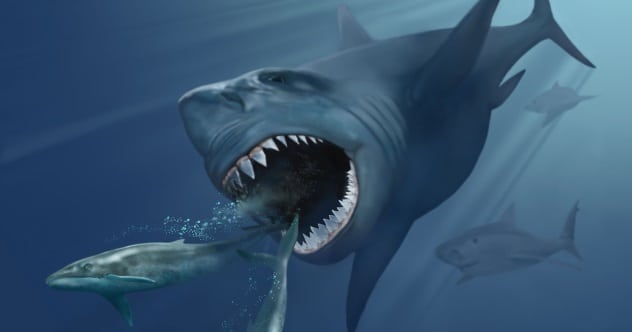
Imagine standing at the edge of a warm prehistoric sea. The water looks peaceful. The sun is doing its shiny little sun thing. A few ancient whales are cruising by, probably thinking about whatever whales thought about millions of years before podcasts. Then the ocean darkens beneath them. Something enormous rises from below with teeth the size of steak knives and a bite that could turn a whale into a very bad afternoon.
That terrifying guest star is the megalodon, more accurately known today as Otodus megalodon. It was not a movie monster, not a deep-sea rumor, and definitely not a shark waiting politely under your local beach pier. It was a real prehistoric apex predator that dominated ancient oceans for millions of years. Its fossil teeth have been found around the world, and those teeth tell a story of size, power, adaptation, and extinction.
The megalodon remains one of the most fascinating prehistoric animals because it sits perfectly between science and imagination. We have enough evidence to know it was astonishing, but not enough complete fossil material to answer every question. That mystery is part of the fun. So grab your metaphorical snorkel, keep your hands inside the boat, and let’s dive into 10 fascinating facts about the frightening megalodon.
1. Megalodon Was One of the Largest Predators Ever to Live
Megalodon was not just “a big shark.” That phrase is like calling a hurricane “a breezy inconvenience.” Traditional estimates often placed the largest megalodons around 50 to 60 feet long, already far larger than modern great white sharks. More recent research has suggested that some individuals may have reached even greater lengths, with one 2025 reassessment proposing a maximum reasonable estimate of about 80 feet.
Because scientists do not have a complete megalodon skeleton, every size estimate comes with caution tape wrapped around it. Sharks have skeletons made mostly of cartilage, which does not fossilize as easily as bone. That means paleontologists rely heavily on fossil teeth, vertebrae, and comparisons with living and extinct sharks. Still, even conservative estimates make megalodon a true ocean giant.
Why Size Matters
Being enormous gave megalodon several advantages. A huge body could help it travel long distances, overpower large prey, and stay near the top of the food chain. But size also came with a grocery bill that would make a blue whale blink. A predator this big needed abundant prey, especially marine mammals such as whales. When ocean ecosystems changed, that appetite may have become a serious problem.
2. Its Name Literally Means “Big Tooth”
The word “megalodon” comes from Greek roots meaning “big tooth,” which is refreshingly honest branding. No marketing department needed. Some megalodon teeth measure more than seven inches long, and they are not merely big; they are beautifully engineered cutting tools.
Unlike the smooth teeth of some sharks, megalodon teeth were broad, triangular, and serrated. Those saw-like edges helped the shark slice through thick flesh, bone, and blubber. In other words, these teeth were not designed for nibbling. Megalodon did not gently sample the buffet. Megalodon was the buffet’s final boss.
Fossil Teeth Are the Main Clue
Since teeth fossilize better than cartilage, megalodon teeth are the primary evidence scientists use to study the species. They reveal clues about diet, size, evolution, and where the animal lived. Fossil hunters still find megalodon teeth in places such as Florida, the Carolinas, California, and other former coastal environments where ancient marine sediments are exposed.
3. Megalodon Was Not Simply a Giant Great White Shark
For years, popular culture loved portraying megalodon as a supersized great white shark. It is easy to understand why: take the scariest shark most people know, enlarge it until it can ruin a submarine’s day, and you have instant blockbuster material. But science is more complicated and more interesting.
Modern research suggests megalodon belonged to an extinct shark lineage called Otodontidae, not the same direct line as the modern great white shark. Great whites are more closely linked with mako-like ancestors. Megalodon may have shared some ecological similarities with great whites, but it was not simply “Jaws, but with a gym membership.”
A Different Body Shape?
Recent studies have also challenged the classic chunky great-white-like reconstruction. Some researchers now argue that megalodon may have had a longer, more slender body, perhaps superficially closer to a lemon shark in overall proportions. That would make sense for an animal built for efficient long-distance cruising rather than constant high-speed chasing.
4. Megalodon Ruled Warm Ancient Seas
Megalodon lived during the Miocene and Pliocene epochs, roughly from about 23 million to 3.6 million years ago, depending on the dating used in different studies. During much of that time, Earth’s oceans were warmer than they are today, and large marine mammals were evolving and spreading through the seas.
Warm coastal waters, continental shelves, and productive marine ecosystems offered megalodon plenty of hunting opportunities. Fossils have been found on multiple continents, showing that this prehistoric shark had a wide distribution. It was not a neighborhood menace; it was more like an international ocean celebrity with a terrifying dental plan.
A Global Predator
Its broad range suggests that megalodon could thrive in many marine environments, especially where prey was abundant. However, its connection to warm, productive waters may also have made it vulnerable when ocean circulation, climate, sea levels, and prey populations changed.
5. Its Bite Was Built for Whale-Sized Meals
Megalodon was an apex predator, meaning it sat at or near the top of the food web. Fossil evidence, including whale bones with bite marks matching large serrated shark teeth, suggests that megalodon preyed on marine mammals. Its menu likely included whales, seals, large fish, sea turtles, and possibly other sharks.
Scientists have estimated that megalodon had one of the most powerful bites of any known animal. Exact numbers vary by model, but the basic conclusion is not subtle: this shark could bite extremely hard. Its jaws were not designed for polite chewing. They were designed to grip, cut, disable, and consume large prey efficiently.
The Ocean’s Heavyweight Hunter
A fully grown megalodon may have targeted large whales, while younger individuals likely ate smaller prey. This kind of feeding flexibility would have helped the species succeed for millions of years. Still, relying on large prey also made megalodon vulnerable when marine ecosystems shifted and food sources became less predictable.
6. Baby Megalodons Were Already Huge
If you think baby sharks sound cute, megalodon babies may change your definition of cute. Some research suggests newborn megalodons could have been several meters long at birth. That is less “adorable aquarium baby” and more “why is the kindergarten bus underwater?”
Like some modern sharks, megalodon may have given birth to live young. There is also evidence suggesting that young megalodons used shallow coastal nursery areas, where they could grow with some protection from larger predators. Fossil teeth from juvenile megalodons found in ancient nursery habitats support this idea.
Nursery Areas Were a Survival Strategy
Shallow nurseries would have offered warmth, food, and relative safety. That strategy is still seen in modern sharks. It shows that megalodon was not just a mindless monster; it was part of a complex life cycle shaped by reproduction, growth, habitat, and survival pressure.
7. Megalodon Teeth Were Nature’s Ultimate Cutting Tools
Megalodon teeth are famous because they are dramatic, collectible, and frankly look like something a villain would wear as a necklace. But scientifically, they are more than souvenirs. Their shape reveals an evolutionary story.
Earlier relatives of megalodon had teeth with different shapes, including side cusplets that helped grip prey. Over time, the teeth became broader, flatter, and more uniformly serrated. This design was ideal for slicing through large marine animals. It was evolution sharpening the knives.
Why Tooth Shape Changed
As marine mammals became more important prey, tooth design mattered. A tooth that could cut through thick blubber and bone gave megalodon a clear advantage. The fossil record shows how feeding strategies can shape anatomy over millions of years, one terrifying tooth at a time.
8. Megalodon May Have Been Warm-Blooded in a Sharky Way
Some large modern sharks, including great whites and makos, can keep parts of their bodies warmer than the surrounding water. This is called regional endothermy. It helps with muscle performance, digestion, and hunting in cooler waters.
Researchers have suggested that megalodon may also have had some level of regional endothermy. If true, that would help explain how it became so large and active. A warmer body could support a powerful predatory lifestyle. But there is a catch: maintaining that biology requires energy. Lots of it.
A Strength That Became a Weakness
Regional endothermy may have helped megalodon dominate, but during environmental change it could have become expensive. Cooler oceans, shifting prey, and rising competition may have made its high-energy lifestyle harder to sustain. Evolution often works that way: yesterday’s superpower can become tomorrow’s subscription fee.
9. Great White Sharks May Have Helped Push Megalodon Toward Extinction
Megalodon did not vanish because one unlucky shark forgot where it parked. Extinction is usually complicated, and megalodon’s disappearance likely involved several pressures. Climate change, shifting ocean currents, habitat loss, declining prey, and competition all may have played roles.
One fascinating idea is that early great white sharks and their relatives competed with megalodon for similar prey. Great whites were smaller, agile, and likely required less food. If they were eating some of the same marine mammals, they may have added pressure to an already stressed giant.
Not a Single Villain
It is tempting to say, “The great white killed the megalodon,” because that sounds like a prehistoric sports headline. But the truth is more nuanced. Great whites may have contributed to megalodon’s decline, but they were probably one part of a larger ecological shake-up.
10. Megalodon Is Definitely Extinct
Let’s gently harpoon the myth: megalodon is not secretly living in the Mariana Trench, waiting for a film crew with dramatic music. Scientists have found megalodon fossils only in ancient deposits, not in modern sediments. No fresh teeth, no recent bones, no verified sightings, no mysterious modern carcasses, and no credible evidence show that it survived into the present.
The deep ocean is mysterious, but it is not magic storage for 80-foot prehistoric sharks. A predator as large as megalodon would leave evidence. It would need a huge food supply, produce teeth throughout its life, interact with marine ecosystems, and occasionally show up in ways scientists could detect. The fossil record strongly supports extinction millions of years ago.
The Myth Survives Because It Is Fun
The idea of a living megalodon is popular because humans love monsters with a “maybe” attached. But the real megalodon is already exciting enough. We do not need to invent a secret survivor when the fossil record gives us a genuine ocean giant that once hunted whales and shaped ancient ecosystems.
Why Megalodon Still Captures Our Imagination
Megalodon fascinates us because it combines three irresistible ingredients: enormous size, sharp teeth, and unanswered questions. It was real, yet partly unknown. We can hold one of its fossil teeth in our hand, but we cannot see a complete skeleton. We can estimate its bite, but not watch it hunt. We can reconstruct its body, but new discoveries can still change the picture.
That mix of evidence and mystery keeps megalodon alive in museums, documentaries, books, movies, and search engines. It is also a useful reminder that prehistoric life was not a warm-up act for humans. Earth has hosted ecosystems so strange and spectacular that they make modern life look like the edited version.
Experience Section: Meeting Megalodon Through Fossils, Museums, and Imagination
There is something strangely personal about seeing a megalodon tooth for the first time. A photograph does not quite prepare you for it. On a screen, it looks like a cool triangle. In your hand, or behind museum glass, it suddenly becomes evidence of a mouth you would absolutely not want to be near. The tooth has weight. It has edges. It has the quiet confidence of an object that once belonged to an animal with no natural fear of anything in its neighborhood.
For many people, the best megalodon experience begins in a natural history museum. You walk past mineral displays, dinosaur bones, and maybe a taxidermied animal making intense eye contact from 1912. Then you turn a corner and see a reconstructed megalodon jaw. The scale is ridiculous in the best possible way. Adults stop pretending they are too mature to be impressed. Kids look upward with the exact expression that means, “I have just discovered my new personality.”
What makes the experience memorable is not only fear. It is perspective. A megalodon jaw forces you to imagine the ancient ocean as a living system, not just a blue background in nature documentaries. There were whales evolving new survival strategies, seals and sea turtles moving through dangerous waters, and sharks filling roles that shaped entire food webs. Megalodon was frightening, yes, but it was also part of a balanced world that changed over millions of years.
Fossil hunting can make that connection even stronger. In places where fossil shark teeth wash out of ancient marine sediments, people search riverbeds, beaches, and spoil piles for dark triangular shapes. Most finds are small teeth from other sharks, and that is already exciting. But the dream is always the same: a large megalodon tooth, whole enough to feel like a message from deep time. Finding one is like receiving a postcard from an ocean that no longer exists.
Even without finding a tooth yourself, megalodon invites a powerful mental exercise. Stand on any modern beach and look at the water. The waves may seem ordinary. Someone is applying sunscreen with the seriousness of a surgeon. A gull is committing snack theft. But millions of years ago, a warm sea in a similar place may have held animals so large and dramatic that our imagination struggles to keep up. That is the gift of megalodon: it turns ordinary coastlines into time machines.
The best way to experience megalodon is to let science make it more amazing, not less. The facts do not shrink the monster; they sharpen it. Knowing that its teeth reveal diet, that its body size is still debated, that its extinction involved climate and competition, and that its fossil record is incomplete makes the animal richer than any movie version. Real science gives megalodon texture. It changes the creature from a jump scare into a story.
And perhaps that is why this prehistoric shark remains so popular. Megalodon is not only frightening because it was huge. It is fascinating because it reminds us that the planet has always been changing, experimenting, and producing life forms that seem almost impossible. It ruled the seas, then disappeared. Its body vanished, but its teeth remained. Those teeth now sit in museums, collections, and riverbeds, still doing what they have always done best: grabbing attention.
Conclusion
The megalodon was a real prehistoric giant, not a campfire story with fins. It had massive serrated teeth, hunted large marine animals, used ancient oceans as its kingdom, and likely disappeared because of a combination of climate shifts, prey changes, and competition. Its exact size, shape, and lifestyle are still being refined by science, which makes the story even better.
In the end, the frightening megalodon is more than a monster. It is a lesson in evolution, ecology, and humility. The ocean once held a shark so large that our best comparisons still sound exaggerated. Yet even that giant could not escape change. The megalodon ruled the sea for millions of years, but the sea always gets the final edit.