

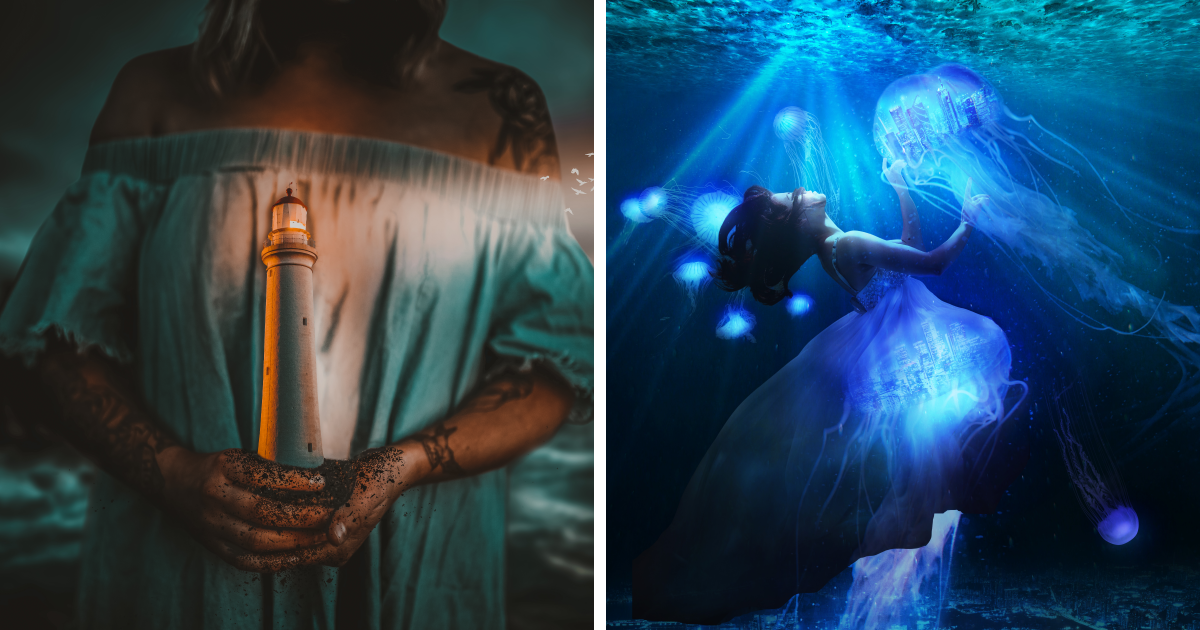
Some artists begin a series because they have a polished concept, an elegant studio, and a suspiciously clean desk. Others begin because life has backed them into a corner and the only available door appears to be drawn in Photoshop.
“I Created 40 Surreal Art Pieces Trying To Better My Life” belongs firmly to the second category. The project, created by artist David Masters, is more than a collection of strange and imaginative pictures. It is a record of persistence shaped by financial hardship, exhausting workdays, lost opportunities, and the stubborn belief that creative ability might still offer a path forward.
Surreal art cannot pay every bill, repair every relationship, or make uncertainty disappear in a puff of artistically arranged smoke. It can, however, turn fear into an object, confusion into a landscape, and an impossible situation into something that can be examined, revised, and shared.
The Difficult Life Behind the 40 Surreal Art Pieces
Masters described himself as a New Yorker who had been living in Guatemala for several years. During a period of serious financial trouble, he worked six days a week at a hostel for roughly two dollars an hour. He sometimes survived on a can of tuna a day and wondered how he could escape a life that seemed to be shrinking around him.
His response was not glamorous. There was no cinematic scene in which a wealthy collector knocked on the door while inspirational music played. Masters woke at approximately 3 a.m. to create art before beginning his hostel shift. When he returned home, he continued working.
That punishing routine gradually produced results. His social media following grew, commissions appeared, and art began providing more reliable access to food. Then the COVID-19 pandemic disrupted employment and commission work. Masters wrote that he had to borrow money from his father, who was living with stage 4 cancer, while once again facing extreme economic insecurity.
The story matters because it changes how the images are viewed. A surreal composition is no longer simply an entertaining visual puzzle. It becomes evidence of time spent working when rest would have been easier, safer, and entirely understandable.
Creativity as Work, Not Decorative Magic
People often romanticize struggling artists as if hunger provides free creative software and overdue bills improve color theory. In reality, financial instability usually makes sustained artistic work harder. Stress consumes attention. Limited equipment narrows options. Paid employment takes the hours that creative practice needs.
Producing 40 pieces under those conditions required more than inspiration. It demanded repetition, planning, technical problem-solving, and the willingness to continue when an individual post received little attention. Inspiration may light the match, but routine keeps the stove running.
Why Surreal Art Can Express What Ordinary Language Cannot
Surrealism emerged in the early twentieth century as artists and writers searched for ways to move beyond rational, orderly representation. The movement became formally associated with André Breton’s 1924 manifesto and with techniques intended to release imagination from conventional logic. Dreams, chance, automatic creation, unexpected objects, distorted spaces, and uncanny combinations became tools for exploring the subconscious.
That history makes surrealism especially suited to personal struggle. Financial fear does not always feel like a tidy spreadsheet. Depression does not politely introduce itself, sit in a normal chair, and explain its agenda. Grief can make time feel stretched, folded, or frozen. Anxiety can turn a minor problem into a twelve-story monster wearing sensible office shoes.
Surreal digital art gives those experiences a visual grammar. A body can become a landscape. A room can open into the sky. A familiar object can appear at an impossible scale. A face can be fragmented, repeated, hidden, or combined with architecture. The resulting image does not need to explain an emotion literally. It only needs to create a recognizable sensation.
Strange Images Can Contain Familiar Feelings
The strongest surreal art usually balances two forces: recognition and disruption. Viewers need something familiar enough to enter the image, followed by something impossible enough to make them pause.
A door, staircase, eye, cloud, hand, tree, or human silhouette can provide that starting point. Once the artist changes its scale, location, texture, or relationship to other objects, the ordinary world becomes psychologically charged. The viewer begins asking questions, and those questions often reveal as much about the audience as they do about the artist.
This is one reason surreal art pieces can feel personal without functioning as straightforward autobiography. The artist supplies the unusual visual situation. The viewer supplies memories, associations, fears, and private interpretations.
Humor Keeps the Darkness From Owning the Room
Surrealism also has a natural relationship with humor. Put an ocean inside a teacup, give the moon a zipper, or ask a goldfish to manage a corporate meeting, and the result may be unsettling and funny at the same time.
That humor is not necessarily an escape from serious subjects. It can be a pressure valve. A strange image allows an artist to acknowledge absurdity without surrendering to it. Life may be chaotic, but for a few hours the creator controls where the floating staircase goes.
What Creating a 40-Piece Art Series Can Change
One finished artwork can be a lucky afternoon. Forty works reveal a practice.
A series forces an artist to move beyond the first obvious idea. The initial pieces may rely on familiar techniques or symbols. Later works require experimentation. New visual relationships appear, unsuccessful approaches are abandoned, and technical weaknesses become difficult to ignore.
This process can improve both artistic skill and personal confidence. The creator accumulates evidence that difficult tasks can be started, revised, completed, and survived. That evidence may be more useful than a motivational slogan printed over a mountain that has never answered an email at 2 a.m.
Consistency Builds an Artistic Identity
Creating a large body of surreal digital art also helps establish a recognizable visual identity. Audiences rarely understand an artist through one isolated post. They begin noticing patterns across several works: recurring moods, preferred textures, types of composition, symbolic objects, and distinctive ways of combining reality with fantasy.
A cohesive portfolio makes it easier for potential clients, collaborators, galleries, and followers to understand what the artist offers. It also gives the artist material that can be adapted for prints, book covers, album artwork, editorial illustration, exhibitions, licensing, and commissioned projects.
None of those opportunities is guaranteed. Artistic careers are less like vending machines and more like raccoons: unpredictable, surprisingly resourceful, and occasionally found inside places that appeared securely closed. Still, a substantial portfolio creates more possibilities than a folder containing three unfinished files named “final,” “final2,” and “actually_final.”
A Series Creates Structure During Uncertainty
Large creative projects divide time into manageable units. Instead of solving an entire life at once, the artist solves today’s composition. Which image should be masked? Does the lighting match? Is the central figure too large? Does the concept need another element, or is the artist merely avoiding the terrifying “export” button?
These limited questions can provide structure during periods when employment, income, health, or the future feels uncontrollable. Completing one piece does not fix everything. It does create one completed thing in a week that may otherwise feel unresolved.
Can Making Art Actually Improve Well-Being?
Research suggests that creative activity can support stress reduction, emotional processing, self-reflection, and feelings of competence. In a small study involving 39 adults, approximately 45 minutes of art-making was associated with a statistically significant reduction in cortisol, with lower levels recorded in about three-quarters of participants. Prior artistic experience was not significantly related to the outcome. Other research reviews have also found promising stress-management effects from active creative arts interventions.
Those findings should be understood responsibly. Making a digital collage is not a universal treatment, and a single creative session will not produce the same response in everyone. Art may support well-being, but it cannot substitute for food, safe housing, medical care, fair employment, supportive relationships, or appropriate mental health treatment.
Art as Therapy Is Not the Same as Art Therapy
Self-directed painting, drawing, photography, or digital editing may be therapeutic in the everyday sense. A person can feel calmer, more focused, or more emotionally expressive while creating.
Clinical art therapy is different. The American Art Therapy Association defines it as a mental health profession combining active art-making, psychological theory, and a psychotherapeutic relationship. Qualified art therapists receive advanced education and supervised clinical training. The distinction is important because difficult images and memories can sometimes bring intense emotions to the surface.
Masters publicly discussed experiencing suicidal thoughts during his period of hardship while also expressing a desire to live and for his circumstances to improve. Anyone experiencing similar thoughts deserves immediate human support, not the burden of trying to create their way through a crisis alone. In the United States, people can call or text 988 to reach the Suicide & Crisis Lifeline; immediate danger should be directed to emergency services.
How to Start a Surreal Art Project That Supports Personal Growth
Choose a Theme With Emotional Energy
Begin with a question rather than a visual gimmick. What feels unresolved? What part of life seems impossible to describe directly? Possible themes include isolation, changing identity, financial pressure, ambition, grief, migration, aging, belonging, or the gap between online appearance and private reality.
A strong theme does not require public confession. Artists can protect personal details while still working with authentic emotions.
Create Useful Constraints
Constraints reduce decision fatigue. Choose a fixed canvas ratio, limited palette, recurring symbol, specific number of source photographs, or standard production schedule. A rule such as “one image every three days” may be more productive than waiting for inspiration to arrive wearing a velvet cape.
Build a Repeatable Workflow
Separate the process into stages: idea collection, thumbnail sketching, source selection, composition, masking, lighting, color correction, texture, revision, export, and archiving. A repeatable workflow preserves mental energy for the decisions that actually require creativity.
Keep an Idea Bank
Record fragments before they disappear. Dreams, overheard sentences, unusual shadows, emotional contradictions, and accidental visual combinations can all become raw material. “A house that grows roots when its owner lies” is not yet an artwork, but it is considerably more useful than “make something cool.”
Share Without Handing Over Your Self-Worth
Publishing art can create community and professional opportunities, but algorithms are inconsistent judges. A quiet response does not prove that a piece lacks value. It may reflect timing, audience size, presentation, platform behavior, or the internet’s urgent need to watch another video of a dog refusing to enter a bathtub.
Use feedback as information rather than a final verdict. Notice which images generate conversation, but protect space for experiments that serve the project even when they are not instantly popular.
Related Experiences: What Making Forty Surreal Pieces Can Feel Like
The beginning of a long art series often feels wonderfully dramatic. The concept arrives, reference folders multiply, and the artist becomes convinced that the entire project will emerge in a glorious creative sprint. Piece one is exciting. Piece two confirms the style. Piece three receives a promising response online. Clearly, international museums should begin preparing wall space.
Then piece seven happens.
The easy ideas have been used. Technical problems become repetitive. The artist notices that several compositions rely on the same visual trick. Instead of feeling like an inspired explorer of the subconscious, the creator feels like a tired person moving a cloud layer three pixels to the left and then three pixels back.
This middle stage is where the project begins doing its real work. Continuing requires a different kind of motivation. Excitement must be replaced by curiosity, discipline, or simply a promise made to oneself. The artist learns that creative confidence does not always mean feeling certain. Sometimes it means continuing while uncertainty complains loudly from the passenger seat.
By the tenth or fifteenth piece, patterns become visible. Certain symbols keep returning without being deliberately invited. A color associated with one emotion appears across multiple compositions. Figures repeatedly face away from the viewer. Doors remain open, but nobody walks through them. These patterns can become clues to the artist’s concerns, even when no single interpretation explains them completely.
The project also develops a memory of its own. Opening an early file reveals technical mistakes that once seemed invisible. Edges are rough, shadows disagree with the light source, and perspective has apparently resigned from its position. Yet those flaws provide proof of improvement. The newer pieces exist because the weaker ones were finished rather than hidden forever.
Another experience is the strange separation between public and private meaning. A viewer may describe an image as peaceful when the artist created it during a frightening week. Someone else may see grief in a composition intended as a joke. Neither response is necessarily wrong. Once an artwork is shared, it becomes a meeting place between the creator’s history and the audience’s imagination.
Financial pressure complicates that relationship. When art must generate income, every post can feel like an audition. Likes become potential groceries. A commission is not merely flattering; it may determine whether the month is manageable. Under those conditions, advice to “ignore numbers and create purely for yourself” can sound charmingly detached from rent.
The healthier goal is not to pretend that money does not matter. It is to prevent commercial uncertainty from erasing the original reason for creating. Some pieces may be designed for clients or broad appeal. Others may remain experiments. A sustainable practice usually needs both: work that reaches outward and work that keeps the artist’s inner world alive.
Finishing piece forty may not produce the emotional fireworks imagined at the beginning. The final export can feel surprisingly ordinary. The computer hums. The room looks the same. Problems outside the project remain stubbornly present.
But something has changed. Forty times, the artist faced an empty canvas and made a decision. Forty times, an unclear thought became visible. Forty completed works now exist where only uncertainty existed before. That is not a magical rescue, but it is a form of movementand movement matters when life has felt stuck.
Conclusion: Surreal Art Does Not Fix Life, but It Can Help Reframe It
David Masters’ 40 surreal art pieces represent more than technical imagination. They emerged from a determined attempt to build opportunity under conditions that offered very little of it. The project shows how artistic resilience can grow through repetition, how surreal imagery can communicate emotions that resist ordinary language, and how a body of work can become both a portfolio and a record of survival.
Creating art is not a guaranteed escape from poverty, illness, depression, or uncertainty. Presenting it as one would unfairly place responsibility for structural problems on the individual who is already struggling. Yet creative work can still provide structure, connection, self-expression, and evidence of personal agency.
Sometimes bettering a life begins with a dramatic decision. Sometimes it begins at 3 a.m., with an old computer, an unfinished composition, and the decision to make one more impossible world before the workday starts.