

There is a glamorous version of the billion-dollar SaaS story: brilliant founders, hockey-stick charts, enormous funding rounds, champagne, and perhaps a tasteful Patagonia vest. Then there is the version experienced by the people actually operating the company: pricing mistakes, messy data, questionable hires, changing customer profiles, hard decisions, and a suspicious amount of time spent inside spreadsheets.
Docebo’s journey belongs firmly in the second category. The enterprise learning software company evolved from a relatively small European technology business into a publicly traded SaaS organization serving major global companies. During that transformation, Alessio Artuffo became one of the executives most closely associated with its international expansion and commercial growth.
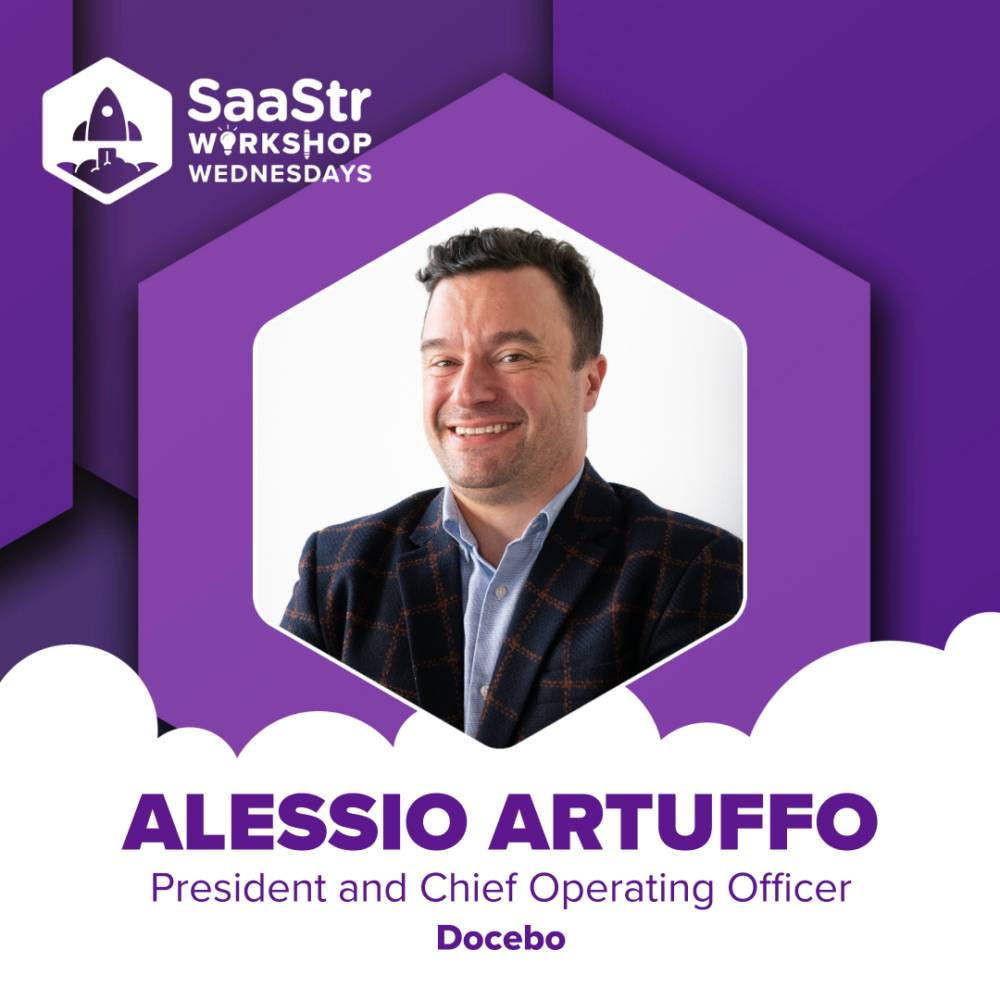
When Artuffo discussed the company’s “road to $1B” with SaaStr in 2023, he was serving as Docebo’s President and Chief Operating Officer. The billion-dollar reference was about building a company capable of achieving a billion-dollar valuation, not magically finding a billion dollars between the office couch cushions. Artuffo later became Docebo’s CEO in September 2024.
What makes the story useful is not simply the destination. It is the collection of decisions, mistakes, corrections, and operating principles that helped Docebo move from a small SaaS operation toward enterprise scale.
Docebo’s Growth Story Was Built Over Years, Not Overnight
Docebo was founded in 2005, but its transformation into the SaaS company recognizable today accelerated in the following decade. Artuffo joined in 2012 as Director of International Business Operations and became deeply involved in establishing the company’s North American presence.
That timing mattered. Docebo was moving beyond its earlier roots and developing a subscription-based learning platform capable of supporting increasingly sophisticated organizations.
By 2019, the company reported approximately $41.4 million in annual revenue, up more than 50% from the previous year. Its average contract value had also increased as Docebo began attracting larger customers. The company completed its Toronto Stock Exchange IPO that October, raising C$75 million in gross proceeds.
In December 2020, another milestone arrived when Docebo listed on Nasdaq, completing an upsized U.S. public offering priced at $48 per share.
By the third quarter of 2023, annual recurring revenue had reached approximately $181.8 million. Full-year 2023 revenue ultimately reached about $180.8 million, with subscription revenue representing roughly 94% of the total. The company was not merely getting bigger; it was demonstrating that a SaaS business could pursue growth while becoming increasingly disciplined about profitability and free cash flow.
Lesson One: Your Best Market May Not Be the Market You Started With
One of the most important parts of the Docebo SaaS growth strategy was the gradual move upmarket.
Early Docebo was much more oriented toward small and midsize businesses. At one stage, customers could begin using the product through a relatively inexpensive self-service model. That helped the company find users without requiring an army of salespeople.
There was just one tiny problem: Docebo was creating more value than it was charging for.
As its product matured, management realized that the platform was particularly valuable to organizations with complicated learning requirements. Large enterprises needed to train thousands of employees, customers, distributors, partners, franchisees, and other audiences. Those problems were harder to solve, but they were also worth considerably more.
Moving Upmarket Changed the Economics
Serving larger organizations meant bigger contracts and higher average contract values. It also meant longer sales cycles, more demanding implementations, stronger security requirements, deeper integrations, and customers who occasionally arrive at meetings with enough stakeholders to populate a small village.
The trade-off was worthwhile because Docebo’s increasingly sophisticated product matched those more complex use cases.
This is an important scaling lesson. A company’s original ideal customer profile does not have to remain its permanent ideal customer profile. Product-market fit can evolve as the product gains capabilities and the organization learns where customers receive the greatest economic value.
Lesson Two: Multiple Use Cases Can Become a Marketing Headache
Docebo discovered another complication as its market expanded: the platform could solve several substantially different problems.
A traditional learning management system is often associated with employee training. But corporations also need customer education, partner enablement, certification programs, sales training, product education, compliance programs, and extended-enterprise learning.
That sounds fantastic from a total-addressable-market perspective. From a marketing perspective, it can turn the homepage into alphabet soup.
At the time of Artuffo’s SaaStr discussion, Docebo said a significant percentage of customers were using the platform for both internal and external audiences. That flexibility expanded the opportunity while creating a messaging challenge.
More Capabilities Do Not Automatically Produce Better Positioning
The lesson for SaaS companies is simple: being able to serve everyone is not the same as being able to market effectively to everyone.
A chief learning officer considering employee development may care about skills, compliance, engagement, and career growth. A customer education leader may care about product adoption, support-ticket reduction, certification, and retention. A channel executive may care about partner readiness and revenue.
The underlying platform may be similar, but the buying story is different.
Successful SaaS positioning therefore requires choosing clear ideal customer profiles, understanding specific buying triggers, and translating one broad platform into messages that make sense to individual audiences.
Lesson Three: Growth Does Not Require Setting Cash on Fire
One of Artuffo’s more interesting arguments challenged a familiar Silicon Valley assumption: aggressive SaaS growth does not necessarily require enormous cash burn.
Docebo’s development was comparatively capital efficient. Rather than treating fundraising as a competitive sport, the company spent years building commercial infrastructure carefully.
Its expansion into the United States provides a useful example. Instead of automatically placing its early American operation in one of the country’s most expensive technology centers, Docebo established an important presence in Athens, Georgia.
Athens offered access to university talent and substantially different operating economics from places such as San Francisco or New York. It was not as glamorous as telling investors that everyone worked within walking distance of a venture capital office, but rent has an irritating habit of appearing on the income statement every month.
Capital Efficiency Creates Strategic Freedom
Being efficient does more than improve financial ratios. It gives management options.
A company that requires constant external funding can become highly sensitive to capital-market conditions. When financing disappears, strategy can suddenly become “please stop spending money immediately.”
A business with stronger unit economics and positive cash generation has more freedom to decide when to hire, where to invest, and which opportunities deserve additional resources.
Docebo’s 2023 financial results illustrated the changing balance. Revenue increased 27% for the year, while adjusted EBITDA reached $16.3 million compared with only $1.3 million the previous year.
Lesson Four: Underpricing Is Not Always a Noble Strategy
Almost every SaaS founder loves hearing that customers think the product is a bargain. Sometimes that is excellent news. Sometimes it means someone forgot to charge appropriately.
Artuffo has discussed Docebo’s early tendency to undervalue the platform. Cheap plans helped acquire users and gather feedback, but the company eventually needed pricing that reflected the business outcomes it delivered.
Pricing deserves deliberate strategic attention because it affects nearly everything else: customer acquisition economics, sales compensation, market positioning, support capacity, margins, and the kind of customers a company can afford to serve.
Price According to Value, Not Anxiety
Young companies often price defensively. They worry that prospects will disappear if prices rise. Yet enterprise customers are not simply buying software screens. They may be buying faster onboarding, scalable customer education, reduced administrative work, stronger compliance, partner enablement, or better product adoption.
When those outcomes are valuable, pricing purely according to the cost of providing software can leave substantial value on the table.
Docebo’s rising average contract value over time demonstrates how moving toward larger customers and more complex applications can transform SaaS economics.
Lesson Five: More Data Will Not Rescue Bad Judgment
Modern companies collect impressive quantities of data. They have dashboards tracking dashboards that were created to explain other dashboards. Somehow, uncertainty survives.
Artuffo’s argument was that companies often exaggerate the importance of achieving perfect data before making decisions.
Sales attribution will contain inconsistencies. CRM records will be incomplete. Marketing sources will occasionally make no sense. Historical definitions will change. Some field created four years ago will be named “final_final_source_v2.”
Waiting for perfect information can become an excuse for avoiding action.
Build a Data Culture Instead of a Data Warehouse
The more valuable capability is knowing how to interpret imperfect information consistently.
Teams need shared definitions, reasonable reporting standards, clear ownership, and executives capable of connecting numbers to what is happening with customers.
Data should improve judgment rather than replace it.
For growing SaaS organizations, a handful of carefully understood metrics can often produce better decisions than hundreds of reports nobody trusts.
Lesson Six: Customer Success Becomes More Important as You Scale
Artuffo also emphasized staying close to customers, particularly as an organization grows.
This sounds obvious until calendars become crowded with internal meetings. A founder who once spoke personally with every customer can eventually spend an entire week discussing customers without talking to one.
That is dangerous.
Customer success is not merely a department responsible for sending polite emails when renewal dates approach. Retention depends on product decisions, implementation quality, support, sales expectations, education, executive relationships, and whether customers ultimately achieve what they purchased the platform to accomplish.
Do Not Outsource Customer Understanding
Executives should continue visiting customers, participating in strategic calls, reviewing customer feedback, and understanding why deals are won or lost.
This becomes particularly important when moving upmarket. Enterprise customers expose product weaknesses that smaller organizations may never encounter. They also reveal opportunities for new functionality, integrations, services, and use cases.
Docebo’s expansion into customer and partner learning is an example of what can happen when a company looks beyond the narrow definition of its original product category.
Lesson Seven: A Famous Resume Does Not Guarantee a Great Executive Hire
Scaling companies eventually encounter another temptation: hiring executives from gigantic technology companies because surely someone who managed a huge operation can manage a much smaller one.
Sometimes that works beautifully. Sometimes the startup discovers that its shiny new executive is accustomed to infrastructure, brand recognition, budgets, and support teams that do not exist.
Artuffo’s experience suggests that leadership fit matters as much as prestige.
Different Growth Stages Require Different Operating Muscles
Early SaaS companies often need leaders comfortable doing several jobs simultaneously. Later-stage organizations require specialization, repeatable processes, forecasting discipline, and executives capable of managing managers.
The best leader is therefore not automatically the candidate from the largest company. It is the person whose strengths match the company’s current stage and culture.
Artuffo himself illustrates the other side of this principle. Rather than repeatedly replacing leaders as Docebo grew, he expanded his responsibilities across international operations, sales, revenue leadership, the presidency, operations, and eventually the CEO role.
Companies should hire people capable of growing with the organization while accepting that not everyone willor shouldmake every stage of the journey.
Execution Was the Unsexy Superpower
A recurring theme in Docebo’s road to a billion-dollar valuation is execution.
There was no single magical tactic. Instead, the company tested markets, expanded geographically, moved upmarket, refined pricing, added capabilities, built North American operations, invested in artificial intelligence, acquired complementary technology, and gradually improved financial efficiency.
Docebo was also an early advocate of applying AI to enterprise learning, introducing AI-related functionality well before generative AI became the favorite phrase of virtually every software earnings call. Its 2023 acquisition of Edugo.AI extended that strategy into generative AI, adaptive learning, semantic search, skills tagging, and AI-assisted content creation.
The underlying lesson is refreshingly boring: strategy only becomes valuable when organizations repeatedly execute it.
Success Still Included Setbacks
A billion-dollar valuation does not transform a company into a machine that only receives good news.
Docebo has experienced the same pressures that challenge many SaaS businesses: changing growth rates, investor expectations, increasingly demanding enterprise customers, competitive pricing, implementation complexity, and the need to balance innovation with usability.
Independent software reviews illustrate this trade-off. Customers frequently praise Docebo’s flexibility, customization, multi-audience capabilities, integrations, and scalable learning management. Other reviewers note that advanced configurations can become complicated, implementations require meaningful work, and premium functionality can make the platform expensive for organizations that do not need its full capabilities.
Those criticisms are not unusual for enterprise software. In fact, they reveal one of the inevitable tensions of moving upmarket: software powerful enough to solve complex problems can eventually become complex itself.
The challenge is continuously reducing that complexity without removing the capabilities enterprise customers are paying for.
500-Word Experience Section: What SaaS Operators Can Apply From Docebo’s Road to $1B
The most useful way to study the Alessio Artuffo Docebo story is to imagine applying its lessons to a growing SaaS company today.
Experience One: Let Customer Complexity Guide Your Market
Suppose a startup sells workflow software for $99 per month to small businesses. After a year, the team notices that small customers use three basic features while several larger customers are requesting APIs, permission controls, analytics, integrations, and dedicated environments.
The natural reaction may be frustration: “Why do these enterprise customers want so many things?”
A better question is: “Why are they willing to pay dramatically more for them?”
That was an important element in Docebo’s evolution. Complex requirements can reveal where the product creates its greatest economic value. The experience suggests founders should segment customers by outcomes, retention, support cost, expansion potential, and willingness to pay rather than simply counting logos.
Experience Two: Fix Pricing Before Hiring More Salespeople
Imagine that a company closes $10,000 contracts easily but struggles to generate healthy margins. Management’s first instinct may be to hire additional sales representatives.
But if customers routinely obtain $100,000 of measurable value from the software, the bigger problem might be pricing.
Adding salespeople to an underpriced product is like hiring more cashiers for a store accidentally selling laptops for $40. Volume is not necessarily your friend.
Review packaging, minimum contract sizes, usage limits, enterprise functionality, services, and value metrics before assuming that revenue problems require a bigger sales organization.
Experience Three: Protect Direct Access to Customers
At 20 customers, the CEO knows everyone’s name. At 2,000 customers, there are account managers, support queues, CRM summaries, customer health scores, dashboards, and quarterly presentations.
The danger is that executives begin consuming filtered customer information.
A practical response is establishing a recurring habit: executive customer calls, win-loss interviews, advisory boards, implementation reviews, and direct conversations with customers considering cancellation.
You do not need to speak with everyone. You need enough unfiltered conversations to recognize when internal reports are missing something important.
Experience Four: Hire for the Next Problem, Not the Previous Employer
Consider two candidates for VP of Sales. One managed 300 representatives at a famous software company. The other built a 20-person team into an 80-person organization at a less glamorous company operating at approximately your current stage.
The famous logo is emotionally satisfying. The relevant operating experience may be more valuable.
The Docebo experience encourages founders to ask candidates exactly what they personally built, what resources already existed, which mistakes they made, and whether they can operate without enormous institutional support.
Experience Five: Make Efficiency Part of the Culture Before You Need It
Cost discipline is easiest to establish when the company is healthy. Waiting until revenue slows usually produces painful emergency cuts rather than intelligent efficiency.
Teams can instead evaluate office locations, hiring plans, software expenses, customer acquisition channels, product investments, and organizational layers continuously.
This does not mean refusing to spend money. It means spending aggressively where returns are understood and being skeptical everywhere else.
Docebo’s history demonstrates why that habit matters. Capital efficiency allowed the company to grow without making enormous cash burn a prerequisite for success.
What the Road to $1B Really Teaches
The biggest lesson from Alessio Artuffo’s experience is that scaling SaaS is mostly an exercise in continuous adaptation.
The customer that gets you started may not be the customer that takes you public. Your original price may be wrong. Your messaging may become confusing. The executive who looks perfect on paper may fail. Your data will remain imperfect. The organization will become more complicated precisely when customers expect it to become more reliable.
The answer is not avoiding mistakes. That option is unfortunately unavailable.
The answer is building an organization capable of recognizing mistakes early, learning quickly, and executing corrections without turning every setback into a corporate identity crisis.
Docebo’s journey from a small learning technology company to a publicly traded enterprise SaaS business shows that ambitious growth and financial discipline do not have to be enemies. It also demonstrates that customer proximity, pricing, positioning, leadership development, and relentless execution remain valuable even when the technology changes.
Artificial intelligence may transform enterprise learning. SaaS business models will continue evolving. Market valuations will rise and fall. But companies that understand where they create value, charge appropriately for it, listen closely to customers, hire stage-appropriate leaders, and execute consistently will retain a powerful advantage.
And perhaps the most human lesson is the one Artuffo has emphasized throughout the journey: scaling never really becomes easy. If the constant building, rebuilding, experimenting, and occasionally discovering that yesterday’s brilliant plan was not especially brilliant stops being enjoyable, running a high-growth SaaS company may be a very expensive way to have a bad time.
Note: The article title reflects Alessio Artuffo’s position as President and COO when the original SaaStr discussion took place in 2023. He was appointed Chief Executive Officer of Docebo in September 2024.