

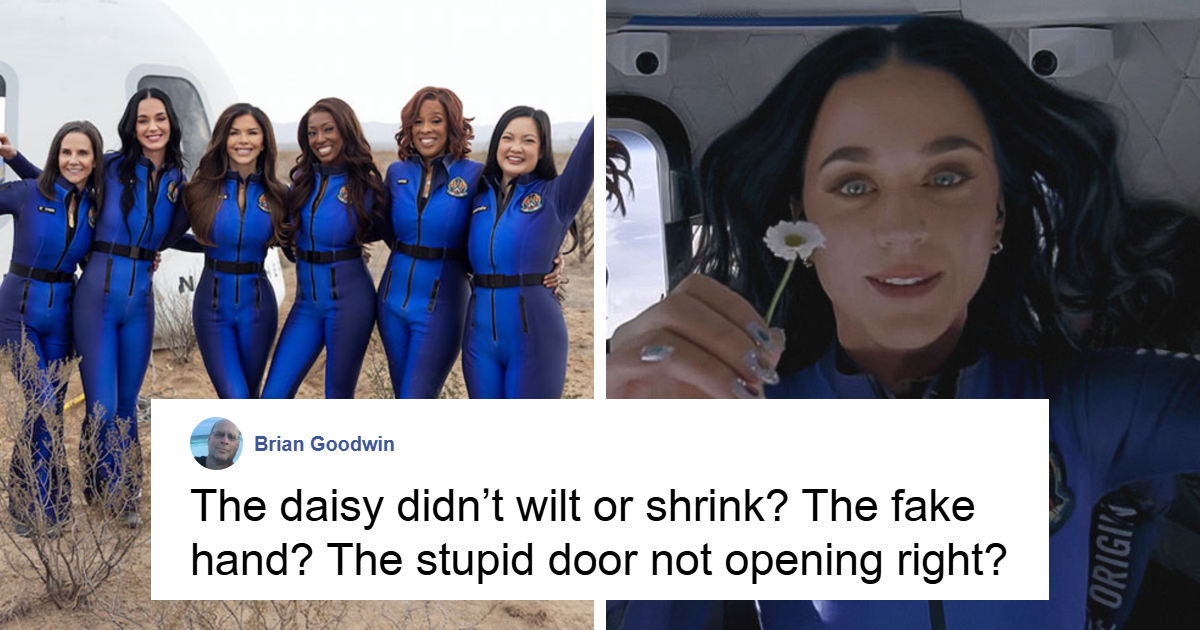
Editor’s note: This article is based on public reporting and official mission information about Blue Origin’s NS-31 flight. The “fake space trip” claims discussed below are viral conspiracy theories, not proven facts.
When Pop Culture Met Space Tourism, the Internet Put on a Detective Hat
Katy Perry has survived pop chart wars, headline storms, meme cycles, and enough online commentary to power a small planet. But after her short Blue Origin space trip, the internet found a new mission: deciding whether the whole thing was real, fake, staged, glitched, symbolic, wasteful, inspiring, embarrassing, or somehow all of the above before lunch.
The headline practically wrote itself: “Mission Impossible”: People Think Katy Perry’s Space Trip Was “Fake” As New Theory Emerges. And yes, “Mission Impossible” is doing a lot of work here. There were no exploding sunglasses, no Tom Cruise dangling from a rocket, and no secret agent whispering “your mission, should you choose to accept it.” There was, however, a 10-to-11-minute suborbital flight, a very famous pop star, Jeff Bezos opening a capsule hatch, and the internet zooming into video frames like it had been hired by NASA’s Department of Suspicious Hair.
On April 14, 2025, Blue Origin launched its NS-31 mission from West Texas. The all-female crew included Katy Perry, Gayle King, Lauren Sánchez, Aisha Bowe, Amanda Nguyen, and Kerianne Flynn. The New Shepard spacecraft crossed the Kármán line, widely described as the boundary of space at around 62 miles above Earth, before returning safely under parachutes. Blue Origin describes New Shepard as a fully autonomous suborbital rocket system, meaning there are no pilots onboard during the flight.
The mission was heavily publicized, livestreamed, and promoted as a milestone for women in space tourism. It was also criticized almost immediately. Some critics called it a vanity project. Others questioned the environmental and social value of celebrity space tourism. Then came the conspiracy theories: Katy’s hair did not behave “correctly,” Gayle King’s hand supposedly disappeared, the hatch looked suspicious, and an old mannequin photo was recycled as “proof” that the crew never went anywhere.
So, was Katy Perry’s space trip fake? Based on available evidence, no. But the reaction around it says a lot about celebrity culture, public distrust, space tourism, and why the internet now treats every viral video like a crime scene with Wi-Fi.
What Actually Happened During Katy Perry’s Blue Origin Flight?
Blue Origin’s NS-31 mission was a short suborbital flight aboard New Shepard, a reusable rocket and capsule system designed to carry passengers above the Kármán line. Unlike orbital missions to the International Space Station, New Shepard does not circle Earth. It launches upward, separates the capsule from the booster, gives passengers a few minutes of weightlessness, and then returns the capsule to the ground using parachutes.
That short timeline is important because many people hear “went to space” and picture astronauts floating around for days, eating squeeze-tube food, and arguing with Velcro. A New Shepard ride is different. It is closer to a vertical roller coaster with aerospace engineering, very expensive seats, and a view that makes people suddenly speak in inspirational quotes.
The crew included a mix of entertainment, media, science, advocacy, and aviation figures. Katy Perry was the most recognizable global celebrity onboard, which made her the lightning rod for jokes and criticism. Gayle King brought mainstream media visibility. Lauren Sánchez, who organized the crew, framed the trip as a message about women “taking up space.” Aisha Bowe brought aerospace credentials as a former NASA rocket scientist and STEM entrepreneur. Amanda Nguyen, a civil rights advocate and bioastronautics researcher, became widely noted as the first Vietnamese woman to travel to space. Kerianne Flynn added a film and storytelling background.
After landing, Perry kissed the ground, spoke about love and connection, and said the mission was not just about her. She also reportedly sang “What a Wonderful World” during the flight. Naturally, this gave the internet two choices: appreciate the sentiment or turn the entire event into a roast buffet. The internet chose both, then went back for seconds.
Why Did People Think the Space Trip Was Fake?
The “Katy Perry space trip fake” theory did not come from one single claim. It grew from several viral doubts, each amplified by social media users who were already skeptical of billionaires, celebrity PR, and space tourism as a concept. The result was a perfect online storm: a glamorous celebrity mission, a short flight that looked anticlimactic to casual viewers, and enough odd-looking video moments to fuel frame-by-frame speculation.
The Hair Theory
One of the most shared theories focused on Katy Perry’s hair. Skeptics compared her hair during the Blue Origin flight with videos of NASA astronaut Sunita “Suni” Williams aboard the International Space Station. Williams’ hair famously floated upward in microgravity during her long stay on the ISS. Perry’s hair, some viewers argued, did not float in the same dramatic way. Therefore, they claimed, the Blue Origin flight must have been staged.
That sounds clever until you remember that hair is not a certified aerospace instrument. Williams was living aboard the ISS for months, where astronauts experience continuous microgravity. Perry was on a short suborbital flight with only a few minutes of weightlessness. Hair length, texture, styling products, seat position, cabin movement, camera angle, and timing can all affect how hair appears on video. If someone uses hairspray before going to space, physics still exists, but the hair may negotiate.
In other words, “her hair did not look like Suni Williams’ hair” is not strong evidence of a hoax. It is evidence that two different women, in two different spacecraft, on two different types of missions, with different hair and different conditions, did not look identical. Shocking, yes. Criminal, no.
The Gayle King “Disappearing Hand” Claim
Another viral claim suggested that Gayle King’s hand disappeared or glitched during the Blue Origin footage, supposedly revealing CGI. This theory spread through clipped or altered videos and screenshots, the kind of material that often becomes more mysterious the more times it is compressed, reposted, slowed down, circled in red, and paired with dramatic music.
Original footage from the mission does not support the claim that a CGI failure proved the flight was fake. Online video artifacts happen all the time. Motion blur, compression, reflection, low frame rates, camera movement, and partial obstruction can create strange-looking moments. Anyone who has paused a video of themselves mid-sentence knows the camera can turn a normal human into a cryptid in one frame.
The disappearing-hand theory works because it feels visual. People trust their eyes. But digital footage is not the same as direct observation, especially when viewers are reacting to reposted clips instead of verified originals. A blurry hand is not a smoking gun. Sometimes it is just a blurry hand.
The Capsule Hatch Debate
The hatch became another major talking point. After the capsule landed, Jeff Bezos was filmed opening the door from the outside with a tool. But some viewers noticed footage that appeared to show the hatch opened from inside earlier, then closed again before Bezos performed the public opening moment.
To skeptics, this looked staged. To others, it looked like a normal recovery sequence being managed for safety, timing, or camera presentation. NASA human-spaceflight design guidance states that hatches and doors should be operable by a single crew member from both sides during nominal operations. So the idea that a crew member could open a hatch from inside is not automatically suspicious. In fact, from a safety standpoint, it would be strange if crew members had absolutely no way to operate their own exit.
Was the Bezos hatch moment theatrical? Possibly. Billionaire space branding does enjoy a grand gesture. But “this looked like PR choreography” is not the same as “the entire mission was fake.” A staged exit shot after a real landing is still compatible with a real landing.
The Old Mannequin Photo
One of the weakest but most viral claims involved a photo showing what appeared to be a mannequin or fake hand inside a Blue Origin capsule. Some users presented it as evidence that dummies, not people, had flown during the Katy Perry mission.
The problem: the image was from an older New Shepard test flight, not the 2025 NS-31 mission. Blue Origin has used test mannequins before, including the cheekily named “Mannequin Skywalker,” because engineers often test vehicles before putting humans inside them. This is not evidence of a hoax. This is evidence that engineers enjoy both safety procedures and Star Wars jokes.
Using an old test image to “prove” a new mission was fake is a classic misinformation pattern. A real image gets detached from its real context, repackaged with a new claim, and suddenly thousands of people are debating a false premise.
Why the Theory Spread So Fast
The fake-space-trip theory spread because it had all the ingredients of modern virality. First, it involved a celebrity. Second, it involved a billionaire-owned space company. Third, it involved a short, visually unusual event most people do not fully understand. Fourth, it arrived in a culture already primed to suspect that big institutions are selling polished versions of reality.
For many viewers, the issue was not just whether Katy Perry went to space. It was whether the mission deserved to be celebrated. Critics argued that space tourism looks out of touch during a time when many people are worried about rent, groceries, healthcare, student debt, climate change, and job security. In that emotional environment, a celebrity flying above Earth for a few minutes can feel less like inspiration and more like a luxury commercial with rocket exhaust.
That frustration matters. You can believe the flight was real and still question the message around it. You can admire women breaking into historically male-dominated spaces and still wonder whether celebrity space tourism is the best symbol of progress. You can respect aerospace technology and still roll your eyes when a space mission comes with designer flight suits and red-carpet energy.
The internet, however, often struggles with nuance. Instead of saying, “This was real but maybe overhyped,” some users jumped to, “This was fake.” The first argument is cultural criticism. The second requires evidence. And the evidence has not held up.
Space Tourism Is Real, But the Marketing Is Complicated
Blue Origin, SpaceX, and Virgin Galactic have helped turn private spaceflight from science fiction into a luxury market. That does not mean space is suddenly accessible to ordinary people. It means a small group of very wealthy, famous, invited, or strategically selected passengers can experience what professional astronauts once had almost entirely to themselves.
This is where the NS-31 reaction becomes bigger than Katy Perry. The flight represented a new era where space exploration overlaps with celebrity branding, social media spectacle, corporate storytelling, and lifestyle marketing. A mission can be technically impressive and socially awkward at the same time. A rocket can reach space while the public conversation crash-lands back on Earth.
The all-female crew framing also sparked debate. Supporters saw representation: women from media, science, music, activism, and film taking part in a symbolic spaceflight. Critics argued that women have already achieved far greater milestones in serious space missions, including NASA astronauts who train for years and spend months in orbit. Some felt the Blue Origin campaign leaned too heavily on empowerment language while selling a luxury experience connected to one of the richest men in the world.
Both reactions can exist. Representation can matter. Marketing can be cringe. Space tourism can inspire some people and annoy others. The trouble starts when criticism turns into conspiracy without evidence.
Was Katy Perry an Astronaut?
This is another place where language gets messy. In casual conversation, people may say Katy Perry “went to space” or “became an astronaut.” Technically, she was a spaceflight participant or space tourist on a suborbital commercial flight. She did not pilot the vehicle, command a mission, perform the kind of training associated with career astronauts, or live and work in orbit.
That distinction does not make the flight fake. It simply describes what kind of flight it was. A passenger on a commercial jet really flies even if they are not a pilot. A tourist in a submarine really goes underwater even if they are not a marine biologist. Katy Perry really took part in a suborbital spaceflight, but that does not make her equivalent to astronauts who conduct complex missions aboard the ISS or travel beyond low Earth orbit.
The public backlash partly came from this language gap. To many people, “astronaut” implies sacrifice, danger, technical mastery, and years of preparation. When the label appears next to celebrity glamour, it can feel inflated. That is why careful wording matters. “Space tourist” may sound less majestic, but it is more accurate.
What the Viral Backlash Reveals About Trust
The Katy Perry Blue Origin conspiracy theory is not really about one singer’s hair. It is about trust. Many people no longer trust corporate media, billionaire projects, celebrity messaging, edited video, or official explanations. Sometimes skepticism is healthy. Without skepticism, the internet would be one giant “click here to win a free yacht” festival.
But skepticism needs standards. A real question asks for evidence. A conspiracy theory often starts with a conclusion and then hunts for screenshots to decorate it. Real media literacy means asking where a video came from, whether a clip is original, whether an image is old, whether a claim has been verified, and whether a simpler explanation fits the facts.
In the NS-31 case, the simpler explanation is clear: the flight happened, it was short because suborbital flights are short, the hair looked different because conditions differed, the hatch could plausibly be opened from inside, and the mannequin image came from an older test mission.
That does not mean everyone must applaud the trip. People can criticize the cost, the branding, the optics, the environmental implications, or the celebrity framing. But criticism is stronger when it stays attached to reality.
Experience Section: Why This Story Felt So Familiar to Anyone Who Lives Online
Anyone who spends enough time online has probably experienced the strange lifecycle of a viral controversy. First, a dramatic clip appears. Then comes the caption: “Am I the only one who noticed this?” Next, someone zooms in 400 percent, adds arrows, slows the footage down, and suddenly everyone is an expert in aerospace engineering, video compression, human hair dynamics, and billionaire stagecraft.
The Katy Perry space trip theory followed that familiar pattern almost perfectly. For many readers, the experience was less about space and more about the feeling of watching the internet become a courtroom with no judge. One side insisted the mission was obviously fake. Another side insisted the theories were ridiculous. A third group did not care whether it was fake or real because they were too busy making jokes about a pop star taking the world’s most expensive up-and-down elevator ride.
What makes these moments so addictive is that they invite participation. You do not need a Ph.D. in astrophysics to comment on a strand of hair. You do not need to understand capsule recovery systems to say a hatch “looks weird.” You just need a screen, a suspicion, and the confidence of someone who has watched three TikToks and is now ready to brief Congress.
There is also a social experience at work. People enjoy feeling like they have spotted something hidden. Finding the “real truth” behind a polished media event can feel empowering, especially when the event involves celebrities and billionaires. The problem is that the emotional satisfaction of suspicion can outrun the evidence. A claim that feels rebellious is not automatically true. Sometimes the hidden truth is simply that a luxury spaceflight had awkward PR.
The story also reflects how modern audiences react to celebrity sincerity. When Katy Perry spoke about love, Earth, and making space for the future, some people found it moving. Others heard a celebrity trying to turn an exclusive experience into a universal message. That disconnect created fertile ground for mockery. The public is increasingly allergic to grand inspirational language when it comes wrapped in wealth. People do not necessarily hate wonder; they hate being sold wonder by people who can afford the premium package.
For publishers, this topic is a useful reminder that readers want more than a yes-or-no answer. They want the facts, but they also want the cultural meaning. Was the flight real? Yes. Were the conspiracy theories convincing? Not really. Was the backlash understandable? In some ways, yes. Did the internet turn a short space trip into a full dramatic miniseries? Absolutely. If there is one thing Earth still produces better than rockets, it is discourse.
Conclusion: The Real Mission Was the Internet Reaction
Katy Perry’s Blue Origin space trip was not “Mission Impossible,” and there is no credible evidence that it was fake. The NS-31 flight was a real suborbital mission that crossed the Kármán line, gave its passengers a few minutes of weightlessness, and returned safely to Earth. The viral theories about hair, hands, hatches, and mannequins are better understood as examples of how quickly online speculation can transform ordinary visual confusion into supposed proof of a grand hoax.
Still, the reaction was not random. It exposed public discomfort with celebrity space tourism, billionaire branding, and empowerment language attached to luxury experiences. Many people were not just asking whether Katy Perry went to space. They were asking why this kind of mission receives so much attention, what it says about inequality, and whether the future of space exploration is becoming a VIP lounge with better views.
The best answer is balanced: the flight was real, the criticism is worth discussing, and the conspiracy theories are not supported by solid evidence. In other words, Katy Perry went up, came down, kissed the ground, and accidentally launched one of the internet’s favorite hobbies: arguing at escape velocity.
Note: This article treats viral “fake trip” claims as unverified theories and explains them using publicly reported mission facts, technical context, and media analysis.