

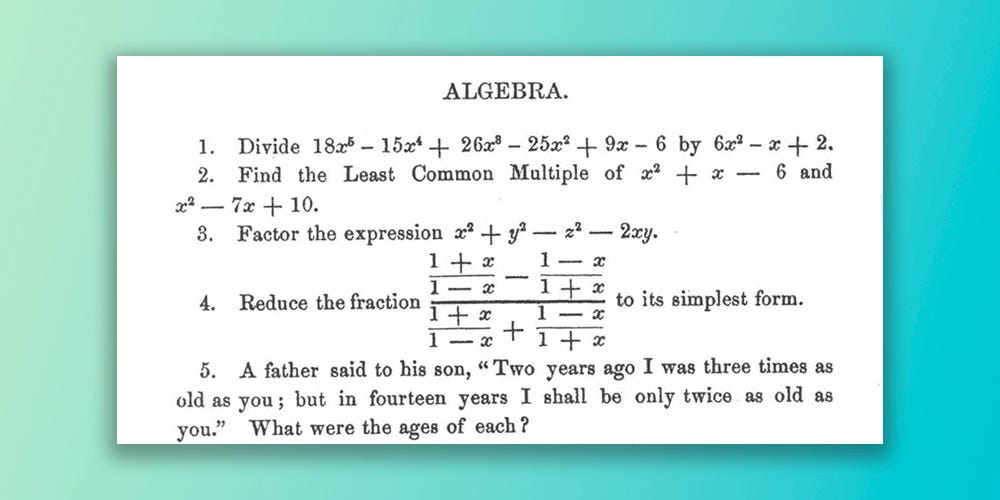
A father, a son, two time jumps, and one deceptively short question: that is all it takes to send thousands of confident adults hunting for pencils. This viral MIT math puzzle looks like casual family conversation, but its wording quietly hides a system of linear equations.
The problem reportedly appeared on an 1876 Massachusetts Institute of Technology entrance examination. More than a century later, it resurfaced through puzzle videos and popular publications, giving modern solvers an irresistible challenge: Could you pass a math test written before calculators, standardized testing, and the invention of the “I was never good at algebra” excuse?
The Original MIT Math Puzzle
A father said to his son, “Two years ago I was three times as old as you; but in fourteen years I shall be only twice as old as you. What were the ages of each?”
Before reading further, try solving it without scrolling to the answer. Give yourself five minutes. You may use paper, but your calculator can remain on the bench looking decorative.
The problem asks for the father’s and son’s present ages. The challenge is not difficult arithmetic. It is translating phrases such as “two years ago” and “in fourteen years” into precise mathematical expressions.
Why This Apparently Simple Puzzle Is Tricky
Age word problems compress several moments into one paragraph. The father and son have current ages, past ages, and future ages, yet every statement refers to the same two people. A solver who mixes those timelines can produce an elegant equation that answers a completely different question.
Age differences stay constant
If a father is 32 years older than his son today, he was also 32 years older two years ago and will remain 32 years older fourteen years from now. Their age ratio, however, changes. A baby and a 32-year-old parent have a ratio of 32 to 0 if one attempts that awkward calculation; eighteen years later, ages 18 and 50 have a much smaller ratio.
That changing ratio is the engine of the MIT age puzzle. The father moves from being three times the son’s age to twice his age, even though both gain years at exactly the same rate.
The wording must be translated as a unit
“Two years ago I was three times as old as you” does not mean the father’s current age minus two equals three times the son’s current age. Both people must travel two years into the past. Likewise, both ages increase by fourteen in the future statement.
How to Solve the Viral MIT Math Puzzle
Let:
- f represent the father’s present age.
- s represent the son’s present age.
Step 1: Translate the statement about two years ago
Two years ago, the father was f − 2 years old, while the son was s − 2. The father was three times the son’s age, so:
f − 2 = 3(s − 2)
Distribute the 3:
f − 2 = 3s − 6
Add 2 to both sides:
f = 3s − 4
Step 2: Translate the statement about fourteen years from now
In fourteen years, the father will be f + 14, and the son will be s + 14. The father will then be twice the son’s age:
f + 14 = 2(s + 14)
Distribute the 2:
f + 14 = 2s + 28
Subtract 14 from both sides:
f = 2s + 14
Step 3: Solve the system of equations
We now have two expressions equal to the father’s age:
f = 3s − 4
f = 2s + 14
Because both right-hand sides equal f, set them equal to each other:
3s − 4 = 2s + 14
Subtract 2s from both sides:
s − 4 = 14
Add 4:
s = 18
The son is currently 18. Substitute that value into either equation:
f = 2(18) + 14 = 50
Answer: The father is 50 years old, and the son is 18 years old.
Checking the Answer
A correct-looking answer still deserves verification. Algebra is helpful, but it occasionally leaves the house wearing mismatched socks.
| Time | Father’s Age | Son’s Age | Required Relationship |
|---|---|---|---|
| Two years ago | 48 | 16 | 48 = 3 × 16 |
| Present | 50 | 18 | Age difference = 32 |
| In fourteen years | 64 | 32 | 64 = 2 × 32 |
Both conditions work, and the age difference remains 32 years throughout. The solution is therefore consistent with the original problem.
A Faster Solution Using the Constant Age Gap
There is another way to solve the puzzle with less formal algebra. It relies on the fact that the difference between two people’s ages never changes.
Suppose the son was x years old two years ago. The father was three times as old, so he was 3x. Their age difference was therefore:
3x − x = 2x
Now move sixteen years forward, from two years ago to fourteen years in the future. The son’s future age will be x + 16. At that point, the father will be twice as old as the son, so the age gap will equal one copy of the son’s age:
Age gap = x + 16
Because the gap remains constant:
2x = x + 16
Therefore, x = 16. The son was 16 two years ago, making him 18 now. The father was 48 two years ago, making him 50 now.
This approach is especially satisfying because it exposes the puzzle’s central idea: ratios change with time, while age differences do not.
Common Wrong Answers and Where They Come From
Changing only one person’s age
A common setup is f − 2 = 3s. That expression sends the father into the past while leaving the son in the present. Unless the son owns a highly selective time machine, both ages must change.
Forgetting to distribute multiplication
From f − 2 = 3(s − 2), the right side becomes 3s − 6, not 3s − 2. The multiplier applies to everything inside the parentheses.
Treating an age ratio as permanent
Some solvers assume that if the father was three times as old in the past, he must remain three times as old forever. In reality, ratios get closer to 1 as both people age. A 50-year-old is not quite three times as old as an 18-year-old, and a 90-year-old is certainly not three times as old as a 58-year-old.
Stopping before checking
Substituting the results into both original statements catches most sign errors and timeline mistakes. It takes less than a minute and can rescue an otherwise doomed solution.
Why Did This 1876 MIT Puzzle Go Viral?
The puzzle has several ingredients that perform remarkably well online. It is short enough to fit in a social post, associated with a famous university, understandable without advanced mathematical vocabulary, and difficult enough to bruise the ego gently.
Its historical origin adds another layer of appeal. Modern readers naturally wonder how they would compare with nineteenth-century applicants. Yet the mathematics itself is accessible: the problem uses variables, distribution, and a system of two linear equations rather than calculus or obscure theory.
The “MIT applicants” label also creates suspense, but it should be interpreted carefully. The problem appeared on a historical entrance exam; that does not prove that it defeated most applicants. Viral headlines often season an old puzzle with a generous pinch of drama.
Most importantly, the question provides a small moment of discovery. The instant the words become two equations, the apparent riddle turns into an orderly model. That shift from confusion to structure is one of algebra’s best tricks.
What This Math Brain Teaser Actually Tests
The arithmetic is elementary, but the reasoning involves several useful problem-solving skills:
- Reading precisely: The solver must distinguish past, present, and future ages.
- Defining variables: Clear symbols prevent the timeline from becoming tangled.
- Mathematical modeling: Everyday language must be converted into equations.
- Solving simultaneous equations: Two independent conditions determine two unknowns.
- Verification: The final ages must satisfy every condition in the prompt.
- Flexible thinking: The equation method and constant-gap method reach the same result differently.
Educational resources on systems of equations commonly recommend this same process: understand the question, name the unknowns, translate each relationship, solve, and check the result in context. The MIT puzzle packages that entire workflow into two sentences.
Try Two Variations of the Puzzle
Variation 1: A new timeline
A mother tells her daughter, “Four years ago I was four times your age. In eight years, I will be twice your age.” What are their current ages?
Let their present ages be m and d. The equations are:
m − 4 = 4(d − 4)
m + 8 = 2(d + 8)
Solving gives a daughter aged 10 and a mother aged 28.
Variation 2: Write your own age puzzle
Choose two realistic current ages. Calculate their relationship at two different times, then write those relationships as clues. Finally, ask another person to recover the original ages. Creating a valid puzzle can be harder than solving one because every clue must produce a consistent system.
The Solver’s Experience: From Confusion to the “Aha!” Moment
The first experience many people have with this viral math puzzle is overconfidence. The wording is short, the numbers are friendly, and there are no alarming symbols wandering around with exponents. It feels as though the answer should appear after a few seconds of mental arithmetic.
Then the timelines begin colliding. Two years ago, fourteen years from now, three times an age, twice another agesuddenly the brain is trying to hold six ages at once. A solver may guess that the son is 16 because that number fits neatly into part of the story, only to discover that 16 is his past age, not his current one.
The temptation to guess
Guessing can make the puzzle feel approachable. Someone might test a 40-year-old father and a 14-year-old son, then adjust the numbers when the future condition fails. This method can eventually work, but it becomes a mathematical version of trying every key on an enormous key ring. Algebra creates the correct key from the information already provided.
The breakthrough comes from organizing time
The experience changes as soon as the solver draws three columns labeled “past,” “present,” and “future.” Writing f − 2 and s − 2 in the first column removes much of the mental clutter. The problem stops behaving like a riddle and starts behaving like a model.
That is the real “aha!” momentnot necessarily obtaining 50 and 18, but realizing that every phrase has a specific algebraic home. “Two years ago” means subtract two from both current ages. “In fourteen years” means add fourteen to both. “Three times” and “twice” describe relationships at those exact moments.
Solving with someone else feels different
In a classroom, office, or family group, the puzzle often produces several competing strategies. One person writes simultaneous equations. Another focuses on the fixed 32-year age gap. Someone else begins guessing ages with impressive enthusiasm and questionable efficiency.
Comparing those methods can be more valuable than announcing the answer. The equation approach is systematic and reusable. The age-gap approach is faster once its key insight is recognized. Guessing demonstrates number sense but also reveals why a structured method matters. Different paths make the reasoning visible.
Mistakes become useful evidence
A wrong equation such as f − 2 = 3s is not random nonsense. It shows that the solver recognized the past condition but applied it to only one person. Examining that error clarifies the rule more effectively than simply replacing it with the correct formula.
This is why well-designed math puzzles can create productive struggle. They offer enough resistance to require thought without demanding specialized knowledge. The frustration is usually brief, and the correction becomes memorable because the solver can identify exactly where the timeline went sideways.
The answer is satisfying because it checks perfectly
Once the ages 50 and 18 appear, verification delivers the final reward. Two years ago, 48 is exactly three times 16. Fourteen years later, 64 is exactly twice 32. The same 32-year difference survives every time jump.
That clean fit explains why this historical MIT entrance exam problem remains enjoyable. It is not merely an old test question with a famous label. It is a compact demonstration of how algebra turns a confusing story into a result that can be tested, explained, and trusted.
Final Answer
The father is 50 years old, and the son is 18 years old. The viral MIT math puzzle is less a test of advanced calculation than a lesson in precise reading, timeline management, and mathematical modeling.
If you solved it, congratulations: your algebra survived a meeting with 1876. If you did not, the important discovery is the method. Define the ages, move both people through time, translate each relationship, and check the result. That strategy will outlive any viral headline.