

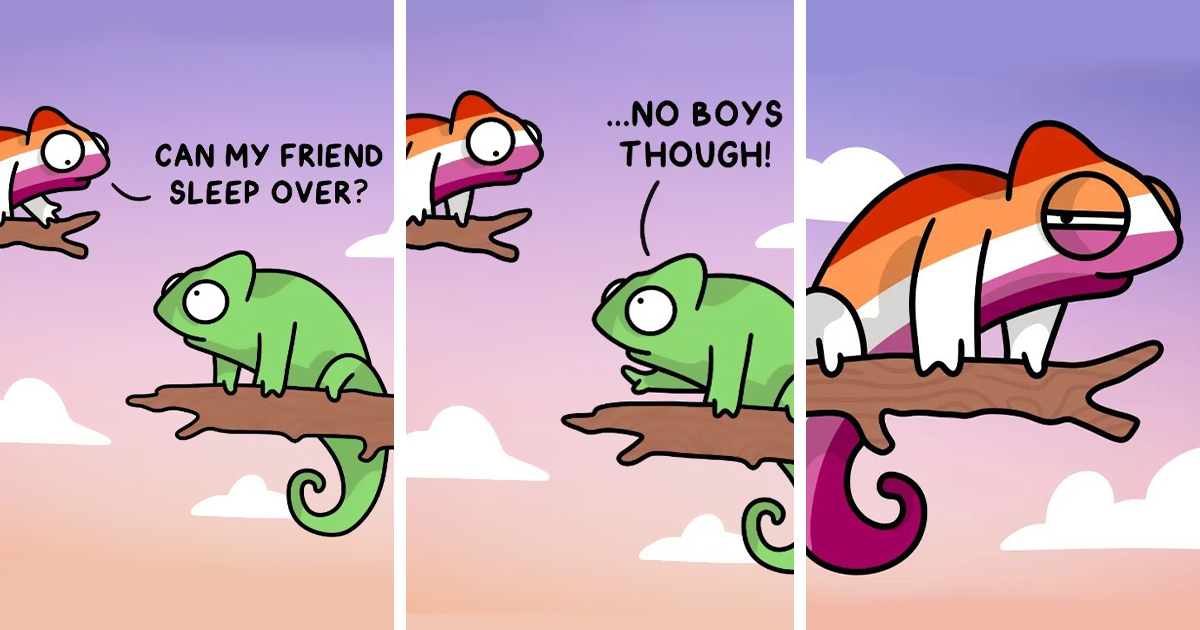
Sometimes the quickest way to explain a complicated human experience is not with a 400-page textbook, a heated debate, or an uncle who has suddenly become an “expert” after watching three videos online. Sometimes all you need is a colorful chameleon, a few well-placed speech bubbles, and a joke that lands because it is painfully, hilariously true.
That is the charm of Amee Wilson’s Queer Chameleon comics. Through bright illustrations, gentle humor, and remarkably sharp observations, Wilson explores what it can feel like to live outside the neat little boxes society keeps trying to hand us. Her comics touch on coming out, pronouns, stereotypes, identity labels, relationships, discrimination, queer joy, chosen family, and the eternal mystery of why strangers sometimes feel entitled to conduct a surprise interview about another person’s sexuality.
This collection of 35 wholesome comics continues a project that has grown from a social-media creation into a wider body of work about LGBTQ+ life. Wilson, a British-Australian illustrator and writer who has also worked as an art director, has described her creative approach as a mixture of topical issues, personal experiences, and ideas inspired by her audience. Her Queer Chameleon and Friends book similarly explores identity, coming out, awkward questions, and life beyond conventional social categories.
The result is something deceptively simple: comics that make people laugh while quietly asking them to reconsider what they think they know.
Meet Amee Wilson and the Queer Chameleon
The Queer Chameleon is exactly what the name promises: a delightfully expressive little reptile navigating a world full of expectations, assumptions, labels, love, confusion, and occasional nonsense.
The chameleon is an especially clever choice for a central character. Chameleons are famous for changing color, while queer people are frequently pressured to “pick a side,” explain themselves, remain consistent with other people’s expectations, or present their identities in ways outsiders find easy to understand. Wilson turns that visual metaphor into something playful rather than preachy.
Her work also recognizes that there is no single universal queer experience. Wilson has spoken about how creating the series pushed her to learn more about identities and perspectives beyond her own. She has said that the diversity within the LGBTQ+ community means there is always more to learn and that she wants to continue broadening the range of experiences represented in her art.
That willingness to keep learning matters. LGBTQ+ is an umbrella covering many sexual orientations, gender identities, and lived experiences. Even people who share the same label may understand it differently. GLAAD’s guidance on LGBTQ+ language emphasizes that there is no single way to be LGBTQ+, while Pew Research Center data shows substantial diversity in how LGBTQ adults describe themselves and how important different identity terms are to them.
In other words, the rainbow contains more than seven colors, metaphorically speaking. Science teachers may now lower their raised hands.
Why These 35 Wholesome Comics Feel So Relatable
They Turn Awkward Questions Into Comedy
Many queer people eventually encounter questions that are presented as innocent curiosity but arrive with the subtlety of a marching band entering a library.
Who is “the man” in the relationship? When did you decide to be queer? Are you sure? Which bathroom do you use? What is your “real” name? Why do you need labels? Why are there so many flags?
Wilson’s comics are effective because they expose the strange logic behind these interactions without turning every panel into a lecture. Instead, the characters often respond with exaggeration, reversal, or absurdity. A ridiculous assumption becomes visibly ridiculous once a cartoon chameleon says it out loud.
This is one of humor’s oldest and most useful tricks: hold an idea up to the light and let people notice the cracks themselves.
They Show That Coming Out Is Not One Single Event
Popular culture often treats coming out as one giant cinematic moment. A character makes an emotional announcement, everyone reacts, inspiring music begins, and the credits roll.
Real life rarely respects screenplay structure.
For many LGBTQ+ people, coming out can happen repeatedly: to family, friends, coworkers, doctors, new acquaintances, classmates, or partners. Some people come out in certain spaces but not others. Some decide that disclosure is unsafe. Others simply do not believe strangers are entitled to a PowerPoint presentation on their personal lives.
Support organizations such as PFLAG and the Human Rights Campaign emphasize that coming out is an individual process rather than an obligation or a one-size-fits-all milestone. PFLAG also notes that the experience can remain difficult even though the concept of coming out is now widely familiar.
Wilson’s work captures this ongoing negotiation particularly well. A small exchange between cartoon characters can reveal the mental calculations behind a seemingly ordinary conversation: Is this person safe? Do I correct them? Do I explain? Do I laugh it off? Do I have enough energy for Queer Studies 101 before lunch?
They Make Room for Queer Joy
Representation of discrimination and hardship is important, but LGBTQ+ storytelling becomes incomplete when queer characters appear only to suffer.
Queer people also fall in love, make terrible puns, adopt too many plants, argue about movies, find community, wear excellent outfits, develop chaotic group chats, and experience the full range of ordinary human life.
That is why the wholesomeness of Queer Chameleon matters. The comics do not ignore difficult realities, but they refuse to let those realities consume every panel. Wilson has described balancing topical subjects with simpler and more joyful ideas drawn from personal experiences and suggestions from followers.
Joy is not a distraction from meaningful representation. It is part of meaningful representation.
Queer Representation Can Be Small and Still Matter
Not every piece of LGBTQ+ media needs to be an epic historical drama with six awards campaigns and a soundtrack composed entirely of emotionally devastating piano.
Sometimes representation is a two-minute comic about pronouns.
Sometimes it is a joke about being asked an invasive question.
Sometimes it is seeing a fictional character experience something you thought only happened to you.
The Library of Congress has highlighted LGBTQIA+ comics and queer creators as part of a broader history of representation in the medium, including independent and web-based work. Digital comics have made it easier for artists to speak directly to audiences without waiting for traditional gatekeepers to decide whether a particular identity is “marketable.”
Wilson’s success fits naturally into that tradition. Queer Chameleon began as online storytelling and eventually expanded into a published collection. ABC News described the character as a social-media sensation that became a comic book exploring coming out, identity, and sexual orientation.
The format is part of the magic. A comic can travel quickly, communicate visually, and reach someone during an otherwise mindless scroll through social media. One moment you are looking at a video of a dog refusing to leave a bathtub; the next, a cartoon chameleon has accurately summarized an identity struggle you have never known how to explain.
The Comics Challenge Stereotypes Without Losing Their Warmth
Stereotypes survive partly because repetition makes them feel familiar. Queer people have been portrayed as confused, tragic, threatening, hypersexual, attention-seeking, or useful only as supporting characters in someone else’s story.
Wilson pushes back by focusing on recognizable people rather than abstract debates.
Her characters can be confident one day and uncertain the next. They may know exactly which labels fit them, or they may still be figuring things out. They can be frustrated by prejudice while also laughing at the absurdity of it. They are allowed to be complicated.
That complexity becomes increasingly important as more Americans openly identify as LGBTQ+. Gallup reported in 2026 that 9% of U.S. adults identify as LGBTQ+, more than double the share measured when it began tracking this trend in 2012.
Visibility, however, does not automatically produce equal understanding. Pew Research Center found substantial differences in perceived social acceptance, with LGBTQ adults seeing considerably less acceptance for transgender and nonbinary people than for gay and lesbian people.
That helps explain why a cheerful little comic can still be doing serious cultural work.
Why Humor Is Such a Powerful Tool for LGBTQ+ Storytelling
Humor creates an unusual kind of opening. People may become defensive when they feel they are being instructed, but laughter can slip past the security guard.
A good joke does not erase the seriousness of discrimination. Instead, it can expose contradictions more efficiently than an argument.
Consider the familiar complaint that LGBTQ+ people are “making everything about sexuality.” A comic can respond by showing how heterosexual romance appears constantly in movies, songs, advertisements, wedding traditions, casual conversation, and nearly every sitcom ever made. Suddenly the supposed double standard is visibleand funny.
Wilson’s light visual style makes these observations accessible. The artwork is colorful and friendly, which creates a contrast with some of the heavier subjects underneath. A reader may arrive for an adorable cartoon animal and leave thinking about social expectations.
That is quite an efficient chameleon.
Wholesome Does Not Mean Shallow
One of the most impressive things about these comics is their ability to remain warm without pretending everything is fine.
LGBTQ+ people can still face rejection, bullying, discrimination, isolation, and mental-health pressures. The Trevor Project’s 2024 national survey found serious mental-health challenges among LGBTQ+ young people, while also consistently documenting the importance of affirming environments and support.
Research and advocacy organizations repeatedly point toward a similar principle: acceptance matters. PFLAG encourages families to listen intentionally and demonstrate support, even through seemingly small actions. GLAAD has likewise emphasized the cultural importance of fair and accurate representation, arguing that greater familiarity with LGBTQ+ people in media can contribute to greater comfort and understanding.
Wilson’s comics operate in this space between education and affirmation. A reader outside the LGBTQ+ community may encounter an unfamiliar experience. A queer reader may encounter something even more powerful: recognition.
That quiet moment of “Oh. Other people feel this too” should never be underestimated.
What the Queer Chameleon Gets Right About Identity
Labels Can Help, but They Are Not Prison Cells
Labels can provide language, community, history, and relief. Learning that there is a word for your experience can feel like discovering a door in a wall you assumed was solid.
But identity language also evolves. Different people may prefer different terms, and a label that once felt useful may later feel incomplete. Wilson has discussed learning about disagreements and nuances surrounding definitions while creating her work.
The comics generally approach this complexity with curiosity rather than declaring one vocabulary test that everyone must pass.
There Is No Correct Way to “Look Queer”
Queer people do not arrive with standardized uniforms.
A person’s haircut, clothes, voice, hobbies, relationship status, or choice of beverage does not provide a reliable identity scanner. Yet assumptions about who “looks gay,” “looks trans,” or “doesn’t seem bisexual” remain remarkably persistent.
Wilson’s colorful cast undermines the idea that identity has one appearance. That fits with the broader reality described by LGBTQ+ organizations: the community includes people across races, religions, ages, socioeconomic backgrounds, gender expressions, and countless other identities.
Being Yourself Should Not Require a Debate Team
One recurring frustration in queer life is the expectation to defend your own existence as though you have accidentally wandered into a televised panel discussion.
Why do you identify that way? How do you know? Can you prove it? What scientific papers have you brought?
Meanwhile, straight people are rarely asked to submit peer-reviewed evidence before mentioning a crush.
The humor in Queer Chameleon often comes from revealing this imbalance. The characters are not asking for special treatment. Usually, they are asking for the astonishing privilege of being allowed to exist without completing an oral examination.
Why Amee Wilson’s Comics Connect Beyond the LGBTQ+ Community
You do not need to share every experience in a comic to understand its emotional logic.
Most people know what it feels like to be misunderstood. Most have felt pressure to fit expectations, worried about rejection, searched for belonging, or wished someone would simply listen instead of immediately offering an unsolicited theory.
That universality makes Wilson’s work accessible without flattening its queer specificity.
The comics remain rooted in LGBTQ+ experiences, but their deeper themesidentity, acceptance, friendship, fear, self-expression, and communityare broadly human. This is one reason inclusive storytelling can be so effective. It does not require audiences to be identical to a character. It asks them to recognize the person inside an experience different from their own.
Experiences Behind the Panels: What Queer Life Can Feel Like in Everyday Moments
One reason these 35 comics resonate is that queer experience often lives in small moments rather than dramatic headlines.
It can be the moment someone casually assumes the gender of your partner and you have half a second to decide whether correcting them will change the entire mood of the conversation.
It can be entering a new workplace and quietly scanning for clues. Is there an inclusive policy? Does anyone mention a same-sex spouse? Is the person making that joke merely awkward, or is this environment genuinely unsafe? Coming out in such situations may appear simple from the outside, but internally it can involve a surprising amount of risk assessment.
It can also be the strange experience of becoming an unpaid spokesperson for millions of people. One queer person says they dislike a particular movie, relationship style, label, or fashion trend, and suddenly someone responds, “So is that what the LGBTQ+ community thinks?”
No. Brenda from accounting has an opinion. The community did not hold a referendum.
For some people, queer experience includes years of knowing something feels different without having the vocabulary to name it. A person may recognize attraction, discomfort with gender expectations, or a sense of being out of step long before they discover language that makes those feelings understandable. Pew’s research on LGBTQ adults found that many first sensed they might be gay, lesbian, bisexual, or transgender well before telling another person.
Then there is the relief of community.
For someone who has spent years monitoring every sentence, entering a space where they no longer need to edit themselves can feel almost physically lighter. Suddenly, mentioning a partner does not require a strategy. Pronouns are not treated as a philosophical emergency. Nobody needs a five-minute explanation of why bisexuality does not disappear when someone enters a relationship.
Chosen family can become part of that experience too. Friends, partners, mentors, online communities, and supportive relatives may create networks where people are seen and valued as they are. This does not mean every queer person is rejected by their biological family, nor that every LGBTQ+ community is magically free of conflict. Human beings remain human beings, which unfortunately means someone will still forget to answer the group chat for eleven business days.
Queer joy can be equally ordinary. It may be holding hands without checking who is watching. Hearing the correct name spoken naturally. Finding a character who feels familiar. Going to Pride for the first time. Going to Pride for the tenth time and deciding the real test of endurance is standing in a food-truck line under the June sun.
It may be realizing that the future you once struggled to imagine is now simply your Tuesday.
This is perhaps where Wilson’s wholesome comics are most powerful. They recognize that queer life is not one continuous political argument. Laws, prejudice, and public debates have real consequences, but people still have birthdays. They flirt badly. They decorate apartments. They find love. They lose keys. They worry about whether someone likes them back. They discover new words for old feelings and sometimes discover that no label feels necessary at all.
For allies, these everyday experiences offer an important lesson: support does not always require a grand speech. Often it looks like listening, respecting someone’s name and pronouns, avoiding invasive questions, challenging a cruel joke, or making it clear that a friend does not need to hide around you.
For queer readers, the message may be simpler: you are not uniquely strange because something has been difficult to explain.
Somewhere out there, apparently, a cartoon chameleon gets it.
Conclusion: A Little Chameleon With a Big Message
Amee Wilson’s 35 new wholesome comics demonstrate how much can fit inside a few illustrated panels. Queer Chameleon can be funny without being dismissive, educational without becoming a textbook, and political without forgetting that LGBTQ+ people deserve stories about happiness, silliness, friendship, and ordinary life.
The comics work because they do not claim to define one universal queer experience. Instead, they open the door to many experiences: coming out or choosing not to, embracing labels or questioning them, confronting stereotypes, finding community, dealing with awkward questions, and enjoying the wonderfully unremarkable freedom of being yourself.
In a culture where conversations about LGBTQ+ identity can become needlessly complicated, Wilson offers a refreshingly simple idea. People are different. People deserve dignity. Learning can be joyful. And sometimes the best response to an absurd stereotype is an even more absurd cartoon.
That may not solve every problem in the world. But making someone laugh, feel understood, or think differently for a moment is a pretty impressive achievement for one small chameleon.