

History rarely pauses, checks the lighting, and waits for a photographer to find a flattering angle. It arrives without warning: on a battlefield, beside a burning building, in the middle of a protest, or during a reunion at a railway station. The finest photojournalists recognize that split second and preserve it before it disappears.
The 30 Pulitzer Prize-winning photographs below reveal triumph, grief, injustice, courage, violence, and ordinary people caught inside extraordinary events. Some are individual images; others are award-winning photo sequences represented by their best-known frame or defining visual theme. Several contain disturbing subject matter, but none became important merely because it was shocking. They mattered because they turned distant events into human experiences.
Content note: This article discusses photographs involving war, death, disaster, racial violence, and injured children.
Why Pulitzer Prize-Winning Photography Matters
The Pulitzer Prize introduced its original photography category in 1942. In 1968, the award was divided into Feature Photography and Spot News Photography, with the latter renamed Breaking News Photography in 2000. The categories recognize both patient, long-form visual storytelling and the astonishing reflexes required when history suddenly kicks down the door.
A great news photograph does more than record what happened. It establishes relationships: one person against a crowd, a child beside an armed adult, a grieving family surrounded by political ceremony. Composition, timing, context, and ethical judgment all work together. There is no cinematic soundtrack telling viewers what to feel. The frame must carry the entire emotional load by itself.
The Early Pulitzer Photographs: 1942–1958
1. “Ford Strikers Riot” Milton Brooks, 1942
Milton Brooks photographed a violent confrontation during a Ford Motor Company labor dispute in Detroit. The frame freezes the instant a striker fights back against company security personnel. Its tilted bodies, flying coat, and compressed crowd make the image feel almost audible. It received the first Pulitzer Prize awarded specifically for photography.
2. “Water!” Frank Noel, 1943
After a Japanese torpedo sank a freighter fleeing Singapore, Associated Press photographer Frank “Pappy” Noel found himself stranded in the Indian Ocean. From one lifeboat, he photographed an Indian sailor in another boat desperately asking for water. Noel could offer none; his own group had run out. The picture is survival journalism in its most literal form.
3. “Homecoming” Earle L. Bunker, 1944
At a railway station in Iowa, Lieutenant Colonel Robert Moore returned from World War II service and swept his daughter into his arms. Earle Bunker captured the embrace as Moore’s wife and young nephew watched. No faces are clearly presented, yet the body language says everything. Sometimes happiness does not need a close-up.
4. “Raising the Flag on Iwo Jima” Joe Rosenthal, 1945
Joe Rosenthal’s photograph of six Marines raising the American flag on Mount Suribachi became one of World War II’s defining images. Its diagonal flagpole and intertwined figures create a powerful impression of collective effort. The image inspired a war-bond campaign, appeared on a postage stamp, and became the model for the Marine Corps War Memorial.
5. The Woman Falling From a Burning Hotel Arnold Hardy, 1947
Amateur photographer Arnold Hardy heard fire engines, rushed to Atlanta’s Winecoff Hotel, and photographed a woman falling from an upper floor. Her white dress and extended body appear suspended against the blackened building. Hardy became the first amateur photographer to win the prize, proving that history occasionally ignores press credentials.
6. “Babe Ruth Bows Out” Nathaniel Fein, 1949
Nathaniel Fein photographed an ailing Babe Ruth from behind as the baseball legend stood before a packed Yankee Stadium. Ruth’s thin legs, oversized uniform, and bowed head transformed a sports ceremony into a quiet portrait of mortality. The photograph shows how an icon can appear most human when the camera declines to show his face.
7. Korean Refugees Crossing a Wrecked Bridge Max Desfor, 1951
Max Desfor’s Korean War photograph shows refugees crawling across the twisted framework of a destroyed bridge over the Taedong River. Tiny human figures cling to bent steel above frozen water. Instead of presenting military hardware as heroic, the frame reveals civilians improvising a dangerous escape through ruins created by war.
8. The Johnny Bright Incident John Robinson and Don Ultang, 1952
A six-image sequence documented a deliberate assault on Black college football star Johnny Bright during a game between Drake and Oklahoma A&M. Bright’s jaw was broken. The photographers’ rapid sequence provided visual evidence that the hit was not an innocent accident, demonstrating the camera’s ability to challenge convenient explanations.
9. “Tragedy by the Sea” John L. Gaunt, 1955
John Gaunt photographed a young couple standing together beside a rough Pacific Ocean shortly after their small son had been swept away. Their bodies lean into each other while the empty beach stretches around them. Gaunt did not need to show the child or the accident. Absence became the photograph’s most devastating subject.
10. “Faith and Confidence” William C. Beall, 1958
During a parade, a two-year-old boy approached a police officer to ask whether he was a Marine. William Beall crouched to the child’s eye level and photographed the officer patiently answering him. After so many images of catastrophe, this gentle exchange offers a useful reminder: photojournalism can preserve trust as effectively as turmoil.
Civil Rights, Assassinations, and the Vietnam Era
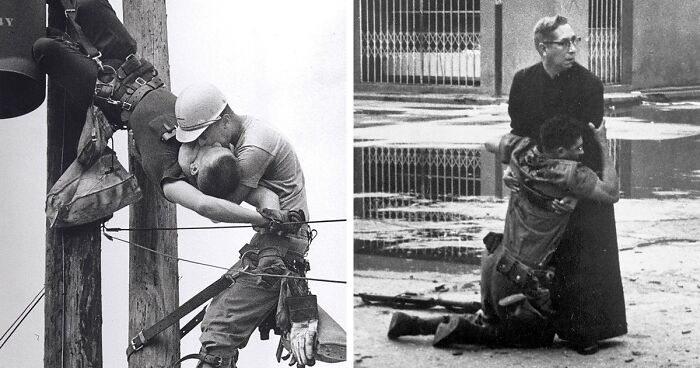
11. “Aid From the Padre” Héctor Rondón, 1963
During a Venezuelan military uprising, Héctor Rondón captured a priest supporting a wounded soldier in a street surrounded by gunfire. The priest’s white robe contrasts with the soldier’s dark uniform and the damaged storefronts behind them. Compassion occupies the center of the frame while violence remains just beyond its edges.
12. Jack Ruby Shooting Lee Harvey Oswald Robert H. Jackson, 1964
Robert H. Jackson pressed the shutter as nightclub owner Jack Ruby shot Lee Harvey Oswald in the basement of Dallas police headquarters. Oswald recoils, Ruby lunges, and detectives react a fraction too late. The photograph remains an extraordinary example of timing: one exposure captured an event that instantly created decades of questions.
13. James Meredith After Being Shot Jack R. Thornell, 1967
Civil rights activist James Meredith was shot during his March Against Fear in Mississippi. Jack Thornell photographed Meredith lying wounded beside the road while looking back toward the gunman’s direction. The image captured both physical vulnerability and defiance, becoming an enduring visual record of the danger faced by civil rights marchers.
14. “The Kiss of Life” Rocco Morabito, 1968
Rocco Morabito spotted two utility workers high on a power pole after one had been shocked unconscious. The second worker administered mouth-to-mouth resuscitation while both men remained suspended above the ground. The photograph’s title sounds romantic until viewers realize the “kiss” is an urgent battle to keep a colleague alive.
15. Coretta Scott King at Martin Luther King Jr.’s Funeral Moneta Sleet Jr., 1969
Moneta Sleet Jr. focused on Coretta Scott King and her daughter Bernice during Dr. King’s funeral. Their faces are framed by a black mourning veil, turning a national event into an intimate picture of a wife and child confronting loss. Sleet became the first Black photographer to receive a Pulitzer Prize.
16. “Saigon Execution” Eddie Adams, 1969
Eddie Adams photographed South Vietnamese police chief Nguyễn Ngọc Loan executing prisoner Nguyễn Văn Lém during the Tet Offensive. The image compressed a complicated war into a horrifying instant and became one of the century’s most influential photographs. Adams later worried that the frame encouraged viewers to judge an entire life from one fraction of a second.
17. The Kent State Shooting John Paul Filo, 1971
John Paul Filo photographed 14-year-old Mary Ann Vecchio crying over the body of student Jeffrey Miller after National Guard troops opened fire at Kent State University. Four students were killed. Vecchio’s outstretched arms and anguished expression made the violence of America’s political divisions impossible to keep at a comfortable distance.
18. “The Terror of War” Huynh Cong Ut, 1973
The photograph commonly known as “Napalm Girl” shows nine-year-old Phan Thị Kim Phúc running naked and burned after a napalm strike near Trảng Bàng. The official Pulitzer record credits Associated Press photographer Huynh Cong Ut, known as Nick Ut. That authorship has faced public challenges, but AP reviews found no definitive evidence warranting a credit change.
19. “Burst of Joy” Slava Veder, 1974
Slava Veder captured the family of returning prisoner of war Robert Stirm racing across the runway to greet him. The daughter leading the group seems almost airborne, making the image a national symbol of reunion after Vietnam. Yet the family’s private story was complicated, reminding viewers that a joyful frame does not guarantee a joyful ending.
20. The Boston Fire Escape Collapse Stanley Forman, 1976
Stanley Forman photographed a woman and child falling when a fire escape suddenly collapsed during a rescue attempt. One frame shows help apparently seconds away; the next shows the structure giving way. The sequence is terrifying because it records the exact border between rescue and disaster, a border no photographer can ask to be repeated.
Conflict, Disaster, and the Modern News Image
21. “The Soiling of Old Glory” Stanley Forman, 1977
During Boston’s school-desegregation conflict, Forman photographed a white protester wielding an American flag like a spear against a Black attorney. The flag, usually presented as a symbol of unity, becomes a weapon inside the frame. That bitter contradiction gives the picture its lasting power and its deeply uncomfortable title.
22. “Firing Squad in Iran” Jahangir Razmi, 1980
A line of blindfolded Kurdish prisoners collapses under gunfire in Jahangir Razmi’s photograph of an execution in Iran. The image was initially published without his name because identifying him could have placed his life in danger. His authorship remained secret until 2006, when he consented to being publicly recognized.
23. The Attempted Assassination of Ronald Reagan Ron Edmonds, 1982
Ron Edmonds produced a rapid sequence as shots were fired outside a Washington hotel and Secret Service agents pushed President Ronald Reagan into his limousine. The pictures show confusion rather than choreographed heroism: bodies collide, faces tense, and trained professionals react before the public understands what has happened.
24. The Rescue of Baby Jessica Scott Shaw, 1988
After 18-month-old Jessica McClure spent more than two days trapped in a narrow Texas well, Scott Shaw photographed the moment rescuers finally brought her to the surface. Harsh lights, exhausted faces, and tightly packed bodies turn the scene into a visual exhale after a rescue followed by millions of anxious viewers.
25. The Oklahoma City Bombing Child Charles Porter IV, 1996
Charles Porter IV was working as a bank employee when the Oklahoma City bombing occurred. Carrying a camera, he photographed a firefighter cradling a one-year-old victim. The image became one of the disaster’s defining photographs because it stripped away the language of terrorism, politics, and casualty counts, leaving one child in one rescuer’s arms.
26. The Seizure of Elián González Alan Diaz, 2001
Alan Diaz was inside the Miami home of Elián González’s relatives when armed federal agents entered. His photograph shows the terrified six-year-old held by Donato Dalrymple as an agent points a weapon into the room. Flashlight glare, faces, hands, and gun barrels collide inside a frame that feels almost too crowded to contain the political crisis.
27. The September 11 Attacks The New York Times Staff, 2002
The Pulitzer went to a portfolio rather than one photograph, honoring the newspaper’s visual coverage of the attacks and their aftermath. Images of collapsing towers, dust-covered survivors, firefighters, missing-person posters, and grieving families created a collective record of a day too vast for any single frame to explain.
28. Hurricane Katrina The Dallas Morning News Staff, 2006
Photographers documented stranded residents, rooftop rescues, overwhelmed shelters, floodwater, exhaustion, and grief after Hurricane Katrina engulfed New Orleans. The portfolio showed that a natural disaster can become a human-made crisis when infrastructure and government response fail. There were no tidy before-and-after picturesonly people attempting to survive the middle.
29. The Charlottesville Car Attack Ryan Kelly, 2018
Ryan Kelly photographed the instant a car drove into people protesting a white nationalist rally in Charlottesville, Virginia. Bodies, shoes, signs, and personal belongings appear lifted by the impact. Kelly had planned to leave newspaper journalism after that workday; instead, his final assignment produced a chilling document of domestic extremism.
30. A Migrant Family Fleeing Tear Gas Reuters Staff, 2019
One defining frame from Reuters’ Pulitzer-winning migrant portfolio shows Honduran mother Maria Meza pulling her young daughters away from tear gas near the U.S.-Mexico border. Photographer Kim Kyung-Hoon captured the family running together through the fumes. The picture condensed a vast immigration debate into an instinct every parent understands: get the children to safety.
A Viewer’s Experience: How to Look at Pulitzer Photography
Begin With the Image, Not the Caption
Looking through Pulitzer Prize-winning photographs can feel like entering a museum where every room is emotionally louder than the previous one. The most rewarding approach is to slow down. Before reading the caption, examine where your eyes go first. Is it a face, a weapon, an empty space, or a small detail at the edge of the frame? Notice how the photographer guides attention without arrows, animations, or a cheerful button demanding that you “click here.”
Then read the caption and look again. The second viewing is often completely different. A joyful reunion may contain private sorrow. A photograph that appears spontaneous may belong to a sequence documenting a larger injustice. A person who initially seems anonymous may have a name, a family, and a life extending decades beyond the famous moment.
Pay Attention to What Is Outside the Frame
Every photograph excludes almost everything that happened. Eddie Adams’ camera recorded an execution but could not contain the entire Tet Offensive. John Filo’s Kent State image preserved one student’s anguish but not every argument, decision, or act that led soldiers to fire. That limitation does not make the pictures untruthful. It makes context essential.
A useful viewing habit is to ask three questions: What happened immediately before this frame? What happened afterward? Who is not visible? These questions protect viewers from treating a powerful photograph as a complete historical explanation. A camera is an excellent witness, but it is not a time machine with unlimited seating.
Allow Discomfort Without Turning Suffering Into Entertainment
Many Pulitzer photographs are difficult to view because the people inside them were not performing. They were grieving, injured, frightened, or dying. Ethical viewing means resisting the urge to consume these images as visual thrills. Spend time with names and captions. Recognize that famous subjects are not symbols first; they are human beings first.
This consideration matters even more online, where historic images are frequently separated from their original captions, cropped into memes, colorized without explanation, or reposted by accounts hunting for engagement. Archival preservation involves more than saving a digital file. Dates, credits, captions, negatives, contact sheets, and publication history help keep an image attached to the truth it documented.
Study the Photographer’s Decisions
For photographers, writers, and visual storytellers, these pictures offer an informal master class. Strong news images often have surprisingly simple structures. One central gesture carries the story. Background details establish context without stealing attention. The photographer moves close enough to make the moment human but not so close that the scene becomes unreadable.
The greatest lesson, however, is readiness. Arnold Hardy heard fire engines and followed them. Charles Porter kept a camera nearby even though photography was not his regular job. Ryan Kelly continued working during confusion and danger. Technical knowledge mattered, but preparation allowed technique to become useful when the unrepeatable moment arrived.
Look Beyond the Famous Frame
Finally, seek out the complete photo essays whenever possible. A single iconic image can dominate public memory so thoroughly that the photographer’s other frames disappear. Contact sheets and portfolios reveal hesitation, movement, failed exposures, alternate viewpoints, and quieter moments. They show that photographic history is rarely created by one magical click. It is built through observation, persistence, editing, and an uncomfortable amount of standing around while nothing happens.
That experience makes Pulitzer photography feel less like a collection of frozen relics and more like an ongoing conversation about evidence. These pictures ask viewers not merely to admire composition, but to decide what deserves remembranceand what responsibilities come with looking.
Conclusion: Thirty Frames, Thirty Open Doors Into History
These Pulitzer Prize-winning photographs endure because they make enormous events personal. War becomes a thirsty sailor. Political violence becomes a wounded marcher looking backward from the road. Immigration policy becomes a mother pulling her daughters through smoke. Disaster becomes a firefighter holding a child.
The photographs are not flawless explanations, and they should never be treated as substitutes for careful reporting. Their power comes from opening the door. Once viewers step through, captions, articles, archives, eyewitness accounts, and historical research must complete the journey.
In an era when billions of pictures are created and discarded with the casual enthusiasm of someone cleaning an email inbox, these 30 images demonstrate why certain frames survive. They preserved moments that could not be repeated, looked away from, or fully forgotten.