

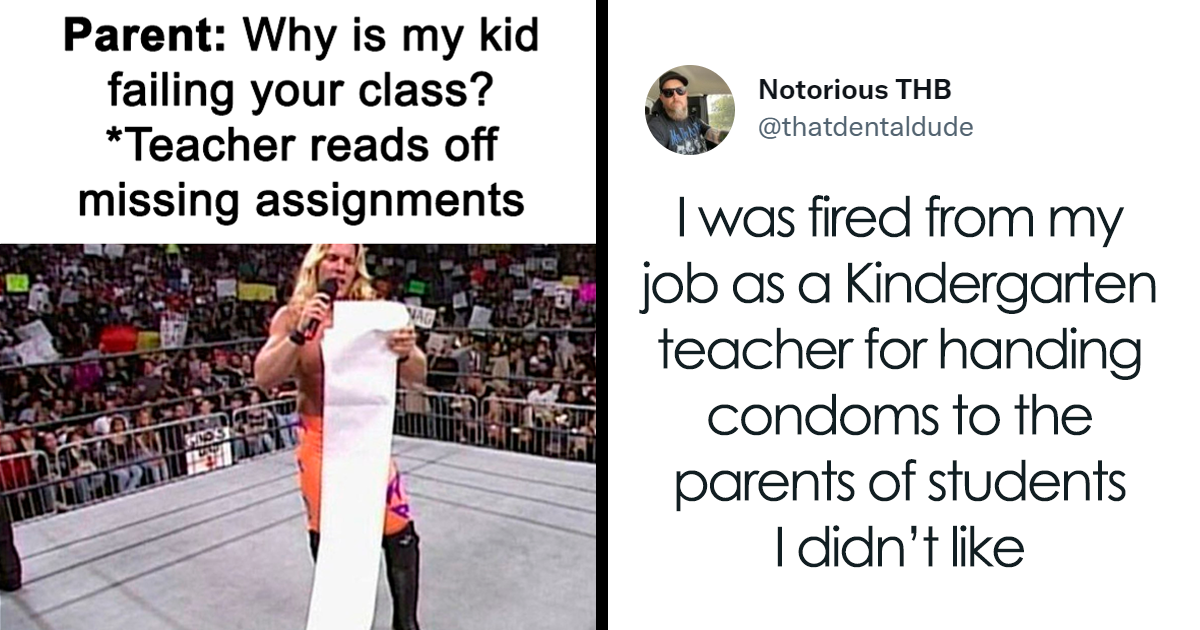
Teachers spend their days explaining fractions, locating missing pencils, settling disputes over chairs, and answering questions that no reasonable adult could have predicted. Naturally, some of them use social media to document the comedy before it disappears into the mysterious black hole where unfinished homework apparently lives.
The funniest teacher tweets work because they reveal a recognizable truth: classrooms are carefully planned environments occupied by deeply unpredictable humans. A teacher may arrive with a color-coded lesson plan and leave wondering why someone tried to charge a Chromebook with a glue stick.
Education publications and research organizations have also explored the more serious side of this humor. Strategic, good-natured comedy can ease classroom tension, support relationships, and create camaraderie among educators. That laughter matters in a profession frequently affected by heavy workloads, student behavior challenges, digital distractions, and burnout.
The 50 moments below are original reconstructions and paraphrases inspired by recurring experiences publicly shared by educators. They are not copied or presented as verbatim posts from identifiable teachers.
Classroom Logic That Deserves Its Own Curriculum
Students do not merely think outside the box. They occasionally deny the existence of the box, replace it with a juice carton, and ask whether the assignment is graded.
1. The Homework Investigation
A teacher asked why a student had not completed the homework. The student replied, “I didn’t know we had homework.” It was written on the board, posted online, announced twice, and printed on the worksheet. The homework was apparently working undercover.
2. A Revolutionary Math Strategy
One student solved a difficult equation incorrectly but confidently. When asked to show the work, the student explained, “I estimated emotionally.” Mathematics has officially entered its feelings era.
3. The Suspiciously Honest Book Report
A teacher received a book report beginning with, “I did not read this book, but the cover suggests that several things probably happened.” Technically, that is literary prediction.
4. The Emergency Pencil Shortage
A student announced that learning was impossible because there was no pencil. The teacher pointed to a container holding 40 pencils. The student clarified that none of them were “his preferred pencil.” Negotiations immediately collapsed.
5. A Creative Definition of Participation
After sleeping through most of class, a student argued that he had participated because he was “physically present and emotionally supportive.” Human resources may contact him soon.
6. The Invisible Deadline
A teacher reminded the class that an assignment was due Friday. One student asked, “This Friday or the Friday that feels right?” Somewhere, a calendar quietly resigned.
7. Advanced Historical Analysis
During a discussion about an ancient civilization, a student asked whether the people knew they were living “a really long time ago.” The teacher needed several seconds and possibly a vacation.
8. The Scientific Method, Reimagined
A student wrote, “My hypothesis was wrong, so I changed the experiment until it became right.” Several corporations would like to offer this child an internship.
9. The Power of Selective Hearing
A teacher could whisper the word “candy” from across the room and receive instant attention. Yet saying, “Please submit your assignment,” at full volume produced the silence of an abandoned lighthouse.
10. Technically Not Cheating
Two students submitted identical answers, identical mistakes, and identical doodles. One insisted they had not copied because they had “worked together separately.” The legal defense was bold, if unsuccessful.
Technology: Making Education Easier Since Never
Classroom technology can connect students to nearly unlimited knowledge. It can also spend 20 minutes updating immediately before an important presentation.
11. The Muted Microphone Mystery
During an online lesson, a teacher repeatedly told a student that his microphone was muted. The student continued speaking for two full minutes, then typed, “Why is everyone ignoring me?”
12. Chromebook Battery Mathematics
A student arrived with a Chromebook at 2% battery and no charger. When asked why it had not been charged overnight, the student replied, “It still had 2%, so I thought it was basically full enough.”
13. The Internet Ate My Homework
The modern dog is apparently digital. It deletes documents, disconnects Wi-Fi, corrupts uploads, and waits until 11:59 p.m. to reveal its criminal activity.
14. Password Security Excellence
A teacher told students not to share their passwords. One student shouted, “Nobody can guess mineit’s my birthday!” Cybersecurity professionals felt a disturbance in the universe.
15. The Accidental Presentation
A student shared a screen during class and revealed 37 open tabs, including a game, three shopping pages, six videos, and one lonely document titled “Essay FINAL final2 REALLYFINAL.”
16. Artificial Intelligence Meets Natural Procrastination
A student submitted an obviously computer-generated paragraph containing phrases such as “as a language model.” The student’s defense was that the computer had “added its own opinion.”
17. The Printer Senses Fear
A teacher reported that the school printer works perfectly when printing one unimportant page. Ask it for 30 test packets, and it develops a paper jam, an identity crisis, and concerns about work-life balance.
18. The Update Nobody Requested
A classroom computer announced a mandatory 45-minute update as students entered for a technology-based lesson. The teacher immediately introduced Plan B, also known as “talking like it’s 1997.”
19. Searching for the Search Engine
A student asked where to find Google. The teacher said, “Open your browser.” The student responded, “Can I Google how to do that?” The circle was complete.
20. Digital Organization
One student claimed an assignment had disappeared. It was eventually found in a folder named “new folder,” inside another “new folder,” inside “stuff,” beside 16 screenshots of sneakers.
Elementary Students: Small People, Enormous Plot Twists
Young children possess limitless curiosity, brutal honesty, and very little interest in maintaining an adult’s self-esteem.
21. The Surprise Age Estimate
An elementary teacher asked students to guess her age. Estimates ranged from 19 to 84. One child explained, “You look young, but you know a lot of old things.”
22. The Family Secret
During morning sharing time, a student announced, “My dad says we’re not supposed to tell people this.” Every adult in the room stopped breathing at once.
23. Career Day Confidence
A child said he wanted to become a dinosaur when he grew up. When informed that this might be difficult, he replied, “Not with that attitude.” The teacher conceded the point.
24. The Compliment Sandwich
A student told the teacher, “You’re pretty today.” Before gratitude could fully form, the child added, “Yesterday you looked like you needed medicine.”
25. An Unexpected Anatomy Lesson
A kindergartner asked whether teachers sleep under their desks after school. The teacher said no. The student looked disappointed and whispered, “Then where do they keep you?”
26. The Ultimate Classroom Currency
A student offered the teacher two stickers, half a cracker, and a small rock in exchange for canceling math. Honestly, it was one of the better-funded proposals the school had seen.
27. The Emergency Announcement
A child raised a hand with tremendous urgency. After being called on, the student said, “I forgot what I was going to say, but it was extremely important.” Government meeting experience unlocked.
28. The Question After the Story
A teacher finished reading a beautiful story about courage, friendship, and loss. One child raised a hand and asked, “Did you know my uncle has a boat?” Literature had made an impact.
29. The Missing Tooth Economy
A student lost a tooth during class and immediately asked for a plastic bag because “the fairy does not accept loose inventory.” That child understands supply-chain management.
30. The Unfiltered Observation
A teacher wore new glasses to school. A student studied them carefully and said, “Now you look like someone who knows the rules.” Apparently, authority was one accessory away.
Middle and High School: Confidence Without Supporting Evidence
Teenagers can be brilliant, thoughtful, and compassionate. They can also ask whether a test counts toward their grade while actively taking the test.
31. The Grade Negotiation
A student with several missing assignments asked what could be done to earn an A. The teacher suggested completing the missing work. The student replied, “I was hoping for something more realistic.”
32. Shakespeare’s Social-Media Problem
After reading a tragedy, a student concluded that the entire plot could have been prevented if the characters had created a group chat. English teachers everywhere reluctantly agreed.
33. The Bathroom Time Traveler
A student requested a bathroom pass and returned 26 minutes later carrying a snack from another building. Apparently, the restroom was located beyond several major trade routes.
34. The Presentation Minimalist
A student’s presentation contained one slide reading “The End.” When reminded that nothing had come before it, the student said, “I wanted to avoid unnecessary details.”
35. Attendance With Conditions
A teenager arrived late and asked, “Did I miss anything?” The teacher considered replying, “No, we paused education until you returned,” but chose continued employment.
36. The Essay’s Dramatic Conclusion
One essay ended with, “In conclusion, I have run out of things to say.” It was not elegant, but it was more honest than many professional reports.
37. Group Project Mathematics
In every four-person project, one student does 80% of the work, two students choose the font, and one appears on presentation day asking, “Wait, what topic did we get?”
38. The Quiz Surprise
A student was shocked by a quiz despite the teacher announcing it every day for a week. “I thought you were joking,” the student said. Teachers are apparently famous for seven-day comedy setups.
39. Vocabulary Innovation
A student could not remember the term “apostrophe” and called it “the floating comma.” The teacher corrected the terminology but privately admitted that floating comma was better branding.
40. The Motivational Poster Critic
A classroom poster said, “You miss 100% of the shots you don’t take.” A student added, “You also save 100% of the energy.” The debate team had found its next captain.
Teacher Survival, Staff Meetings, and Other Extreme Sports
Educators must be instructors, technology specialists, mediators, event planners, data analysts, amateur detectives, and enthusiastic participants in professional development sessions involving chart paper.
41. The Staff Meeting Email
A meeting was scheduled to discuss how the school could reduce unnecessary meetings. Every teacher stared into the distance like a character in a serious documentary.
42. Casual Friday
A teacher wore jeans to school and reported feeling so powerful that she briefly considered checking the copier without first asking whether it was broken.
43. The Sunday-Night Transformation
Sunday at 4 p.m.: a responsible adult enjoying the weekend. Sunday at 8 p.m.: a detective searching email for clues about what Monday intends to do.
44. Coffee as Instructional Technology
A teacher described coffee as a classroom management tool, emotional support beverage, hand warmer, personality replacement, and legally available morning miracle.
45. The Substitute Plan
Teachers write substitute plans detailed enough to operate a small airport, then return to discover that the class watched a video and somehow misplaced three chairs.
46. Picture Day Reality
School picture day is the annual tradition in which teachers carefully dress up and are photographed after six hours of answering questions about combs, collars, and mysterious stains.
47. The Last Week Before Break
Students arrive with the energy of 400 squirrels in a trampoline park. Teachers continue discussing learning objectives as though society remains fully operational.
48. Professional Development Bingo
Teachers quietly listen for familiar phrases: “rigor,” “data-driven,” “best practices,” “student ownership,” and “we’ll give you ten minutes back.” Only the last one produces measurable excitement.
49. The End-of-Year Classroom
By May, every pencil is two inches long, the stapler has vanished, and the teacher is negotiating with a dried-out marker as though it controls the nation’s water supply.
50. The Teacher’s Summer Vacation
People imagine teachers spending summer beside a pool. Teachers spend June recovering, July preparing, and August standing in a store wondering whether 200 pencils will last until Wednesday.
Why Funny Teacher Tweets Are So Easy to Share
The best teacher humor does more than deliver a punch line. It compresses an entire professional experience into a few recognizable sentences. A missing pencil is never just a missing pencil. It is a symbol of planning, responsibility, improvisation, and the extraordinary ability of classroom supplies to disappear without witnesses.
These posts also create a sense of community. An educator may experience a bizarre moment alone in one classroom, share it online, and discover that thousands of teachers have survived nearly identical incidents. The names and locations change, but the characters remain familiar: the student who asks for instructions immediately after the instructions, the printer that fears deadlines, and the meeting that should have been an email.
That shared recognition explains why classroom humor travels so quickly. Teachers understand the practical details. Former students recognize themselves. Parents suddenly reconsider what happens during the seven hours between morning drop-off and afternoon pickup.
Humor works best when it is affectionate rather than humiliating. Laughing about an impossible situation can strengthen a community; laughing at a particular child can damage trust. Effective teacher comedy usually points upward, inward, or toward the universal absurdity of school life. The teacher becomes part of the joke rather than an untouchable observer.
Social media adds another layer. Teachers can exchange ideas, encouragement, warnings, and funny stories beyond the faculty lounge. However, educators must still protect student privacy, avoid identifying details, and remember that a supposedly casual post may reach families, administrators, or a much larger audience than expected. Education outlets continue to emphasize both the community-building possibilities and professional risks of online participation.
Experiences Behind the Humor: What Classroom Comedy Really Feels Like
The Lesson Plan Rarely Survives First Contact
Anyone who has spent time teaching eventually learns that a lesson plan is less like a train schedule and more like a hopeful weather forecast. The teacher may prepare an elegant introduction, a cooperative activity, an assessment, and a meaningful reflection. Then the projector refuses to connect, the fire alarm rings, and a student discovers an insect near the window.
The teacher’s real skill appears in the recovery. Good educators learn to redirect attention, simplify instructions, abandon activities that are not working, and transform interruptions into teachable moments. From the outside, this flexibility can look effortless. Inside the teacher’s head, several emergency committees are meeting simultaneously.
Students Remember the Unexpected Moments
Many adults forget individual worksheets but remember the teacher who used a ridiculous voice while reading, turned a mistake into a joke, or admitted not knowing an answer. Those moments make the classroom feel human. They communicate that learning does not require perfection and that confusion can be explored without embarrassment.
A harmless joke can also reset a tense room. When students are tired, anxious, or afraid of making mistakes, a little humor creates breathing space. The purpose is not to transform every lesson into a comedy performance. Teachers are educators, not entertainers hired to compete with every video on a student’s phone. The goal is connection.
The Funniest Stories Often Arrive Without Warning
Planned jokes can succeed, but spontaneous classroom comments are usually more memorable. Children combine incomplete knowledge with complete confidence. Teenagers use sophisticated sarcasm while forgetting to write their names on their papers. Teachers spend years studying instruction and assessment, yet no training manual fully prepares them for a student asking whether Abraham Lincoln had Wi-Fi.
The challenge is maintaining professional composure. Teachers develop techniques: turning toward the board, pretending to look for something in a drawer, drinking water at suspiciously convenient moments, or asking students to begin independent work while the adult attempts to regain control of facial muscles.
The Staff Room Has Its Own Comedy Genre
Classroom stories are only half the experience. Educators also encounter malfunctioning copiers, changing schedules, unexpected observations, acronym-filled initiatives, and meetings in which 20 adults debate the location of a recycling bin.
Shared humor helps colleagues support one another. A quick joke in the hallway may communicate, “I understand the kind of day you are having,” more efficiently than a long conversation. It does not solve understaffing, workload pressure, or inadequate resources, but it can interrupt isolation.
Behind Every Joke Is Serious Work
Funny teacher tweets succeed because the audience senses the effort underneath them. Teachers are not simply observing amusing children. They are helping students read, reason, communicate, cooperate, recover from mistakes, and develop confidence. They are doing that work while managing dozens of individual needs in real time.
The humor is not evidence that educators take their responsibilities lightly. Often, it demonstrates the opposite. People joke about experiences they know intimately. A teacher can produce one perfect sentence about dismissal chaos because that teacher has supervised dismissal hundreds of times, in every kind of weather, while answering questions and locating missing backpacks.
That is why the funniest teacher posts tend to feel both absurd and affectionate. They acknowledge that school is exhausting, unpredictable, and occasionally held together by dry-erase markers that stopped working three weeks ago. They also reveal why many teachers return each morning: amid the noise and confusion, something meaningfuland usually something hilariousis always about to happen.
Conclusion
These 50 hilarious teacher-tweet moments capture the strange magic of education. A classroom can move from serious discussion to complete nonsense in less time than it takes to distribute a worksheet. Students provide the plot twists, technology supplies the conflict, and teachers somehow keep the story moving.
Online teacher humor gives educators a place to recognize one another’s experiences and gives everyone else a glimpse behind the classroom door. The jokes may involve missing homework, broken printers, awkward questions, or mysteriously uncharged laptops, but the underlying message is consistent: teaching requires patience, adaptability, creativity, and a truly industrial sense of humor.
Note: This article synthesizes recurring themes found across Bored Panda, BuzzFeed, WeAreTeachers, Edutopia, Education Week, the National Education Association, Pew Research Center, RAND Corporation, Harvard Graduate School of Education, ASCD, the American Psychological Association, Chalkbeat, and TODAY. All numbered scenarios and wording are original paraphrases created to protect privacy and avoid reproducing copyrighted social-media posts.