

For most travelers, renewing or replacing a passport is an administrative chore involving an unflattering photograph, a form that asks the same question three different ways, and the uneasy hope that nothing was signed in the wrong box. For Hunter Schafer, the process became something far more consequential.
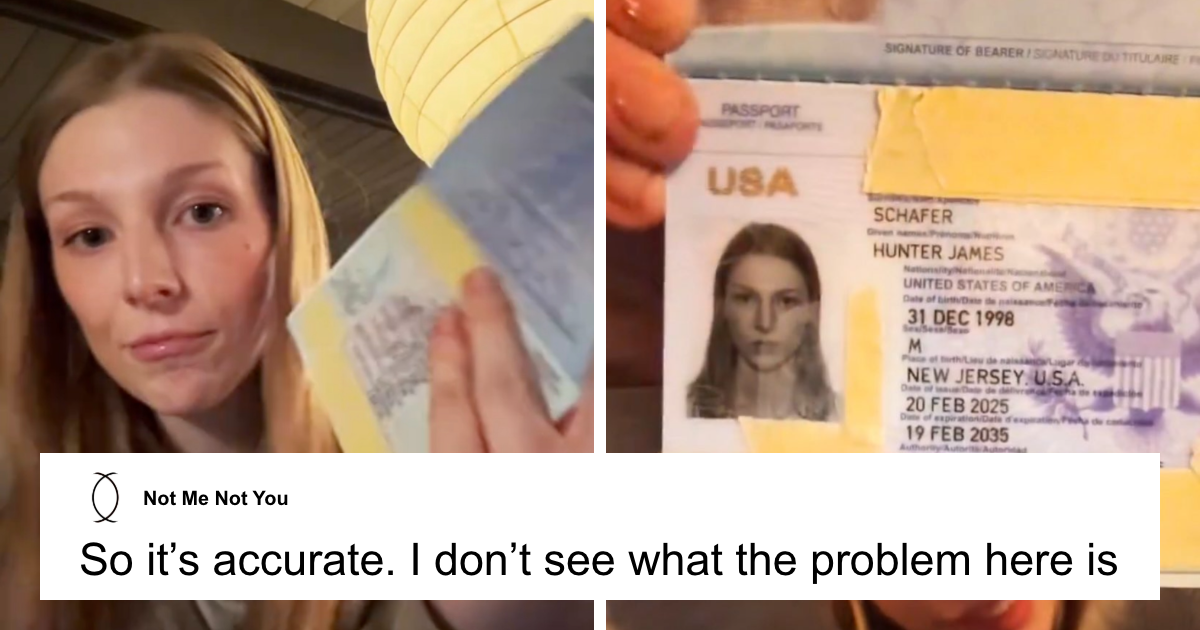
In February 2025, the Euphoria actor revealed that her newly issued U.S. passport listed her sex as male, even though she had selected female on her application and had carried identification with female markers since she was a teenager. The single letter “M” did not change who Schafer was. It did, however, provide a stark example of how a federal policy announcement can move rapidly from a presidential desk to an ordinary person’s most important travel document.
What Happened to Hunter Schafer’s Passport?
Schafer explained in a social-media video that her long-term passport had been stolen while she was working in Spain. She initially received an emergency passport and later applied for a permanent replacement in Los Angeles.
According to Schafer, she completed the application as she normally would and selected female. When the replacement arrived, however, the sex marker was “M.” Her driver’s license and earlier passports had reportedly identified her as female for nearly a decade, although she said her birth certificate had never been amended.
That detail led Schafer to suspect that passport officials had reviewed her birth records or information connected to earlier government documents rather than simply accepting the marker she selected on the new application. The State Department did not discuss her individual file, citing privacy rules, but confirmed that it was implementing the administration’s new policy.
A Policy That Suddenly Became Personal
Schafer acknowledged that she had heard about President Donald Trump’s executive order concerning federal definitions of sex. Initially, she did not expect the announcement to affect her replacement passport so quickly. Receiving the document turned an abstract political debate into a concrete problem she would have to carry through airports, immigration counters, hotels, visa applications, and international productions.
She said the passport would not change her identity or stop her from being transgender. Her concern was practical: a document identifying her as male could force her to disclose that she is transgender whenever an official notices a discrepancy between the marker, her photograph, her other identification, and the way she is perceived.
The passport may contain only one unexpected letter, but that letter can start a very long conversation at the least convenient moment imaginableusually under fluorescent airport lighting while a line of impatient travelers performs synchronized sighing behind you.
Why Did the Government Change the Sex Marker?
On January 20, 2025, President Trump signed Executive Order 14168. The order directed federal agencies to recognize only two sexes, male and female, and defined them according to the administration’s concept of sex at conception. It also instructed agencies responsible for identification documents, including passports and visas, to ensure those documents reflected that definition.
The State Department subsequently stopped issuing passports with an “X” marker and stopped honoring requests for an “M” or “F” marker that differed from the applicant’s sex at birth. Current State Department guidance says new, renewed, and replacement passports are issued with an “M” or “F” marker matching the government’s determination of the applicant’s birth sex.
What Changed From the Previous Passport Rules?
Before the 2025 reversal, U.S. passport policy had gradually made gender-marker updates easier. Starting in June 2021, applicants seeking an “M” or “F” marker different from their other documents no longer needed medical certification of transition. Beginning in April 2022, applicants could self-select “M,” “F,” or “X,” with “X” available for people who identified as nonbinary, intersex, or another gender.
Under that system, a person’s passport marker did not have to match the marker on a birth certificate or driver’s license. The government treated the applicant’s attestation as sufficient for the passport’s sex field. The 2025 policy reversed that approach, making birth records and the State Department’s historical files central again.
That distinction explains why Schafer’s application could say female while the finished passport said male. The new policy was not designed merely to prevent people from selecting “X.” It also directed officials not to accept a transgender applicant’s selection of “M” or “F” when that selection differed from the government’s record of sex at birth.
Why a Passport Marker Matters in Real Life
A passport is more than proof that someone has survived the application process without losing the tiny photograph stapled to a form. It is a primary document for proving citizenship and identity across international borders.
Travelers present passports to airline employees, airport-security personnel, immigration officers, foreign consulates, hotel clerks, employers, banks, universities, cruise operators, and government officials. When a passport marker conflicts with a person’s appearance or other records, it can invite additional questions and scrutiny.
Research from the Williams Institute at UCLA School of Law has found that transgender people with incorrect markers on their identification are more likely to have their names or gender questioned by Transportation Security Administration officers. In the underlying survey data, 18% of transgender respondents with an incorrect passport marker reported such questioning, compared with 6% of those whose passport marker was accurate.
The Risk of Being Involuntarily Outed
For many transgender travelers, the problem is not simply that an official document feels disrespectful. The document may reveal personal information they did not choose to disclose.
Imagine a traveler whose appearance, name, driver’s license, employment records, and airline reservation all identify her as a woman. A passport marked male can prompt officials to wonder whether the document is fraudulent, whether the reservation belongs to someone else, or whether additional verification is needed.
That interaction may happen in a crowded public area. It may occur in a country with weak protections for transgender people. It may involve officials who are unfamiliar with transgender identitiesor officials who are unfortunately very familiar and openly hostile.
TSA guidance focuses primarily on confirming identity rather than requiring travelers to present a particular gender identity. Nevertheless, travelers whose information raises questions can face additional verification or screening. LGBTQ+ legal and civil-rights organizations have warned that inconsistent documents may increase the likelihood of delays, humiliation, discrimination, or unwanted disclosure.
Fame Did Not Exempt Schafer From the Policy
Schafer is internationally recognizable. She has starred in major television and film projects, appeared in global fashion campaigns, and traveled extensively for work. Yet the passport system did not create a celebrity exception, a red-carpet waiver, or a special “but she was in Euphoria” checkbox.
That is partly why her story attracted so much attention. The episode demonstrated that the policy was not merely rhetorical language aimed at energizing a political audience. It had entered the machinery of federal administration and was being applied to real documents.
Schafer also recognized that she had resources many other transgender Americans do not. A famous actor may have attorneys, professional representatives, flexible travel arrangements, and a public platform. An ordinary traveler may discover the same marker days before a family emergency, overseas job assignment, medical appointment, wedding, or long-planned vacation.
Celebrity visibility can make a policy easier for the public to understand, but the people with the greatest difficulties are often those whose stories never trend. They may not have the money to replace documents repeatedly, seek legal advice, rebook missed flights, or challenge an official decision.
The Legal Battle Over Transgender Passport Markers
In February 2025, transgender and nonbinary plaintiffs represented by the American Civil Liberties Union filed Orr v. Trump, challenging the passport policy. They argued that forcing passports to display sex at birth violated constitutional equal-protection guarantees and federal administrative law.
In April 2025, a federal judge temporarily blocked the policy for several named plaintiffs. In June, the court expanded that protection to a broader class of transgender, nonbinary, and intersex passport applicants. The administration appealed and asked higher courts to permit the policy to take effect while litigation continued.
On November 6, 2025, the U.S. Supreme Court granted the administration’s request to stay the lower court’s injunction. The unsigned order allowed the birth-sex passport policy to be enforced during the continuing lawsuit. The Court’s three liberal justices dissented, with Justice Ketanji Brown Jackson emphasizing the possibility of extra scrutiny and humiliation for affected travelers.
What the Supreme Court’s Order Didand Did NotDecide
The Supreme Court’s emergency order was not necessarily the final judgment on every legal claim in the case. It addressed whether the lower-court injunction should remain in effect while appeals and litigation proceeded.
Nevertheless, its practical effect was immediate. Passport Services resumed issuing new, renewed, and replacement passports under the administration’s restrictive rules. The State Department’s guidance, last updated in March 2026, explicitly cites the Supreme Court stay as the reason it will not honor requests for a preferred marker that differs from sex at birth.
Are Existing Passports With F, M, or X Markers Still Valid?
According to current State Department guidance, existing passports remain valid until they expire, are replaced at the holder’s request, or are invalidated under applicable federal regulations. That means a transgender person who already holds an unexpired passport with an accurate “M” or “F” marker generally does not automatically lose that passport solely because the policy changed.
Existing passports with an “X” marker also remain valid under the published guidance. However, a person applying for a renewal or replacement should expect the newly issued document to follow the birth-sex policy currently in force.
This difference makes losing a passport unusually consequential. A document that previously contained an accurate marker may be replaced with one that does not. Schafer’s experience illustrates precisely that risk: she did not voluntarily reopen the marker question as part of a political statement. She needed a replacement because the original passport had been stolen.
Applications requesting an “X” marker or a marker different from sex at birth may also experience delays while officials request additional information. In bureaucratic language, that sounds pleasantly neutral. In real life, “additional processing” can mean refreshing an application-status page so often that the browser begins to feel like a judgmental roommate.
What “So Much Ignorance” Captures About the Debate
The phrase “so much ignorance” appeared in public reactions to Schafer’s case, reflecting frustration that many people view a passport marker as a trivial symbol rather than part of a larger identity system.
Critics of the policy argue that it creates confusion rather than clarity. A passport is supposed to help an official confirm that the document belongs to the person standing in front of them. When the marker conflicts with the traveler’s name, presentation, other records, and everyday identity, the passport may generate questions that would not otherwise arise.
The administration and its supporters frame the policy differently. They argue that the sex field should record what the government considers an objective, historical biological classification and that a federal identification document expresses government information rather than an applicant’s personal identity.
The core disagreement, therefore, is not about typography or whether the letter “M” has behaved badly. It concerns what a passport’s sex marker is supposed to communicate. Is it primarily an immutable birth classification, or should it help identify the person as they are known and recognized today?
Schafer’s experience pushes that argument out of theoretical territory. Whatever language politicians use, the policy determines what happens when an actual person opens an official envelope and discovers that the government has replaced a marker she has used since adolescence.
A Passport Cannot Define a Person, but It Can Complicate a Life
Schafer’s response balanced defiance with realism. She stressed that the new marker did not make her less of a woman and did not alter her transgender identity. At the same time, she refused to pretend that the document was harmless.
Both things can be true. A government record does not possess the philosophical power to decide who someone is. It does possess the administrative power to make that person explain themselves repeatedly.
The lasting significance of the Hunter Schafer passport controversy is therefore larger than celebrity news. Her case shows how a broad executive directive can reshape individual experiences at airports, borders, embassies, workplaces, and government offices.
Policies often arrive dressed in formal language, complete with numbered sections and enough capital letters to intimidate a filing cabinet. Their real meaning emerges laterwhen a traveler receives a document, approaches a checkpoint, and realizes that one small field may now affect every journey that follows.
Experience-Based Perspective: What Carrying a Mismatched Passport Can Feel Like
The following examples are illustrative composites based on documented concerns about inconsistent identity records. They are not presented as Hunter Schafer’s personal experiences beyond what she publicly described.
The Check-In Counter
Imagine arriving at an airport three hours early, as every anxious traveler is instructed to do, only to discover that three hours might not be enough. The airline employee studies the passport, looks at the traveler, and studies the passport again. Nothing has technically gone wrong, but the pause communicates that something is considered unusual.
A supervisor is called. The traveler is asked whether the passport contains an error. Explaining the policy means disclosing that she is transgender to two employees and everyone standing close enough to hear. The interaction lasts five minutes. Emotionally, it can occupy the entire flight.
The Immigration Booth
Now place the same traveler at a foreign border after an overnight journey. She is tired, unfamiliar with local law, and unsure how officials in that country treat transgender visitors. The immigration officer notices the male marker and asks a question she cannot immediately understand.
Perhaps the officer is merely confirming information. Perhaps nothing serious happens. Yet uncertainty is its own burden. The traveler must decide how much to explain, which documents to show, and whether honesty will reduce suspicion or create a new problem.
For a cisgender traveler whose passport matches every other part of their identity, this calculation may never occur. The document is presented, stamped, and returned. That ordinary interaction is precisely what many transgender travelers say they want: not applause, not a parade at baggage claim, just the gloriously boring privilege of being waved through.
The Family Emergency
Consider someone replacing a lost passport because a parent has become seriously ill overseas. The applicant is not thinking about constitutional litigation or executive authority. They are trying to reach a hospital.
If the replacement application is delayed because the selected marker differs from the government’s records, the policy becomes more than an ideological disagreement. It can affect whether a person reaches a loved one in time.
The applicant may contact the passport agency, a congressional office, an attorney, and an advocacy organization. Each call requires another explanation. The administrative process turns private history into a password that must be repeated before assistance becomes available.
The Work Assignment
A transgender employee may also need a passport for a conference or temporary assignment. A mismatched marker can create anxiety about corporate travel systems, visa paperwork, background checks, hotel registration, or meeting local partners.
The employee may disclose the problem to a manager or human-resources representative before traveling. Even in a supportive workplace, this means sharing information that colleagues did not previously need to know. The passport changes not only the border experience but also the level of privacy available at work.
The Quiet Mental Load
The most exhausting part may be preparation. A traveler checks destination laws, prints supporting documents, stores legal contacts, arrives early, rehearses explanations, and worries about whether a routine interaction could become confrontational.
Most trips will not end in detention or a dramatic airport scene. That does not make the concern imaginary. People regularly change their behavior to avoid low-probability but high-consequence events. We lock doors even though burglars do not arrive nightly. We save confirmation emails even though hotels usually find the reservation. We photograph our luggage because airlines occasionally send suitcases on independent spiritual journeys.
For transgender travelers, an accurate passport can reduce one category of uncertainty. An inaccurate marker introduces it again. That is why Schafer’s reaction resonated: she was not claiming that a letter could erase her identity. She was showing that it could create a new obstacle every time someone asked her to prove it.