

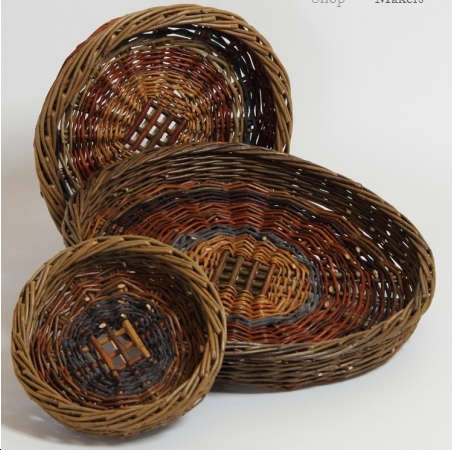
Some baskets are designed to hide clutter. Others are so handsome that hiding them in a cabinet would feel vaguely criminal. Willow Scoib Baskets belong firmly in the second category. With their broad, shallow shape, handwoven character, and unmistakable connection to Irish rural life, these traditional baskets manage to be useful, decorative, historical, and pleasantly unpretentious all at once.
The name may look unfamiliar because several spellings appear in English and Irish references. You may encounter scoib, skib, sciob, skiob, ciseog, or cuiseog. Although details differ by region and maker, these names commonly describe a wide, relatively flat Irish basket traditionally associated with preparing, draining, serving, and eating potatoes. Smithsonian collections specifically identify the traditional skib or ciseog as a basket once used to strain and serve boiled potatoes.
Today, the Willow Scoib Basket has moved comfortably from farmhouse necessity to contemporary home accessory. It can hold fruit, bread, produce, linens, keys, flowers, or precisely nothing at all. Sometimes an object earns its place in a room simply by looking wonderful, and the scoib has had several centuries to practice.
What Is a Willow Scoib Basket?
A traditional scoib is generally a round, open, shallow willow basket. Unlike the tall storage baskets that modern shoppers may picture when they hear the word “wicker,” a scoib has more in common with an oversized woven tray or platter.
The low profile was practical. Cooked potatoes could be drained in the basket, carried to the eating area, and served directly from it. Historical descriptions of Irish scoibs also note that the basket could be supported on a stool or another basket while family members gathered around it. Once the meal was finished, scraps might be knocked out for farm animals before the basket was cleaned and hung up until its next assignment.
In other words, it was the rural Irish version of multipurpose kitchenwareexcept nobody had to find space for another plastic lid.
Scoib, Skib, Sciob, or Ciseog?
The spelling can become confusing when researching these baskets online. “Skib” is widely used in English-language museum references, while “sciob,” “scoib,” and regional Irish names such as “ciseog” also appear. These terms should not always be treated as perfectly interchangeable in every historical or linguistic context, but shoppers searching for the familiar shallow Irish willow potato basket will often see them describing closely related forms.
This vocabulary is useful when buying antique baskets or researching contemporary makers. Searching only for “Willow Scoib Baskets” may produce a small number of results, while terms such as Irish skib basket, ciseog basket, Irish potato basket, and handwoven willow basket reveal a much broader craft tradition.
The Traditional Irish Story Behind the Scoib
Basketmaking is far older than most surviving baskets because natural fibers eventually decay. Nevertheless, basketry has been an essential technology in many cultures for thousands of years. People have woven plant materials into containers for harvesting, cooking, fishing, carrying goods, storage, ceremonies, and trade.
The Smithsonian American Art Museum emphasizes that basketry traditions continue through Indigenous, African, and European influences in the United States, while its collections demonstrate how materials including willow, oak, grass, bark, and other locally gathered fibers connect finished objects directly to the landscapes where makers live.
The Irish scoib belongs to that same broad story of people turning materials available close to home into objects perfectly adapted to everyday life.
Why Potatoes Shaped the Basket
Potatoes became enormously important to Irish food culture, particularly among rural households. A basket used for draining and serving them therefore did not need extravagant decoration or complicated hardware. It needed to work.
The scoib’s open weave allowed water and steam to escape. Its broad surface helped distribute food rather than piling everything into a deep container. Its light weight made it easy to move, while willow provided enough flexibility for weaving and enough strength for repeated household use.
That combination of purpose and simplicity is a major reason the design still looks appealing today. The scoib was not invented by a marketing department searching for something “rustic.” It became rustic because people actually used it in rural life.
Why Willow Works So Well for Basketmaking
Willow is one of basketry’s classic materials for good reason. Certain willow species produce long, relatively straight, flexible shoots that can be woven while properly prepared and become firm as they dry.
Willow can also respond vigorously to coppicingthe practice of cutting stems back so new shoots develop. Penn State Extension describes shrub willow as fast-growing and capable of resprouting after harvesting, characteristics that help explain why willow has been useful wherever renewable supplies of slender woody rods are desired.
Natural Variation Is Part of the Appeal
A handmade willow basket rarely looks as mathematically perfect as something stamped from a mold, and that is precisely the point. Rod thickness can vary. Color shifts naturally. One side may reveal a slightly different rhythm in the weave. The rim may have subtle irregularities that prove human hands, rather than industrial tooling, shaped the object.
Contemporary craft institutions continue to value that relationship between maker and material. The American Craft Council has documented modern artisans working with locally grown willow and traditional techniques, while Smithsonian exhibitions have highlighted basketmakers who gather and prepare natural materials themselves as an essential part of the creative process.
Kathleen McCormick and the Modern Willow Scoib
One widely circulated modern example of the Willow Scoib Basket was associated with Irish basketmaker Kathleen McCormick and featured by design publication Remodelista through Makers & Brothers.
According to that profile, McCormick began learning basketmaking in 1999 after taking time away from the demanding routine of dairy farming. She studied with respected Galway basketmaker Joe Hogan and later grew willow on her own farm near the River Boyne on the Meath-Kildare border.
Her story illustrates something important about traditional craft: preservation does not necessarily mean freezing an object in the past. A basket may retain its historical form while finding completely new uses in modern homes.
How Willow Scoib Baskets Are Made
Traditional basketmaking requires much more preparation than the finished object suggests. The peaceful-looking weave is the final chapter of a considerably longer story involving growing, harvesting, sorting, drying, soaking, trimming, and selecting willow rods.
1. Preparing the Willow
Dried willow generally must be rehydrated before weaving so the rods can bend without breaking. Smithsonian educational material on willow weaving describes a process that includes selecting plant material, cleaning it, soaking it, and preparing it before construction begins.
2. Building the Center
The basketmaker establishes a structural center using stronger rods. Traditional Irish potato baskets can feature distinctive open centers or patterned structures. A Smithsonian example by basketmaker Dorothy Gill Barnes Lewis uses a grid-like “window” center inspired by traditional Irish skib baskets.
3. Weaving Outward
Thinner rods are worked around structural spokes, gradually expanding the circular form. Consistent tension matters. Too loose, and the basket feels floppy; too tight, and rods can kink or distort the shape.
4. Forming the Rim
Finally, the remaining structural rods are turned, tucked, or woven into a border. The rim is not merely decoration. It stabilizes the outside edge, helps the basket keep its form, and gives the piece its finished visual character.
Traditional Function Meets Modern Interior Design
One reason Willow Scoib Baskets have aged so gracefully is that their materials suit current enthusiasm for natural texture. Architectural Digest has repeatedly highlighted woven baskets as objects capable of combining storage with handmade visual interest, while Better Homes & Gardens notes how natural woven fibers can warm rooms that otherwise feel flat or overly polished.
A scoib is especially useful because it is shallow enough to display rather than dominate a surface.
Use One as a Fruit Basket
This is perhaps the easiest modern interpretation. Place apples, pears, citrus, or other firm fruit in the basket and let the open texture provide contrast against smooth countertops.
Turn It Into a Bread Basket
Line the scoib with a clean linen napkin and use it for rolls, biscuits, or a sliced loaf at dinner. The combination of linen and willow produces an effortless farmhouse look without requiring your kitchen to contain either a farmhouse or an actual farm.
Style It as a Table Centerpiece
A shallow woven basket works nicely as a base for seasonal arrangements. Try pinecones and greenery in winter, lemons in summer, small pumpkins in fall, or dried flowers when you want something that will survive your vacation.
Hang It on the Wall
The circular pattern of a scoib can read almost like graphic artwork when viewed vertically. Decorative basket walls have become a familiar interior-design technique because woven pieces introduce dimensional texture without requiring heavy framing.
Use It as an Entryway Catchall
A smaller scoib can hold keys, sunglasses, mail, dog-leash accessories, and the mysterious collection of objects that accumulates near every front door.
Willow Scoib Baskets vs. Ordinary Wicker Baskets
“Wicker” is commonly misunderstood as a particular plant. In practical decorating terminology, wicker usually refers to a method or style of weaving rather than one single raw material. Wicker objects may be constructed from willow, rattan, cane, bamboo, synthetic fibers, or other materials.
A genuine willow scoib is more specific. Its identity comes from the combination of material, traditional form, weaving method, and Irish cultural context.
If you want inexpensive household storage, almost any sturdy woven basket may do the job. If you want an object that carries a recognizable craft tradition and looks equally convincing holding potatoes or hanging in an artfully renovated dining room, the scoib has a stronger case.
How to Choose a Good Handmade Willow Scoib Basket
When comparing baskets, look beyond perfect symmetry. A well-made handmade basket should feel intentional rather than mechanically uniform.
Check the Weave
Look for reasonably consistent tension and rods that sit securely against neighboring elements. Small irregularities are normal. Large gaps caused by loose structural weaving deserve more attention.
Inspect the Rim
The border should feel stable without numerous sharp broken ends. Remember that natural willow is not polished plastic, so tiny fibers or texture are normal.
Ask About the Material
If heritage or sustainability matters to you, find out whether the maker grows or locally harvests willow. For serious craft buyers, information about the artisan and materials can be as meaningful as dimensions and color.
Consider the Intended Use
A decorative wall basket does not need the same strength as one regularly carrying produce. Likewise, a basket used with food should be kept clean and dry and, when appropriate, lined with washable cloth.
How to Clean and Care for Willow Scoib Baskets
Natural basketry prefers gentle treatment. Dust can collect between woven rods, but soaking a finished basket in water is usually unnecessary and may encourage distortion or moisture problems.
Martha Stewart’s guidance for wicker care recommends removing dust first, then cleaning with a lightly dampened cloth and mild cleaning solution without oversaturating the material. A soft brush can help reach tight spaces, followed by thorough air-drying.
Basic Care Routine
- Dust periodically with a soft brush, microfiber cloth, or gentle vacuum attachment.
- Wipe small marks with a slightly damp cloth rather than soaking the basket.
- Allow the basket to dry completely with good airflow.
- Avoid storing it permanently in damp basements or humid enclosed cabinets.
- Keep it away from intense heat that may make natural fibers excessively brittle.
- Do not overload a lightweight decorative scoib with objects it was never designed to carry.
Why Handmade Baskets Still Matter
Mass-produced storage is exceptionally good at being cheap, stackable, and identical. Handmade basketry offers something different: evidence of material, place, time, and skill.
The Smithsonian’s Cole-Ware collection illustrates how baskets can move beyond simple containers to become significant works of contemporary craft while retaining relationships to harvesting and everyday life. Architectural Digest has similarly observed renewed design interest in artisanal baskets that function simultaneously as useful objects and visual statements.
That helps explain the enduring charm of Willow Scoib Baskets. They do not need to choose between function and beauty. Their beauty grew out of their function.
Practical Experience: Living With a Willow Scoib Basket
To understand the appeal of a scoib, consider a realistic week with one rather than viewing it as another carefully staged product photograph. A medium-size basket arrives and initially goes on the kitchen island. Empty, it already changes the surface. A polished countertop can look visually cold when everything on it is glass, steel, stone, or plastic. The irregular willow instantly adds warmth and texture.
The first experiment is fruit. Five apples, several oranges, and a couple of pears fit comfortably without disappearing into a deep basket. This is where the shallow structure proves useful. Everything remains visible, so that lonely pear at the bottom has a better chance of being eaten before achieving archaeological status.
A few days later, the basket moves to the dining table. A linen cloth goes inside, followed by warm dinner rolls. Suddenly the scoib makes even a simple meal feel intentional. It is not formal in the silver-service sense; it feels relaxed, tactile, and welcoming. That is arguably more appropriate for a basket whose ancestors were built for communal potato meals than for ceremonial dining.
After dinner, the basket gets cleaned with a dry brush to remove crumbs. No complicated maintenance ritual is necessary. The open weave makes debris relatively easy to notice and remove. If a small food mark appears, a barely damp cloth handles it, followed by plenty of time to air-dry.
The next styling test is vertical. The basket is emptied and temporarily hung against a plain wall. This produces a completely different effect. From the front, weaving that seemed merely functional on the table becomes a radial pattern. Shadows between the rods add depth, especially when natural light comes from the side. A group of three baskets in slightly different sizes could create an even stronger installation without requiring colorful artwork.
There are limitations, and recognizing them improves the experience. An open scoib is not a good choice for storing hundreds of tiny objects. Pens, coins, craft supplies, and charging cables can poke through openings or produce instant visual chaos. Nor should a delicate handmade basket become the household container for wet towels. Willow appreciates being useful, but it does not need to audition for every job in the house.
The most satisfying use may ultimately be the simplest: leave the basket on a large table with only a few seasonal objects inside. In spring, perhaps use lemons and flowering branches nearby. During autumn, add small gourds. At Christmas, greenery and ornaments can transform it without permanently altering the basket.
Over time, another quality becomes noticeable. Unlike trend-driven decorative accessories with highly specific colors or graphics, natural willow tends to adapt as surrounding decor changes. Move from farmhouse interiors to Scandinavian simplicity, cottage-inspired rooms, traditional decor, or a modern neutral palette, and the basket can still belong. The setting changes the way you read the object more than the object forces a particular setting on you.
That versatility may be the best argument for buying a genuine handmade scoib. You are not purchasing a container for one narrowly defined purpose. You are acquiring a practical piece of craft capable of moving from kitchen to dining room, wall to sideboard, and everyday use to seasonal decoration. Eventually, scratches and slight color changes may develop. With a handmade natural object, those signs do not necessarily diminish its character; they can become part of it.
Conclusion: A Basket With More Than Storage Space
Willow Scoib Baskets demonstrate what happens when everyday design is refined through generations of actual use. Their broad shape traces back to Irish domestic life and the practical business of preparing and serving potatoes, yet the same qualities that once made them useful in a farmhouse make them appealing in contemporary interiors.
Choose one for its craftsmanship, natural willow texture, Irish heritage, or simply because it makes a bowl of apples look surprisingly sophisticated. A good scoib does not shout for attention. It sits quietly, does its job, and somehow makes the room look better while doing it.
In an era crowded with disposable organizers and factory-perfect accessories, that combination of usefulness, history, renewable natural material, and human craftsmanship feels refreshingly permanent. The humble potato basket has earned a rather impressive second career.
SEO Information
Note: “Scoib” appears alongside spellings and regional names including skib, sciob, skiob, ciseog, and cuiseog. This article uses “Willow Scoib Baskets” as the primary term while acknowledging those traditional variations.