

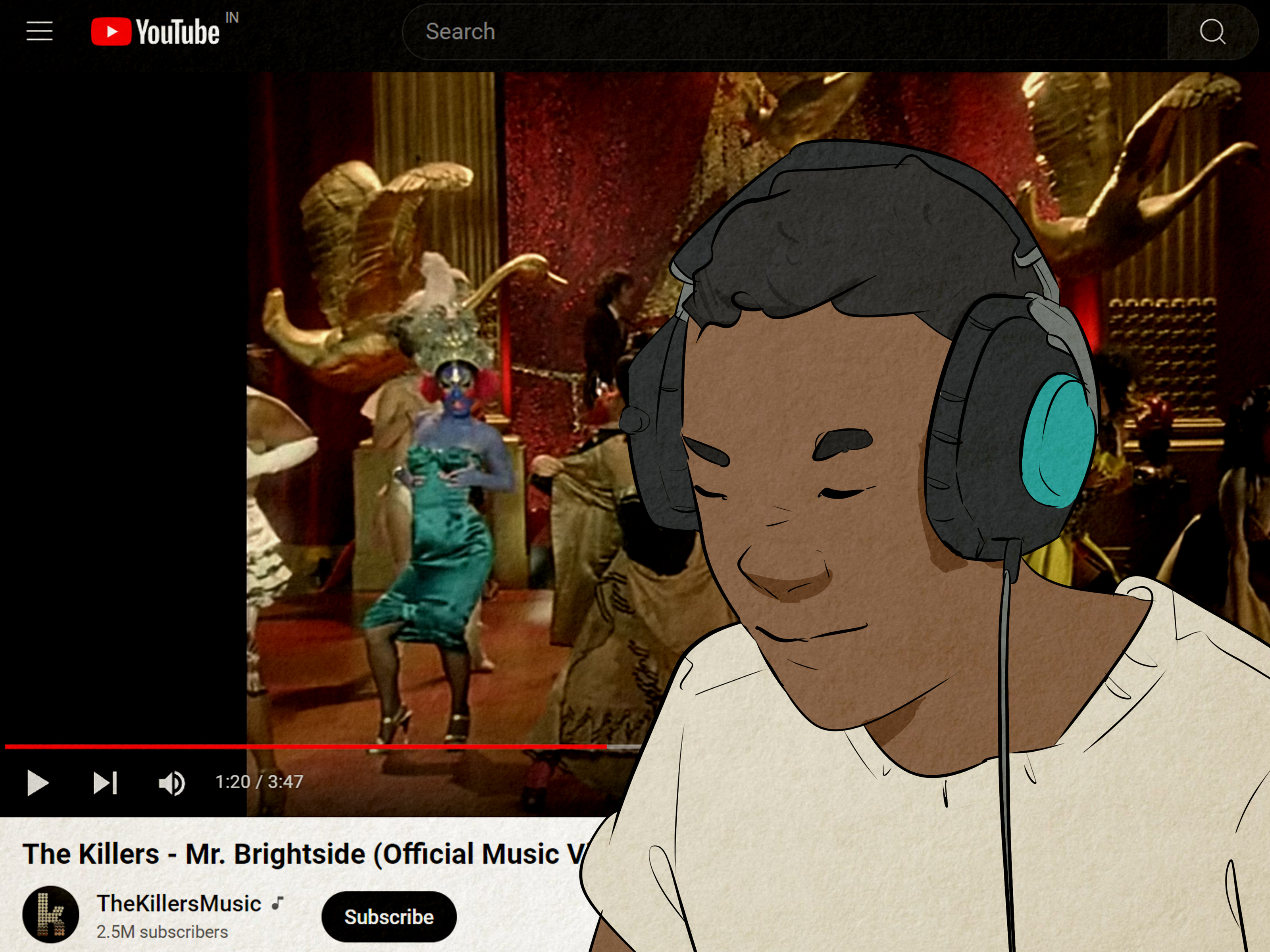
Few songs can turn a room full of rors as quickly as “Mr. Brightside.” The opening guitar pattern arrives, somebody points dramatically at nobody in particular, and within seconds the entire crowd is singing as though everyone has personally investigated a suspicious romantic situation in a Las Vegas bar.
Released by the Killers during the band’s early rise, “Mr. Brightside” sounds triumphant, but its emotional core is anything but cheerful. The song explores jealousy, betrayal, obsessive imagination, wounded pride, and the exhausting mental loop that begins when a person suspectsor discoversthat a romantic partner has chosen someone else.
The title is deliberately ironic. The narrator is supposedly looking on the bright side, yet almost everything happening inside his head is dark, frantic, and increasingly painful. That contrast helps explain why the track has remained so powerful: it converts a private emotional breakdown into an enormous communal celebration.
What Is “Mr. Brightside” Really About?
At its simplest, “Mr. Brightside” is about a man imagining a woman he cares about becoming intimate with someone else. However, calling it merely a song about cheating misses what makes it psychologically convincing.
The song focuses less on the betrayal itself and more on the narrator’s reaction. He does not calmly process what happened, request clarification, or schedule a mature conversation over coffee. Instead, his mind races ahead, constructing a vivid sequence of events that becomes increasingly difficult to escape.
This is jealousy as an internal movie. The narrator sees one troubling moment, then mentally writes, directs, edits, and repeatedly screens the worst possible version of the story. His imagination becomes an emotional accomplice, supplying painful details whether or not he actually witnessed them.
Brandon Flowers has connected the song to the end of his first serious relationship and to discovering his girlfriend with another man at a Las Vegas bar. The emotional wounds were still fresh when he developed the words, which helps explain the performance’s unusual urgency. True Story Behind the Song
Before the Killers became a festival-headlining rock band, Flowers was a young musician attempting to build a life in Las Vegas. Guitarist Dave Keuning had developed the distinctive guitar idea that would become the song’s foundation. After the two connected, Flowers added the vocal melody and lyrics.
The lyrical inspiration came from a painful real-life suspicion. Flowers reportedly sensed something was wrong, went looking for his girlfriend, and found her with another man. That discovery provided the emotional spark for a song that would eventually be shouted at weddings, nightclubs, football games, graduation parties, and probably at least one office holiday event that Human Resources still discusses in hushed tones.
The finished narrative should not necessarily be treated as a precise documentary account. Great songwriting often begins with a real event and then compresses it into a heightened emotional scene. “Mr. Brightside” captures the truth of the narrator’s feelings, even when the details appear filtered through panic, fear, and imagination.
Why the Personal Origin Matters
The backstory matters because the song does not sound like an artist thoughtfully remembering an old breakup years later. It sounds immediate. Flowers performs it as though the discovery is happening while he sings.
There is little emotional distance between the narrator and the event. He has not reached acceptance, gained perspective, or learned a valuable life lesson suitable for a motivational coffee mug. He is stuck in the first brutal stage of heartbreak, when every image feels urgent and every unanswered question becomes its own form of torture.
That authenticity gives the song its lasting emotional credibility. Listeners may not share Flowers’ exact experience, but many recognize the sensation of knowing just enough to become miserable while lacking enough information to feel certain.
Jealousy, Paranoia, and the Unreliable Narrator
One of the most interesting ways to interpret the “Mr. Brightside” lyrics is to view the narrator as unreliable. An unreliable narrator is not necessarily dishonest. He may simply be too emotionally overwhelmed to describe events objectively.
The song moves quickly from observable reality into imagined intimacy. This transition suggests that the narrator’s greatest suffering comes not only from what he knows, but from what he pictures. His mind fills the gaps with scenes designed almost perfectly to hurt him.
The Difference Between Seeing and Imagining
The narrator appears to witness enough to trigger suspicion, but the song’s later details feel increasingly internal. He visualizes physical closeness, emotional replacement, and humiliation. Whether every element literally occurred is almost beside the point. His body reacts as though it did.
This is a realistic portrayal of jealousy. Human beings frequently experience imagined threats with startling intensity. A delayed message, an unexplained absence, or one ambiguous interaction can become the first scene in a mental drama with a terrible ending.
The song never pauses to confirm the narrator’s assumptions. Instead, the arrangement pushes forward while his thoughts accelerate. There is no neutral observer available to say, “Perhaps we should gather more information before emotionally setting the building on fire.”
Jealousy as a Loss of Control
Jealousy in the song is not presented as romantic devotion. It is a loss of control. The narrator cannot stop watching the imagined scene, cannot interrupt his own thoughts, and cannot protect himself from the images his mind keeps producing.
That lack of control is essential to the song’s meaning. He understands that jealousy is consuming him, yet recognizing the problem does not free him from it. The track therefore captures a familiar emotional contradiction: knowing that a thought pattern is unhealthy while continuing to experience it at full volume.
Why Is the Song Called “Mr. Brightside”?
The title offers the song’s sharpest piece of irony. A person described as “Mr. Brightside” would normally be relentlessly optimisticthe friend who finds a positive lesson in a canceled flight, a flooded kitchen, or a haircut that technically qualifies as an emergency.
The narrator, however, is doing the opposite. He is staring directly at the darkest interpretation of events. His thoughts are suspicious, self-punishing, and catastrophic.
The title may represent an attempt at emotional survival. By identifying himself with optimism, the narrator tries to reclaim control over a situation that has made him feel powerless. He cannot change what happened, so he attempts to choose how the story ends inside his mind.
Yet the optimism feels fragile rather than convincing. He reaches toward acceptance, but the rest of the song shows how far away acceptance remains. “Mr. Brightside” is therefore not simply a cheerful nickname. It is a mask worn by someone who is still falling apart underneath it.
Why the Repeated Verse Is So Effective
Unlike a conventional pop song that develops through multiple lyrical verses, “Mr. Brightside” largely repeats the same central verse. Flowers has explained that the unusual structure developed because he had not written another verse, and the repetition remained in the finished song. may have begun as a practical songwriting decision became one of the track’s greatest artistic strengths.
The Structure Mimics Obsessive Thinking
People in emotional distress rarely think in beautifully organized chapters. They replay the same moment. They revisit the same evidence, ask the same questions, and imagine the same outcome with slightly different shades of misery.
The repeated verse recreates that cycle. The narrator does not advance because emotionally he cannot advance. He is trapped in the scene, and the song traps the listener there with him.
By the time the words return, their meaning has changed slightly. The first appearance feels like discovery. The repetition feels like obsession. Nothing new has happened externally, but the emotional pressure has increased.
Repetition Makes the Song Easy to Remember
The structure also contributes to the song’s extraordinary sing-along quality. Listeners hear the same sequence more than once, allowing the words to become familiar almost immediately. Even someone who entered the room halfway through the track can usually join the emotional emergency before it ends.
That memorability has helped “Mr. Brightside” move beyond ordinary hit status. It functions as a collective ritual, with audiences recognizing not just the melody but the precise emotional journey they are about to repeat together.
How the Music Reinforces the Lyrics
The meaning of “Mr. Brightside” is not contained in the words alone. The instrumental arrangement turns the narrator’s jealousy into physical momentum.
Keuning’s bright, rapidly repeating guitar figure creates tension from the beginning. It sounds energetic enough for a celebration but restless enough for a panic attack. That combination defines the entire song: emotionally devastated lyrics delivered by music that refuses to sit still.
A Vocal Performance With Almost No Breathing Room
Flowers delivers much of the narrative in a narrow, insistent melodic range. Rather than gently shaping each line, he pushes forward with the urgency of someone attempting to explain everything before his composure disappears.
The vocal pattern resembles anxious speech. Thoughts arrive faster than they can be processed, producing a performance that feels controlled on the surface and frantic underneath.
As the arrangement expands, his voice becomes more forceful. The shift reflects the narrator’s increasing emotional intensity. He begins by describing a situation and ends by trying to overpower it.
The Production Preserves the Nervous Energy
The recording retained the immediacy of the Killers’ early sessions. Mix engineer Mark Needham has described completing an early mix of “Mr. Brightside” remarkably quickly on a limited console; the raw, energetic result ultimately became central to the familiar recording. production is polished enough to sound enormous but not so polished that it loses its desperation. The instruments press against one another, creating a sense that the song might burst through its own walls.
The Meaning of Destiny in “Mr. Brightside”
Near the emotional peak, the narrator shifts from jealousy toward the language of fate. This suggests that he is trying to convert a humiliating personal experience into something inevitable.
Calling an event destiny can offer comfort because it removes the burden of control. If the relationship’s collapse was unavoidable, perhaps the narrator did not fail. Perhaps he was simply carried toward an ending already waiting for him.
However, destiny can also become an excuse to avoid confronting painful details. The narrator may be attempting to leap directly from betrayal to meaning without passing through the inconvenient middle stage known as honest emotional processing.
This ambiguity gives the ending its power. It can sound hopeful, defeated, defiant, or all three at once. The narrator may finally be moving forwardor merely inventing a grand explanation because reality hurts too much.
Why a Sad Song Sounds So Joyful
“Mr. Brightside” belongs to a beloved category of popular music: songs with miserable subject matter that make people behave as though happiness has been declared mandatory.
The upbeat tempo provides release. Instead of asking listeners to sit quietly with jealousy, the song allows them to move, shout, and transform private pain into public energy. The sadness remains, but it becomes usable.
This emotional contradiction is one reason the song works so well in groups. A lonely ballad can make a listener feel isolated. “Mr. Brightside” makes heartbreak feel crowded. Everyone gets to bring an old disappointment into the chorus, wave it around for a few minutes, and leave slightly lighter.
How “Mr. Brightside” Became a Generational Anthem
The song grew from an early Killers composition into one of the most enduring rock singles of its era. It became especially successful in the United Kingdom, where its chart longevity turned it into a cultural institution rather than a temporary hit. Official Charts has documented its record-setting ability to return, remain visible, and attract steady weekly listening years after its original release. popularity cannot be explained by nostalgia alone. New listeners continue to discover it, and younger crowds often respond with the same enthusiasm as audiences who encountered it in the 2000s.
It Begins Immediately
There is almost no introduction. The song announces itself with its recognizable guitar figure and moves directly into the vocal. In an age of limited attention, that immediate identity is extremely valuable.
It Creates Participation, Not Passive Listening
“Mr. Brightside” does not politely invite a crowd to sing. It appears to seize the microphone, hand everyone an imaginary spotlight, and demand a dramatic personal confession.
The repeated language, rising intensity, and familiar structure make participation nearly automatic. The audience becomes part of the arrangement, especially during live performances where thousands of voices can overwhelm the band itself.
Its Emotions Are Specific but Universal
The song originates in a particular romantic experience, yet its emotional pattern applies far beyond infidelity. Listeners can connect it to rejection, insecurity, exclusion, regret, comparison, or the fear of being replaced.
Nearly everyone has experienced a moment when imagination made a difficult situation worse. “Mr. Brightside” gives that moment a guitar riff.
Is “Mr. Brightside” Ultimately Hopeful?
The answer depends on how generously we interpret the narrator’s final emotional turn.
One reading suggests that he begins to accept the loss. He recognizes that jealousy has imprisoned him and attempts to step outside it. Under this interpretation, the bright side is not pretending that nothing painful happened. It is deciding that the pain will not control the rest of his life.
A darker reading suggests that he has not escaped at all. The repeated verse proves that he remains trapped, and the language of optimism merely covers unresolved anger and humiliation.
The strongest interpretation may combine both views. Recovery rarely arrives as a clean victory. A person can understand that it is time to move on while still replaying the past. The narrator stands between obsession and acceptance, which is exactly where many people find themselves after heartbreak.
The “Mr. Brightside” Experience: Why the Song Feels Personal
Understanding the lyrics intellectually is one thing. Experiencing “Mr. Brightside” in the wild is another. The song often becomes attached to particular rooms, relationships, and stages of life, giving it meanings that extend beyond the original story.
Hearing It After a Breakup
After a breakup, the song can feel less like entertainment and more like an unauthorized reading of private thoughts. The narrator’s inability to stop imagining his former partner with someone else reflects a common post-relationship struggle: the mind continues gathering information long after gathering information has stopped being helpful.
A listener may recognize the temptation to check social media, reinterpret old conversations, or compare themselves with a new romantic interest. Each action promises clarity but frequently produces another question. In this context, the song becomes a warning about the emotional cost of compulsive comparison.
It can also provide relief. Hearing jealousy expressed so openly reduces the shame surrounding it. The emotion may be uncomfortable, but it is not unusual. Millions of people have apparently experienced something similar, and many of them are currently yelling about it beside a sticky dance floor.
Singing It With a Crowd
In a crowded bar or concert, the song’s meaning changes. The original narrative describes isolation, but the performance creates community. Hundreds or thousands of listeners temporarily adopt the same perspective, turning one person’s romantic disaster into a shared release.
This is why the track can feel euphoric despite its subject. The audience is not celebrating betrayal. It is celebrating survival. Everyone knows the narrator is hurting, but everyone also knows he made it far enough to turn the experience into something enormous.
The communal setting also removes the need for dignity. Participants can sing too loudly, point at the ceiling, embrace strangers, and briefly behave as though a professional camera crew is documenting the climax of their personal biopic.
Returning to the Song Years Later
The interpretation often changes with age. A younger listener may identify completely with the narrator and see the romantic rival as the obvious villain. Years later, the same listener may notice the narrator’s assumptions, obsessive thinking, and lack of emotional perspective.
That change does not make the song less effective. It makes it richer. The listener can sympathize with the pain while recognizing that jealousy is not always reliable evidence. The emotional experience remains valid even when the narrator’s conclusions deserve questioning.
Returning to “Mr. Brightside” can therefore feel like meeting an earlier version of oneself: dramatic, wounded, absolutely certain, and perhaps in need of water and a sensible friend.
Using the Song as Emotional Release
The song offers a safe container for feelings that are difficult to express politely. Anger, envy, embarrassment, and grief can all be discharged through its relentless momentum. For a few minutes, listeners do not need to solve those emotions. They only need to keep pace with them.
This may be the track’s greatest achievement. It does not provide relationship advice, moral certainty, or a tidy ending. It simply captures the instant when heartbreak turns the imagination against itselfand then makes that instant exhilarating enough to survive.
Conclusion
The meaning of “Mr. Brightside” lies in the collision between reality and imagination. Inspired by Brandon Flowers’ own romantic heartbreak, the song follows a narrator whose jealousy expands beyond what he can directly observe. He becomes trapped inside a repeating mental scene, while the title’s forced optimism hints at his struggle to regain control.
The repeated verse, urgent vocal delivery, restless guitar work, and accelerating arrangement make the listener experience that emotional loop rather than merely hear about it. Meanwhile, the contrast between painful lyrics and euphoric music transforms private suffering into communal release.
That is why “Mr. Brightside” continues to thrive. It is specific enough to feel honest, broad enough to fit countless personal experiences, and energetic enough to make heartbreak sound temporarily conquerable. The narrator may not have found the bright side yet, but every crowd singing with him helps create one.
Note: This analysis discusses the song’s themes, composition, cultural impact, and publicly documented creative background without reproducing its copyrighted lyrics.