

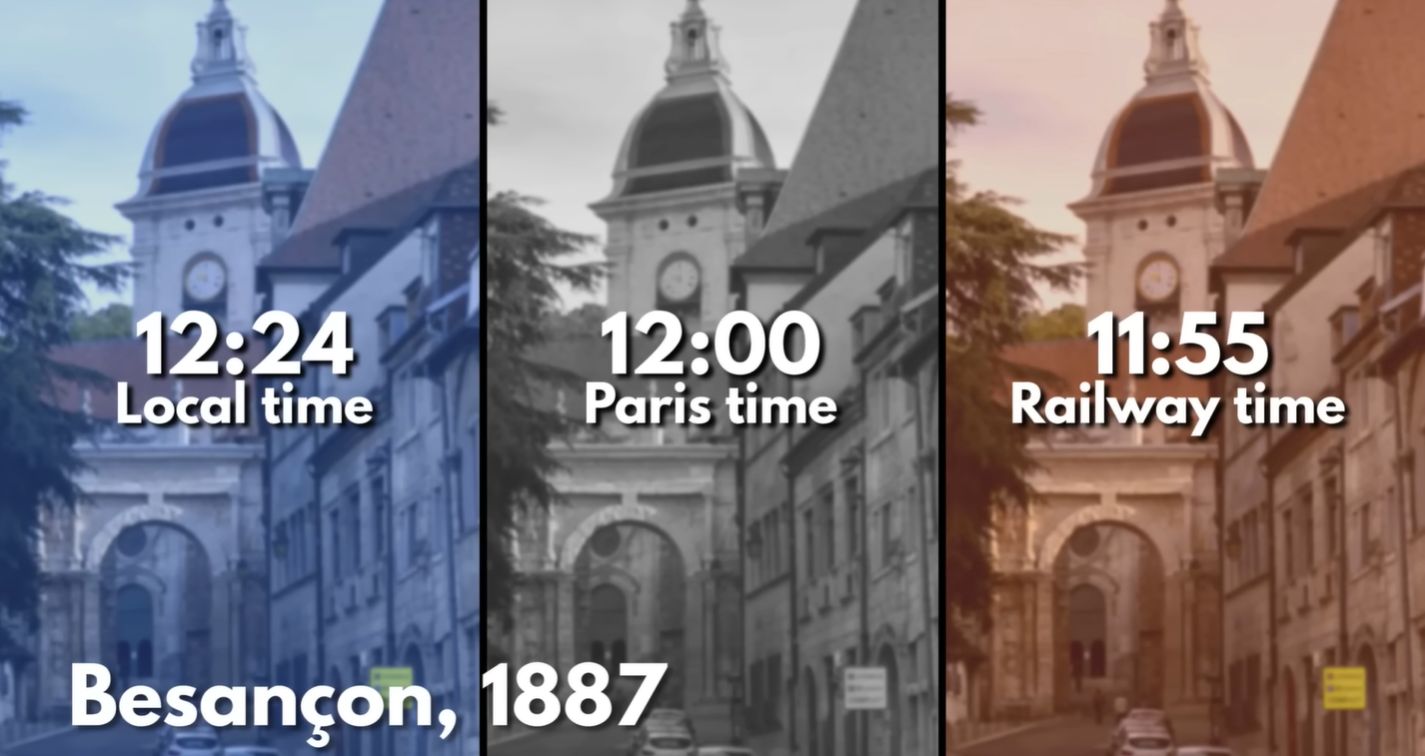
Imagine arriving at a Paris railway station in the late 1800s, checking the city clock, checking the station clock, and discovering that time itself appeared to have missed its connection.
The station clock could be five minutes behind official Paris time. This was not a mechanical failure, a nationwide shortage of competent clockmakers, or an early French experiment in relaxed scheduling. The difference was deliberate. French railway companies operated with a special form of railway time that effectively gave passengers a small cushion before departure.
Today, when smartphones synchronize themselves to atomic clocks and a train app can complain that your train is 47 seconds late, intentionally setting public clocks five minutes slow sounds wonderfully strange. Yet the practice made considerable sense in an era when Europe was struggling to transform thousands of local solar times into coordinated national and international systems.
The story of why France’s railways ran five minutes behind is therefore much bigger than five minutes. It is about railroads, telegraphs, national pride, Greenwich Mean Time, industrialization, passenger behavior, and the moment when humanity realized that modern transportation required everyone to agree on what time it was.
Before Railways, Every Town Could Have Its Own Time
For most of human history, precise synchronization between distant places was unnecessary. Local time was local because daily life was local.
A town could determine noon by watching the sun reach its highest point in the sky. Because Earth rotates continuously, solar noon occurs at slightly different moments at different longitudes. Travel a modest distance east or west, and the local clock might differ by several minutes.
That was barely a problem when traveling 30 or 40 miles might consume most of a day. If your destination’s clock differed from your hometown clock by seven minutes, the horses were unlikely to file a scheduling complaint.
Railroads changed everything.
Suddenly, people could travel between cities faster than the old local-time system was designed to handle. Trains had to meet other trains, use shared tracks, coordinate station staff, publish timetables, arrange connections, and avoid collisions. A system in which every town defined noon independently became less charming and more dangerous.
The telegraph intensified the problem. Information could now move almost instantly between cities whose clocks disagreed. Industrial society was compressing distance, and time had to be compressed with it.
Railways Became Machines for Standardizing Time
Railroads did more than transport passengers and freight. They became some of the most powerful forces for standardized timekeeping in the 19th century.
The same transformation was happening across the Atlantic. American railroads faced an extraordinary patchwork of local and railroad times. In 1883, major railroads in the United States and Canada adopted Standard Railway Time, organizing operations around geographic zones rather than the solar time of individual towns.
The Smithsonian, Library of Congress, U.S. Naval Observatory, NIST, Harvard, PBS, and other historical sources all describe essentially the same industrial problem: faster transportation made traditional local time increasingly impractical.
Railroads needed one answer to a deceptively simple question:
When the timetable says 10:00 a.m., whose 10:00 a.m. are we talking about?
France faced exactly that challenge.
France Turned to Paris Time
As the French railway network expanded during the 19th century, using the local solar time of every city along a route became increasingly impractical. Railway companies therefore used Paris time as an operational reference.
This created a transitional period in which several concepts of time could coexist. A town might still maintain local solar time while the railway operated according to Paris time. Passengers therefore had to understand that the railway clock was not necessarily the same as the clock in the town square.
France eventually standardized legal time nationally. In 1891, metropolitan France and Algeria adopted Paris Mean Time as the official reference.
You might think that would have ended the clock confusion.
France, being France, found room for one more clock.
Why French Railway Time Was Five Minutes Slow
French railway companies maintained a special railway convention under which station and timetable time ran five minutes behind official Paris time.
The practical purpose was simple: it created a grace period for passengers.
Suppose a train was scheduled for 9:00 according to railway time. Because the railway clock was five minutes slow, the corresponding civil time would be approximately 9:05. A traveler rushing into the station shortly after 9:00 by an ordinary Paris clock could discover that the train had not actually departed yet.
In modern language, the railways had built a five-minute buffer into the user experience.
There was no push notification saying, “Boarding closes in five minutes.” No GPS telling you that you were 230 yards from Track 4. No smartwatch vibrating angrily because you had stopped to buy a newspaper.
Instead, the railway adjusted the clock.
Historical descriptions indicate that travelers could encounter different clocks around a station. Scientific American reported in 1911 that clocks inside French stations were regulated according to the railway standard, while clocks outside could display the correct Paris time.
The arrangement sounds confusing today, but its logic was surprisingly human: railway operations needed precision, while railway passengers occasionally needed mercy.
The Curious Connection With Rouen
The five-minute offset was sometimes associated with Rouen time. That was not entirely arbitrary.
Rouen lies west of Paris, and its local solar time was approximately five minutes behind Paris time. Historical calculations placed the difference at roughly four minutes and 58 secondsclose enough to make “Rouen time” a remarkably convenient nickname for the railway’s five-minute delay.
Thus, in an age obsessed with increasingly exact timekeeping, railway travelers could encounter official Paris time, older local solar traditions, and railway time operating almost side by side.
If your modern office has three wall clocks showing different times because nobody changed the batteries together, congratulations: you have accidentally recreated part of 19th-century transportation history.
Was This the Same as Trains Running Five Minutes Late?
No, and this distinction matters.
Saying that French trains “ran five minutes late” can create the wrong impression. The railway system was not necessarily failing to meet its own timetable. Rather, the timetable itself was based on a clock intentionally set five minutes behind civil Paris time.
If a departure was listed as 3:20 p.m. railway time, railway employees could dispatch the train at 3:20 according to their operational clock. Against official civil time, however, that moment would be about 3:25.
The train could therefore be perfectly punctual according to railway time while appearing five minutes late according to another clock.
It is a beautiful example of how punctuality depends on agreeing about the clock before arguing about the train.
Why Railroads Needed Such Precise Timekeeping
The five-minute passenger cushion was charming, but railway timekeeping itself was deadly serious.
Timetables Had to Coordinate Multiple Stations
A railway timetable connects dozens or hundreds of events. A departure from one station affects an arrival at another, which affects a connection somewhere else. Small inconsistencies can spread through the network.
Shared Tracks Made Timing a Safety Issue
Early railway operations frequently depended on schedules to organize the movement of trains over limited infrastructure. Accurate clocks were therefore part of railway safety, not merely customer convenience.
Telegraph Networks Made Synchronization Possible
Electrical telegraphy allowed observatories and railway organizations to transmit precise time signals over long distances. Harvard College Observatory, for example, established a public telegraphic time service in 1851, illustrating how astronomy, telecommunications, and transportation increasingly became interconnected.
The railroad station clock was no longer just a clock. It was the visible endpoint of an emerging technological network.
Meanwhile, the World Was Moving Toward Greenwich
National standardization solved only part of the problem. International shipping, telegraphy, science, and transportation still faced competing national meridians.
In October 1884, representatives of nations met at the International Meridian Conference in Washington, D.C. The conference selected the meridian passing through Greenwich, England, as the international prime meridian.
France was not enthusiastic.
The choice involved science and practical navigation, but national prestige was impossible to ignore. Paris had its own distinguished astronomical tradition and its own meridian. Accepting Greenwich meant accepting a British reference point at a time when the two countries had spent centuries perfecting the art of being neighbors without making it look easy.
France abstained when Greenwich was selected at the conference and continued to use Paris-based legal time afterward.
Paris Was 9 Minutes and 21 Seconds Ahead of Greenwich
The Paris meridian lies east of Greenwich, which meant Paris Mean Time was approximately nine minutes and 21 seconds ahead of Greenwich Mean Time.
That offset was manageable within France but increasingly awkward in a world moving toward international standards.
Consider the layers involved around the beginning of the 20th century:
- Greenwich Mean Time was becoming an important international reference.
- French legal time followed the Paris meridian.
- French railway time was another five minutes behind Paris civil time.
A few minutes here and nine minutes there may sound trivial. For international schedules, communications, financial activity, navigation, and scientific observation, however, every conversion created another opportunity for mistakes.
The 1911 Reform Ended the Five-Minute Railway Quirk
France finally changed its legal time system in March 1911.
The country’s clocks were shifted back by nine minutes and 21 seconds, bringing French civil time into alignment with Greenwich-based Western European time. Contemporary reports in Scientific American and Nature described the change as a major step toward international standardization.
French lawmakers famously avoided giving Greenwich excessive rhetorical satisfaction. The legal formulation could describe the new standard as Paris Mean Time delayed by nine minutes and 21 seconds rather than simply announcing that France had surrendered its clocks to Greenwich.
Technically correct? Absolutely.
Diplomatically hilarious? Also yes.
The reform also removed the special five-minute railway offset. Station clocks, civil clocks, and train schedules could finally operate from the same standard.
France had entered a new era in which a passenger could look at a clock without first asking which philosophy of time it represented.
France Was Part of a Much Larger Timekeeping Revolution
Although the French five-minute rule was unusual, the broader problem was universal.
In North America, railroads replaced scores of competing railway times with standardized zones in 1883. Britain had already moved toward common railway time decades earlier. International navigation increasingly relied on Greenwich. Telegraph networks distributed clock signals. Observatories became providers of precise time as well as centers of astronomy.
Eventually, governments formalized systems that private transportation networks had helped create.
The progression tells us something important about technology: infrastructure does not merely operate inside society’s rules. Sometimes it forces society to invent new rules.
Railroads changed landscapes, economies, migration, commerce, and warfare. Less visibly, they also changed humanity’s relationship with the clock.
Before railways, noon could be whatever the sun said it was in your town. After railways, noon needed paperwork.
What Railway Time Teaches Us About Modern Technology
The French railway-time story feels antique, but its basic problem is surprisingly modern.
Engineers often create one system for technical operations and another for human behavior. Airlines tell passengers that boarding closes before departure. Concert venues print door-opening times. Online auctions synchronize to server clocks. Computer networks rely on standardized time protocols. Financial exchanges measure events down to fractions of a second.
The principle is the same: coordinated systems require a shared definition of “now.”
France’s five-minute railway clock added another ideathe usefulness of a behavioral buffer. Instead of assuming every traveler would arrive with perfect timing, the railway system accommodated ordinary human imperfection.
There is something almost elegant about it. Modern technology usually tries to make humans obey increasingly precise clocks. The French railway system briefly made the clock bend for the humans.
Passenger Experience: What Those Five Minutes Might Have Felt Like
To understand why the system lasted, it helps to imagine the experience rather than looking only at the mathematics.
Picture a traveler in Paris around the turn of the 20th century. There is no digital ticket in a smartphone wallet. The traveler may have paper luggage, trunks, a printed timetable, perhaps a pocket watch, and a station crowded with porters, families, vendors, railway workers, and passengers trying to identify the correct platform.
Reaching the station itself could involve walking, a horse-drawn cab, an omnibus, or another urban railway connection. Traffic could not be checked on Google Maps. A delayed carriage did not automatically recalculate an arrival estimate.
Then comes the familiar moment experienced by travelers in every century: the realization that departure time is getting dangerously close.
You enter the station believing the train leaves at 10:00. Your watch says 10:02.
Your heart sinks.
Then you look at the railway clock.
It says 9:57.
Suddenly, civilization seems marvelous again.
The five-minute railway offset did not eliminate missed trains, of course. Someone determined enough can miss transportation under any known timekeeping system. But it created a practical margin between official civil time and railway departure time.
There was also a psychological effect. A passenger looking at the station clock interacted with the railway’s version of time. Once inside the station, railway time governed the environment. The building effectively became its own temporal zone.
That experience would probably feel bizarre to a modern traveler at first. We expect clocks to agree. If a station clock today differed from a phone by five minutes, most passengers would assume somebody needed to call maintenance.
Yet modern transportation quietly preserves similar buffers.
An airline may schedule a 3:00 p.m. departure but close the aircraft door earlier. A high-speed railway may recommend arriving well before the listed departure. Airports tell international passengers to appear two or three hours before takeoff. Events advertise different times for doors opening and performances beginning.
We no longer manipulate the clock itself; we manipulate the instructions around it.
That makes French railway time fascinating because it solved a recognizable modern problem using a method that now seems almost unthinkable. Rather than telling passengers, “Please arrive five minutes early,” the railway effectively moved scheduled railway time five minutes later relative to civil time.
There is also something wonderfully physical about the system. Time was visible on giant station clocks. Travelers relied on public clocks because personal watches varied in quality and not everyone carried one. The station clock had authority. People raised their heads, found the dial, and organized their movements around its hands.
Compare that with today’s railway experience. Modern passengers often walk through spectacular historic stations without noticing the enormous clock overhead because the authoritative clock is now a four-inch screen in their hand. That phone receives time from networks ultimately connected to standards of precision unimaginable to a 19th-century passenger.
Yet the emotional experience has barely changed.
You still hurry down a platform. You still search for the carriage number. You still wonder why the person directly in front of you has chosen this precise moment to stop walking. And when you reach the train with two minutes remaining, those two minutes feel like a personal gift from the universe.
French travelers received five.
Conclusion: Five Minutes That Helped Change the Meaning of Time
The story of French railway time is more than a historical curiosity about clocks running slow. It captures a turning point when transportation technology forced societies to rethink something people had once considered natural.
Before modern railways, time could belong to individual towns. After railways connected those towns, time increasingly had to belong to networks.
France standardized around Paris, railway companies introduced their memorable five-minute passenger buffer, and international pressure eventually pushed the country toward the Greenwich-based system in 1911. What began as a practical railway problem became part of the worldwide transformation from local solar time to synchronized modern timekeeping.
So were French railways really five minutes late?
Not exactly.
They were operating according to a different clockand giving hurried passengers one last chance to catch the train.
Note: The historical narrative above is an original synthesis of transportation, museum, scientific, government, and timekeeping research. The five-minute difference refers to the historical railway-time convention rather than ordinary train delays.