

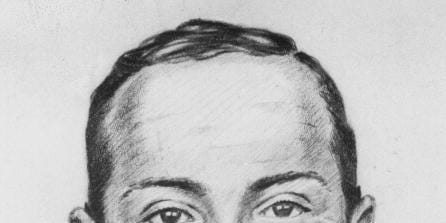
For nearly half a century, one man in a dark suit managed taving a satisfying explanation. He bought a short airline ticket under the name Dan Cooper, claimed he had a bomb, collected $200,000 and four parachutes, and vanished from the rear of a Boeing 727 into a cold Pacific Northwest night.
In July 2016, the FBI suspended active work on the legendary D.B. Cooper case after 45 years. The decision did not identify the hijacker or determine whether he survived. It acknowledged that decades of tips, searches, forensic testing, and suspect interviews had failed to produce evidence strong enough to prove who Cooper was. The government stepped away, but the mystery refused to leave.
Sources:
The Hijacking That Became an American Legend
A One-Way Ticket to Infamy
On November 24, 1971, the day before Thanksgiving, a nondescript man approached the Northwest Orient Airlines counter in Portland, Oregon. He paid cash for a one-way ticket to Seattle and gave his name as “Dan Cooper.” Wearing a business suit, black tie, white shirt, loafers, and dark sunglasses, he looked more like a traveling salesman than the future star of America’s most famous unsolved skyjacking.
After Flight 305 took off, Cooper handed a note to flight attendant Florence Schaffner. She initially assumed it was a phone number and placed it in her purse. Cooper calmly indicated that she should read it because he had a bomb. He opened an attaché case enough to reveal wires and red-colored objects. Whether the device was real has never been established, but nobody aboard volunteered to conduct the world’s worst in-flight inspection.
Cooper demanded $200,000 in $20 bills, four parachutes, and a fuel truck waiting in Seattle. Witnesses remembered him as controlled and generally polite. He drank bourbon and soda and showed no interest in harming passengers as long as his instructions were followed.
Sources:
The Ransom Exchange and the Jump
When the plane landed at Seattle-Tacoma International Airport, authorities delivered the money and parachutes. Cooper released the passengers, kept several crew members aboard, and ordered the aircraft toward Mexico with a planned refueling stop in Reno, Nevada.
His choice of plane mattered. The Boeing 727 had a rear stairway that could be lowered in flight. Cooper instructed the crew to fly low with the cabin unpressurized, then sent the flight attendant forward and remained alone in the rear cabin.
A little after 8 p.m., somewhere between Seattle and Reno, the crew felt a noticeable movement in the aircraft. Cooper had apparently lowered the stairs and jumped into darkness carrying the ransom. He wore ordinary business clothes and entered rain, wind, and rugged terrain. It was either a brilliantly calculated escape or an extremely expensive way to lose a loafer.
Sources:
How “Dan Cooper” Became “D.B. Cooper”
The hijacker used the name Dan Cooper, not D.B. Cooper. Early reporting connected the crime to an Oregon man with the initials D.B., although investigators quickly determined that he was not the skyjacker. The mistaken name raced through wire reports and headlines, and the public kept it.
The FBI later considered whether “Dan Cooper” came from a French-language Canadian comic-book hero who parachuted from aircraft. That possibility suggested the hijacker might have encountered the comics abroad or in Canada, but it never became proof. Even his famous name remains a mixture of fact, error, and theorya perfect summary of the whole case.
Sources:
Inside the FBI’s 45-Year NORJAK Investigation
Hundreds of Suspects and Persistent Forensics
The FBI named the investigation NORJAK, short for Northwest Hijacking. Agents interviewed witnesses, coordinated searches, examined the aircraft, tracked ransom serial numbers, tested physical evidence, and investigated hundreds of suspects. By the fifth anniversary, the bureau had considered more than 800 people and eliminated all but a small group from serious consideration.
Evidence left on the plane included Cooper’s black clip-on tie and tie clasp, along with fingerprints and parachute-related items. The tie later yielded a DNA sample, but not the clean, courtroom-ready answer that television crime dramas usually deliver before the final commercial break.
Investigators distributed the ransom serial numbers to banks, casinos, and law enforcement agencies. Yet no confirmed spending spree, bank deposit, or suitcase of matching bills exposed the hijacker.
Sources:
The $5,800 Found at Tena Bar
The biggest physical breakthrough came in 1980. Brian Ingram, a child digging in sand along the Columbia River near Vancouver, Washington, uncovered decaying bundles of $20 bills. Their serial numbers matched the Cooper ransom, and the total was $5,800.
The discovery proved that some of the money reached the riverbank, but it raised new questions. Did Cooper lose it during the jump? Did water move it? Was it buried later? Why were only a few bundles found? No theory has reliably reconstructed Cooper’s route, landing point, fate, and identity from the evidence. Most of the ransom, the escape parachute, and Cooper himself remain missing.
Sources:
Why the FBI Suspended the D.B. Cooper Case
On July 8, 2016, the FBI redirected NORJAK resources toward other priorities. The bureau said it had reviewed credible leads, collected available evidence, interviewed identified witnesses, coordinated among field offices, and applied newer investigative techniques as they emerged. None produced a definitive identification.
The decision was practical. Every new tip required agents to evaluate names, stories, photographs, alleged confessions, claims of sudden wealth, and objects supposedly linked to the hijacking. Most led nowhere. Continuing to chase speculation meant diverting manpower from cases involving current threats, living victims, and evidence that could still support prosecution.
Crucially, the FBI did not announce that Cooper had been identified or the crime solved. It preserved the evidence and said authorities should still be contacted if specific physical evidence appeared, especially a parachute or ransom money. The case went onto a very high shelf; it was not launched into the sun.
Sources:
Did D.B. Cooper Survive?
The skeptical case is powerful. Cooper jumped at night into bad weather over difficult terrain, wearing a suit and loafers while carrying a heavy bag of cash. The FBI has long considered it possible, even likely, that he died during the escape.
The survival argument points to his knowledge of the Boeing 727, his selection of the rear stairs, his flight instructions, and his calm behavior. Those details may suggest military, aviation, or parachuting experience. Supporters also note that searches did not produce a confirmed body, canopy, or impact site.
Neither position settles the matter. Skilled people make fatal mistakes, and reckless people sometimes survive astonishing odds. Cooper may have been an expert, an informed amateur, or a confident improviser who knew just enough to become permanently confusing.
Sources:
The Suspects and New Clues That Kept the Mystery Alive
Richard McCoy Jr., who carried out a similar parachute hijacking in 1972, became one of the most discussed suspects. Robert Rackstraw, Lynn Doyle Cooper, and numerous military veterans, pilots, aerospace workers, and criminals also inspired books, documentaries, and private investigations. Some matched parts of the description or possessed relevant skills. None was tied to Flight 305 by a complete, publicly verified chain of evidence.
After 2016, independent researchers continued studying microscopic particles on Cooper’s tie, arguing that traces of titanium and other industrial materials might point toward aerospace, metallurgy, electronics, or manufacturing work. Other theories relied on alleged coded letters, fabric fragments, DNA comparisons, and newly discovered parachutes.
In 2024, renewed attention centered on a parachute found on property associated with McCoy’s family. The claim generated headlines, but the FBI did not publicly announce that it solved the case, and the theory remains disputed. As of 2026, no publicly verified development has established Cooper’s identity. Resemblance is not identification, opportunity is not proof, and a dramatic family story remains a story until physical evidence supports it.
Sources:
How the Cooper Hijacking Changed Aviation
Cooper’s escape exposed a vulnerability in the Boeing 727. The Federal Aviation Administration later required a device commonly called the “Cooper vane,” an external latch that prevents the rear stairs from being lowered during flight. His crime also occurred during an era of frequent American skyjackings, when airport screening was far lighter than modern travelers would recognize.
The broader wave of hijackings accelerated stronger passenger screening and baggage inspection. Cooper became the glamorous face of the era in popular culture, but the practical consequence was less romantic: airlines and regulators made repeating his stunt far more difficult. In folklore, he beat the system. In aviation history, he helped force the system to change.
Sources:
Why America Still Cannot Let D.B. Cooper Go
The story has the structure of a perfect modern myth: a mysterious stranger, a bag of money, a stormy night, a daring leap, and no final scene. There is no arrest photograph, verified confession, courtroom testimony, or grave marked with the answer.
That absence lets audiences create the Cooper they prefer. Some imagine a clever antihero who embarrassed powerful institutions. Others see a reckless criminal who probably died minutes after his escape. Investigators saw an unidentified hijacker whose threat terrified a crew and endangered everyone aboardthe detail that romantic retellings tend to crop out.
Every clue therefore becomes an invitation. A tie particle becomes a profession. A parachute becomes a suspect. A family rumor becomes a documentary. The fewer confirmed facts available, the more imaginative space remains, and Cooper has been living rent-free in that space since 1971.
Sources:
Experience Section: What Following the D.B. Cooper Mystery Teaches Us
Reconstructing an Incomplete Story
Researching the D.B. Cooper case is an exercise in intellectual humility. At first, the story seems simple enough to fit on a cocktail napkin: man boards plane, demands money, jumps, disappears. Then the details multiply. Witness memories vary. Flight-path calculations shift. Weather conditions are debated. Suspects look convincing until one inconvenient fact arrives and kicks over the theory.
The experience resembles assembling a puzzle from several boxes, with half the pieces missing and someone insisting the picture is definitely a moose. It teaches an important habit: separate evidence from inference. The ticket, ransom demand, aircraft, tie, parachutes, jump, and recovered bills are evidence. Claims about Cooper’s profession, landing point, survival, and identity are interpretations.
Seeing the Pacific Northwest as Evidence
For travelers and history enthusiasts, the case changes how ordinary places feel. Portland marks the departure. Seattle-Tacoma International Airport hosted the ransom exchange. The Columbia River became part of the evidence when confirmed bills appeared on its bank. Rural Washington contains possible landing zones, each forest road and river bend looking ready for an unsolved chapter.
The responsible experience is historical, not a license to trespass or dig up private property. Understanding the region’s distances, weather, rivers, and thick evergreen terrain explains why searches were so difficult. “Somewhere in the Pacific Northwest” is not a useful address. It is an efficient way to lose nearly anything.
Becoming a Responsible Armchair Investigator
The case is unusually accessible because the public can examine FBI files, witness descriptions, photographs, and decades of reporting. Readers can compare timelines and test theories. The danger appears when someone becomes emotionally attached to a suspect and every fact begins to look cooperative.
A careful investigator asks disconfirming questions. What would prove the theory wrong? Does the suspect match witness recollections rather than merely resembling a famous sketch? Is the timeline physically possible? Is an alleged artifact documented from 1971, or did its story begin decades later? Can independent experts reproduce the conclusion?
That experience reaches beyond true crime. It is training in media literacy. A confident narrator, ominous soundtrack, and side-by-side photograph can make a theory feel solved without adding one verified fact.
Accepting an Unsolved Ending
The hardest lesson is that effort does not guarantee closure. Modern audiences expect a DNA match, hidden confession, or final reveal. Cooper offers no such courtesy. The FBI’s suspension shows that more information does not always create certainty.
Perhaps a verified parachute, matching ransom bundle, or reliable DNA connection will emerge. Until then, the honest approach is to study the evidence, enjoy the mystery, and leave room for uncertainty. Cooper’s greatest trick may not have been escaping the plane. It may have been escaping certainty.
Sources:
Conclusion
The FBI suspended the active D.B. Cooper investigation because 45 years of work had not produced proof capable of identifying and prosecuting the hijacker. The bureau preserved the evidence, redirected resources, and left a narrow door open for genuine physical discoveries involving the parachutes or ransom money.
That decision closed an investigative era, not the legend. Cooper may have survived and quietly disappeared. He may have died before spending a dollar. He may have been one of the famous suspects, or someone whose name never appeared in a documentary.
For now, the final line remains unchanged: a man called Dan Cooper jumped from an airplane in 1971, and the world still does not know where he landed.
Note: The FBI’s 2016 action is most accurately described as suspending active investigation and redirecting resources. It was not an announcement that the hijacker had been identified or that the historical mystery had been solved.
Sources: