

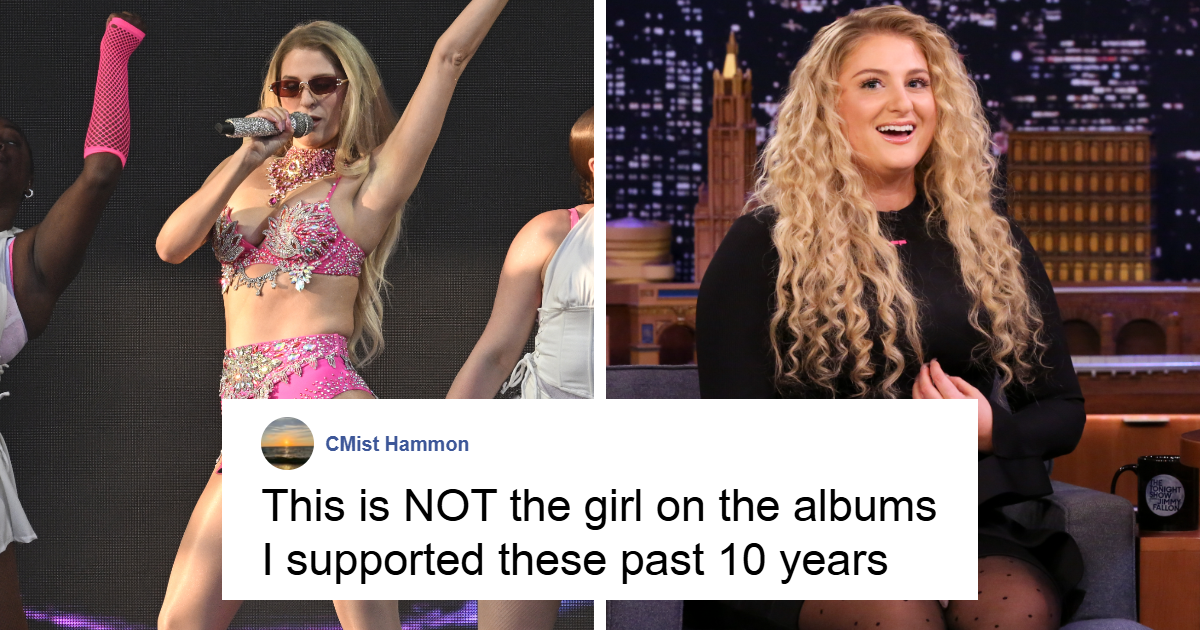
Editor’s note: This article is based on public reporting from reputable U.S. entertainment, music, health, and culture outlets, including coverage of Meghan Trainor’s 2025 Wango Tango performance, her comments about cosmetic surgery, her weight-loss journey, and the long-running discussion around “All About That Bass.”
Meghan Trainor has never been a quiet pop star. From the first pastel-colored boom of “All About That Bass” in 2014, she built her brand on confidence, retro-pop sparkle, and the kind of chorus that can move into your brain without paying rent. But more than a decade later, one small lyric change during a live performance set off a very modern internet debate: Can a body-positive anthem keep the same meaning when the artist’s body, image, and public message have changed?
The discussion exploded after Trainor performed at 102.7 KIIS FM’s Wango Tango in California in May 2025 and replaced one of the song’s most recognizable body-image lines with a joking reference to her breast augmentation. Instead of singing, “I ain’t no size two,” she sang, “I got some new boobs.” The moment was brief, playful, and very Meghan Trainor. The reaction, however, was anything but small.
Some fans laughed and treated the lyric swap as harmless stage banter. Others said the song had “lost its meaning,” arguing that a track once associated with self-acceptance now sounded like a commercial jingle for reinvention. As usual, the internet put on its judge’s wig, grabbed a megaphone, and held court in the comment section.
Why Meghan Trainor’s Lyric Change Became A Big Deal
On paper, this was one changed line in one live performance. Artists do this all the time. They update lyrics, make jokes, shout out cities, tease fans, and adjust old songs to fit new eras. But “All About That Bass” is not just any old song in Trainor’s catalog. It is the song that introduced her to the world, topped charts, earned major award recognition, and became a cultural shortcut for 2010s body positivity.
That is why the lyric change hit a nerve. The original song arrived at a time when mainstream pop was starting to talk more openly about body image, curves, self-love, and the narrowness of beauty standards. Trainor’s doo-wop-inspired hit positioned her as a cheerful challenger to the size-zero ideal. The message was simple: you do not have to shrink yourself to be attractive, lovable, or worthy of a dance floor moment.
But the song was never free from criticism. Even back in 2014, some listeners praised it as a confidence anthem while others argued that it leaned too hard on comparing women’s bodies. Critics pointed out that celebrating one body type by poking at another is not exactly the gold medal version of empowerment. In other words, “All About That Bass” has always been both catchy and complicatedlike a glitter-covered emotional support kazoo.
The Plastic Surgery Context: What Meghan Trainor Has Shared
The lyric update did not happen in a vacuum. Trainor had already spoken publicly about undergoing breast surgery, including a breast lift and implants, after pregnancy, breastfeeding, weight loss, and lifestyle changes affected how she felt in her body. She has framed the procedure as something she wanted for confidence, not as a rejection of her past self.
Trainor has also been open about other cosmetic and wellness choices. She previously discussed having too much Botox and a lip-related procedure that affected her smile, later using the experience as a cautionary tale about researching treatments and understanding possible results. She has also spoken about using medical support, nutrition guidance, strength training, and lifestyle changes during her post-pregnancy health journey.
That openness is part of what makes the debate messy. Trainor is not pretending nothing changed. She is not whispering behind a curtain while pretending the curtain is naturally lifted. She has been unusually direct about her body changes, and that honesty deserves some credit. At the same time, fans are allowed to examine how those changes interact with the message that made her famous.
From Body Positivity To Body Autonomy
The Meghan Trainor lyric controversy highlights a bigger cultural shift. In the early 2010s, “body positivity” often meant celebrating bodies that had been excluded from mainstream beauty standards. It pushed back against the idea that thinness was the only acceptable form of beauty. Today, the conversation has expandedand sometimes splinteredinto terms like body neutrality, body autonomy, wellness culture, and self-optimization.
Body positivity asks society to respect and celebrate different bodies. Body autonomy says each person has the right to make choices about their own body, including choices other people may not understand. The Trainor debate sits right at the intersection of those two ideas. Can someone champion self-love and still choose cosmetic surgery? Yes. Can fans feel confused when a body-positive star jokes about a surgically altered body while singing her old anthem? Also yes.
The problem comes when either side gets too tidy. It is too simple to say Trainor betrayed her message just because she changed her body. It is also too simple to say fans have no reason to feel uneasy. Pop music does not exist in a private diary. Once a song becomes an anthem, listeners attach their own memories, insecurities, victories, and mirror pep talks to it. When the artist changes the frame, the audience notices.
Why Some Fans Felt The Song “Lost Its Meaning”
For many listeners, “All About That Bass” was not merely a pop single; it was a permission slip. It told them they could take up space. It arrived with a candy-colored video, vintage styling, and a wink that made confidence feel accessible. For anyone who had spent years hearing that smaller was better, the song felt like a neon sign flashing, “Relax, you are allowed to exist.”
So when Trainor swapped a size-related lyric for a line about cosmetic enhancement, some fans heard more than a joke. They heard a shift from acceptance to alteration. They wondered whether the song’s original message still stood if the singer now appeared to be pursuing a more conventional celebrity beauty ideal: slimmer body, enhanced curves, polished glam, and carefully managed public transformation.
That does not mean their interpretation is the only fair one. But it explains the emotional charge. People rarely argue this intensely about a lyric unless the lyric is connected to something personal. Nobody is writing a 12-post thread because a singer changed “tonight” to “Los Angeles.” They react because the song once helped them feel seen.
Why Other Fans Defended Meghan Trainor
Supporters pushed back with a different argument: Meghan Trainor is not a museum exhibit. She is a person. She has had children, experienced body changes, aged through a decade of fame, and made choices about her appearance and health. Expecting her to stay physically frozen in 2014 just to preserve a pop narrative is unrealistic and, frankly, a little creepy.
They also argued that cosmetic surgery does not automatically cancel self-love. For some people, self-acceptance means changing nothing. For others, it means making a choice that helps them feel more comfortable. A breast lift, implants, weight training, medication, styling changes, or a new haircut can all be part of someone’s relationship with confidence. The key question is whether the choice is freely made, safely pursued, and honestly discussed.
In that sense, Trainor’s defenders see her lyric change as cheeky self-awareness. She was not hiding the surgery. She was naming it, laughing with the audience, and updating a song that has followed her for more than ten years. Pop stars remix their images all the time. Trainor just did it with a punchline.
The Mounjaro And Weight-Loss Conversation
The lyric controversy also collided with public discussion about Trainor’s weight loss. She has said she worked with professionals, changed her lifestyle, exercised with a trainer, and used medical support, including Mounjaro, as part of her journey after having children. Because GLP-1 and related medications have become a major celebrity talking point, her comments landed in an already heated conversation.
Some people praised the transparency. Others felt it complicated her brand. Celebrity weight-loss stories often create a strange double bind: if stars deny help, audiences accuse them of lying; if they admit help, audiences accuse them of promoting shortcuts. Either way, the comment section warms up its pitchforks.
The more useful takeaway is not whether strangers approve of Trainor’s choices. It is that public figures influence how fans talk about bodies, health, and beauty. When a celebrity known for body acceptance discusses weight-loss medication and cosmetic surgery, the conversation needs nuance. Medical decisions belong between a patient and qualified professionals. Public messaging, however, belongs to the cultureand culture always talks back.
Was “All About That Bass” Ever A Perfect Body-Positive Anthem?
Here is the twist: the song at the center of the debate was never universally accepted as a flawless empowerment anthem. Yes, it helped many people feel confident. Yes, it challenged certain beauty standards. Yes, it gave pop radio a bubbly alternative to the usual polished perfection. But it also used body comparison as part of its hook, which made some listeners uncomfortable from the beginning.
That history matters because today’s backlash is not coming from nowhere. The new lyric reopened old questions. Does the song promote self-love, or does it simply flip the beauty hierarchy? Does it celebrate curves, or does it still measure women through desirability? Is the message about confidence, or about being attractive in a slightly different approved way?
The answer may be: all of the above. Pop songs are rarely academic essays with a bibliography and a conflict-resolution worksheet. They are emotional snapshots. “All About That Bass” captured a specific 2014 moment when mainstream audiences were hungry for a more playful rejection of thin-only beauty standards. In 2025 and beyond, listeners are asking sharper questions.
Why The Backlash Says As Much About Us As It Does About Meghan
The intensity of the reaction reveals how much pressure we place on celebrities to represent our values perfectly. We want stars to be honest, but not too messy. Empowering, but not contradictory. Evolving, but not in ways that disturb the poster we made of them in our minds. Basically, we want humans to behave like brand guidelines, and then we act shocked when they do human things.
Trainor’s changed lyric became a screen onto which people projected wider frustrations: the return of ultra-thin beauty trends, the rise of weight-loss drugs, the normalization of cosmetic procedures, and the exhaustion of being told to “love yourself” while every ad suggests a new way to improve your face, body, hair, skin, gut, sleep, jawline, and possibly your left eyebrow’s career prospects.
That is why the phrase “lost its meaning” resonated. People were not only talking about one pop song. They were talking about the feeling that body-positive messaging has been absorbed by the same beauty machine it once resisted. The machine did not disappear. It just learned softer language and bought a pastel backdrop.
How Artists Can Evolve Without Erasing Their Old Messages
Artists should be allowed to grow. Nobody should be chained forever to the exact beliefs, body, clothes, or hairstyle they had during their debut era. But when a song becomes meaningful to fans, artists can benefit from treating it with care. A joke can still be funny while acknowledging why some listeners may feel protective of the original message.
One path forward is transparency with context. Trainor could frame her evolution not as a rejection of self-love, but as a continuation of it: she loved herself then, she is caring for herself now, and she believes people deserve agency over their bodies at every size and stage. That message would not please everyone, but it would make the bridge clearer.
Another path is updating the conversation around “All About That Bass” itself. Instead of pretending the song is a perfect manifesto, Trainor and fans can acknowledge that it was a catchy cultural milestone with flaws, joy, and real emotional impact. Sometimes a song can be imperfect and still matter. Actually, that describes most pop musicand most people.
The Real Lesson: Confidence Is Not A Fixed Costume
The Meghan Trainor lyric change is not just celebrity gossip with better lighting. It is a reminder that confidence changes shape. The version of self-love that helps someone at 20 may not look identical at 31. Pregnancy, parenthood, fame, health, aging, stress, money, and public criticism can all reshape how a person relates to their body.
That does not mean every choice is immune from criticism. Public figures sell messages, not just songs. When those messages shift, audiences are allowed to respond. But criticism works best when it avoids turning body autonomy into a courtroom drama. Trainor’s choices do not require universal approval, and fans’ disappointment does not require mockery.
The better conversation is bigger than one singer. It asks whether we can support body acceptance without demanding that people never change. It asks whether we can discuss cosmetic surgery without shaming those who choose it. It asks whether pop culture can move past the exhausting habit of treating women’s bodies like group projects.
Experience-Based Reflections: Why This Topic Feels So Personal
Anyone who has ever attached a song to a stage of life understands why this controversy feels personal. A song can become a mirror, a shield, or a tiny three-minute therapist wearing platform shoes. When listeners first heard “All About That Bass,” many were not analyzing it like a graduate seminar. They were singing along in cars, bedrooms, gyms, school bathrooms, and dressing rooms where jeans were being dramatic for no reason.
For a teenager who felt too big, too different, or too visible, the song may have felt like backup. It said confidence could be loud. It said curves could be celebrated. It said the body you had did not need an apology letter attached. That kind of emotional memory does not vanish just because the singer later makes different choices.
At the same time, many adults know what it feels like to change your mind about your body. You can love yourself and still want a procedure. You can believe in acceptance and still pursue weight training. You can preach confidence and still have days when the mirror seems to be using bad lighting as a personal attack. Human beings are not consistent slogans. We are walking revisions.
That is why the Meghan Trainor debate is more useful when treated as a conversation rather than a cancellation ceremony. One listener may feel that the new lyric undercuts the song. Another may feel inspired by Trainor’s honesty. A third may simply wonder why we expect a 2014 pop hit to solve the entire history of beauty standards while also having a catchy bridge.
In real life, body image is rarely clean. A person can feel empowered on Monday, insecure on Tuesday, and ready to buy an entire new wardrobe by Wednesday because one pair of pants betrayed them. The internet prefers simple labels: hypocrite, icon, sellout, queen. But most people live in the gray area between those words.
The most relatable part of this story may be the awkwardness of evolving in public. Most of us are lucky enough that our old opinions, outfits, and body-image experiments are not preserved on music video platforms with billions of views. Trainor’s challenge is that her younger self is permanently available for comparison. Every new photo, quote, lyric, or procedure gets placed next to the candy-colored image that made her famous.
For readers, the experience offers a practical takeaway: be careful about building your self-worth on celebrity consistency. Songs can encourage us, but they cannot carry the whole weight of our identity. A pop star can inspire confidence, but your confidence needs roots deeper than a chorus. Otherwise, when the artist changes, your reflection can feel shaken too.
It also helps to separate admiration from ownership. Fans can love what a song gave them without owning the singer’s future body. Trainor can make choices for herself without controlling how every listener interprets them. Both realities can exist at once, even if social media prefers a boxing match.
Ultimately, “All About That Bass” still means what it meant to the people who needed it. It can also mean something different now. That is how culture works. Meanings age, stretch, crack, and sometimes get a little cosmetic work of their own. The challenge is not to freeze old anthems in place, but to keep asking better questions about why they mattered.
Conclusion
Meghan Trainor’s decision to change a famous “All About That Bass” lyric after plastic surgery became controversial because the song was never just a song. It was a symbol of confidence, body acceptance, and mainstream pop’s complicated attempt to push back against narrow beauty standards. Her updated line brought humor, honesty, and discomfort into the same spotlight.
Did the song lose its meaning? For some fans, yes. For others, no. The more honest answer is that its meaning changed because Meghan Trainor changed, the culture changed, and the body-image conversation changed with it. That does not erase the song’s impact. It does remind us that empowerment is not a fixed pose. It is a moving target, and sometimes it sings a different line on stage.