

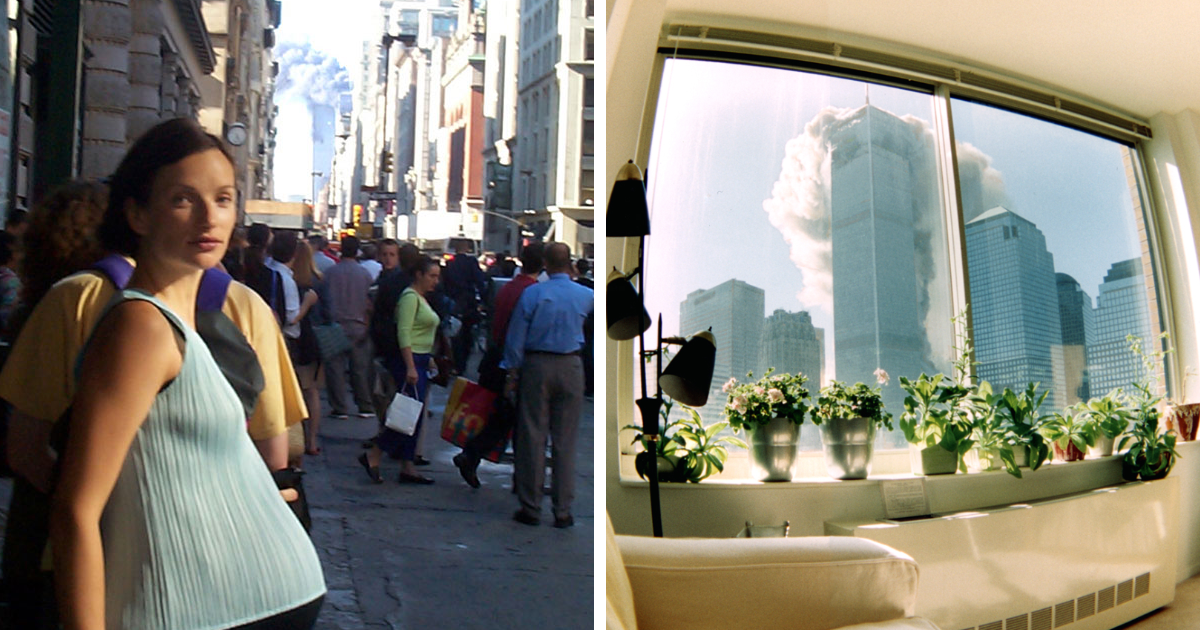
More than two decades after September 11, 2001, a small number of photographs have become visual shorthand for the attacks: smoke pouring from the Twin Towers, terrified pedestrians running through Lower Manhattan, firefighters raising an American flag, and the enormous cloud that swallowed city blocks after the buildings collapsed. Those photographs remain essential records. But they represent only a fraction of the visual history preserved in museums, government archives, news collections, personal albums, and boxes of film.
Thousands of lesser-seen 9/11 photos tell a quieter and, in some ways, more complicated story. They show abandoned desks buried in gray dust, commuters crossing bridges on foot, emergency crews working days after television cameras moved on, a hospital ship entering New York Harbor, damage inside and outside the Pentagon, investigators searching the Flight 93 site, and aerial images revealing the astonishing scale of destruction.
These photographs deserve to be approached as historical evidence rather than shocking internet curiosities. Nearly 3,000 people were killed in the coordinated terrorist attacks, and the consequences continued long after the morning itself through injuries, trauma, environmental exposure, illness, war, security changes, and lives permanently altered. The images below are therefore best understood as windows into experiences that familiar television footage could never completely capture.
Why There Are So Many 9/11 Photos Most People Have Never Seen
September 11 happened during an unusual moment in photographic history. Professional photojournalists still routinely carried film cameras, but digital cameras were becoming increasingly practical. Television crews were everywhere in New York and Washington, while ordinary people were beginning to own compact digital cameras in greater numbers.
That combination produced an enormous visual record from dramatically different perspectives. The Smithsonian’s National Museum of American History preserves a September 11 photographic collection containing more than 2,400 objects, ranging from amateur snapshots to professional photography and digital media. Its holdings represent New York, the Pentagon, Shanksville, memorials, portraits, panoramas, and aftermath scenes. The Library of Congress separately preserves a collection containing 250 unattributed photographs documenting the World Trade Center disaster and emergency operations.
The FBI created an even larger investigative record. During what became the bureau’s largest investigation, photographers made more than 170,000 images while personnel processed evidence at the World Trade Center, Pentagon, and Flight 93 crash sites. Most Americans will never encounter more than a tiny percentage of those pictures.
1. Ordinary Offices Frozen in Time
Some of the most unsettling rare photos of 9/11 contain no flames at all.
Photographers entering damaged buildings around the World Trade Center recorded desks, computer monitors, telephones, chairs, papers, and personal possessions coated in thick gray dust. In one image preserved by the Smithsonian, a workplace appears almost strangely orderly beneath the debris. The arrangement of objects suggests an ordinary Tuesday morning interrupted without warning.
Images like these change the scale of the event. Television naturally focused on skyscrapers, explosions, emergency vehicles, and enormous crowds. A dusty coffee cup or office chair makes the disaster personal. Someone had expected to return to that desk. Someone had probably been thinking about a meeting, an unfinished email, lunch, or the commute home.
2. The Evacuation Happening Far From Ground Zero
Many famous photographs look toward the World Trade Center. Lesser-known ones often look away from it.
As Lower Manhattan emptied, huge numbers of people moved north or crossed bridges and waterways. Photographs of civilians walking across the Brooklyn Bridge are striking because the foreground can look almost routine: office clothing, shopping bags, backpacks, people moving steadily forward. Behind them, however, the skyline is burning.
These photographs reveal how enormous disasters are experienced by people who are not directly inside the central scene. Thousands were trying to contact relatives, understand conflicting reports, find transportation, or simply put distance between themselves and Lower Manhattan. A photograph of people walking home can therefore communicate something dramatic footage cannot: the long, uncertain hours after immediate escape.
3. Photographers Working Almost Inside the Disaster
Some photographers moved toward the World Trade Center while everyone around them was being told to leave.
The Smithsonian’s photographic archives document work by professionals and amateurs who photographed firefighters, falling paper, damaged buildings, street-level confusion, memorials, and recovery operations. Their backgrounds varied widely. Some were working journalists; others happened to have cameras and suddenly found themselves documenting history.
Reuters photographer Shannon Stapleton, for example, photographed survivors emerging through dust after the South Tower had collapsed. One image captured survivor Kayla Bergeron after she had descended dozens of floors from the North Tower. Years later, both photographer and survivor spoke publicly about the psychological effects the experience left behind. Their story is an important reminder that a photograph is not merely a rectangle containing an event. There is a human being on each side of the lens.
4. Ground Zero Days Later
When people remember 9/11 visually, they often remember Tuesday morning. Archival photographs from September 12, September 15, September 19, and later reveal a different phase of the catastrophe.
Navy photographers documented police officers, firefighters, heavy machinery, mangled vehicles, smoke, twisted steel, and rescue personnel moving through enormous piles of wreckage. One surviving photograph shows an overturned fire truck among the debris. Another shows a lone fire engine surrounded by the smoldering remains of the World Trade Center. A separate frame records a firefighter standing beneath an American flag amid the destruction.
The recovery did not become tidy once the initial attacks ended. Fires continued burning within the debris, working conditions remained dangerous, and teams operated around the clock.
A City Still Smoking More Than a Week Later
Photographs dated September 19 show firefighters continuing to confront smoldering debris more than a week after the attacks. Such images challenge the compressed version of history produced by anniversary documentaries. September 11 was one day on the calendar, but Ground Zero remained an active disaster and recovery site for months.
5. The View From the Water
New York Harbor produced another category of seldom-seen 9/11 imagery.
The Navy hospital ship USNS Comfort left Baltimore on September 12 and reached New York on September 14. Navy photographers aboard documented smoke rising over Lower Manhattan as the ship approached the city. Other photographs show the wreckage from the harbor and personnel preparing to assist responders.
The ship ultimately provided support including meals, rest, medical attention, and mental health services to firefighters, police officers, volunteers, and other workers involved in the response. Photographs from aboard the Comfort provide a remarkable geographic perspective: instead of being trapped inside Manhattan’s narrow streets, the viewer sees the disaster stretched across the skyline.
6. Rare Aerial Images Show the Scale Ground-Level Photos Cannot
Street photography makes the destruction feel immediate. Aerial photography makes its scale understandable.
A NOAA aerial photograph preserved by the Library of Congress was taken on September 23 from approximately 3,300 feet above Manhattan. Seen from the air, the World Trade Center site becomes part of a much larger urban landscape, making it possible to see both the concentrated devastation and the recovery effort operating within one of America’s densest neighborhoods.
Scientific imagery provides an even stranger perspective. The U.S. Geological Survey used airborne imaging equipment over the World Trade Center area on September 16, 18, 22, and 23. Researchers mapped the debris plume, studied materials in the dust, and identified thermal hot spots. Satellite imagery from September 12 also captured smoke continuing to travel away from Lower Manhattan.
These aren’t conventional photojournalism images, yet they are among the most revealing visual records of the aftermath. They show 9/11 not only as an attack on buildings but also as an environmental and urban disaster whose physical footprint extended well beyond the footprints of the towers.
7. The Pentagon Beyond the Familiar Exterior Shot
New York dominates popular visual memory of September 11, but rare 9/11 photographs from Virginia document a second enormous emergency response.
At 9:37 a.m., American Airlines Flight 77 struck the Pentagon. Photographs preserved by the Department of Defense show the damaged west side of the building and emergency personnel operating in the surrounding area. One official description notes that the impact damaged the reinforced structure through multiple sections of the building and that the exterior grounds quickly became a staging area for medical and emergency teams.
The FBI’s photographic record additionally documents evidence teams working at the Pentagon. Images of investigators, firefighters, temporary command areas, debris, and damaged offices reveal a side of the attack that received less continuous television coverage than Manhattan.
8. Shanksville: A Disaster Scene That Looked Completely Different
United Airlines Flight 93 crashed near Shanksville, Pennsylvania, at 10:03 a.m. after passengers and crew members fought the hijackers. Unlike the towering fires of New York or the damaged Pentagon, photographs from Pennsylvania show open countryside transformed into a carefully controlled investigation and recovery site.
Because there was no enormous skyline landmark in the background, photographs of the Flight 93 site can initially appear almost minimal: fields, investigators, equipment, markers, and disturbed ground. Yet their quietness makes them particularly powerful.
They also broaden the meaning of “9/11 photography.” The day’s visual history belongs not to one city but to three primary attack locations, four aircraft, many emergency agencies, and countless communities affected by the people who were lost.
9. Missing-Person Posters Became Portraits of Loss
Among the most important photographs from the days after September 11 are pictures of other pictures.
Families and friends placed missing-person flyers on walls, fences, hospital entrances, phone booths, storefronts, and public spaces across New York. These handmade posters typically contained a photograph, a name, a workplace, a floor number, physical descriptions, and a phone number to call with information.
At first they represented hope. As the days passed, many became memorials.
Photographs documenting these posters returned individuality to a catastrophe often described using enormous numbers. Instead of “thousands,” viewers saw one person’s face at a time. The 9/11 Memorial & Museum preserves such material as part of its historical collections, emphasizing how families searched for loved ones during the chaotic aftermath.
10. Photographs Reveal How Quickly Americans Began Recording Memory
Documentation did not stop at rescue sites. Almost immediately, photographers began recording candles, flowers, handwritten signs, vigils, flags, church gatherings, improvised shrines, and neighborhood memorials.
The Library of Congress September 11 Documentary Project later gathered interviews, graphics, written narratives, and personal responses reflecting grief, anger, fear, patriotism, uncertainty, and solidarity. The Smithsonian also collected photographs of temporary memorials, helping preserve the emotional atmosphere that existed outside the formal disaster zones.
These scenes matter because history is not solely the record of what happened. It is also the record of how people understood what happened while living through it.
What “Rare 9/11 Photos” Really Means
The word rare can be misleading. Many photographs discussed in articles with titles like this one are not secret, newly discovered, or hidden. Some have been publicly accessible for years in federal archives and museum databases.
They are better described as lesser-seen 9/11 photographs: images that never became iconic enough to appear annually on television or circulate constantly online.
The distinction is important because sensational claims can distort historical material. Reliable archives typically provide photographers’ names when known, dates, locations, descriptions, collection numbers, and usage restrictions. That context is what separates historical documentation from an unidentified image reposted on social media with an unverifiable caption.
Verify an Image Before Publishing It
Anyone creating a 9/11 photo gallery should verify both historical accuracy and image rights. Some U.S. government photographs are in the public domain, including particular Navy and USGS materials, while photographs held by museums, commercial agencies, newspapers, or individual photographers may be copyrighted.
A photograph being viewable online does not automatically make it free to republish. Publishers should consult the archive’s rights statement, identify the photographer where possible, preserve the original caption context, and avoid cropping or presenting an image in a way that creates a misleading interpretation.
The Essential Timeline Behind the Photographs
Understanding the chronology helps viewers interpret what they are seeing. At 8:46 a.m., American Airlines Flight 11 struck the North Tower. At 9:03 a.m., United Airlines Flight 175 struck the South Tower. Flight 77 hit the Pentagon at 9:37 a.m. The South Tower collapsed at 9:59 a.m. Flight 93 crashed near Shanksville at 10:03 a.m., and the North Tower collapsed at 10:28 a.m.
The short span between those moments helps explain the chaotic visual record. Photographers were working without the benefit of knowing what would happen next. People photographed what they believed might be important while simultaneously trying to understand an unprecedented situation.
That uncertainty is visible in the pictures themselves.
Experiencing Lesser-Known 9/11 Photographs More Than Two Decades Later
Looking through an archive of rare photos of the 9/11 attacks is very different from watching a short anniversary news package. Television coverage usually follows a familiar sequence: the first burning tower, the second impact, the collapses, responders at Ground Zero, and memorial ceremonies. An archive has no such neat rhythm.
You may move from a photograph of an apparently untouched Manhattan street to an apartment buried in dust. The next frame might show firefighters sleeping from exhaustion, followed by an aerial scientific image or an ordinary family photograph attached to a missing-person notice. That unevenness can make the history feel closer because real experience is rarely organized like a documentary.
One of the strongest impressions is the amount of ordinary life visible around extraordinary destruction. Cars remain parked. Office calendars remain attached to walls. Coffee cups sit on desks. Shoes appear in evacuation routes. Storefronts stand beneath layers of debris. People still carry briefcases while walking away from a skyline that no longer looks familiar.
Another experience is realizing how narrow the famous photographic record actually is. Most people know perhaps a dozen defining 9/11 images. Museums and federal archives hold thousands more. Each photographer stood somewhere different, arrived at a different minute, noticed different details, and made decisions under conditions that were often dangerous and confusing.
Viewing those photographs carefully can also change one’s understanding of first responders. The heroic actions of firefighters, police officers, medical personnel, construction workers, investigators, military personnel, volunteers, and others did not end when television networks stopped broadcasting the collapses. Photographs dated days and weeks later show exhausting manual work occurring amid unstable debris, smoke, heat, contaminated dust, and profound grief.
The environmental images add another dimension. A satellite photograph of smoke drifting from Manhattan or a scientific image identifying thermal hot spots may initially seem emotionally distant compared with a close-up portrait. Yet those pictures help explain the scale of exposure that later became an important part of the 9/11 health story. The 9/11 Memorial & Museum now explicitly documents the long-term effects associated with toxic dust and the experiences of responders, survivors, residents, and workers who were exposed.
Perhaps the most lasting experience of viewing lesser-known photographs is recognition that historical events contain far more individual stories than their famous images can hold. A camera records only a fraction of a second. It cannot tell you everything that happened immediately before or after the shutter clicked.
That limitation is exactly why archival context matters. Captions, oral histories, investigative records, photographers’ recollections, survivor accounts, and museum research turn isolated frames into historical evidence.
For readers who were alive in 2001, such photographs may reopen vivid memories of where they were when they first heard the news. For younger readers, especially those born after the attacks, they provide something textbooks cannot: the small physical details of a day experienced in real time by millions of ordinary people.
Approached respectfully, rare 9/11 photos are therefore not about discovering more shocking pictures. They are about discovering more complete history.
Conclusion: Looking Beyond the Iconic Images
The best-known photographs of September 11 deserve their place in history, but they cannot represent everything that occurred that morning or during the long aftermath. Lesser-known photographs preserved by the Smithsonian, Library of Congress, National Archives, FBI, Department of Defense, U.S. Navy, USGS, the 9/11 Memorial & Museum, news organizations, and individual photographers broaden that record considerably.
They show escape and investigation, destruction and recovery, public grief and private absence. They document the Pentagon and Shanksville alongside New York. They reveal what streets, offices, homes, emergency staging areas, and the skyline looked like after the moments most people remember from television.
Most importantly, these photographs remind us that September 11 was not a collection of iconic images. It was a human event experienced by thousands of victims, survivors, relatives, responders, witnesses, photographers, investigators, and communities. The deeper we look into the archival record, the more difficult it becomes to reduce that history to a handful of familiar frames.
Editorial note: This article uses the phrase “rare photos” to mean lesser-seen archival photographs rather than secret or previously undiscovered images. Graphic imagery has deliberately not been described in unnecessary detail. Publishers wishing to reproduce historical photographs should independently verify captions, licensing terms, copyright status, and appropriate attribution with the institution or rights holder responsible for each image.