

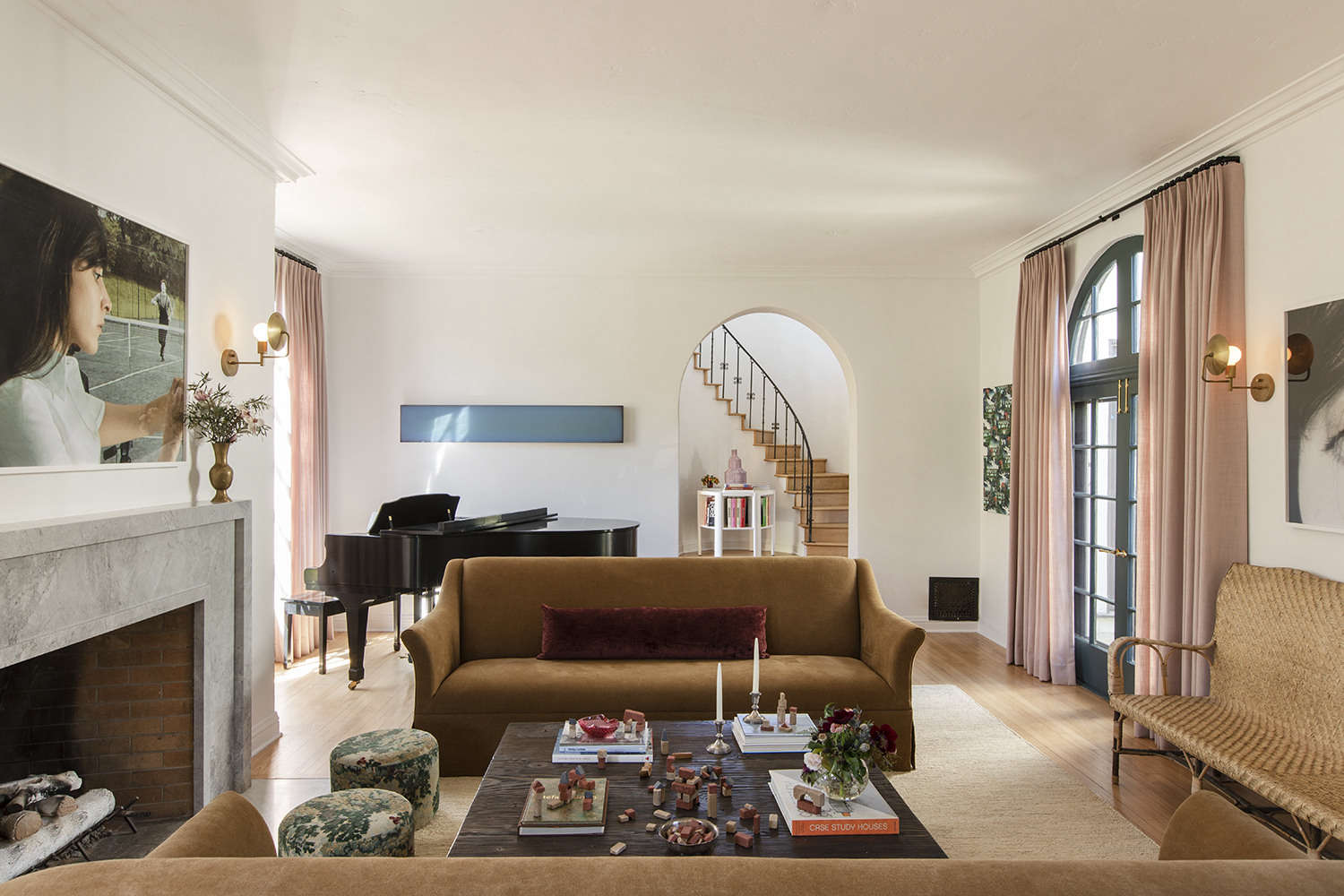
A great music room should do more than provide parking for a piano. It should encourage someone to sit down, play a few notes, invite friends to listen, and remain comfortable enough for ordinary life after the impromptu concert ends. That is precisely what makes this Los Angeles music room so memorable.
Located in a 1926 Mediterranean-style house in Little Holmby, the room was created for architect Sherry McKuin and her family by Frances Merrill of Reath Design. Rather than separating music from daily life, Merrill transformed the main living room into a flexible gathering place with a piano at one end, drums at the other, and a sociable seating arrangement in between. It feels refined without becoming precious, colorful without looking chaotic, and musically inclined without covering every wall in framed concert posters.
Here is how to recreate its warm Los Angeles interior design, including the paint palette, furniture, lighting, textiles, acoustic considerations, and less-expensive substitutions that capture the spirit without requiring a full orchestra-sized budget.
Why This Los Angeles Music Room Works
The room succeeds because it was designed as a living room first and a music room at the same time. The instruments are not squeezed into leftover corners, yet they are not treated like museum exhibits either. They belong to the architecture and to the family’s routine.
This approach reflects one of the strongest ideas in contemporary listening-room design: music spaces work best when comfort, atmosphere, and sound quality receive equal attention. Upholstered seating, rugs, curtains, wood, and warm lighting create a sensory environment where people want to linger. A dedicated room is helpful but not essential; even one carefully arranged section of a living room can become a meaningful place for listening or playing.
The Los Angeles room is also visually balanced. Crisp white walls keep the architecture calm, while dark blue-green trim outlines the windows and doors. Curry-colored sofas introduce warmth. A pale woven rug softens the floor, and rattan provides a lighter, more relaxed counterpoint to the substantial upholstered pieces. Brass wall lights contribute a little glow and glamour, but not so much that anyone expects a velvet rope at the entrance.
The Original Design Composition
A Historic Shell With a Cleaner Attitude
The house began as a 1926 Mediterranean residence with graceful proportions and traditional details. McKuin initially simplified the interior by refinishing the oak floors, whitening the walls, and removing decorative additions that did not feel original. When Merrill joined the project, the goal was not to erase the house’s history but to make its elegance more comfortable for a modern family.
That distinction matters when stealing the look. You do not need arched doorways, a marble mantel, or a Los Angeles ZIP code. You need a room with a clear architectural framework. Emphasize whatever structure already exists: windows, door casings, built-in shelves, ceiling beams, a fireplace, or simply a well-proportioned wall. Then use color to make those features look intentional.
White Walls and Blue-Green Trim
The walls in the original home are painted Benjamin Moore White PM-2, a crisp, versatile white with a high light-reflectance value. Instead of continuing the white across every surface, Merrill used Benjamin Moore Yorktowne Green on doors and window frames. The manufacturer describes Yorktowne Green as a dark teal containing blue, green, and gray notes, which explains why it can appear greener in warm daylight and bluer as the light cools.
This contrast is one of the easiest elements to reproduce. Keep the walls quiet and apply a saturated color to the trim, built-ins, or interior doors. Deep teal, smoky navy, bottle green, or charcoal blue can all work. Test large samples beside the floor, upholstery, and windows before committing. A color that looks sophisticated on a small card can become “submarine control room” when expanded across twelve feet of cabinetry.
Curry Upholstery as the Warm Center
The two main sofas were designed by Reath Design and upholstered in a curry-colored Rue Hérold linen. Their low, substantial forms create a comfortable center for conversation while the golden upholstery warms the otherwise cool white-and-teal palette. A rectangular arrangement also leaves the room visually open to both musical ends.
To recreate the effect, look for sofas with simple arms, generous seats, and upholstery in mustard, ochre, tobacco, copper, burnt orange, or muted saffron. The color should feel earthy rather than neon. Linen blends, textured wool, performance velvet, and tightly woven performance fabrics are practical options for homes where the audience occasionally arrives carrying juice boxes.
You do not need two identical custom sofas. A warm-toned sofa can face a pair of lounge chairs, a settee, or a long bench. What matters is creating a central conversation zone rather than lining every seat against the walls like nervous guests at a middle-school dance.
Rattan for Lightness and Rhythm
A vintage woven settee squares off the seating area and prevents the room from becoming too heavy. The original design was associated with a 1960s rattan canapé sourced through Atelier Vime. Its open weave adds pattern and texture without introducing another solid block of color.
Search vintage stores, estate sales, and resale marketplaces for rattan benches, cane-back sofas, woven stools, or rush-seat chairs. Minor patina usually adds character, but inspect joints carefully. “Charming vintage flexibility” is sometimes a seller’s poetic way of saying “one enthusiastic guest away from collapse.”
A Neutral Rug That Quietly Does Several Jobs
The pale rug in the room visually connects the seating while softening the refinished wood floor. Remodelista identified the Graham Rug in Parchment, designed by Anu Gupta for Obeetee, as a similar option. Its heathered wool and basket-weave construction offer subtle texture rather than a dominant pattern.
A music room rug should be large enough to anchor the furniture. Ideally, at least the front legs of the major seating pieces should rest on it. Wool is especially useful because it is durable, tactile, and naturally good at reducing some of the hard reflections created by bare floors. Add a quality rug pad to improve comfort, control movement, and provide another modest layer of acoustic softness.
Unlined Curtains and Los Angeles Light
The original French doors are dressed in Fabricut Newport fabric, made into unlined curtains so that daylight can filter through. The fabric was intentionally allowed to respond naturally to the sun rather than behaving like a blackout barrier. Custom fabrication by Valley Drapery helped the treatments suit the room’s proportions.
For a similar effect, choose lightweight linen, cotton-linen, or a loosely woven textile. Hang the panels above the window frame and let them reach the floor. Repeating the same mounting height around the room creates order, while higher placement can make the ceiling feel taller. Lighter fabrics filter daylight; heavier curtains provide more privacy and sound absorption, so choose according to how the room is actually used.
Lighting That Feels Like Part of the Performance
The brass Orbit Sconces by Workstead replaced more ornate wrought-iron wall lights and had already lived in the family’s previous house. Their circular reflectors create warm pools of light while acting as sculptural objects on the white walls. Workstead’s current Orbit design includes a rotating reflective disc and integrated dimming, allowing the fixture to direct or soften its glow.
Wall sconces are particularly effective in a music room because they provide atmosphere without occupying floor space or shining directly into a player’s eyes. Pair them with a focused piano lamp, adjustable reading light, or small shaded table lamp. Use dimmable, warm-white bulbs so the room can shift from daytime practice to an evening listening session without suddenly resembling a dentist’s office.
Brass is an easy route to the original mood, but bronze, aged nickel, darkened steel, or painted ceramic can work just as well. The fixture should have a strong silhouette and a gentle output. One memorable light is more effective than six anonymous fixtures scattered around the room.
How to Arrange Instruments Without Creating Clutter
Let the Largest Instrument Establish the Plan
Begin with the piano, drum kit, keyboard, or primary listening system. Treat it as part of the room’s architecture and allow enough space for a player to sit, move, open a lid, adjust a bench, or reach cables comfortably.
Acoustic pianos should be protected from direct sunlight, heating or cooling vents, and severe environmental fluctuations. Steinway recommends maintaining roughly 40 to 60 percent relative humidity and a temperature range of 68 to 78 degrees Fahrenheit. Even without a concert grand, a small digital hygrometer can help protect wood instruments and identify seasonal changes in the room.
Create Clear Activity Zones
Divide the space into three zones: playing, listening, and storage. The Los Angeles room places music at both ends and social seating in the middle, allowing people to move naturally between activities. A smaller room might use one wall for instruments, one cabinet for records and accessories, and one comfortable chair positioned for listening.
Keep pathways free of stands, pedals, cases, and power cables. Floor cable covers, wall-mounted hooks, attractive lidded baskets, and low cabinets can prevent the room from becoming an obstacle course composed in the key of ankle injury.
Display Selectively
One or two instruments can become beautiful visual elements, especially when their wood tones relate to the furniture. However, not every tambourine needs a spotlight. Display frequently used or visually distinctive pieces and store the rest safely.
Records and sheet music can be organized in sturdy shelving near the listening area. Album covers may be displayed on slim ledges and changed regularly, creating inexpensive rotating artwork. Closed storage is useful for cables, tuners, cleaning supplies, headphones, and all the mysterious adapters musicians retain because they may become essential seven years from now.
Improve the Acoustics Without Making the Room Look Like a Studio
A pleasant music room needs a balance of absorption, reflection, and diffusion. Too many hard surfaces can produce sharp echoes and muddy details. Too much absorption can make music sound unnaturally flat. Rugs, upholstered furniture, curtains, books, artwork, and record shelves help control reflections while preserving the appearance of a normal living space.
For serious listening, begin with symmetrical speaker placement. A common starting point is an equilateral triangle, with the listener and two speakers positioned at approximately equal distances. Speakers often perform better when given some breathing room from the walls, and seating can benefit from space behind it rather than being pressed against the rear wall.
If echoes remain obvious, add decorative fabric panels, thick curtains, a second textile, or acoustic panels wrapped in a fabric that coordinates with the room. Bass traps and broadband absorbers may be needed for recording or critical mixing, particularly at corners and first-reflection points. Soundproofing, which reduces transmission to neighboring rooms, is a different task from acoustic treatment, which improves sound inside the room. Sealing air gaps around doors, windows, outlets, and wall intersections can help limit leakage.
Steal the Look at Three Budget Levels
Focused Refresh
Keep the existing furniture and make three high-impact changes: paint the trim a deep blue-green, add an appropriately sized neutral rug, and install warm wall or table lighting. Rearrange the furniture so it faces inward and gives the instruments a clear relationship to the seating. This version captures the composition without replacing the entire ensemble.
Midrange Makeover
Add a mustard or tobacco sofa, floor-length linen curtains, a vintage rattan bench, and closed storage for music accessories. Mix new upholstery with secondhand wood furniture so the room does not feel as though it arrived in one enormous delivery truck.
Full Recomposition
Invest in custom upholstery, tailored window treatments, architectural lighting, built-in record storage, and professional acoustic planning. Replace an overly decorative mantel or trim detail only when it genuinely conflicts with the room. The original Los Angeles project works because the historic shell was clarified, not indiscriminately stripped of personality.
Living With the Look: A Real-World Experience
Imagine the room over the course of an ordinary week. On Monday morning, sunlight passes through the unlined curtains and lands softly on the rug. The white walls keep the space bright, but the blue-green trim prevents it from feeling blank. A piano occupies one side of the room, yet the space still reads as a welcoming living area rather than a rehearsal facility that happens to contain a sofa.
Later that afternoon, someone practices scales while another family member reads. The upholstered seating and rug take the hard edge off the sound, so the piano feels present without bouncing wildly around the room. The performance is still audible throughout the housethis is design, not sorcerybut the room itself sounds calmer and more controlled.
On Wednesday, the disadvantages of a real music room briefly introduce themselves. Sheet music begins to spread across the coffee table. A cable appears beneath a chair. Two drumsticks migrate to the mantel for reasons no one can explain. This is when storage becomes more important than another decorative pillow. A shallow drawer for music, a basket for small accessories, and dedicated hooks for headphones can restore order in minutes.
By Friday evening, the wall sconces are dimmed and the room changes character. The warm upholstery becomes richer, the brass fixtures glow, and the dark trim nearly frames the windows like painted scenery. Friends sit in a loose circle rather than in a rigid row. Someone plays a song; someone else joins with percussion; a third person contributes enthusiastic rhythm on a glass and is politely encouraged to stop.
The arrangement works because the furniture supports both attention and conversation. When music is being performed, most seats have a reasonable view. When no one is playing, the same seats face one another closely enough for relaxed conversation. Nothing needs to be dragged across the floor before the room becomes useful.
Weekend cleaning reveals another practical lesson: textured rooms hide everyday disorder better than severe minimalist ones, but they still need discipline. Dust collects on instruments, woven furniture catches crumbs, and dark paint makes fingerprints surprisingly ambitious. A soft cloth near the piano, a handheld vacuum for the rattan, and washable cushion covers prevent small maintenance tasks from becoming a monthly festival of regret.
The most satisfying experience comes from the room’s flexibility. It can host a lesson in the morning, family conversation in the afternoon, and focused listening at night. Children can play instruments without being exiled to a remote practice room. Guests understand immediately that music is part of the household’s identity. Even during quiet hours, the instruments contribute form, material, and personal history.
That is the deeper lesson behind the Los Angeles design. A successful music room is not created by buying every identified product. It emerges when color, comfort, sound, storage, and daily habits support one another. The white walls matter because they make space for richer elements. The teal trim matters because it defines the architecture. The curry upholstery matters because it invites people to sit. The rug and curtains matter because they soften both light and sound. Most importantly, the instruments matter because they are used.
Final Takeaway
To steal this well-composed Los Angeles music room, begin with function rather than shopping. Decide where people will play, listen, talk, and store equipment. Build a restrained architectural background with white walls and dark blue-green trim. Introduce warmth through ochre upholstery, aged wood, brass lighting, and woven rattan. Add a generous wool rug and soft curtains to improve comfort and acoustics.
Then leave room for personality. Display the albums that are actually played, keep favorite instruments accessible, and allow collected art to arrive gradually. The result should feel composed but never finished to the point of intimidation. After all, a music room that is too perfect to use has missed the beat entirely.