

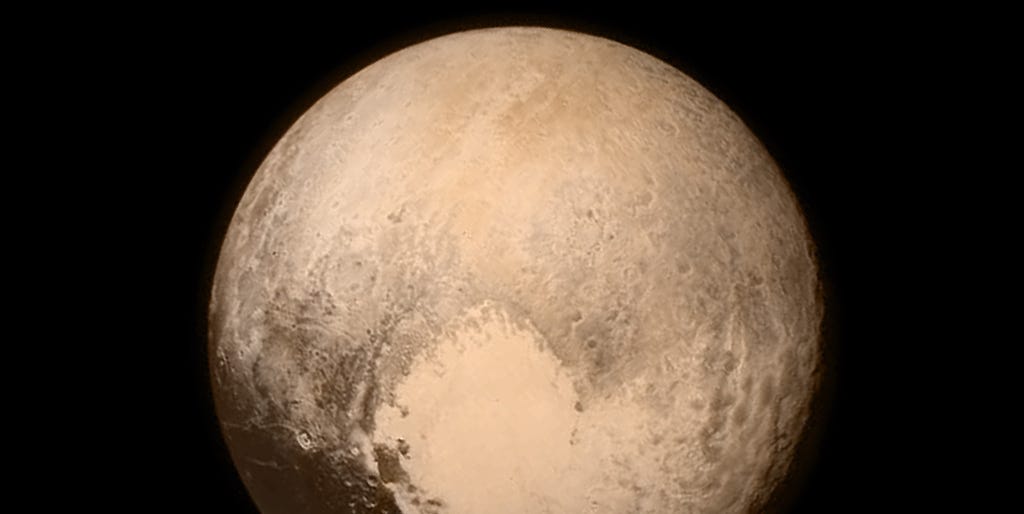
Pluto may live billions of miles from Earth, but it knows how to make an entrance. When NASA’s New Horizons spacecraft flew past the dwarf planet in July 2015, it revealed towering mountains, flowure shaped suspiciously like a Valentine.
That feature, known as Tombaugh Regio, quickly became Pluto’s visual trademark. It also created a planetary science mystery. Why is one side of the heart a deep, smooth basin? Why is it shaped more like a pear than a conventional impact crater? And why does it sit near Pluto’s equator instead of drifting toward a pole?
A detailed three-dimensional modeling study offers a dramatic answer: Pluto may have received its heart during a slow, angled collision with a planetary body roughly 700 kilometers, or about 435 miles, across. The impact did more than dent the surface. It may have left part of the intruder buried inside Pluto like a cosmic souvenir the dwarf planet never managed to digest.
Research basis: Nature Astronomy, NASA New Horizons and University of Bern. luto’s Heart Is Actually Two Very Different Lobes
Although Tombaugh Regio looks like one continuous heart from a distance, its two halves are geologically different. The eastern lobe consists of bright uplands coated with a relatively thin layer of volatile ice. The western lobe is the feature that commands most scientific attention: Sputnik Planitia.
Sputnik Planitia is an immense, low-lying basin filled primarily with nitrogen ice, along with smaller amounts of methane and carbon monoxide ice. Its central plain lies roughly three to four kilometers below much of the surrounding terrain. The glacier covering it stretches approximately 1,000 kilometers across, making it the largest known glacier in the solar system.
The basin’s surface is unusually smooth and almost free of impact craters. That does not necessarily mean Sputnik Planitia formed yesterday in geological terms. Instead, moving and convecting nitrogen ice continually refreshes the visible surface, erasing scars before they can accumulate like stickers on an old suitcase.
Research basis: NASA and Nature Astronomy. he Clues Hidden in Sputnik Planitia
Scientists have long suspected that a major collision created Sputnik Planitia. Its depressed elevation, mountainous margins and enormous scale resemble an ancient impact basin. Earlier computer models showed that an impactor hundreds of kilometers wide could excavate a large depression on Pluto.
There was one stubborn problem: ordinary head-on impact simulations tended to produce round or broadly elliptical craters. Sputnik Planitia is elongated, asymmetrical and somewhat teardrop-shaped, with a broad northern section and a narrower southern tail.
Its location was equally puzzling. A basin formed by removing material should create a negative mass anomaly. As Pluto slowly adjusted its orientation, that lighter region would normally migrate toward a rotational pole. Sputnik Planitia, however, is positioned near the equator and closely aligned with the axis connecting Pluto and Charon, Pluto’s largest moon.
In other words, Sputnik Planitia behaved as though it were heavier than its surroundings, not lighter. Something substantial appeared to be hiding underneath all that bright nitrogen ice.
A Giant Object Struck Pluto at an Angle
To investigate the mystery, researchers led by scientists at the University of Bern used three-dimensional hydrodynamic simulations. Instead of modeling only direct collisions, they varied the impactor’s size, composition, speed and approach angle. They also tested different assumptions about Pluto’s internal temperature and structure.
The Most Convincing Collision Scenario
The simulation that most closely reproduced Sputnik Planitia involved an impactor approximately 700 to 730 kilometers wide. The object was probably differentiated, meaning it had separated into an icy exterior and a denser rocky core.
Rather than striking Pluto head-on, it arrived at an angle of about 30 degrees. It was also moving relatively slowly by planetary-collision standards, at roughly the mutual escape velocity of the two bodies.
This combination was crucial. A faster collision might have blasted and melted enormous quantities of material. A more direct impact would have created a rounder basin. The slow, shallow collision instead smeared the impactor’s material across and beneath Pluto, producing an elongated footprint with a broad head and narrow tail.
A Cosmic Splat Instead of a Fiery Explosion
Pluto and the incoming body were extremely cold. In the simulation, their water ice behaved more like rigid rock than the soft ice cubes in a kitchen freezer. The impact was certainly catastrophic, but it was not simply a fiery explosion in which everything instantly melted and mixed.
The impactor’s icy mantle spread across the collision region. Its stronger rocky core penetrated Pluto’s outer ice but did not disappear completely into Pluto’s own core. Instead, the rocky material settled near the boundary between Pluto’s core and mantle, forming what researchers memorably described as a buried “splat.”
This leftover core could still exist beneath the southern portion of Sputnik Planitia. Pluto, it seems, was hit by another world and kept part of it as an internal organ transplant that nobody asked for.
Research basis: peer-reviewed simulations and supporting institutional explanation. ow a Collision Became a Bright White Heart
The impact alone did not paint a perfect white heart on Pluto. It created the underlying basin and supplied its unusual internal structure. Pluto’s climate completed the artwork.
Because Sputnik Planitia sits lower than the surrounding landscape, it became a natural cold trap. Nitrogen from Pluto’s thin atmosphere condensed and accumulated inside the depression. Methane and carbon monoxide ice joined it, although nitrogen became the dominant material across the plain.
Over time, the thick nitrogen glacier covered the collision’s rougher topography. Heat rising slowly from Pluto’s interior helped drive solid-state convection within the ice. Warmer material rose, cooler material sank and the surface reorganized into large polygonal cells visible in New Horizons images.
Sublimation and condensation continue to move nitrogen between Pluto’s surface and atmosphere. During warmer periods, ice turns directly into gas. When temperatures fall, that gas freezes again. This cycle helps power winds and refresh the glacier, giving Pluto a “heartbeat” that lasts about 6.4 Earth days per Plutonian rotation.
Research basis: NASA and Smithsonian reporting on Pluto’s nitrogen cycle. he Buried Core May Explain the Heart’s Location
The proposed remnant core solves more than the basin’s strange shape. Because rock is denser than water ice, the buried material would create a concentration of mass beneath Sputnik Planitia. Planetary scientists call such a feature a mass concentration, or “mascon.”
Additional nitrogen ice piled into the basin would increase its mass further. The combination of dense rock below and frozen nitrogen above could turn an apparent hole into a region heavier than its surroundings.
That extra weight may have caused Pluto to reorient itself through a process called true polar wander. The solid surface and interior shift relative to the spin axis until a large mass anomaly settles into a more stable position. It is not the same as the crust sliding independently through plate tectonics. It is closer to the entire dwarf planet adjusting its balance.
The result could explain why Sputnik Planitia ended up near the equator and almost directly opposite Charon. Its position may therefore preserve evidence not only of an impact, but also of Pluto’s long-term rotational history.
Research basis: Nature Astronomy, NASA and Scientific American. oes the New Theory Mean Pluto Has No Ocean?
Before the impactor-remnant model was developed, one influential explanation for Sputnik Planitia’s positive mass anomaly involved a subsurface ocean. In that scenario, an impact thinned Pluto’s outer shell, allowing denser liquid water or watery slush to rise beneath the basin. The uplifted material, combined with accumulated nitrogen ice, would make the region heavy enough to remain near the equator.
The newer simulations demonstrate that an ocean is not necessarily required. A dense fragment of the impactor could provide the missing mass even if Pluto’s water-ice mantle was mostly solid when the collision occurred.
That is an important distinction, but it does not prove that Pluto is completely oceanless today. Other observationsincluding global fractures, possible cryovolcanic terrain and models of Pluto’s thermal evolutionhave been interpreted as evidence for liquid water deep below the surface.
The impact theory weakens one specific argument that required an ocean to explain Sputnik Planitia. It does not magically drain every proposed ocean model. Planetary science rarely ends with someone dramatically slamming a folder shut and announcing, “Case closed.” More often, one explanation becomes more efficient while several alternatives remain available for cross-examination.
What Scientists Still Need to Confirm
The collision scenario is a hypothesis supported by simulations, not a direct recording of Pluto’s ancient history. Researchers must make assumptions about the impactor’s composition, Pluto’s temperature, material strength and the way the basin evolved over billions of years.
The eastern half of Tombaugh Regio also remains incompletely explained. It may have received nitrogen ice transported from Sputnik Planitia, but its formation was not reproduced as part of the same impact structure.
Scientists would also like detailed measurements of Pluto’s gravity field. A rocky mass buried beneath Sputnik Planitia should produce a detectable gravitational signature. New Horizons performed a fast flyby rather than entering orbit, so it could not map Pluto’s gravity with the precision needed to confirm the buried remnant.
A future Pluto orbiter equipped with radar, gravity-science instruments and high-resolution cameras could test the model. Such a mission could determine the thickness of Sputnik Planitia’s nitrogen ice, probe the structure beneath it and investigate whether Pluto still possesses a deep ocean.
Research basis: study limitations and future-work recommendations. hy Pluto’s Mysterious Heart Matters
The proposed impact reveals how differently collisions can behave in the outer solar system. Near Earth, large impacts generally occur at high velocities and generate intense shock heating. In the Kuiper Belt, collisions between cold bodies may happen more slowly, allowing large pieces of an impactor to survive.
That means other icy dwarf planets could contain hidden, chemically distinct regions inherited from ancient collisions. Their surfaces and interiors may be mixtures of materials assembled from multiple worlds rather than neatly blended planetary layers.
Sputnik Planitia also demonstrates how impact geology, climate, glacial movement and planetary rotation can interact. One collision may have created a basin; the basin trapped nitrogen; the added mass altered Pluto’s balance; and the resulting glacier began influencing the atmosphere. It is an impressive chain reaction for a world once dismissed as a small, inactive ball of ice.
Experiencing Pluto’s Heart as a Scientific Detective Story
The most rewarding way to experience this discovery is to begin with the original New Horizons images rather than jumping directly to the collision simulation. At first glance, Pluto’s heart appears almost playful. It is bright, recognizable and strangely familiar on an otherwise alien landscape. The human brain spots the shape before it notices the geology.
Then the scale becomes apparent. That cute little heart is not a decorative patch. Sputnik Planitia is a continent-sized glacier surrounded by mountains made largely of water ice. Some of those mountains rise several kilometers above the plain. Features that look like faint scratches are cliffs, valleys, ice flows and fields large enough to swallow entire metropolitan areas.
Comparing natural-color and enhanced-color images adds another layer to the experience. Pluto is not simply gray and white. It contains rusty reds, pale creams, charcoal-colored regions and blue atmospheric haze. The colors reflect mixtures of volatile ice and complex organic compounds produced when sunlight and energetic particles alter methane in the atmosphere.
Zooming in on Sputnik Planitia reveals polygonal cells across the nitrogen ice. They resemble the cracked surface of drying mud, although the physics is very different. These shapes are evidence that the glacier is slowly overturning. On Pluto, “active geology” does not need erupting lava or shaking continents. Solid nitrogen creeping over millions of years is enough to remodel a world.
The collision study changes the viewing experience again. Once the proposed impact direction is understood, the heart stops looking symmetrical. The western lobe becomes a teardrop: broad where the incoming body first struck and narrow where its core traveled through Pluto’s mantle. What initially looked like a romantic symbol begins to resemble a preserved forensic outline.
There is also something humbling about the investigation itself. New Horizons passed Pluto only once and gathered its most important observations during a matter of hours. Scientists then spent years converting those measurements into maps, climate models, geological interpretations and collision simulations. A brief encounter produced a mystery that may occupy researchers for decades.
Readers can recreate part of that process by examining the evidence in stages. First, identify Tombaugh Regio. Next, separate its two lobes. Trace the edge of Sputnik Planitia and notice its elongated southern section. Look for the mountainous rim, smooth central cells and apparent glacial flows entering the basin. Finally, compare that outline with illustrations from the angled-impact model.
This approach turns the image from a space photograph into a scientific argument. Every curve, elevation and patch of ice becomes a clue. The excitement does not come from being told that scientists have solved the mystery. It comes from seeing why a particular explanation fits the evidence better than the simpler alternatives.
The experience also provides a useful lesson about scientific uncertainty. A successful simulation is not a time machine. It demonstrates that a proposed event can create the observed result under plausible conditions. Confirmation requires independent predictions, such as a measurable gravity anomaly beneath the basin.
That unresolved element makes Pluto’s heart more interesting, not less. The image is beautiful, the explanation is physically grounded and the final verdict is still waiting for another spacecraft. Pluto has offered humanity a planetary cold case with a likely suspect, a reconstructed collision and one enormous piece of evidence buried beneath a nitrogen glacier.
Conclusion
The best current explanation for Pluto’s mysterious heart begins with a slow, oblique collision. A large icy-rocky body struck the young dwarf planet, spread its outer layers across the surface and left its dense core buried beneath an elongated basin. Nitrogen ice later filled that depression, creating the bright western lobe of Tombaugh Regio and possibly helping reposition Pluto itself.
The theory explains Sputnik Planitia’s shape, depth and unusual equatorial alignment without requiring a subsurface ocean. It does not settle every question, but it gives scientists a coherent reconstruction of one of the solar system’s most remarkable landscapes. Pluto may have a frozen heart, but its history was anything but gentle.