

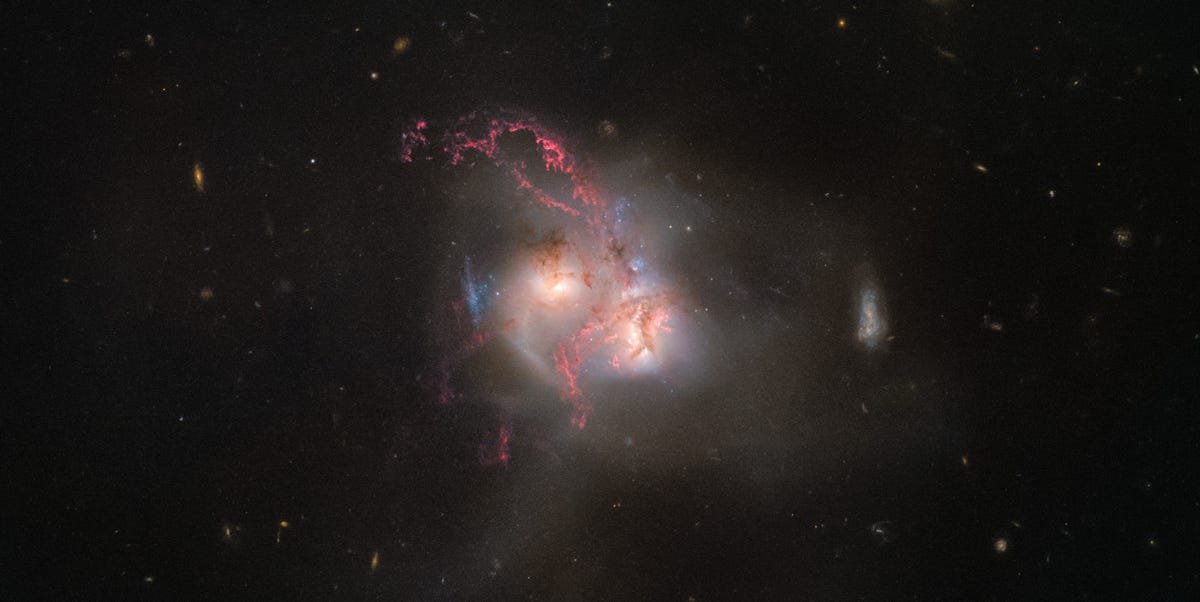
There are dramatic space photos, and then there are Hubble photos that look as if the universe spilled glitter, smoke, and starlight into one enormous cosmic blender. The Hubble Space Telescope image of the colliding galaxies NGC 5256, also known as Markarian 266, belongs firmly in the second category. It is beautiful, chaotic, scientifically rich, and just a little rude to every desktop wallpaper that came before it.
At first glance, the image looks like a glowing knot of cosmic fireworks. Bright central regions burn through smoky lanes of dust. Blue trails hint at young stars being born in violent bursts. Wispy plumes stretch outward as if the galaxies are waving goodbye to their former shapes. But this is not abstract art. It is a real galactic collision about 350 million light-years away in the constellation Ursa Major, where two disk galaxies are in the process of merging into one.
The main keyword here is easy to love: Hubble colliding galaxies. But the story is much bigger than one gorgeous space image. NGC 5256 shows how galaxies grow, how gravity reshapes the universe, why star formation can explode during galactic encounters, and why “collision” in astronomy rarely means what Hollywood would like it to mean. Spoiler: stars are not usually smashing into each other like billiard balls. Space is much roomier than that, which is both reassuring and mildly disappointing for anyone hoping for cosmic demolition derby footage.
What Exactly Did Hubble Capture?
Hubble captured NGC 5256 in the late stages of a galactic merger. This object is not one tidy galaxy posing politely for the camera. It is made of two disk galaxies whose cores are separated by roughly 13,000 light-years. That may sound enormous, because it is, but on galactic scales it is practically “standing too close in the elevator.”
The two galaxies are gravitationally tangled. Their stars, gas, and dust are being stretched, compressed, heated, and rearranged. The image shows streamers of gas around the two nuclei and blue spiral-looking trails that signal recent star formation. These bright blue areas are important because massive young stars shine strongly in blue and ultraviolet light. In other words, the collision is not just tearing things apart. It is also switching on new stellar nurseries.
Why NGC 5256 Looks So Messy
Galaxies are not solid objects. They are giant gravitational systems made of stars, gas, dust, dark matter, and central black holes. When two galaxies interact, gravity pulls on different regions with different strength. This creates tidal effects, much like the Moon raises tides on Earth, except here the “ocean” is made of stars and gas clouds spread across tens of thousands of light-years.
Those tidal forces can fling material into long arcs, tails, bridges, and plumes. The smoke-like features in NGC 5256 are visual evidence of that gravitational tug-of-war. The galaxies are losing their neat disk shapes and becoming something stranger, larger, and more turbulent. Think of two spinning pizza doughs colliding in slow motion, except the dough is made of stars, and the chef is gravity with a flair for drama.
Why Colliding Galaxies Do Not Usually Mean Colliding Stars
The phrase “colliding galaxies” sounds catastrophic, and in many ways it is. Entire galactic structures are disrupted. Gas clouds crash together. Shock waves heat material. Supermassive black holes may eventually spiral toward a shared center. Yet individual stars almost never hit each other during these events.
The reason is simple: galaxies are mostly empty space. A galaxy can contain hundreds of billions of stars, but the distances between those stars are vast. If the Sun were the size of a marble, the nearest star system would still be thousands of miles away at the same scale. So when galaxies merge, their stellar populations pass through and around one another more like swarms than solid walls.
That does not make the event gentle. Gas clouds are much more likely to collide, compress, and collapse. This compression can trigger waves of star formation. In NGC 5256, the bright star-forming regions show that the merger is fueling a fresh generation of stars. The old galaxies are being remodeled, and the universe, apparently, is not afraid of knocking down a few walls to create an open-concept floor plan.
NGC 5256: A Cosmic Laboratory in Ursa Major
NGC 5256 sits in Ursa Major, the constellation famous for containing the Big Dipper asterism. While casual skywatchers can enjoy Ursa Major with the naked eye, NGC 5256 itself is far too distant and faint to appreciate without serious telescopic power. That is where Hubble earns its fan club.
Hubble orbits above Earth’s atmosphere, which gives it a much sharper view than ground-based telescopes often get in visible light. Earth’s atmosphere is wonderful for breathing and terrible for perfectly crisp astronomy. It blurs, blocks, and scatters light. Hubble avoids most of that interference, allowing astronomers to study fine details in distant objects like NGC 5256.
Why Hubble Images Are More Than Pretty Pictures
It is tempting to treat Hubble images as cosmic postcards, and honestly, they do make excellent postcards. But the colors, structures, and shapes in these images are packed with data. Astronomers use different filters to isolate specific wavelengths of light. In the case of NGC 5256, additional H-alpha data helped reveal glowing gas associated with star formation. That means the image is not just showing where stars are; it is showing where the galaxy is actively changing.
This is one reason Hubble remains so important even in the era of the James Webb Space Telescope. Webb is extraordinary at infrared astronomy, especially for peering through dust and studying the early universe. Hubble still provides powerful visible and ultraviolet observations that help scientists see hot stars, ionized gas, galaxy structure, and other features that complement infrared data. In science, teamwork beats telescope jealousy.
The Science Behind Galactic Mergers
Galactic mergers are one of the major ways galaxies evolve. Over billions of years, small galaxies fall into larger ones, spiral galaxies interact with neighbors, and clusters of galaxies become enormous gravitational theaters. These encounters can change a galaxy’s shape, feed central black holes, trigger starbursts, and create elliptical galaxies from once-orderly spirals.
NGC 5256 is especially interesting because it is a luminous, disturbed system with evidence of starburst activity. Its gas and dust are not sitting quietly. They are being stirred and compressed, producing regions where stars are forming rapidly. Observations across infrared, millimeter-wave, radio, visible, and X-ray wavelengths give astronomers a fuller picture of what is happening. One wavelength alone is like hearing only the bass line of a song. Multiwavelength astronomy gives you the whole band.
Active Galactic Nuclei and Hungry Black Holes
Each merging galaxy in NGC 5256 contains an active galactic nucleus. That means gas and other material are feeding a supermassive black hole near the center, releasing intense radiation as the material heats up. These black holes are not cosmic vacuum cleaners roaming around space, but they can become extremely energetic when matter falls toward them.
During a merger, gas can be funneled inward toward galactic centers. That may feed black holes and power active galactic nuclei. Astronomers also study hot gas between the nuclei, where shock waves can form as gas clouds collide at high speeds. So yes, while stars usually avoid direct collisions, the gas is having a much rougher day.
Why the Hubble Shot Feels So Dramatic
The visual drama of the Hubble image comes from contrast. Bright cores shine through darker dust. Blue star-forming regions cut across warmer, smoky material. The galaxy no longer has the graceful symmetry of a classic spiral. Instead, it looks warped, stretched, and alive with motion, even though the actual merger unfolds over millions of years.
This is one of the strange joys of astronomy: we see frozen moments in events that are almost impossibly slow by human standards. A galactic merger can take hundreds of millions of years. Civilizations could rise, invent spoons, argue about parking, and vanish before the galaxies finish becoming one object. Yet Hubble gives us a snapshot that lets our brains grasp the process in one glance.
How Hubble Helps Us Understand Our Own Galactic Future
Studying colliding galaxies is not just about distant cosmic fireworks. It also helps astronomers understand the possible future of the Milky Way. For years, scientists expected the Milky Way and Andromeda galaxies to merge billions of years from now. More recent studies suggest the exact odds and timeline are more complicated than once thought, especially when the gravitational influence of nearby galaxies is included.
Still, the larger lesson remains: galaxies are not permanent statues. They are evolving systems. The Milky Way has already absorbed smaller galaxies and continues to interact with satellite galaxies. When astronomers study objects like NGC 5256, they are looking at a process that has shaped the universe from its early history to the present day.
What Would a Merger Mean for a Galaxy?
A merger can transform a galaxy’s appearance. Spiral arms may be disrupted. Gas can be driven inward. Star formation can surge and later decline. Over time, two galaxies may settle into a larger elliptical or irregular system. The final result depends on mass, gas content, speed, angle of approach, and the surrounding environment.
In NGC 5256, the close separation of the two nuclei shows that the merger is already far along. The galaxies are no longer distant dance partners. They are locked in a gravitational embrace, and the old boundaries between them are becoming increasingly meaningless.
Why This Hubble Image Still Matters
The Hubble Space Telescope has been operating since 1990 and has made more than 1.7 million observations of the universe. That archive is not just a photo album. It is a scientific treasure chest. Astronomers continue to study Hubble data to understand galaxies, nebulae, star clusters, exoplanets, dark matter, black holes, and the expansion of the universe.
Images like NGC 5256 are part of Hubble’s enduring value. They combine public wonder with scientific depth. A casual viewer can admire the beauty. A student can learn about gravity and star formation. A professional astronomer can analyze gas, dust, structure, and energetic activity. That is the rare magic of Hubble: it makes the universe feel both majestic and readable.
Experiences Inspired by “Gorgeous Hubble Shot Captures Colliding Galaxies”
Looking at a Hubble image of colliding galaxies is a peculiar experience because it makes the universe feel both enormous and oddly personal. You may know, logically, that NGC 5256 is hundreds of millions of light-years away. You may understand that the image is showing light that traveled across space long before modern humans built cities, launched satellites, or decided that tiny dogs needed sweaters. But the moment you look at the image, the science becomes emotional.
One of the most memorable experiences related to this topic is the feeling of scale suddenly clicking into place. A person can read the phrase “350 million light-years” and nod politely, but a Hubble image gives that number a face. The glowing cores, blue star-forming regions, and twisted dust lanes make distance visible. The galaxies are no longer abstract coordinates in a catalog. They become a scene, a story, a slow-motion transformation playing out on a stage larger than imagination comfortably handles.
Another experience is realizing that chaos can be creative. On Earth, a collision usually means broken glass, insurance paperwork, and at least one person saying, “I swear it came out of nowhere.” In space, a galactic collision can destroy familiar structures while also building new ones. Gas clouds compress. Stars are born. Tidal tails stretch into the darkness. A merger may look like destruction, but it is also construction with a very dramatic lighting budget.
For students, writers, photographers, and curious readers, the image can spark a useful habit: looking longer. At first, the picture is simply beautiful. After a few minutes, details appear. The bright cores suggest the original galaxies. The blue regions point to young stars. The smoky plumes reveal tidal disruption. The irregular shape tells you gravity has been busy. This is the kind of image that rewards patience. It teaches the viewer to read space the way one might read weather patterns, tree rings, or an old map.
There is also a humbling experience in comparing human time with cosmic time. We are used to events that happen in seconds, days, or decades. NGC 5256 is changing over millions of years. Hubble gives us one frame from a movie we cannot live long enough to watch. That could feel frustrating, but it also feels generous. The universe allows us glimpses. We catch one shimmering chapter and use science to infer the rest.
Finally, this Hubble shot reminds many viewers why astronomy remains so powerful for public imagination. It is not only about facts, though the facts are spectacular. It is about perspective. A colliding galaxy image can make daily annoyances feel smaller without making human life feel meaningless. The opposite happens. Life feels rarer, stranger, and more worth noticing. Somewhere in Ursa Major, two galaxies are becoming one. Here on Earth, we get to witness it through a telescope named Hubble, with enough curiosity to ask what it means and enough humor to admit that the universe has better special effects than we do.
Conclusion: A Beautiful Collision With a Scientific Backbone
The Hubble image of NGC 5256 is gorgeous, but its beauty is only the front door. Behind the color and drama is a serious scientific story about gravity, galaxy evolution, star formation, gas dynamics, active galactic nuclei, and the long history of cosmic change. Two disk galaxies are merging about 350 million light-years from Earth, their cores separated by roughly 13,000 light-years, their gas and dust stirred into chaotic structures, and their star-forming regions glowing like blue sparks in the dark.
That is what makes this Hubble shot so compelling. It is not just a picture of destruction. It is a picture of transformation. Galaxies collide, merge, and reinvent themselves. Stars are born in the pressure of cosmic disruption. Black holes feed. Tidal forces sculpt new shapes. The universe, as usual, refuses to sit still for the family portrait.
For readers, the image offers wonder. For astronomers, it offers data. For anyone who has ever looked up and wondered whether space is quiet, NGC 5256 gives a glowing answer: not exactly. The cosmos is busy, beautiful, and occasionally very messy. Thankfully, Hubble is still there to catch it in the act.