

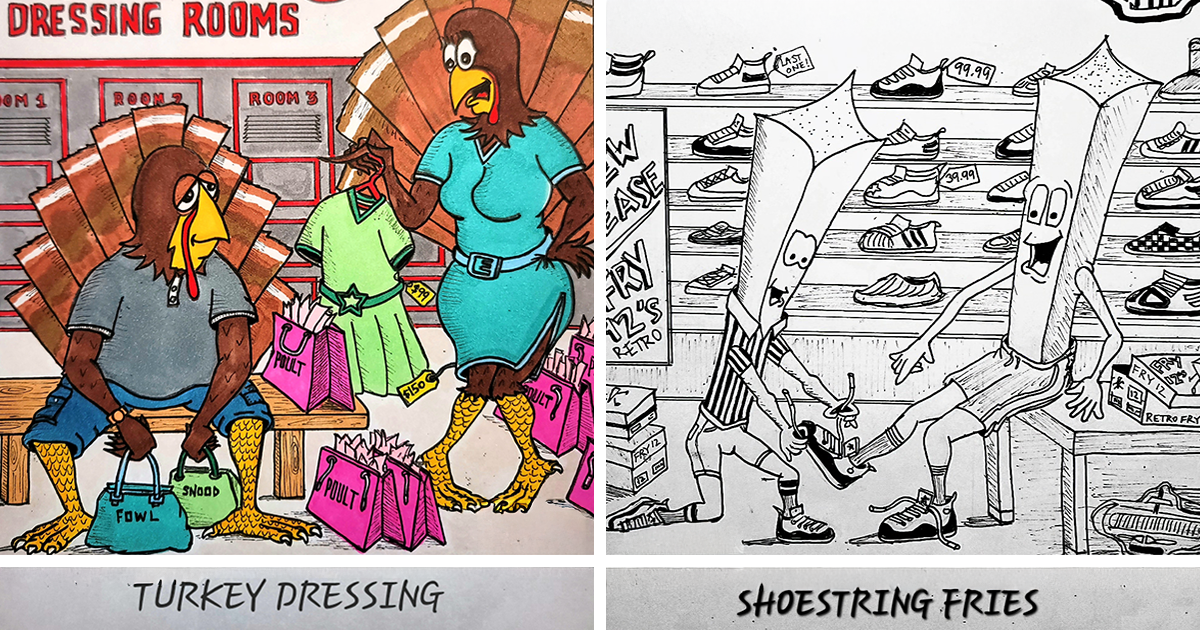
Some people wake up and make coffee. I wake up and wonder whether a talking tomato would need therapy after being called “sauce material” all its life. That, in a nutshell, is the strange little kitchen where my one-panel comic series, “Today’s Special,” gets cooked.
“Today’s Special” is a collection of humorous one-panel comics built around food, everyday objects, animal characters, restaurant culture, wordplay, and the tiny disasters of modern life. The concept is simple: take something familiar, give it a personality, sprinkle in a pun, and let the punchline do a graceful face-plant. The result is a bite-sized cartoon universe where steaks have stage fright, chickens question workplace safety, vegetables hold grudges, and menus suddenly feel like they are hiding emotional backstories.
One-panel comics have a special kind of magic. They do not have the luxury of three acts, dramatic lighting, or a slow-motion training montage. They get one frame, one setup, one punchline, and one chance to make the reader snort through their nose in public. That pressure is exactly what makes them fun. A good single-panel cartoon is like a tiny joke grenade: small, quiet, and surprisingly effective when it lands.
What Is “Today’s Special”?
“Today’s Special” is my ongoing humorous comic series inspired by food, diners, kitchens, grocery aisles, family restaurants, and the odd emotional lives I imagine for things that probably should not have emotional lives. It is a one-panel comic collection, which means every cartoon has to tell a complete joke in a single image. There is no second panel to explain the gag. No extra strip to rescue a weak punchline. No narrator standing nearby with cue cards saying, “Please laugh here.”
The series plays with a simple idea: food is already funny. Bananas look like they are permanently mid-prank. Eggs are fragile little philosophers. Hot dogs are the only food that sounds like both a snack and a very specific emergency. Once you start looking at the menu as a cast list, the jokes begin to appear everywhere.
The tone of “Today’s Special” is light, silly, and family-friendly, but it also leans into clever wordplay and unexpected character reactions. A single-panel comic about a sandwich may be ridiculous on the surface, but underneath the lettuce there is usually a small human truth: anxiety, ambition, jealousy, awkwardness, overconfidence, or the universal fear of being reheated in a microwave at work.
Why One-Panel Comics Work So Well
One-panel cartoons have been part of American humor culture for generations. From magazine cartoons to newspaper “funnies,” single-panel comics have long offered readers a fast burst of entertainment in the middle of everyday routines. Their strength is efficiency. They do not ask readers to commit to a long story. They simply invite them to pause, look, process the twist, and enjoy the little mental click that happens when the joke connects.
That “click” matters. A successful one-panel comic usually works because the image and caption do different jobs. The drawing creates the situation. The caption changes the meaning. When the two collide, the joke appears. It is the cartoon version of opening the fridge and discovering your leftovers have joined a union.
The Beauty of the Fast Punchline
Readers online move quickly. They scroll through social media, news feeds, search results, videos, memes, and messages at a speed that would make a caffeinated squirrel file a workplace complaint. One-panel comics fit this behavior perfectly. They are visual, compact, and instantly shareable. A strong comic can be understood in seconds, but remembered for days.
That is why funny one-panel comics continue to perform well on platforms where attention is precious. The best cartoons do not waste time. They walk in, tell the joke, steal a fry from your plate, and leave.
Why Food Makes a Great Comedy Subject
Food is universal. Everyone eats. Everyone has opinions about pizza toppings. Everyone has encountered a salad that looked healthier than it tasted. Because food is so familiar, it gives the reader an instant point of entry. A comic about a lawyer potato or a nervous pancake does not require a complicated backstory. The reader already knows what those things are. The humor comes from giving them a surprising role, emotion, or problem.
In “Today’s Special,” food becomes a way to talk about everyday human behavior without pointing directly at people. A jealous pickle, a dramatic cheeseburger, or a carrot with career anxiety can say something funny about us while wearing the disguise of lunch. It is social commentary with condiments.
Here Are 15 “Today’s Special” Comic Ideas and What Makes Them Funny
Since this article is about 15 humorous one-panel comics, here is a behind-the-scenes look at the kind of jokes that fit the “Today’s Special” universe. These are the types of setups, characters, and punchlines that make the series feel playful, food-focused, and pleasantly absurd.
1. The Overconfident Egg
An egg stands on a stage in front of a talent-show audience and announces, “Tonight, I’m going to crack everyone up.” The humor works because the punchline uses a familiar phrase while also pointing to the egg’s greatest personal weakness. Confidence is wonderful, but shells are not known for long-term stability.
2. The Therapy Session With a Tomato
A tomato sits on a therapist’s couch and says, “Everyone keeps telling me I’m saucy, but no one asks how I feel.” This comic plays with food language and emotional vocabulary. It gives personality to a common ingredient and turns a casual description into a miniature identity crisis.
3. The Chicken at the Job Interview
A chicken sits across from a hiring manager and says, “My biggest weakness? Crossing roads without a five-year plan.” The joke borrows from the classic chicken-crossing-the-road format but updates it with modern workplace language. It is silly because the oldest joke in the book suddenly has a résumé.
4. The Nervous Slice of Pizza
A pizza slice looks at a group of hungry people and whispers, “I feel like everyone wants a piece of me.” It is dramatic, literal, and oddly relatable. Many people have felt stretched thin. In this case, the character may literally be stretched cheese.
5. The Pickle With Boundaries
A pickle holds up a tiny sign that reads, “Respect my brine.” The humor is quick and character-based. It turns a food-preservation detail into a personal boundary. Suddenly, the pickle is not just a side item. It is an emotionally evolved cucumber with standards.
6. The Pancake Identity Crisis
A pancake stares into a mirror and says, “Am I breakfast, dessert, or just a flat cake with timing issues?” The joke works because pancakes really do sit in a strange category. Add syrup, fruit, chocolate chips, or whipped cream, and breakfast begins suspiciously resembling a party that started too early.
7. The Hot Dog’s Complaint
A hot dog sits in a bun and says, “I’m tired of being judged by my name.” The panel creates humor by making the hot dog aware of its own absurd label. There is no dog involved, no barking, and no explanation that satisfies a serious person. The food industry really did just name it and move on.
8. The Dramatic Onion
An onion stands beside a group of crying chefs and says, “Finally, people understand my art.” This comic flips the usual onion joke. Instead of being blamed for tears, the onion sees itself as an emotional performer. It is not causing discomfort; it is delivering theater.
9. The Avocado at the Bank
An avocado applies for a loan and says, “I have excellent toast-based assets.” This gag blends food trends with financial language. It also pokes fun at how avocados became cultural shorthand for brunch, wellness, and suspiciously expensive breakfast choices.
10. The Bacon’s Fitness Plan
A strip of bacon wearing a sweatband says, “I’m trying to get crispy, not shredded.” The joke plays with fitness vocabulary and cooking terminology. It is a tiny collision between gym culture and breakfast culture, two worlds that probably should not share locker rooms.
11. The Salad Feeling Ignored
A salad watches someone order fries and says, “I dressed up for nothing.” The humor comes from the double meaning of “dressed.” A salad can be dressed with vinaigrette, but in this panel, it also sounds like someone who wore a nice outfit to a party no one attended.
12. The Steak With Stage Fright
A steak stands under a spotlight and mutters, “I wasn’t prepared for this grilling.” The word “grilling” becomes both cooking and intense questioning. The steak is not just dinner; it is a witness under pressure.
13. The Broccoli Motivational Speaker
A broccoli floret addresses a room of vegetables and says, “People may push us to the side of the plate, but we are still the main character in fiber.” This joke gives the least glamorous side dish a heroic voice. It is absurd, but also strangely inspiring. Go broccoli. Live your crunchy truth.
14. The Ice Cream Cone’s Existential Panic
An ice cream cone melts under the sun and says, “I always knew success would be short-lived.” The panel is funny because the character’s physical reality creates the emotional stakes. Ice cream is delicious because it is temporary, which is also the kind of wisdom you expect from dessert after a rough Tuesday.
15. The Menu as a Gossip Column
A restaurant menu whispers to another menu, “The soup of the day changes personalities every morning.” This comic gives the entire restaurant a secret social life. Menus, specials, soups, sides, and desserts all become characters in a workplace comedy where the customers have no idea the appetizers are judging them.
The Creative Recipe Behind “Today’s Special”
Making a one-panel comic often begins with a word, not a picture. I might hear a phrase like “grilled,” “dressed,” “seasoned,” “cracked,” “stuffed,” or “well done,” and immediately wonder whether it could mean something else in a cartoon. Food words are especially rich because many of them already overlap with human emotions, social situations, and everyday expressions.
For example, “seasoned” can describe a well-flavored dish or an experienced professional. That opens the door to a comic where a salt shaker gives career advice to a rookie french fry. “Stuffed” can mean filled with ingredients or exhausted after Thanksgiving. “Rare” can describe steak or a collector’s item. Every double meaning is a tiny doorway, and behind some of those doors is a chicken wearing reading glasses.
Step One: Find the Ordinary Thing
The best comic ideas often start with something painfully ordinary: a carton of eggs, a diner booth, a ketchup bottle, a grocery store shelf, or a plate of spaghetti. Ordinary subjects are useful because readers recognize them instantly. Recognition creates speed, and speed matters in one-panel humor.
Step Two: Add an Unexpected Emotion
Once the object is familiar, I give it an emotion it should not have. A muffin feels jealous. A steak feels nervous. A potato feels underappreciated. The more specific the emotion, the funnier the situation becomes. “Sad bread” is fine. “Bread upset because it was passed over for artisanal sourdough” is better.
Step Three: Cut Everything That Does Not Help the Joke
One-panel comics are ruthless little editors. If a line does not support the punchline, it gets removed. If a background detail distracts from the main gag, it disappears. The goal is clarity. The reader should never have to study the panel like it is a treasure map left by a sarcastic pirate.
Why Simple Drawings Can Make Stronger Jokes
A comic does not need hyper-detailed artwork to be funny. In fact, too much detail can sometimes slow the joke down. Simple cartooning helps readers understand the scene quickly. Clear expressions, readable body language, and strong composition can do more for humor than elaborate shading.
That does not mean the art is unimportant. The art is the delivery system. A raised eyebrow, a tiny frown, a nervous posture, or a suspiciously confident pickle can change the entire rhythm of a punchline. The drawing tells the reader how to feel before the caption finishes the job.
For “Today’s Special,” the visual style needs to feel approachable. The characters should look funny before they even speak. A tomato with too much confidence or a pancake having an emotional crisis should be visually readable at a glance. The humor should not require a magnifying glass, a glossary, or a culinary degree.
How “Today’s Special” Connects With Readers Online
Funny comics travel well on the internet because they are easy to share. A reader can send one to a friend with a message like, “This is you,” which is either a compliment or a tiny act of war depending on the comic. Relatable humor gives people a reason to pass it along.
Food-based humor also has broad appeal. It does not rely heavily on politics, celebrity gossip, or complicated trends that expire faster than milk in a hot car. A joke about pizza, eggs, coffee, or fries can work for a wide audience because these subjects belong to everyday life.
For web publishing, comics also benefit from strong presentation. Descriptive titles, clean formatting, image captions, alt text, and relevant surrounding text help readers and search engines understand the content. A comic post should not simply throw images onto a page and hope the algorithm brings snacks. The article around the comics matters too.
SEO Tips for Publishing One-Panel Comics
To help a comic collection perform better in search, use clear headings that include natural phrases such as “one-panel comics,” “funny comics,” “humorous cartoons,” and “food comics.” Each image should have a descriptive file name and helpful alt text. Instead of uploading a file called “IMG_0047.png,” use something like “funny-one-panel-comic-nervous-pizza.png.” Search engines appreciate clarity. So do readers. So does everyone who has ever opened a folder full of mystery images and felt their soul leave the room.
Alt text should briefly describe what is important in the image. For comics, that often means identifying the characters, action, and joke context without overexplaining the punchline. Accessibility is not just a technical checkbox. It is part of making humor available to more people.
My Personal Experience Creating “Today’s Special”
Creating “Today’s Special” has taught me that humor is everywhere, but it usually hides in plain sight wearing a tiny fake mustache. At first, I thought the hardest part would be drawing. Then I realized the real challenge is noticing. A cartoonist has to look at normal life from a slightly crooked angle. A trip to the grocery store becomes character research. A restaurant menu becomes a script. A lonely grape rolling under the refrigerator becomes, somehow, a tragedy in three seconds.
The experience is both exciting and humbling. Some ideas arrive fully cooked. Others show up half-baked, which is appropriate for a food comic but inconvenient for deadlines. I may start with a phrase that feels funny, sketch it quickly, and realize the joke does not work visually. Other times, a doodle has a perfect facial expression, but the caption limps behind it like a shopping cart with one bad wheel. The process requires patience, testing, revising, and occasionally staring at a carrot as if it owes me money.
One of the biggest lessons has been learning how much can fit inside one panel. A single image can suggest a location, a character relationship, a conflict, and a punchline. But it has to be arranged carefully. If there are too many characters, the joke gets crowded. If the caption is too long, the rhythm suffers. If the expression is wrong, the punchline loses flavor. One-panel comics are small, but they are not easy. They are like espresso shots of storytelling: tiny, concentrated, and dangerous if consumed at midnight.
I have also learned that the funniest ideas often come from emotional truth. A talking sandwich is silly, but a talking sandwich worried about being overlooked is recognizable. A nervous steak is absurd, but everyone understands the fear of being judged. A salad saying it “dressed up for nothing” works because people know what it feels like to make an effort and still lose to french fries. The more specific the food joke becomes, the more human it can feel.
Sharing the comics online has added another layer to the experience. Readers notice details I did not expect. They respond to characters I thought were minor. They sometimes laugh hardest at the smallest visual touch: a worried eyebrow, a tiny sign, a background object, or a ridiculous facial expression. That feedback is valuable because it reminds me that a comic is not finished when I draw it. It becomes complete when someone sees it, understands it, and gives it their own little laugh.
There is also a strange joy in building a world where food has opinions. Once the concept exists, everything becomes potential material. Breakfast has office politics. Dinner has drama. Dessert has confidence issues. The refrigerator is basically a waiting room full of edible personalities. The more I work on “Today’s Special,” the more I realize that the series is not just about food jokes. It is about looking at ordinary things with curiosity and asking, “What if this had feelings, a complaint, and possibly a punchline?”
That mindset changes the way I move through the day. I pay closer attention to conversations, signs, labels, menus, and phrases people use without thinking. Humor often begins as a tiny mismatch between what something is and what it could mean. A cartoonist’s job is to catch that mismatch before it runs away and hides behind the cereal boxes.
The experience has made me more disciplined, too. Creating comics regularly means showing up even when inspiration is out getting tacos. Not every idea becomes a finished cartoon. Not every finished cartoon becomes a favorite. But every sketch builds the habit. Over time, the series develops its own voice, rhythm, and sense of logic. In the world of “Today’s Special,” almost anything can talk, almost anything can panic, and almost everything is one pun away from emotional growth.
Why I Keep Making These Comics
I keep creating “Today’s Special” because humor is a small but meaningful way to interrupt the seriousness of the day. Life is full of bills, deadlines, traffic, emails, appointments, and mystery leftovers that may or may not be safe. A one-panel comic will not solve all of that, but it can offer a quick laugh, and sometimes a quick laugh is exactly what people need.
There is something satisfying about turning everyday objects into tiny comedians. A carton of eggs, a slice of pizza, or a nervous piece of toast can become a reminder that creativity does not always need a grand stage. Sometimes it just needs a pen, a blank panel, and a willingness to ask deeply unserious questions.
“Today’s Special” is my way of serving that little moment of fun. No reservation required. No dress code. Tips appreciated, but laughter is accepted as legal tender.
Conclusion
“I Create Humorous One-Panel Comics Called ‘Today’s Special’, Here Are 15 Of Them” is more than a showcase of funny food cartoons. It is a celebration of compact storytelling, visual humor, wordplay, and the strange joy of giving everyday objects a voice. One-panel comics work because they respect the reader’s time while still delivering a complete comic experience. They are quick, clever, and surprisingly expressive.
Whether the joke features a dramatic onion, a nervous steak, a confident egg, or a salad with hurt feelings, the heart of “Today’s Special” is simple: ordinary life becomes funnier when you tilt it slightly. Food becomes a cast of characters. Menus become comedy scripts. A grocery aisle becomes a stage. And somewhere in the middle of it all, a pickle is probably asking for respect.
Note: This HTML draft is written in original American English for web publishing and is structured with SEO-friendly headings, natural keyword usage, and copy-ready body content.