

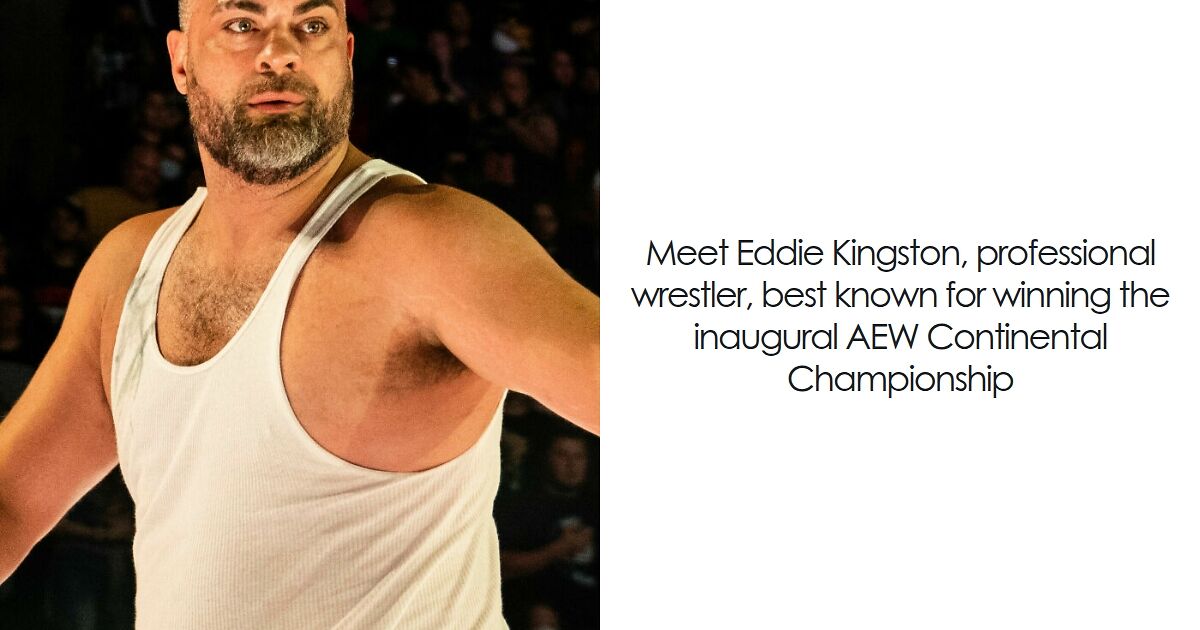
Eddie Kingston is not the kind of professional wrestler who walks into the room and politely asks for attention. He kicks the door open emotionally, spiritually, and sometimes verbally, then somehow makes everyone feel like they have known him since middle school. Known as “The Mad King,” Kingston built his career on grit, bruising honesty, and the kind of promos that sound less like sports entertainment and more like a guy finally telling the truth after holding it in for twenty years.
Born Edward Moore in Yonkers, New York, Kingston became one of the most respected voices in modern wrestling by taking the long road. And by “long road,” we mean the kind with potholes, unpaid tolls, questionable locker rooms, and a GPS that keeps saying, “Turn around when possible.” Before his rise in All Elite Wrestling, he spent nearly two decades grinding through independent wrestling promotions, collecting scars, stories, and a fan base that believed in him long before mainstream TV caught up.
This Eddie Kingston biography looks at his early life, independent wrestling journey, AEW breakthrough, championship wins, major rivalries, injury comeback, and the qualities that make him one of the most authentic performers in professional wrestling today.
Who Is Eddie Kingston?
Eddie Kingston is an American professional wrestler best known for his intense brawling style, emotional interviews, and deep connection with wrestling fans. He is currently associated with All Elite Wrestling and Ring of Honor, where he has become one of the most compelling personalities on television. Kingston is often billed from Yonkers, New York, a detail that matters because his entire character feels like it was built out of New York pavement, old-school wrestling tapes, and a refusal to be anything other than himself.
Kingston’s nickname, “The Mad King,” fits perfectly. He is passionate, unpredictable, stubborn, and strangely lovable even when he looks like he might start a fight over a parking space. His signature offense includes the Backfist to the Future, lariats, suplexes, chops, and a roughneck fighting style inspired by Japanese strong style, American brawling, and the emotional drama of classic pro wrestling.
Early Life And Wrestling Roots
Eddie Kingston was born on December 12, 1981, in Yonkers, New York. He grew up as a fan of professional wrestling and has often spoken about loving the sport since childhood. Unlike some wrestlers who entered the business through athletic pipelines or polished developmental systems, Kingston came up through the independent scene, where charisma matters, but gas money matters even more.
His background and identity helped shape his on-screen presence. Kingston is proud of his New York roots and has Puerto Rican and Irish heritage. That mix of neighborhood toughness, family loyalty, and emotional honesty became a defining part of his character. Fans do not connect with Kingston because he seems perfect. They connect with him because he does not even pretend to be.
Training And Independent Wrestling Beginnings
Kingston began his in-ring career in 2002 after training with respected names including Kevin Knight and Mike Quackenbush. His early work included time in Chikara, a promotion known for colorful characters, technical wrestling, comedy, and surprisingly serious storytelling. Chikara helped Kingston develop range. One minute, the environment could be absurd enough to make a cartoon blush; the next, Kingston could make a feud feel like a family betrayal.
During the 2000s, Kingston became a fixture in several independent promotions, including Combat Zone Wrestling, IWA Mid-South, Jersey All Pro Wrestling, and Pro Wrestling Guerrilla. These were not easy places to build a career. Independent wrestling demanded travel, toughness, improvisation, and the ability to win over crowds that might include forty people, three folding chairs, and one fan who thinks he is part of the show.
But Kingston thrived because he had something rare: believability. He did not look like a manufactured superhero. He looked like a man who had been through things, remembered every slight, and could explain all of it in a promo that made the audience lean forward.
Building A Reputation In Chikara, CZW, And Beyond
Kingston’s early career included notable runs in Chikara and Combat Zone Wrestling. In Chikara, he became associated with emotionally heavy rivalries and long-term storytelling. His feud with Chris Hero became one of the defining independent wrestling rivalries of its era, stretching across multiple promotions and years. It was not just about moves; it was about resentment, pride, and the kind of grudge that needs its own zip code.
In CZW, Kingston showed another side of himself. The promotion was known for hardcore wrestling, violence, and intense crowds. Kingston fit the environment without losing his identity. He captured the CZW World Heavyweight Championship and CZW World Tag Team Championship, proving he could carry both singles and tag team stories. His work there sharpened his reputation as a tough brawler who could talk people into caring before the bell rang.
That ability would become his career superpower. Plenty of wrestlers can throw a chop. Kingston can throw a chop and make you believe it came with fifteen years of unpaid emotional interest.
Impact Wrestling And The “King” Era
Before reaching national prominence in AEW, Kingston appeared in Impact Wrestling. He was involved with the Death Crew Council and later returned under the name “King” as part of the Latin American Xchange storyline. His work with LAX and The OGz gave him a larger platform and showed that his raw promo style could translate to television.
Impact did not turn Kingston into a household name overnight, but it added another layer to his resume. He learned how to work within televised wrestling formats while keeping the rough edges that made him special. That balance would become crucial when AEW later gave him a microphone and, wisely, got out of the way.
The AEW Breakthrough: Cody Rhodes Open Challenge
Eddie Kingston’s mainstream breakthrough came in July 2020 on AEW Dynamite. At the time, Cody Rhodes was defending the TNT Championship in an open challenge format. Kingston answered the challenge and immediately made an impression. He walked out with no glossy introduction, delivered a fiery promo, and challenged Cody in a No Disqualification match.
Although Kingston lost the match, he won something more valuable: instant credibility. Fans who had followed his independent career felt vindicated. New viewers wondered where this guy had been hiding. The answer, of course, was “in plain sight, wrestling everywhere, while the industry took its sweet time noticing.”
AEW signed Kingston shortly after that appearance, and his career entered a new chapter. He became a featured performer, not because he fit the traditional mold of a TV wrestling star, but because he shattered it in the most compelling way possible.
Major AEW Rivalries And Emotional Storytelling
Kingston’s AEW run has included rivalries with Jon Moxley, Bryan Danielson, Claudio Castagnoli, CM Punk, Chris Jericho, and others. His feud with Jon Moxley was especially important because it highlighted Kingston’s gift for emotional realism. The two wrestlers presented themselves not as cartoon enemies but as former friends with complicated history. Their 2020 “I Quit” match at Full Gear gave Kingston one of his earliest AEW pay-per-view main event moments.
His feud with CM Punk in 2021 also became a fan favorite because it felt uncomfortably real in the best wrestling way. Kingston’s promos cut through the usual noise and framed the story around resentment, authenticity, and who really represented the struggle of professional wrestling. It was short, sharp, and memorable.
Against Bryan Danielson and Claudio Castagnoli, Kingston leaned into another major part of his character: insecurity mixed with pride. He respects wrestling tradition deeply, but he also refuses to bow to anyone who looks down on him. That tension made his matches feel like personal wars rather than athletic exhibitions.
ROH World Championship Victory
One of Eddie Kingston’s most emotional career highlights came at AEW Grand Slam in 2023, held at Arthur Ashe Stadium in New York. There, Kingston defeated Claudio Castagnoli to win the ROH World Championship while retaining the NJPW Strong Openweight Championship.
The location mattered. Kingston winning a world title in New York, in front of fans who treated him like one of their own, felt like a career payoff years in the making. The moment was not polished in a corporate way. It was raw, loud, and deeply human. In other words, it was Eddie Kingston.
The victory also carried symbolic weight because the ROH World Championship has been held by many wrestlers Kingston respects. For a performer who openly loves wrestling history, winning that title was not just another belt for the luggage. It was validation.
NJPW Strong Openweight Champion And Japan Influence
Kingston’s admiration for Japanese wrestling is central to his identity. He has often cited classic All Japan Pro Wrestling as a major influence, especially hard-hitting legends such as Toshiaki Kawada and Mitsuharu Misawa. His chops, suplexes, selling, and match structure frequently reflect that inspiration.
In 2023, Kingston defeated KENTA to win the NJPW Strong Openweight Championship. That victory meant a great deal because New Japan Pro-Wrestling represented a dream stage for Kingston. He also competed in the G1 Climax, one of the most demanding tournaments in professional wrestling. For a wrestler who spent years fighting for recognition, stepping into that environment was a major career milestone.
Kingston’s New Japan run helped reshape how fans viewed him. He was not only a great talker or beloved underdog. He was a serious international competitor who could carry championship pressure across promotions.
The Continental Classic And Triple Crown Moment
At AEW Worlds End 2023, Eddie Kingston reached another historic peak. He defeated Jon Moxley in the finals of the inaugural AEW Continental Classic, becoming the first AEW Continental Champion. Because he was already holding the ROH World Championship and NJPW Strong Openweight Championship, Kingston became recognized as a modern American Triple Crown or Continental Crown Champion.
This was one of the most important achievements of his career. The Continental Classic was presented as a serious round-robin tournament, and Kingston’s victory gave the new championship instant emotional weight. He did not win because he was the flashiest wrestler in the field. He won because the story demanded someone whose entire career had been one long argument with doubt.
Defeating Moxley also mattered because Moxley had long been one of Kingston’s most important rivals and friends. Their relationship has always carried a mix of love, anger, and competition. Kingston finally beating him on such a major stage felt like a personal breakthrough.
Injury, Recovery, And Return
In 2024, Kingston suffered a serious leg injury during a match against Gabe Kidd. Reports described a fractured tibia, torn ACL, and torn meniscus, a combination that sounds less like an injury report and more like a mechanic reading the damage after a car crash. The injury forced Kingston out of action for more than a year and interrupted one of the hottest periods of his career.
During his absence, Kingston’s status only grew in some ways. Fans missed his voice, his physicality, and his emotional presence. He later discussed the mental and physical difficulty of recovery, including the challenge of returning to in-ring movement and rebuilding confidence.
Kingston returned to AEW in 2025, defeating Big Bill at All Out. The match marked his first major comeback after the injury and reminded fans why his presence matters. He did not return as a flawless superhero. He returned as Eddie Kingston: defiant, imperfect, and still swinging.
Wrestling Style: Why Eddie Kingston Feels Different
Eddie Kingston’s wrestling style is built around emotion more than acrobatics. He is a brawler, striker, and storyteller. His matches often look like fights between people who have unfinished business, unpaid debts, and maybe one shared therapist who quit halfway through the feud.
His signature Backfist to the Future is simple but effective because Kingston makes it feel like the final punctuation mark on an argument. His chops are loud, his suplexes are rugged, and his selling often communicates frustration as much as pain. He does not wrestle like someone trying to impress a highlight reel. He wrestles like someone trying to survive a bad memory.
That style can be polarizing. Some fans prefer smoother athletic performances. Others see Kingston’s roughness as the point. His appeal lies in making wrestling feel messy, emotional, and alive. In an era of polished production, Kingston brings cigarette-burn realism, even if he is standing under expensive arena lights.
Promo Skills And Authenticity
If Eddie Kingston never threw a single strike, he would still be remembered as one of the best talkers of his generation. His promos are famous because they do not sound scripted. He stumbles, snaps, pauses, laughs bitterly, and says things that feel dangerously close to real life. That is the magic.
Kingston can sell a championship match, a personal feud, or a random Wednesday night fight because he speaks from a place that feels lived-in. He talks about doubt, anger, loyalty, family, mental health, and wrestling as if each subject is connected. For Kingston, wrestling is not just a job. It is therapy, identity, history, and sometimes a very loud group project with violence.
This authenticity has made him deeply relatable. Fans see a man who has struggled, failed, kept going, and somehow turned emotional bruises into art. That is not easy to manufacture. Many have tried. Most end up sounding like motivational posters wearing knee pads.
Career Highlights
Winning The ROH World Championship
Kingston’s 2023 ROH World Championship win over Claudio Castagnoli at AEW Grand Slam remains one of his most celebrated moments. It combined personal history, hometown energy, and championship prestige into a scene that felt genuinely earned.
Becoming NJPW Strong Openweight Champion
Defeating KENTA for the NJPW Strong Openweight Championship was another dream achievement. It connected Kingston directly to Japanese wrestling, a style and culture he has admired throughout his life.
Winning The AEW Continental Classic
Kingston’s victory in the inaugural Continental Classic made him the first AEW Continental Champion and completed his Triple Crown moment. It was a rare case where the title, tournament, and wrestler all elevated one another.
Classic Rivalries With Moxley, Punk, Danielson, And Claudio
Kingston’s rivalries have often been less about wins and losses and more about emotional truth. His programs with Jon Moxley, CM Punk, Bryan Danielson, and Claudio Castagnoli gave AEW some of its most intense character-driven storytelling.
Returning From Serious Injury
His 2025 return after a major leg injury added another comeback chapter to his career. For many fans, seeing Kingston back in the ring was less about one result and more about watching someone refuse to let pain write the ending.
Why Fans Love Eddie Kingston
Fans love Eddie Kingston because he feels real in a business built on illusion. He does not hide the struggle behind the performance. He lets it power the performance. Whether he is yelling at an enemy, thanking fans, or admitting insecurity, Kingston gives audiences permission to care without feeling silly about it.
He also represents a different kind of wrestling success story. He was not chosen early, protected by a machine, or fast-tracked into stardom. He earned attention by surviving. That matters. In an industry often obsessed with youth, physiques, and marketable perfection, Kingston became popular by being older, rougher, louder, and more emotionally available than anyone expected.
Experiences And Lessons From Eddie Kingston’s Career
One of the most meaningful experiences connected to Eddie Kingston’s career is the lesson that authenticity can arrive late and still arrive right on time. Kingston did not become a national wrestling star at twenty-five. He did not have a smooth rise, a shiny launch campaign, or a perfectly packaged hero’s journey. His path looked more like real life: uncertain, frustrating, occasionally broke, and full of moments where quitting would have made practical sense.
For fans, watching Kingston’s rise feels personal because it mirrors the experience of being overlooked. Almost everyone knows what it is like to work hard while someone else gets the shortcut. Kingston’s story speaks to that feeling without turning it into a cheesy slogan. He does not say, “Believe in your dreams” with a sparkle in his eye. He says it like a guy who had to sell gear during a pandemic, nearly walked away from wrestling, and still found one more reason to show up.
Another experience tied to Kingston is the way he changes the atmosphere of a match before it begins. Some wrestlers need elaborate entrances, dramatic lighting, and enough pyro to wake the neighbors. Kingston can walk out in a plain shirt, grab a microphone, and make the building feel like a courtroom, a confession booth, and a boxing gym all at once. That ability teaches a powerful content lesson too: emotion beats decoration. When the message is strong, people listen.
Kingston’s career also shows how valuable long-term credibility can be. His independent wrestling years were not wasted time. They were the foundation. Every small crowd, every brutal travel day, every underpaid booking, and every intense feud helped build the Eddie Kingston fans later discovered on national television. When he arrived in AEW, he did not feel like a new character. He felt like a fully written novel that someone had finally placed on the front table of the bookstore.
There is also a mental health dimension to Kingston’s appeal. He has been open about emotional struggles, self-doubt, and the difficulty of receiving love from fans. That honesty has helped many viewers see him as more than a wrestler. He is a reminder that toughness is not the absence of vulnerability. Sometimes toughness is admitting that you are not okay, then getting up anyway because the bell rang and life has terrible timing.
For writers, creators, athletes, and everyday people, Kingston’s story offers a practical takeaway: do not sand off every rough edge just to look more acceptable. The rough edges might be the reason people believe you. Kingston’s promos work because they are not overly polished. His matches connect because they feel personal. His career matters because it was not designed in a boardroom. It was built in gyms, armories, small venues, big arenas, and emotional places most performers are afraid to visit in public.
That is the experience of Eddie Kingston as a fan: you do not just watch him wrestle; you root for him like you know him. You worry when he gets hurt. You cheer when he comes back. You laugh when he says something painfully blunt. And when he wins, it feels like a victory for every person who took the hard road and kept walking even when the road had the audacity to get harder.
Conclusion
Eddie Kingston’s bio and career highlights tell the story of a wrestler who turned struggle into connection. From Yonkers to Chikara, from CZW wars to Impact Wrestling, from AEW’s TNT open challenge to championship glory in ROH, NJPW, and AEW, Kingston has built a career that feels deeply earned. He is not the smoothest, flashiest, or most corporate-friendly performer in wrestling. That is exactly why he matters.
Kingston represents the emotional core of professional wrestling: pride, pain, loyalty, redemption, and the occasional urge to settle problems with a spinning backfist. His career proves that fans still crave authenticity. They want stories that feel human. They want wrestlers who can make a title match feel like a life event. Eddie Kingston does that better than almost anyone.
Note: This article is written in original language and synthesized from reputable wrestling coverage, official promotion records, and publicly available biographical information.