

Note: This article treats Soviet weapon systems as historical and engineering case studies. Some entered service, some remained prototypes, and a few were essentially Cold War fever dreams with rivets.
The Soviet Union did not invent the idea of “go big or go home,” but it may have issued it a state research budget, a design bureau, and a dramatic parade slot in Red Square. During the 20th century, Soviet engineers worked under extraordinary pressure: defend a vast country, match or outdo NATO, survive nuclear war, and do all of it with enough spectacle to make foreign military attachés spill their coffee.
The result was a long catalog of Soviet weapon systems that ranged from brilliant to bizarre. Some were practical responses to real strategic problems. Others looked as if someone had asked, “What if a battleship, a tank, and a science-fiction prop had a child?” Yet even the strangest Soviet military technology usually had a logic behind it. The logic may have been stretched like a cheap rubber gasket, but it was there.
Below are ten eccentric Soviet weapon systems that show the ambition, creativity, paranoia, and occasional mechanical comedy of Cold War military design.
1. Lun-Class Ekranoplan: The Missile Boat That Wanted to Be an Airplane
The Lun-class ekranoplan was one of the most unforgettable Soviet military machines ever built. It was not quite an aircraft, not quite a ship, and not quite something you would want to explain to your insurance company. Ekranoplans used ground effect, an aerodynamic cushion created when flying very close to a surface, usually water. In theory, this allowed them to travel faster than ships while carrying heavier loads than conventional aircraft of similar size.
The earlier KM ekranoplan, nicknamed the “Caspian Sea Monster” by Western observers, proved that the Soviet Union was serious about this strange category of vehicle. The Lun took the concept into operational military territory. It skimmed above the Caspian Sea and carried anti-ship missiles mounted dramatically along its back, giving it the appearance of a sea monster that had joined the missile age.
The appeal was obvious: high speed, low altitude, and a possible ability to approach naval targets in ways that complicated radar detection. The drawbacks were also obvious, especially once weather, maintenance, sea state, and tactical flexibility entered the chat. The Lun was impressive, but it was also specialized, expensive, and tied to conditions that made it less versatile than traditional aircraft or ships.
Still, as eccentric Soviet weapon systems go, the ekranoplan remains a superstar. It looked impossible, moved like a loophole in physics, and carried enough missiles to make subtlety file a formal complaint.
2. Object 279: The Flying Saucer Tank for Nuclear Battlefields
Object 279 looked less like a tank and more like a heavily armed UFO that had decided to commute by caterpillar track. Developed in the late 1950s, it was an experimental Soviet heavy tank intended to survive and fight in extreme battlefield conditions, including the imagined chaos of nuclear war.
Its most famous feature was its unusual hull shape. The rounded, boat-like body was designed to resist blast waves and deflect armor-piercing and shaped-charge rounds. Beneath it sat four tracks instead of the usual two, improving ground pressure and helping the vehicle move through mud, snow, and broken terrain. In theory, Object 279 could cross miserable ground that would stop more conventional tanks. In practice, it was complicated, heavy, and expensive.
The tank carried a powerful 130 mm gun and heavy armor, but it arrived at the wrong moment in military history. Soviet leadership under Nikita Khrushchev increasingly favored missiles over giant heavy tanks. The age of the lumbering steel monster was ending, and Object 279 became a museum-worthy reminder that sometimes the future arrives looking like a pancake with a cannon.
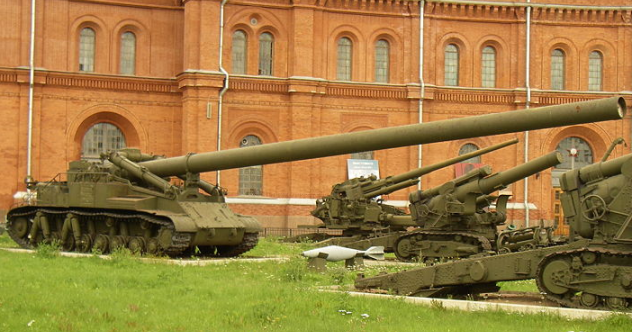
3. 2B1 Oka and 2A3 Kondensator: Nuclear Artillery with Stage Fright
In the 1950s, the United States developed nuclear artillery, including the M65 Atomic Cannon. The Soviet Union responded in classic Cold War style: by asking, “What if ours were even more enormous?” The result included the 2A3 Kondensator, a 406 mm self-propelled gun, and the 2B1 Oka, a 420 mm self-propelled mortar designed to fire tactical nuclear shells.
These vehicles were gigantic. The Oka’s barrel was so long it looked like a tank had accidentally driven under a factory smokestack. The concept was straightforward: deliver nuclear firepower at the tactical level without relying entirely on aircraft or longer-range missiles. On paper, that made sense. On roads, bridges, railcars, and firing ranges, the design became less charming.
The recoil and weight created major mechanical problems. Transport was difficult. Reloading was slow. The vehicles were wide, awkward, and increasingly redundant as tactical ballistic missiles improved. They also represented a very specific moment in Cold War thinking, when armies imagined nuclear war as something one might manage with battlefield artillery, as if the apocalypse simply needed better logistics.
The Oka and Kondensator were eventually abandoned, but not before making public appearances that likely served a propaganda purpose. They were impractical weapons, but excellent theater. If intimidation had been measured in barrel length, the Soviet Union would have won by several meters.
4. Antonov A-40: The Tank That Briefly Became a Glider
The Antonov A-40, also known as the Krylya Tanka or “tank wings,” was one of the strangest ideas to emerge from World War II aviation. The concept was simple in the same way juggling chainsaws is simple: attach wings and a tail to a light tank, tow it behind an aircraft, release it near the battlefield, land it, detach the wings, and drive into combat.
Soviet airborne forces wanted armor that could arrive with paratroopers or support partisans. Rather than merely transport a light tank inside a glider, designer Oleg Antonov attempted to turn the tank itself into a glider. A modified T-60 light tank was stripped down and fitted with a large biplane-style wing and twin tail.
The A-40 did fly in 1942, which is more than many wild military ideas can honestly claim. However, the tow aircraft struggled with the drag and had to release the tank-glider early. The test pilot reportedly landed safely, but the project was canceled because no suitable aircraft could tow it operationally.
The A-40 is a perfect example of Soviet wartime improvisation: bold, urgent, imaginative, and slightly unhinged. It failed as a weapon system, but as a historical anecdote, it has achieved immortality. After all, “we tried to make a tank fly” is not a sentence every military can put on its résumé.
5. T-35 Heavy Tank: The Five-Turret Land Battleship
The T-35 was a Soviet heavy tank of the interwar period, and it embraced the philosophy that if one turret is good, five turrets must be excellent. This was a common line of thought in the 1920s and 1930s, when several nations experimented with multi-turreted tanks. The T-35 was the most dramatic Soviet example and the only five-turreted heavy tank to enter production.
Its nickname, “land battleship,” was not subtle. The T-35 carried a main gun, secondary guns, and multiple machine guns spread across separate turrets. On parade, it looked magnificent: long, imposing, and very useful for convincing crowds that the future had arrived wearing armor plate. On the battlefield, however, the problems were severe.
The tank was slow, mechanically unreliable, difficult to coordinate internally, and protected by armor that became inadequate as anti-tank weapons improved. A large crew had to operate in cramped compartments, and the commander had the unenviable job of managing a small armored apartment building during combat.
When Germany invaded the Soviet Union in 1941, many T-35s were lost to mechanical failure rather than enemy fire. The tank was visually powerful but practically outdated. It remains one of the clearest examples of how military design sometimes confuses “more complicated” with “more capable.”
6. Zveno Project: The Bomber That Carried Its Own Fighter Squadron
The Zveno project was a Soviet parasite aircraft program developed in the 1930s. The idea was to use a large Tupolev TB-3 bomber as a mothership carrying smaller fighter aircraft. These fighters could detach in flight, extend the reach of the strike package, and in some configurations carry bombs that the fighters could not otherwise deliver over long distances.
At first glance, it sounds like aviation designed by someone who had just discovered stacking. But the concept had real advantages. Early fighters had limited range. Bombers were vulnerable. By combining them, Soviet planners hoped to create a flexible system that could deliver attacks and provide fighter support without relying on nearby airfields.
The most successful version, often associated with the Zveno-SPB concept, used fighters as dive bombers after being carried part of the way by the mothership. The system saw limited combat use during World War II, including attacks in the Black Sea region. That makes it one of the rare eccentric Soviet weapon systems that actually moved beyond prototype curiosity into operational history.
Its limitations were also clear. Launching and coordinating aircraft from a flying mothership required skill, planning, and good conditions. As aircraft range and performance improved, the need for parasite fighter systems declined. Still, Zveno deserves respect. It was strange, but not stupid. It was a creative answer to a real problem before better engines and better aircraft made the problem less urgent.
7. Bartini Beriev VVA-14: The Anti-Submarine Aircraft from Another Planet
The Bartini Beriev VVA-14 was designed in the early 1970s as a vertical-takeoff amphibious aircraft with anti-submarine warfare ambitions. Its mission was to hunt U.S. Polaris missile submarines, a serious strategic concern for the Soviet Union. Its appearance, however, suggested that the designers had also been asked to frighten beachgoers.
The VVA-14 was intended to take off from water, fly at altitude, and also skim near the sea surface using ground effect. In its most ambitious form, it would combine the traits of a seaplane, aircraft, hovercraft, and submarine hunter. That is an impressive résumé, although perhaps too impressive for one machine.
Only two prototypes were built. The planned lift engines for vertical takeoff never fully materialized as intended, and the project struggled with complexity. After designer Robert Bartini died, momentum faded. The surviving aircraft later became famous in photographs because of its eerie, half-dismantled appearance at a museum site, where it looked like a prop from a Cold War science-fiction film.
The VVA-14 shows the Soviet willingness to attack a problem from unexpected angles. It also shows the danger of asking one vehicle to do too many jobs. Even in military aviation, there is such a thing as having too many hobbies.
8. R-36O FOBS: The Missile That Tried to Sneak Around the Planet
The R-36O fractional orbital bombardment system, often shortened to FOBS, was one of the more alarming Soviet strategic concepts. Instead of sending a nuclear warhead over the shortest ballistic route toward the United States, FOBS could place a warhead into a partial orbit and then deorbit it toward a target from an unexpected direction.
The strategic logic was chilling. U.S. early-warning radars were largely oriented toward the north, watching for missiles coming over the polar region. A fractional orbital system could approach from another direction, reducing warning time and complicating defense planning. It was a weapon built around geography, surprise, and the unpleasant creativity of nuclear strategy.
The system had drawbacks. It was less accurate than standard intercontinental ballistic missiles, and its advantages declined as warning systems improved. It also raised serious arms-control concerns because it blurred the line between ballistic missile technology and the weaponization of orbital space.
FOBS was eventually phased out under arms-control agreements, but it remains one of the most eccentric Soviet weapon systems because of its strategic imagination. It was not eccentric in shape, like the ekranoplan or Object 279. It was eccentric in concept: a nuclear weapon system designed to turn the planet itself into a delivery route.
9. Polyus-Skif: The Space Laser That Fell Back to Earth
Polyus-Skif was a Soviet prototype orbital weapons platform linked to Cold War anti-satellite ambitions. Developed during the era of American Strategic Defense Initiative debates, it represented the Soviet interest in space-based systems capable of threatening enemy satellites. In simple terms, it was a very large military spacecraft associated with laser weapon concepts. In even simpler terms, it was the sort of thing that makes arms-control diplomats develop migraines.
Launched in 1987 on the first flight of the Energia heavy-lift rocket, Polyus failed to reach orbit. The Energia booster performed successfully, but the payload malfunctioned after separation and reentered the atmosphere over the Pacific. That is a dramatic failure, but a historically important one. It showed both the ambition of Soviet space weapons research and the technical difficulties involved in turning that ambition into an operational system.
Polyus also reflected the late Cold War contradiction inside the Soviet system. On one hand, the country wanted to answer American space-defense initiatives. On the other, Mikhail Gorbachev was trying to reduce tensions and avoid openly escalating the militarization of space. Polyus was therefore both a machine and a political symbol.
As a weapon, it never worked. As a story, it remains extraordinary: a secretive space platform, a giant rocket, a failed orbital insertion, and a Cold War superpower trying to keep up with the future while the present was already cracking under its feet.
10. Project 941 Typhoon-Class Submarine: The Underwater City with Missiles
The Typhoon-class submarine, known in Soviet designation as Project 941 Akula, was not eccentric because it failed. It was eccentric because it succeeded at an almost absurd scale. It remains one of the largest submarine classes ever built, a strategic missile platform so huge that it seemed less like a submarine and more like a submerged industrial district.
The Typhoon was designed for nuclear deterrence, particularly under Arctic conditions. Its multi-hull arrangement, massive displacement, ice-operating features, and ability to carry long-range ballistic missiles made it a central Cold War symbol. Unlike some of the prototypes on this list, the Typhoon entered service and performed a real strategic role.
What makes it eccentric is the scale of the answer. The Soviet Union wanted a survivable second-strike platform that could operate under ice, remain hidden, and launch devastating retaliation if needed. The result was enormous, expensive, and technically impressive. It carried not just missiles but also the weight of an entire strategic doctrine.
The Typhoon’s size also gave it a strange cultural afterlife. It inspired fascination far beyond naval circles and helped shape public imagination about Cold War submarine warfare. In a list full of strange experiments, the Typhoon stands out as the giant that actually worked.
Why Soviet Weapon Design Often Looked So Strange
It is easy to laugh at eccentric Soviet weapon systems, and honestly, some of them practically arrive wearing clown shoes made of armor steel. But strange military technology rarely appears out of nowhere. Soviet designers faced specific problems: enormous borders, harsh geography, fear of surprise attack, competition with the United States, and political pressure to demonstrate strength.
That environment rewarded bold proposals. If NATO had aircraft carriers, the Soviet Union explored missile-carrying sea skimmers. If nuclear war might destroy roads and bridges, engineers designed tanks for blasted terrain. If submarines threatened from the oceans, designers dreamed up amphibious aircraft that could hunt them from air and sea. If space became a military frontier, Soviet planners looked at orbital weapons.
Some of these ideas were ahead of their time. Others were technological dead ends. Many were both. The ekranoplan, for example, still inspires modern interest in ground-effect transport. The Zveno project anticipated later thinking about airborne launch platforms and extended-range strike packages. Even Polyus, despite failure, belongs to the long story of anti-satellite warfare and military space competition.
The real lesson is not that Soviet engineers were reckless. It is that extreme strategic pressure creates extreme machines. The Cold War was a laboratory where fear, ideology, engineering talent, and military bureaucracy mixed together. Sometimes the result was brilliant. Sometimes it was a 420 mm nuclear mortar that damaged itself. History, like machinery, has a sense of humor.
Experiences and Takeaways from Studying 10 Eccentric Soviet Weapon Systems
Spending time with these ten eccentric Soviet weapon systems feels like walking through a museum where every exhibit whispers, “This seemed reasonable at the time.” The first experience is amazement. These machines are visually unforgettable. The Lun-class ekranoplan looks like it should be parked beside a villain’s island base. Object 279 looks like a tank designed by a committee of armor engineers and UFO witnesses. The VVA-14 appears to have been assembled after someone dropped three aircraft manuals into a blender.
But after the initial amusement, a second experience appears: respect. Many of these systems were not random acts of weirdness. They were responses to urgent strategic problems. Soviet engineers were trying to solve difficult questions with the tools available to them. How do you move anti-ship missiles quickly across a closed sea? How do you deliver armor to airborne forces? How do you preserve nuclear deterrence under Arctic ice? How do you threaten satellites when space is becoming a battlefield? These are not silly questions. The answers simply became spectacularly unusual.
A third takeaway is that engineering always negotiates with reality. The Antonov A-40 could fly, but the tow aircraft could not handle it. The Oka could intimidate, but its logistics and mechanical stress made it impractical. Polyus could be launched, but it could not complete the final steps to orbit. In each case, the idea cleared one hurdle and tripped over the next. That pattern is common in military innovation. A concept can be clever, even visionary, and still fail because materials, engines, guidance systems, budgets, or maintenance crews refuse to cooperate.
There is also a human lesson. These weapons remind us that military history is not just a sequence of battles and treaties. It is also a record of imagination under pressure. Designers, pilots, crews, welders, officers, and test engineers all interacted with these machines. Someone had to climb into the A-40 flying tank and trust that the phrase “tank glider” was not an obituary draft. Someone had to test vehicles like Object 279 and discover whether four tracks were a breakthrough or a maintenance department’s villain origin story.
For modern readers, the biggest experience is perspective. Today’s military technology often sounds futuristic: hypersonic weapons, drones, cyber operations, artificial intelligence, orbital surveillance. Yet the Soviet record shows that the future has always been messy. Innovation does not arrive as a clean upgrade. It arrives through prototypes, failures, strange compromises, and machines that look ridiculous until one part of the idea becomes useful decades later.
Studying these systems also helps separate myth from reality. Internet culture loves “crazy Soviet weapons,” but the best stories are not merely crazy. They reveal how a superpower thought, feared, competed, and experimented. The weirdness is entertaining, but the context is what makes it valuable. Behind every giant submarine or flying tank is a strategic anxiety wearing a steel helmet.
Finally, these weapons are a reminder that bigger is not always better, stranger is not always smarter, and a dramatic parade vehicle is not automatically a good battlefield tool. Still, the Soviet Union’s most eccentric weapon systems deserve attention because they were daring. They pushed boundaries. They failed loudly, succeeded massively, or survived as museum pieces that continue to fascinate. In a world of cautious PowerPoint planning, there is something unforgettable about a design culture willing to ask, “Can we make the tank fly?” and then actually try.
Conclusion: The Genius and Madness of Soviet Military Technology
The story of these ten eccentric Soviet weapon systems is not simply a parade of odd machines. It is a window into a century shaped by total war, nuclear fear, superpower rivalry, and relentless technological ambition. From the Lun-class ekranoplan to the Typhoon-class submarine, from Object 279 to Polyus-Skif, Soviet engineers repeatedly explored the edge of what was possible.
Some designs became operational weapons. Others remained prototypes, museum exhibits, or cautionary tales in the long manual of “maybe do not build it that way next time.” Yet each system reveals something important about military innovation. Under pressure, nations do not only build what is practical. They build what they hope will change the rules.
That is why eccentric Soviet weapon systems remain so fascinating. They are strange, yes. But they are also serious artifacts of a dangerous age, when imagination and anxiety shared the same drafting table. And occasionally, that drafting table produced a tank with wings.