

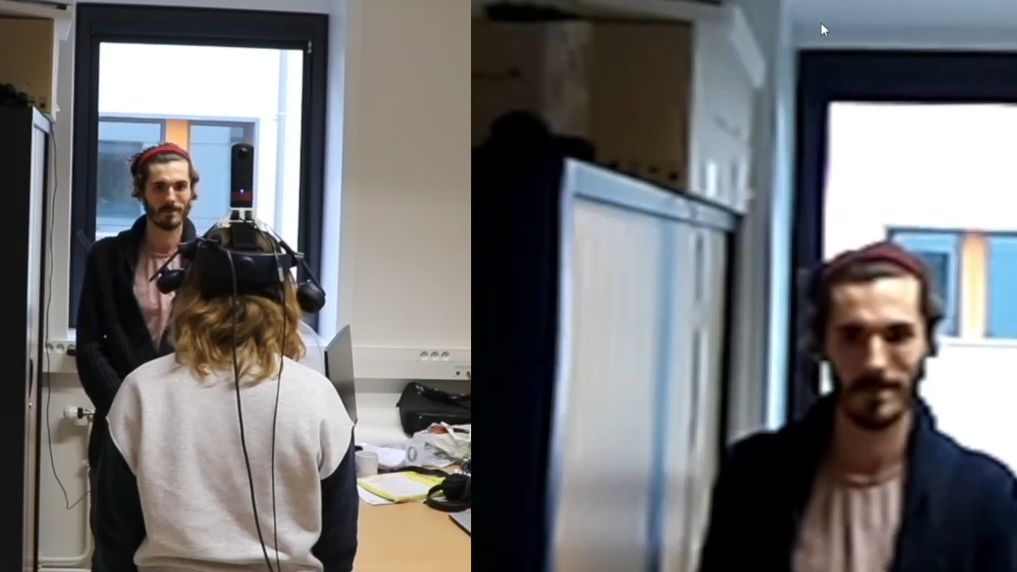
Imagine turning your head slightly to the left and somehow seeing almost behind you. Not in a horror-movie way. Not in a “why is there a raccoon in my kitchen?” way. More like your brain quietly accepts a new visual superpower and says, “Fine, we do owl mode now.” That is the strange appeal behind Owl-Vision, a virtual reality experiment that gives people a wider, owl-like visual field by amplifying head rotation through a VR headset, a 360-degree camera, and clever software.
The idea sounds like it should feel deeply wrong. Human vision is not built like a panoramic security camera. We have forward-facing eyes, a limited field of view, and a neck that politely refuses to rotate like a haunted doll. Yet early demonstrations of Owl-Vision suggest something fascinating: when visual feedback is consistent, the brain can adapt quickly. A person can turn their head within a normal range while the VR system shows them a much wider sweep of the surrounding world. The result feels less like a gimmick and more like a preview of augmented human perception.
This article explores why an owl-like visual field via VR feels surprisingly natural, how the technology works, what it teaches us about perception, and why it could matter for driving, robotics, accessibility, training, and future mixed reality devices. Also, yes, we will talk about owls. They did not ask to become the mascots of human-computer interaction, but they are excellent at branding.
What Is Owl-Vision in Virtual Reality?
Owl-Vision is a research concept that augments a person’s visual field by virtually amplifying head rotation. In simple terms, the user wears a VR headset connected to a 360-degree camera. The camera captures the world around the user, while the headset displays a selected portion of that real-world panorama. The clever part is not merely showing a wide-angle video. The clever part is changing the relationship between physical head movement and visual rotation.
In a normal VR setup, when you turn your head 30 degrees, the virtual view turns 30 degrees. Owl-Vision changes that ratio. A smaller real head turn can produce a larger visual turn inside the headset. For example, turning your head 45 degrees might show a view equivalent to 90 degrees. Turning toward the side could reveal what is behind you. Instead of forcing your neck to do acrobatics, the system lets your visual field stretch beyond normal human limits.
This is different from simply squeezing a 360-degree image into the headset display. Traditional panoramic video often distorts the scene, making the world look warped, stretched, or fishbowl-like. Owl-Vision aims to preserve a natural-looking view while changing how quickly the scene rotates in response to the user’s head. That distinction matters. A distorted view may feel informative but weird. A consistent amplified view can feel usable, even intuitive.
Why the Owl Comparison Makes Sense
Owls are famous for turning their heads dramatically because their eyes are largely fixed in their sockets. Their forward-facing eyes provide strong binocular vision, which is useful for judging depth while hunting. The trade-off is that owls need flexible necks to scan the world around them. Many owl species can rotate their heads far beyond what humans can comfortably manage, giving them the ability to monitor their surroundings while keeping body movement quiet and efficient.
Humans are built differently. Our eyes move inside their sockets, our head turns within a narrower range, and our visual system relies heavily on rapid eye movements, central focus, peripheral awareness, and memory. We do not need to rotate like owls because our brains constantly stitch together a stable sense of space from incomplete information. In other words, your visual experience already contains a little bit of “special effects department” magic. You are not seeing everything at once. Your brain is editing, predicting, smoothing, and filling in gaps like a very hardworking intern with no coffee break.
That is one reason Owl-Vision is so interesting. It does not replace human vision with owl biology. It gives the human brain a new mapping between head movement and visual information, then watches how naturally the brain handles it. The surprising answer appears to be: better than expected.
How an Owl-like Visual Field Via VR Actually Works
1. A 360-Degree Camera Captures the Environment
The system begins with a camera capable of capturing a full panoramic view. Many 360-degree cameras use lenses on opposite sides to record nearly everything around them, then stitch those images into a spherical video feed. Mounted on or near the user’s head, the camera acts like a visual sensor that sees more than the human wearer normally could.
2. The VR Headset Displays a Normal-Looking Slice
Instead of showing the entire 360-degree image at once, the headset displays a view that resembles a normal camera perspective. This is important because users generally need a view that looks spatially coherent. If the system simply crushed the entire world into a single frame, it might be useful for surveillance but terrible for comfort. Nobody wants to feel like they are living inside a doorbell camera.
3. Software Amplifies Head Rotation
The software maps physical head rotation to a larger virtual rotation. This amplification creates an expanded field of awareness without requiring the user to twist unnaturally. The body makes a normal movement; the display shows a larger turn. If the mapping is smooth and predictable, the brain can learn it quickly, similar to how people adapt to a computer mouse sensitivity setting, a flight simulator, or a video game camera.
4. The Brain Builds a New “Normal”
The most fascinating part is not the headset or the camera. It is the user’s perceptual system. Human perception is flexible. People can adapt to altered visual feedback, changed control mappings, and even unusual spatial transformations when those changes remain consistent. Owl-Vision works because the brain is not a passive screen. It is an active prediction engine. Give it reliable rules, and it starts playing the game.
Why It Feels More Natural Than It Sounds
On paper, amplified head rotation sounds like a recipe for dizziness. After all, VR comfort depends heavily on matching what the eyes see with what the inner ear and body feel. When visual motion suggests movement that the body does not feel, users may experience cybersickness. This is why artificial acceleration, camera drift, low frame rates, and latency can make VR uncomfortable.
Owl-Vision avoids some of the worst triggers because the visual change is directly tied to intentional head movement. The user turns their head, and the view responds immediately in the same direction. The gain is larger than normal, but the cause-and-effect relationship remains clear. That consistency gives the brain something it can understand. It is not random motion. It is not a virtual roller coaster launched by a mischievous developer. It is a predictable visual rule.
Think of mouse sensitivity in a first-person game. At first, a high sensitivity setting may feel twitchy. After a short adjustment period, experienced players often use it naturally. The hand moves a little; the camera moves a lot. The brain adapts because the relationship is stable. Owl-Vision applies a similar principle to head movement and real-world vision.
Human Vision Is Already a Beautiful Hack
To understand why this works, it helps to remember that human vision is not a full-resolution movie of reality. Central vision is sharp but narrow. Peripheral vision is broader but less detailed. Your eyes jump around constantly, gathering high-detail samples. Your brain combines those samples with motion cues, memory, expectations, and attention to produce the feeling of a complete scene.
This is why you can walk through a room without staring directly at every chair leg, backpack, and suspiciously placed laundry basket. Peripheral vision helps detect motion and broad shapes, while your brain maintains a spatial model of where things are. Owl-Vision extends that model by giving the user access to visual information that would normally require a larger body turn.
The system does not make people see like owls in the biological sense. It gives them a new interface for sampling space. That is an important difference. The brain does not need to become an owl. It only needs to learn that “a little head turn now reveals a lot more world.” Apparently, the brain is open to that negotiation.
What Could Owl-like VR Vision Be Used For?
Driving and Vehicle Awareness
One obvious application is driving simulation and vehicle control. Drivers already rely on mirrors, backup cameras, blind-spot alerts, and head checks to understand what is around them. A VR or mixed reality system that allows a driver, pilot, or remote vehicle operator to glance behind with a smaller head turn could improve situational awareness in controlled settings.
This does not mean people should wear experimental owl-vision headsets while driving to school or commuting to work. Please do not turn the family sedan into a research paper with cup holders. But in simulators, remote operation stations, industrial vehicles, drones, forklifts, ships, and training environments, amplified visual fields could help operators monitor space more efficiently.
Accessibility and Assistive Vision
Expanded visual fields may also inspire assistive technologies. People with restricted peripheral vision, monocular vision, or mobility limitations often compensate by turning the head or body more frequently. A carefully designed visual augmentation system could help some users access more environmental information with less movement. That would require serious testing, medical collaboration, and personalization, but the direction is promising.
Security, Search, and Rescue
In security monitoring, emergency response, or search-and-rescue training, awareness matters. A firefighter navigating a smoke-filled simulation, a security guard monitoring a crowd, or a rescue worker piloting a robot could benefit from an interface that makes the surrounding environment easier to scan. The goal is not to replace attention. It is to reduce the cost of looking around.
Gaming and Immersive Entertainment
Gamers immediately understand the appeal. A wider functional field of view can make flight simulators, racing games, stealth games, and space combat feel more responsive. TrackIR-style systems have long allowed players to map small head movements to larger camera movements on a monitor. Owl-Vision brings that idea closer to embodied VR, where the view surrounds the user instead of sitting on a flat screen.
Human Perception Research
Perhaps the most important use is scientific. Owl-like VR vision is a tool for studying neuroplasticity, spatial awareness, visual stability, and human adaptation. When researchers alter the relationship between movement and vision, they can observe how quickly users adjust, what kinds of mappings remain comfortable, and where the limits appear. That knowledge can improve VR design far beyond this one experiment.
The Big Challenge: Comfort
Any technology that changes visual motion must respect comfort. VR sickness is real, and it can involve nausea, eye strain, headache, dizziness, sweating, fatigue, and disorientation. Some users are more sensitive than others. Amplified head rotation may feel natural to one person and unpleasant to another. The difference can depend on latency, frame rate, camera quality, user posture, visual complexity, previous VR experience, and even whether the person ate a heroic burrito before testing.
For Owl-Vision to become practical, designers would need adjustable gain settings, low-latency passthrough, stable image stitching, clear calibration, and safety limits. Users should be able to start with mild amplification and increase it gradually. The system should avoid sudden jumps, drifting views, or mismatched motion. In VR, the difference between “wow, my brain adapted” and “please remove this helmet immediately” can be measured in milliseconds.
Why This Matters for the Future of Mixed Reality
Modern VR and mixed reality headsets are becoming more than entertainment devices. They are increasingly cameras, sensors, spatial computers, training platforms, accessibility tools, and human-interface laboratories. Owl-Vision points toward a future where headsets do not merely recreate normal vision. They may extend it.
That future could include selectable vision modes: wide-awareness mode for navigation, rear-view mode for cycling simulators, zoom mode for inspection, contrast-enhancement mode for low-light work, or peripheral-alert mode for people who need extra environmental cues. Some modes will be practical. Some will be silly. Some will be both, which is historically how technology gets interesting.
The deeper lesson is that “natural” does not always mean “identical to biology.” A tool can feel natural if it aligns with how the brain learns, predicts, and acts. A bicycle is not natural in the biological sense, but riding one can feel like an extension of the body. A computer mouse is not part of the human hand, yet people use it without thinking. Owl-Vision may belong to that family of interfaces: unnatural on a diagram, surprisingly natural in practice.
Limitations: We Are Not Owls Yet
It is tempting to overhype any technology that sounds like a superpower. But Owl-Vision is still experimental. It is not a finished consumer feature, not a medical device, and not proof that everyone can comfortably use amplified vision. Real-world use would raise questions about safety, depth perception, latency, attention overload, and long-term adaptation.
There is also a difference between seeing more and understanding more. A wider field of view can provide extra information, but the user still has limited attention. If a system shows too much, too quickly, it could become distracting rather than helpful. Good design will need to balance expansion with clarity. The best version of owl-like VR vision may not be maximum vision all the time. It may be adjustable vision at the right moment.
Experience Notes: What Owl-like VR Vision Might Feel Like
Picture putting on a VR headset and seeing the room through a camera feed. At first, everything feels familiar: the desk, the chair, the doorway, the slightly judgmental pile of cables in the corner. Then you turn your head a little to the right, and the room moves farther than expected. Your eyes say, “We turned a lot.” Your neck says, “No, we did not.” For a second, the brain holds a staff meeting.
The first few moments would likely feel like adjusting to a new control scheme. You might overshoot your target when trying to look at an object. You might turn your head too far and suddenly see more of the room than planned. It could feel like increasing the sensitivity on a gaming mouse or switching from a normal camera lens to a wide-angle one. The world is not broken, but your usual movement habits need a software update.
After a short period, the experience could become strangely efficient. Instead of twisting your shoulders to check behind you, you make a smaller head turn and let the headset reveal the hidden space. Looking around a room becomes less physical. You begin to treat the amplified rotation as normal. The view is not “fake” in the usual VR sense because it is still based on the real environment. It is more like reality with a different steering ratio.
In a driving simulator, the effect would be even more noticeable. A quick glance left could reveal a larger side view. A turn toward the passenger window could bring the rear area into sight. The benefit is obvious: fewer exaggerated movements, faster environmental checks, and a stronger sense of what surrounds the vehicle. The risk is also obvious: if the mapping is too strong, users may misjudge where they are actually facing. That is why training and calibration would matter.
For gaming, the experience could feel like gaining a sixth sense without adding a cluttered interface. In a space simulator, you could track targets around your ship with subtle head turns. In a stealth game, you could peek into blind spots without spinning your whole body. In a racing game, you could check nearby cars more naturally. It would not make you a better driver automatically, but it might reduce the feeling that your virtual neck is made of cardboard.
For everyday mixed reality, the best experience might be gentle rather than extreme. A mild owl-like visual field could help users monitor surroundings while working, navigating, or training. Imagine a warehouse worker receiving a wider awareness cue when backing up equipment, or a remote robot operator checking side areas without losing forward focus. In those cases, the value is not novelty. It is reduced effort.
The emotional experience is the most intriguing part. At first, owl-like VR vision would feel like a trick. Then it might feel like a tool. Finally, with enough consistency, it could feel like a new habit. That progression is the heart of human-computer interaction. The best interfaces disappear into behavior. Owl-Vision suggests that our sense of “normal vision” may be more negotiable than we think.
Conclusion
Giving people an owl-like visual field via VR feels surprisingly natural because the human brain is remarkably good at adapting to consistent sensory rules. Owl-Vision does not magically turn users into nocturnal birds of prey, which is probably good news for local mice. Instead, it uses a 360-degree camera, a VR headset, and amplified head rotation to expand what people can see without forcing extreme physical movement.
The concept sits at the intersection of virtual reality, visual perception, neuroplasticity, and augmented human ability. It shows that the future of VR may not be limited to simulating worlds. It may also reshape how we experience the real one. The most exciting part is not that humans can borrow a little inspiration from owls. It is that our brains may be flexible enough to make such borrowed senses feel ordinary.
For now, Owl-Vision remains an experimental idea with practical challenges, especially comfort, latency, and safety. But as mixed reality hardware improves, this kind of visual augmentation may move from research demo to real interface design. One day, checking behind you with a small head turn may feel as normal as pinching to zoom or swiping a screen. Until then, the owls can keep their crown. We are just renting the concept.
Note: This article is original, web-ready content synthesized from real research and reporting on Owl-Vision, VR perception, peripheral vision, cybersickness, 360-degree video, and owl anatomy.