

“`
Sapo: Mental illness is often described with tidy words: anxiety, depression, trauma, obsession, dissociation. But anyone who has lived with these conditionsor loved someone who hasknows they rarely feel tidy. They feel like static in the skull, a locked door, a room where the furniture keeps moving when nobody else notices. That is why a 31-day Inktober project focused on mental illness and disorders can feel so powerful: it turns invisible battles into ink, shadow, shape, and symbolism. This article explores how mental health illustrations can build empathy, reduce stigma, and help people talk about experiences that ordinary language sometimes drops on the floor like a pen with no cap.
Why Mental Illness Illustrations Hit So Hard
Illustrating mental illness is not the same as diagnosing it, explaining it away, or squeezing a person into one spooky image. The best mental health art works because it admits something honest: symptoms are real, but they are also deeply personal. Depression does not look the same on everyone. Anxiety is not always a trembling hand. OCD is not a cute love of alphabetized spice jars. PTSD is not “being dramatic.” Schizophrenia is not a Halloween costume. And burnout is not solved by buying a planner, though planners do keep trying to look innocent.
An Inktober series about mental disorders uses the discipline of daily drawing to explore one condition at a time. The 31-day structure matters. It says: keep looking. Do not glance once and assume you understand. Mental health awareness requires patience, curiosity, and a willingness to sit with discomfort. Ink is a perfect medium for that. It is bold, unforgiving, and dramatic. One black line can become a cage, a mask, a shadow, a hand reaching out, or a mouth that cannot speak.
Still, the goal should never be to turn people into monsters. The goal is to show the monster someone may be fighting. That distinction is huge. People are not their diagnoses. A mental health condition may affect mood, thinking, behavior, relationships, sleep, appetite, focus, memory, or the ability to function day to day, but it does not erase the person underneath. Good mental illness art makes room for pain and dignity at the same time.
Inktober as a Mental Health Challenge
Inktober began as a drawing challenge built around consistency: make an ink drawing, post it, repeat. Artists often follow official prompt lists, but many create their own themes. A mental illness Inktober theme turns the challenge into a visual diary of human struggle. Each day becomes a small act of translation. Instead of drawing “castle” or “frog,” the artist asks, “What does social anxiety feel like when it enters a room before you do?” or “What shape would insomnia take if it sat at the foot of your bed at 3:17 a.m. like an unpaid intern from the underworld?”
The answer is not clinical. It is emotional. That is where illustration becomes useful. Medical language can identify symptoms, treatments, and risks. Art can show isolation, fear, numbness, compulsive thought, fractured identity, and the exhausting performance of appearing “fine.” Together, the two approaches can create a fuller conversation: science gives us the map; art points to the weather.
All 31 Mental Illness and Disorder Illustrations: A Guided Walk Through the Ink
The following 31 entries explore mental illnesses, neurodevelopmental conditions, trauma-related disorders, eating disorders, dissociative experiences, and related psychological conditions through an illustrative lens. These are not diagnostic descriptions, and they are not meant to represent every person’s experience. Think of them as visual metaphorsdark little lanterns held up to complicated rooms.
-
1. Social Anxiety Disorder
The illustration might show a figure surrounded by faceless eyes, frozen in place while the crowd becomes a storm. Social anxiety is not simple shyness. It can feel like being judged by a courtroom that assembled inside your nervous system without requesting permission.
-
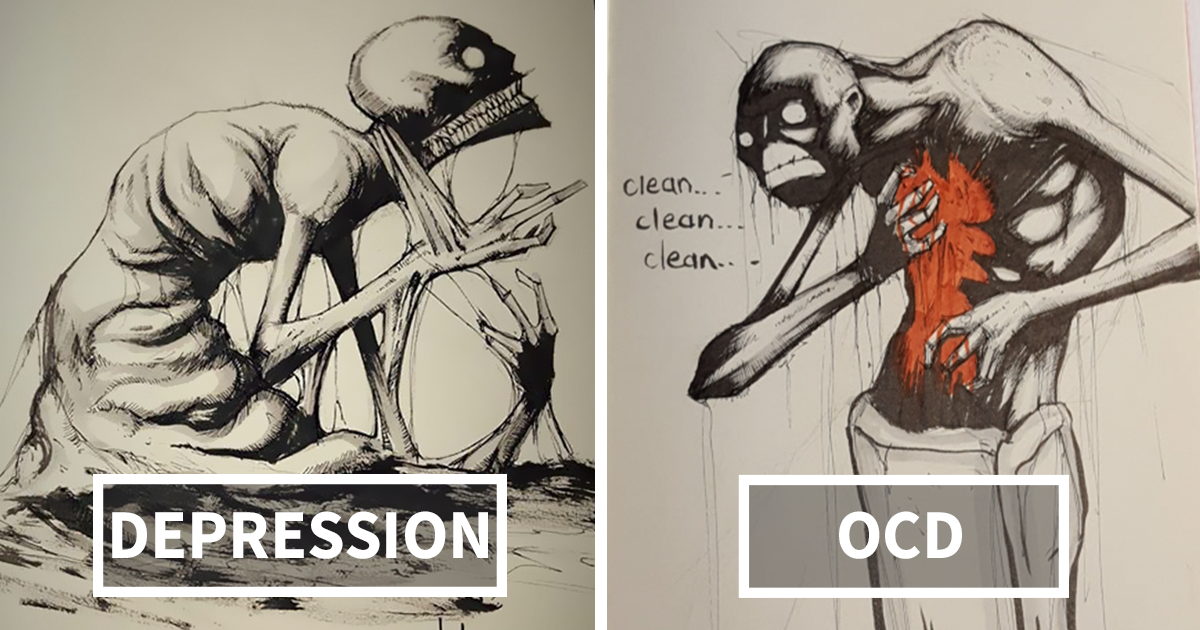
2. Major Depressive Disorder
Depression often appears as heaviness: a body sinking, a shadow leaning too close, a person disconnected from color. A strong illustration avoids melodrama and shows the quieter truthhow ordinary tasks can become mountains wearing socks.
-
3. Insomnia
Insomnia deserves ink because night has teeth. The drawing may show a person wide-eyed beneath a ceiling that stretches forever. Sleep is supposed to be free, yet insomnia makes it feel like a luxury subscription you forgot to renew.
-
4. Post-Traumatic Stress Disorder
PTSD can be illustrated through echoes: hands from the past reaching into the present, a doorway that becomes a battlefield, a face split between “now” and “then.” Trauma is not always visible, but the body may remember with brutal accuracy.
-
5. Bipolar Disorder
A bipolar disorder illustration might contrast elevation and collapse: wings made of fire on one side, stone on the other. The challenge is to show mood episodes without turning them into cartoon “happy-sad” masks. This condition is more complex than emotional weather.
-
6. Borderline Personality Disorder
For BPD, ink can capture emotional intensity, fear of abandonment, and identity pain. A figure may hold a cracked mirror while reaching for someone just out of frame. The image should invite compassion, not the tired old “too much” label.
-
7. Autism Spectrum Disorder
Autism is a neurodevelopmental condition, not a tragedy costume. A respectful illustration might show sensory overload, communication differences, or the exhaustion of masking. The best image avoids pity and instead asks viewers to stop treating different wiring like a broken appliance.
-
8. Paranoid Schizophrenia
Paranoia can be drawn as whispering walls, watching windows, or shadows shaped like suspicion. Schizophrenia is often misunderstood and heavily stigmatized, so an illustration should focus on distress and perception rather than turning the person into a horror villain.
-
9. Obsessive-Compulsive Disorder
OCD is not “I love clean countertops.” It can involve intrusive thoughts and compulsions that feel impossible to ignore. A visual metaphor might show a person tied to repetitive strings, forced to pull them again and again while knowing the knot is unfair.
-
10. Dependent Personality Disorder
DPD can be represented as a figure whose strings are attached to another person’s shadow. The emotional center is fear: fear of being alone, deciding alone, existing alone. It is dependency with panic hiding under the floorboards.
-
11. Anorexia Nervosa
An anorexia illustration must be handled with care. It might show a body facing a distorted reflection or a shadow that lies. The point is not shock value; it is the painful gap between external reality and internal self-perception.
-
12. Depersonalization-Derealization Disorder
This drawing may show a person watching themselves from across the room, as if the soul has stepped outside to “get some air” and forgot the return address. Depersonalization can feel unreal, detached, and deeply frightening.
-
13. Agoraphobia
Agoraphobia can turn open space into a trap. Ink might show a door opening into a vast, hungry street while the figure remains small inside. The fear is not laziness or stubbornness; it is the body interpreting escape as impossible.
-
14. Dissociative Identity Disorder
DID is often sensationalized, so the illustration should avoid cheap “split personality” theatrics. A better image might show multiple silhouettes sharing one outline, emphasizing trauma, survival, memory, and the complicated architecture of self-protection.
-
15. Capgras Syndrome
Capgras syndrome involves the belief that a familiar person has been replaced by an impostor. Visually, it begs for a face peeling away from another face. Emotionally, it shows how recognition can remain while trust disappears.
-
16. Cotard’s Delusion
Cotard’s delusion, sometimes described as the belief that one is dead or does not exist, can be illustrated through emptiness: a person outlined in ink but missing from the center. It is existential horror without needing a single jump scare.
-
17. Disinhibited Social Engagement Disorder
DSED can appear in children who show unusually familiar behavior with unfamiliar adults, often linked to severe neglect or disrupted caregiving. An illustration might show a child reaching toward a crowd of strangers, with safety drawn as a missing border.
-
18. Schizophrenia
Schizophrenia can affect thought, perception, emotion, and functioning. A respectful illustration might show fragmented sound, distorted space, or a mind under siege. It should communicate suffering without repeating the lazy myth that schizophrenia equals violence.
-
19. Generalized Anxiety Disorder
GAD is worry with a gym membership. It lifts weights daily. A drawing may show a figure carrying dozens of tiny future disasters in a backpack labeled “What If?” The humor helps, but the exhaustion is real.
-
20. Panic Disorder
Panic disorder can be drawn as a body sounding every alarm at once: heart racing, breath tightening, walls closing in. The terrifying part is how physical it feels. The brain yells “tiger,” even when the room contains only email.
-
21. Attention-Deficit/Hyperactivity Disorder
ADHD is not a punchline about messy desks. An illustration could show dozens of bright threads pulling attention in different directions. It can involve focus struggles, impulsivity, restlessness, time blindness, and the magical ability to lose keys while holding them.
-
22. Body Dysmorphic Disorder
BDD can be visualized as a mirror that edits the viewer cruelly. The person may see flaws that others do not notice or understand. Ink can show the mirror as an unreliable narrator, which frankly many mirrors are before coffee.
-
23. Substance Use Disorder
A substance use disorder illustration might show a hand reaching for relief while being pulled deeper into a loop. The most compassionate image avoids moral judgment and focuses on craving, dependence, shame, and the possibility of recovery.
-
24. Seasonal Affective Disorder
Seasonal depression can be drawn as a person fading under a low winter sun. The image might use long shadows and a calendar with teeth. Some people do not simply “hate winter”; their mood changes with seasonal light and rhythm.
-
25. Hoarding Disorder
Hoarding disorder is not just clutter having a conference. It can involve distress around discarding possessions and living spaces becoming unusable. An illustration might show objects stacking into walls, protecting and imprisoning the person at the same time.
-
26. Tourette Syndrome
Tourette syndrome involves tics, which may be motor or vocal. A thoughtful illustration could show involuntary movement as marks escaping the body. It should avoid the common media mistake of reducing Tourette’s to swearing jokes.
-
27. Bulimia Nervosa
Bulimia can be illustrated through secrecy, cycles, and shame: a figure split between control and loss of control. Like all eating disorder art, the image should avoid glamorizing suffering or giving visual “instructions.” The aim is empathy, not spectacle.
-
28. Binge-Eating Disorder
Binge-eating disorder is often misunderstood as a willpower issue, which is about as helpful as fixing a leak with motivational posters. A drawing might show emotional hunger, secrecy, and self-blame surrounding a person who deserves support, not ridicule.
-
29. Illness Anxiety Disorder
Illness anxiety disorder can be drawn as a person trapped inside a web of symptoms, searches, and worst-case scenarios. The fear feels persuasive because the body is involved. Every sensation becomes evidence in a trial nobody asked to attend.
-
30. Avoidant Personality Disorder
Avoidant personality disorder may look like a figure watching life through a keyhole, craving connection but expecting rejection. The illustration can show loneliness and longing together. Avoidance is not arrogance; sometimes it is self-protection wearing heavy boots.
-
31. Recovery
The final Inktober illustration does not need to be cheerful in a greeting-card way. Recovery can be a small candle, a stitched line, a door slightly open. It is not a perfect ending. It is proof that the page is not finished.
What Makes Mental Health Art Responsible?
Dark mental illness illustrations can be powerful, but they walk a narrow bridge. On one side is honest expression. On the other is stigma dressed up as aesthetics. Responsible mental health art should avoid turning real people into monsters, using diagnoses as insults, or implying that every condition looks one dramatic way. It should also avoid romanticizing suffering. There is nothing romantic about not sleeping, not eating, panicking in public, losing touch with reality, or feeling trapped inside your own mind. That said, there can be beauty in the act of making something from pain. Beauty is not the illness. Beauty is the resistance.
It also helps when artists include context. A short caption can remind viewers that mental disorders are health conditions, that support exists, and that symptoms vary. The illustration opens the door; the caption makes sure nobody falls down the stairs. Artists are not required to become therapists, but when dealing with mental illness and disorders, they should handle the topic like glass: firmly, carefully, and with respect for the people who may see themselves in it.
Why Viewers Connect With These Illustrations
People connect with mental illness illustrations because they offer recognition. Someone may look at a drawing of depression and think, “That is the weight I could not explain.” Someone else may see social anxiety as a crowd of faceless watchers and think, “Finally, the room looks the way it feels.” Recognition can be relieving. It can also be emotional, especially when a person has spent years being told they are exaggerating, lazy, weird, dramatic, antisocial, careless, or “too sensitive.”
Visual art can also help people who do not live with a particular disorder understand it differently. A friend may not fully grasp OCD from a dictionary definition, but an image of a person bound by repeated rituals can make the distress more visible. A parent may not understand sensory overload until they see a figure buried under noise, light, tags, textures, and expectations. A partner may not understand panic attacks until an illustration shows the body as a house with every alarm screaming.
How Artists Can Approach a Mental Illness Inktober Theme
If you want to create your own mental health Inktober series, begin with research and humility. Read reliable mental health resources. Listen to lived experiences. Avoid assuming that one person’s story represents everyone. Sketch symbols before drawing bodies. Ask yourself: Am I showing the condition, or am I reducing the person? Am I creating empathy, or am I creating a spooky collectible with a diagnosis slapped on it like a discount sticker?
Use metaphor thoughtfully. Cages, masks, mirrors, shadows, strings, doors, static, storms, roots, and distorted rooms are useful visual tools, but they should serve the emotional truth. Do not over-explain every image. Let the viewer feel something. At the same time, do not be so vague that the art becomes a fog machine wearing a beret. Balance mystery with meaning.
Most importantly, remember that mental health art can stir up strong feelings. Consider adding a gentle note that the work is not medical advice and that people in crisis should seek immediate support. In the United States, people can call or text 988 for crisis support. If your audience is international, encourage readers to contact local emergency services or a trusted mental health professional. Art can start a conversation, but it should not be the only lifeboat.
of Experience: What It Feels Like to Illustrate Mental Illness for 31 Days
Illustrating mental illness for Inktober is not like drawing thirty-one pumpkins with different facial expressions, although, to be fair, pumpkins also understand seasonal depression. A project like this asks the artist to show up every day and sit with a difficult idea long enough to make it visible. On day one, there is energy. The sketchbook is clean. The pen feels heroic. You think, “I am going to create a meaningful series.” By day seven, the pen is somewhere under a pile of references, your coffee is emotionally unavailable, and the subject matter has started following you around the kitchen.
The emotional experience can be surprisingly heavy. When drawing social anxiety, you may remember every awkward conversation you have ever had, including one from 2009 that your brain has preserved in museum-quality detail. When drawing insomnia, you may notice how the room changes after midnight: the chair becomes suspicious, the clock becomes rude, and every tiny sound develops a personality. When drawing depression, you may have to resist the temptation to make the image dramatic when the real horror is often quiet. Depression is not always a person crying in the rain. Sometimes it is unanswered texts, laundry that has become geological, and the inability to feel joy even when joy is technically standing right there waving both arms.
The hardest part is responsibility. Mental disorders already carry stigma, so each line matters. A frightening illustration can validate someone’s pain, but it can also accidentally reinforce fear if the person becomes the monster instead of the condition. That means the artist has to keep asking: Where is the humanity? Where is the tenderness? Where is the space for recovery? Even the darkest image should leave room for the viewer to remember that people are more than symptoms.
There is also a strange intimacy in the routine. Thirty-one days of ink creates a relationship between the artist and the subject. You begin to see patterns: isolation, shame, distorted perception, loss of control, fear of judgment, longing for safety. Different diagnoses have different criteria and experiences, but many share the ache of being misunderstood. The sketchbook becomes less like a gallery and more like a waiting room where every condition has been sitting too long with outdated magazines.
By the final illustration, recovery may feel like the only honest ending. Not because every story becomes easy, and not because art magically fixes the brain like a software update with better fonts. Recovery belongs at the end because awareness without hope can become another locked room. The final drawing can be small: a stitched wound, a cracked mask set down, a candle refusing to go out. After thirty-one days of shadows, even a tiny light looks rebellious.
Conclusion
“I Illustrated Mental Illness And Disorders For Inktober (All 31)” is more than a catchy title. It is an invitation to look at mental health with more imagination and more care. Illustration can turn invisible experiences into something viewers can recognize, discuss, and understand. It can challenge stereotypes, start conversations, and remind people that a diagnosis is not a personality, a punchline, or a life sentence. The strongest mental illness art does not say, “Here is what everyone with this condition looks like.” It says, “Here is one way pain can feeland here is why we should listen.”
In a culture that still struggles to talk about mental health without whispering, joking, or changing the subject faster than a cat knocking a glass off a table, art can be a brave interruption. It gives shape to silence. It gives language to people who are tired of explaining. And sometimes, one ink drawing can do what a thousand awkward conversations could not: make someone feel seen.
“`