

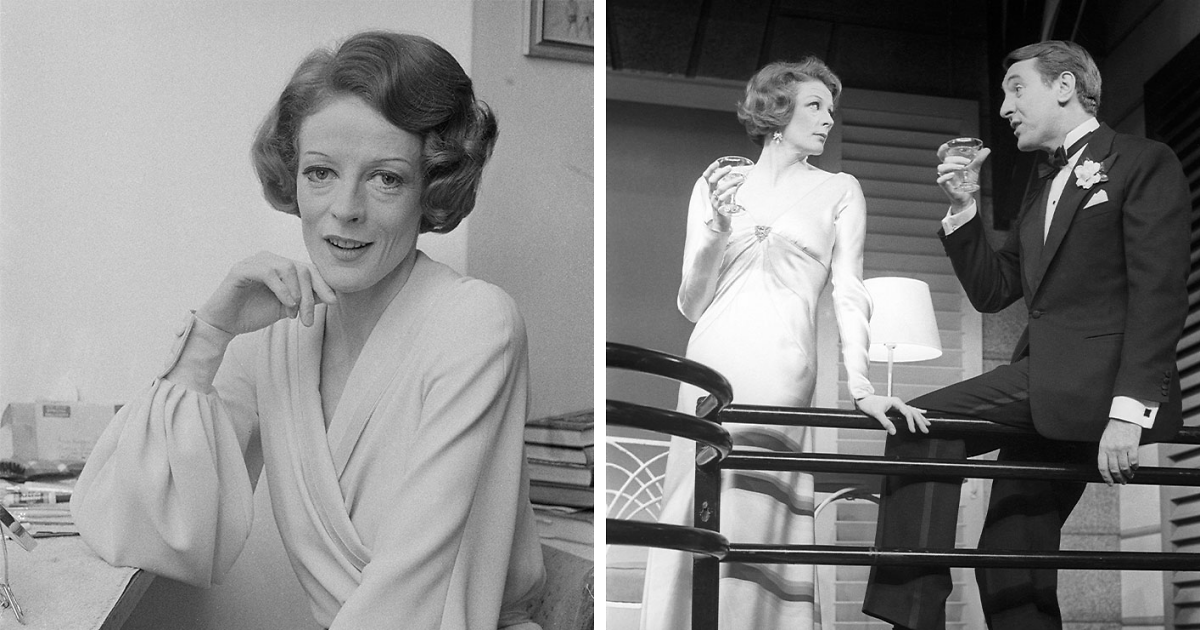
Dame Maggie Smith did not need a wand, a coronet, or a withering Downton Abbey one-liner to command a room. Long before she became Professor Minerva McGonagall to millions of Harry Potter fans and the Dowager Countess of Grantham to viewers who suddenly cared deeply about inheritance law and dinner jackets, Smith was already a stage creature of frightening precision. She could walk on, tilt her head, and make an audience feel as though it had just been personally audited by elegance itself.
That is why a widely shared anecdote from former theatre usher Bruce Bell has traveled so well online. In his recollection, Smith was not simply a polished performer doing as instructed. She was playful, daring, unpredictable, and, yes, a bit rebellious. The story places her in the world of Noël Coward’s Private Lives, the classic comedy directed by Sir John Gielgud, where the young usher allegedly watched Smith push the performance beyond the expected boundaries and into comic electricity.
The result is not just a charming celebrity memory. It is a small window into what made Maggie Smith so unforgettable: her refusal to perform like a museum piece. She honored language, discipline, and tradition, but she also knew that comedy dies when it is embalmed. Her genius lived in the dangerous little gap between control and mischief.
The 1970s Anecdote That Made Fans Smile Again
According to the reported recollection, Bruce Bell was a teenager working as an usher at the Royal Alexandra Theatre in Toronto when Smith was appearing in Private Lives. The production was associated with John Gielgud, one of the great classical actors and directors of the 20th century. In Bell’s memory, Smith began “fooling around” during the run, adding little flourishes that the audience may not have recognized as improvisation but that theatre insiders could spot immediately.
That detail is important. Smith was not described as sabotaging the show or breaking character like a bored student in the back row. She was reportedly playing inside the structure, testing the elasticity of Coward’s brittle comedy. Anyone who has watched a brilliant actor discover an extra beat in a line knows the thrill. The script remains the script, but suddenly the air changes. The audience laughs in a way that feels newly minted.
Bell’s version of events says Gielgud came to watch secretly after management became concerned about Smith’s unorthodox choices. The director, famously exacting, did not necessarily share the usher’s delight. After the performance, Bell claimed, a backstage clash followed. But like many theatrical storms, it apparently ended with affection rather than permanent warfare. Curtain up, tempers down, everyone back to the business of making magic in uncomfortable shoes.
Whether every detail of the memory unfolded exactly as told is less important than what the story captures. It rings true to the public idea of Smith: a disciplined artist with a wicked streak, a performer who understood rules well enough to bend them beautifully.
Why “Rebel At Heart” Fits Maggie Smith So Well
The word “rebel” can sound odd when applied to a Dame Commander of the British Empire. It conjures leather jackets, smashed guitars, and people dramatically ignoring “Please Keep Off the Grass” signs. Maggie Smith’s rebellion was subtler and much more devastating. She rebelled against dullness. She rebelled against vanity. She rebelled against the idea that older actresses should fade politely into the curtains once the industry stopped knowing what to do with them.
Her career was built on intelligence sharpened into performance. In comedy, she could turn a pause into a weapon. In drama, she could show pain without asking the audience to applaud her suffering. She did not chase likability in the modern public-relations sense. Instead, she chased truth, timing, and the exact emotional temperature of a scene.
That is why the theatre usher anecdote feels so satisfying. It gives fans an image of Smith not as a remote monument, but as a working actor enjoying the dangerous sport of live performance. The stage is not film. There is no editor to rescue a dead moment, no second take, no polite post-production wizard with headphones and coffee. On stage, if something goes flat, everyone feels it. Smith seems to have understood that risk was not the enemy of professionalism. Sometimes risk was the performance’s heartbeat.
The Power of Private Lives
Noël Coward’s Private Lives is practically built for actors with nerve. The play follows divorced lovers Amanda and Elyot, who meet again while honeymooning with new spouses. The situation is absurd, glamorous, emotionally reckless, and deliciously cruel. In lesser hands, the play can become a parade of fancy insults delivered by people who appear to be allergic to sincerity. In great hands, it becomes a comic boxing match between desire and self-knowledge.
Smith’s Amanda Prynne was an ideal match for her gifts. Amanda is elegant but impulsive, witty but not bloodless, romantic but not remotely safe. She needs an actress who can make sophistication look like a dangerous substance. Smith could do that. She had the timing for Coward’s epigrams and the physical imagination to make upper-class chaos feel athletic.
Her work in Private Lives earned major recognition on Broadway, including a Tony nomination. That matters because it places the anecdote in the larger story of her stage reputation. This was not a screen star dabbling in theatre. Smith was, first and always, a creature of the stage. Film and television widened her fame, but theatre forged the blade.
From Oxford Stages To International Stardom
Born Margaret Natalie Smith in Ilford, Essex, in 1934, she moved with her family to Oxford as a child and began acting young. Her early stage work at the Oxford Playhouse helped build the foundation for a career that would eventually stretch across seven decades. By the 1950s and 1960s, she was already establishing herself as one of Britain’s most exciting performers.
Her association with the Old Vic and the National Theatre placed her among towering names. Laurence Olivier noticed her talent, and Smith became part of the National Theatre’s early history. That company was not exactly a cozy summer camp. It was a furnace of ambition, technique, ego, and classical training. Smith survived it, thrived in it, and emerged with the kind of authority that cannot be manufactured by publicity departments.
Her screen breakthrough came with The Prime of Miss Jean Brodie, for which she won the Academy Award for Best Actress. The role remains one of her defining achievements: charismatic, manipulative, romantic, funny, and faintly terrifying. Later, she won a second Oscar for California Suite, proving she could turn even the role of an actress in professional distress into a comic jewel box.
The Wit That Became A Signature
For many modern viewers, Maggie Smith arrived fully formed as a master of the devastating line. As Professor McGonagall in the Harry Potter films, she gave the fantasy franchise moral authority, dry humor, and the unmistakable impression that she could defeat evil with one raised eyebrow if the school budget allowed it. As Violet Crawley in Downton Abbey, she became a global meme before some of her fans even knew what a meme was.
But her wit was never just snark. That is the mistake imitators often make. Smith’s best lines worked because she located the thought underneath them. Violet Crawley’s cutting remarks were funny, but they also revealed fear, class instinct, pride, love, and bewilderment at a changing world. McGonagall’s sternness was funny because it was rooted in care. Smith did not merely deliver zingers. She gave them architecture.
This is another reason the former usher’s story feels so right. A performer who understands structure can improvise without making a mess. Smith’s alleged playfulness during Private Lives was not random clowning. It was the instinct of an actor who could feel when a scene had room for another spark.
Rebellion Through Craft, Not Chaos
There is a difference between rebellion and self-indulgence. Bad theatrical rebellion says, “Look at me.” Great theatrical rebellion says, “Look what else this moment can do.” Smith belonged to the second category. Her boldness was anchored by technique.
That technique allowed her to cross genres without losing herself. Shakespeare, Coward, Ibsen, Alan Bennett, fantasy franchises, period dramas, drawing-room comedies, bleak monologuesSmith moved through them all with unnerving adaptability. She could be regal without being stiff, comic without being silly, fragile without becoming sentimental.
Her late-career success was especially satisfying because it introduced her to younger audiences without reducing her to nostalgia. Many actors are “rediscovered” by new generations as though they spent the previous decades hiding in a cupboard. Smith did not need rediscovery. She had been there all along, working. The world simply kept catching up.
What The Anecdote Reveals About Live Theatre
Bell’s memory also reminds us why live theatre creates legends differently from film. A movie performance can be watched again and again, preserved in perfect repetition. A stage performance disappears as soon as it happens. The only evidence left is memory, reviews, photographs, programs, and the slightly haunted look on someone’s face when they say, “You had to be there.”
The former usher’s story is a classic “you had to be there” moment. He was not describing a scene available on a streaming platform. He was describing the charge of being in the building when a great actor decided to test the air. That is why theatre memories can become almost mythic. They are fragile, personal, and impossible to verify in the way a film clip can be verified. Yet they carry emotional truth.
For Smith fans, the anecdote adds warmth to the legend. It says she was not only formidable but playful. Not only precise but mischievous. Not only respected but capable of making an usher remember one performance for half a century.
The Maggie Smith Lesson: Never Let The Room Go Dead
If there is a broader lesson in the story, it is this: mastery is not obedience. Smith’s career shows that great artists learn the rules, absorb them, respect them, and then discover when a tiny act of disobedience will make the work more alive.
That lesson applies beyond theatre. Writers know it when a sentence suddenly asks to turn left. Musicians know it when a live performance finds a groove the rehearsal never reached. Teachers know it when a planned lesson becomes better because a student asks an unexpected question. Even office workers know it when a meeting desperately needs someone to say the obvious thing everyone else is politely avoiding.
Maggie Smith’s “rebel” quality was not about creating disorder. It was about refusing deadness. She seemed allergic to the merely adequate. If a scene could be sharper, funnier, stranger, or more truthful, she went looking for the opening.
Why Fans Still Feel Personally Connected To Her
The global reaction to Smith’s death in 2024 showed how many different audiences felt they owned a piece of her work. Theatre lovers remembered the National Theatre, Broadway, Stratford, and her late return to the stage. Film lovers remembered The Prime of Miss Jean Brodie, A Room with a View, Gosford Park, The Best Exotic Marigold Hotel, and The Lady in the Van. Younger fans remembered Hogwarts. Television audiences remembered every Downton Abbey line that landed like a silver fork dropped on marble.
Few actors manage that range. Fewer still manage it without seeming overexposed. Smith remained intensely private, which made her public performances feel even more precious. She did not need constant confession to feel intimate. Her intimacy came through craft.
That may be why a small backstage anecdote can move people. Fans are not only interested in awards and filmographies. They want glimpses of the person at work: the actor between scenes, the professional testing a boundary, the genius making colleagues laugh, the star getting scolded and then carrying on.
Experience Section: What This Story Teaches Anyone Who Loves Performance
There is something deeply relatable about the idea of a young usher watching a great artist from the edge of the room. Many people have had a version of that experience. Maybe it was not Maggie Smith in a Coward comedy. Maybe it was a school play where one student suddenly became bigger than the room. Maybe it was a concert where the singer changed one phrase and the audience leaned forward. Maybe it was a teacher, a public speaker, a comedian, or even a grandparent telling a family story with such timing that everyone forgot dessert was melting.
Theatre teaches us to notice presence. In daily life, we often reward speed, volume, and polish. Live performance rewards attention. You learn to watch the small things: a pause before a line, the way an actor turns away before turning back, the difference between a laugh that is expected and a laugh that erupts because the room has been surprised. Smith’s genius lived in those details. She did not simply perform a role; she listened to the room and adjusted the temperature.
For anyone who writes, speaks, teaches, sells, leads, or creates, that is a practical lesson. Preparation matters, but so does responsiveness. The best moments often happen when skill meets alertness. You cannot improvise well if you do not know your material. But if you only obey the material, you may miss the living moment in front of you.
The former usher’s anecdote also captures the strange privilege of being near greatness before it becomes history. Ushers, stagehands, dressers, lighting technicians, understudies, and front-of-house workers often see sides of performance that audiences never see. They know which actor warms up quietly, which one jokes before a difficult scene, which director prowls the aisles like a nervous cat, and which star can make a tired Wednesday matinee feel like opening night.
That backstage world is part of theatre’s soul. The audience sees the glamour; the workers see the machinery, the panic, the discipline, and the humanity. A story from an usher matters because it comes from someone positioned between the magic and the labor. Bell’s recollection, whether read as exact history or affectionate memory, honors that special vantage point.
It also reminds fans not to flatten icons into statues. Maggie Smith was decorated, admired, and eventually treated as a national treasure, but she was not marble. She was a working actor. She took risks. She could be funny in ways that unsettled the room. She could be difficult, dazzling, disciplined, and mischievous in the same breath. That combination is far more interesting than perfection.
In a culture that often turns celebrities into brands, Smith remained refreshingly unbrandable. She did not seem designed by committee. She did not offer herself as a lifestyle. She offered performances. And inside those performances was a spirit that could not be fully domesticated, no matter how many honors were attached to her name.
That is why the “rebel at heart” description works. It does not mean Maggie Smith rejected tradition. She came from tradition, mastered it, and sharpened it until it gleamed. Her rebellion was the rebellion of the alive artist against the dead moment. She knew when to respect the line and when to make it detonate.
Conclusion
The former theatre usher’s 1970s anecdote endures because it gives fans a vivid, funny, and human picture of Dame Maggie Smith at work. It shows her not only as an award-winning legend but as an artist willing to play, provoke, and take risks in front of a live audience. The story fits the larger arc of her career: a performer shaped by classical theatre, celebrated by Hollywood, embraced by television, and remembered for a wit so sharp it should probably have required a safety inspection.
Dame Maggie Smith was a rebel at heart not because she rejected craft, but because she understood it too well to let it become lifeless. Her legacy is not only in Oscars, Emmys, Tonys, or beloved franchises. It is also in the memories of people who happened to be in the room when she made the air crackle.
Note: The central theatre-usher story is treated here as a reported personal recollection, while the career timeline, major roles, and awards context are synthesized from public biographical, theatre, and entertainment records.