

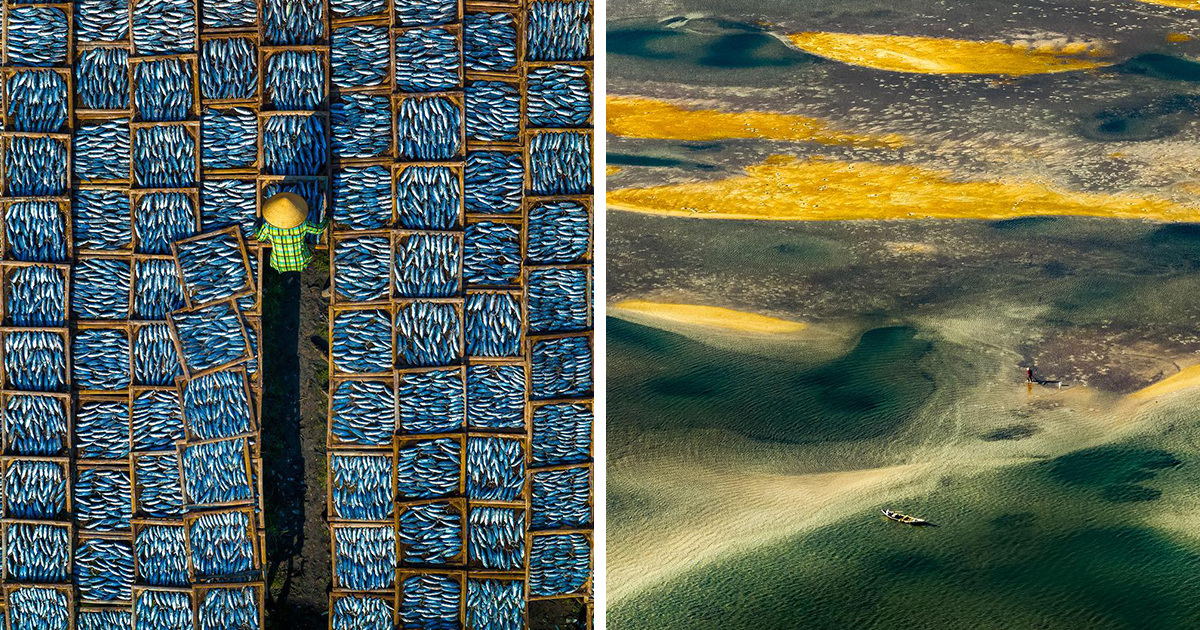
Vietnam drone photography has a special talent for making viewers lean closer to the screen and whisper, “Wait, is that real?” In the case of Vietnamese photographer Khánh Phan, the answer is yesand somehow, the real thing is even better. Her aerial series, often recognized under the idea of Vietnam from Above, transforms everyday scenes into living patterns: women washing water lilies in circular pools of pink, fishermen pulling nets across silver water, salt workers moving like tiny brushstrokes on white fields, and rice terraces folding down mountains like nature’s own staircase.
The title says “39 pics,” but the magic is not only in the number. It is in the perspective. A drone lifts the camera high enough to reveal shape, rhythm, and symmetry, yet Khánh Phan’s eye keeps the images human. Her photos are not empty postcards. They are portraits of labor, culture, landscape, patience, and timing. In other words, the drone may fly, but the story stays firmly on the ground.
In this feature, we explore why these breathtaking drone pictures of Vietnam have captured global attention, what makes Khánh Phan’s style so memorable, and why Vietnam may be one of the most photogenic countries on Earth when seen from above. Warning: you may develop a sudden urge to book a flight, buy a conical hat, and dramatically stare at rice fields during golden hour.
Who Is Khánh Phan?
Khánh Phan is a Vietnamese photographer from Ho Chi Minh City known for colorful aerial images of Vietnam’s landscapes, traditional craft villages, seasonal harvests, and everyday workers. Her work has appeared in international photography conversations because it blends technical precision with emotional warmth. She has been recognized in respected photography competitions, including drone and travel categories, with images that celebrate Vietnam’s rural and cultural beauty.
One of her most recognizable works, often described as a water lily harvesting scene, shows women in boats surrounded by vivid pink flowers. From the ground, the moment might look like a busy morning in the Mekong Delta. From above, it becomes a floating painting. The flowers form soft patterns, the boats become lines of movement, and the workers become the heartbeat of the frame.
That is the secret of her photography: she does not use the drone merely to say, “Look how high I can go.” She uses it to say, “Look what we have been missing from down here.”
Why Drone Pictures Of Vietnam Feel So Different
Vietnam is already visually rich at eye level. Street food smoke curls above sidewalks. Lanterns glow in Hội An. Motorbikes perform their daily ballet in Ho Chi Minh City. Mountains rise in the north, rice fields spread across the countryside, and rivers branch through the Mekong Delta like veins. But when a drone rises above it all, Vietnam becomes geometry with a soul.
Aerial photography turns the country’s familiar scenes into abstract compositions. Rice paddies become green mosaics. Fishing nets become giant circles. Salt fields become white grids. Boats become commas on the water. Even drying fish trays can look like a carefully arranged textile patternthough, admittedly, probably one that smells much stronger than your living room rug.
Khánh Phan’s drone pictures work because Vietnam’s landscapes are full of contrast. There is soft mist over limestone cliffs, bright clothing against muddy fields, red roofs near emerald rivers, and workers in conical hats moving through huge open spaces. Her photos often capture the moment when daily labor becomes visual poetry.
The Beauty Of “Vietnam From Above”
Rice Terraces: Nature’s Staircase
In northern Vietnam, especially in areas such as Mù Cang Chải, Sapa, Hoàng Su Phì, and Lào Cai, rice terraces curve around mountainsides in waves. These terraces are not just pretty; they are the result of generations of agricultural knowledge. From above, the fields look like fingerprints pressed into the hills. During planting season, water-filled terraces reflect the sky. During harvest, they turn gold. During the green season, they look like the Earth decided to wear velvet.
For a drone photographer, rice terraces offer lines, texture, and natural movement. The trick is timing. Too early, and the fields may look empty. Too late, and the best light is gone. Khánh Phan’s style shows an understanding of seasonal rhythm. She photographs not only land, but also the relationship between people and land.
Water Lilies And Lotus Fields: Color With Culture
Vietnam’s lotus and water lily scenes are among the most iconic subjects in aerial photography. In the Mekong Delta and other wetland regions, workers collect flowers in boats, often wearing traditional nón lá hats. From the sky, the flowers create circles, clusters, and flowing patches of pink, purple, and green.
These images are beautiful because they feel both arranged and natural. A viewer might assume the scene was staged by an art director with a very generous flower budget. In reality, it often comes from real agricultural work. Khánh Phan’s gift is recognizing when ordinary labor produces extraordinary form.
Fishing Nets: Circles On Silver Water
Vietnam’s coastline and rivers provide another spectacular stage for drone photography. Fishermen casting nets create wide circles on the water, and the drone captures the exact instant when the net expands like a giant lace umbrella. At sunrise or sunset, the water turns silver, orange, or deep blue, making the human figure appear small but powerful.
These photos remind viewers that aerial photography is not only about height. It is about timing. A drone can hover, but a net opens for only a moment. Miss it, and you are left with water, a boat, and the quiet sound of your camera judging you.
Salt Fields: Minimalism With Sweat Behind It
Salt fields in Vietnam are visually striking from above. Workers move across pale rectangular ponds, gathering salt into small white mounds. The patterns look clean and minimalist, almost like modern design. But the work itself is physically demanding, often done under strong sun.
That contrast gives the photos depth. A salt field from above may look calm, but the image carries the weight of labor. Khánh Phan often brings dignity to such scenes by making workers central to the composition. They are not background details; they are the reason the image exists.
What Makes Khánh Phan’s Drone Photography Stand Out?
1. She Finds Patterns Without Removing Humanity
Many drone photos are impressive but cold. They show scale, but not emotion. Khánh Phan’s work avoids that trap. Her images often include people at work: harvesting, washing, carrying, rowing, drying, sorting, or fishing. The people may appear small from above, but they are never unimportant.
This matters because Vietnam’s beauty is not only in mountains, rivers, and coastlines. It is also in human routine. Her photography says that culture lives in movementin hands washing flowers, in boats drifting through canals, in workers crossing fields before the heat becomes too bossy.
2. Her Colors Are Bold But Believable
Drone pictures of Vietnam can easily become oversaturated, especially when photographers chase social media attention. Khánh Phan’s images are vibrant, but they usually preserve a sense of natural atmosphere. Pink flowers still feel like flowers. Green fields still feel like fields. The colors pop, but they do not scream.
That restraint is important for storytelling. A good travel image should invite viewers into a place, not make them wonder whether the photographer accidentally edited the landscape with a candy-store filter.
3. She Uses Composition Like A Painter
Her strongest aerial photos often have a painterly quality. Boats form diagonals. Workers become repeating dots. Nets create circles. Roads snake through fields. The frame feels balanced, but not stiff. This is difficult to achieve with drone photography because the camera is moving, the subject is moving, the light is changing, and the battery is quietly counting down like a tiny flying alarm clock.
Khánh Phan’s compositions show patience. She waits for the right arrangement, the right light, and the right human gesture. The result is photography that feels spontaneous and carefully seen at the same time.
Vietnam’s Landscapes Were Practically Made For Aerial Photography
Vietnam stretches along the eastern edge of mainland Southeast Asia, giving it an unusually diverse visual identity. The north has mountains, terraced rice fields, limestone valleys, and misty roads. The center has historic towns, beaches, lagoons, and ancient architecture. The south has the Mekong Delta, fruit orchards, canals, wetlands, and coastal fishing communities.
From a drone’s perspective, that variety is a dream. A photographer can capture the karst formations of Hạ Long Bay, the river-threaded calm of Ninh Bình, the lantern-lit roofscape of Hội An, the geometric fish farms of the coast, and the vast agricultural patterns of the delta. Few countries offer so many aerial textures in such a compact visual journey.
Hội An is especially fascinating from above because its old town preserves the feeling of a historic trading port. Yellow walls, tiled roofs, narrow streets, and the Thu Bồn River create a warm, layered composition. At night, lanterns add glow and color. On the ground, Hội An is charming. From above, it looks like someone carefully arranged nostalgia into a town plan.
Hạ Long Bay, meanwhile, gives drone photography drama. Limestone towers rise from green-blue water, boats move between islands, and the scale is cinematic. It is the kind of place that makes a drone feel less like a gadget and more like a passport with propellers.
The Cultural Power Behind The Pictures
The best thing about Khánh Phan’s work is that it does not treat Vietnam as scenery alone. Her drone pictures highlight traditional livelihoods and local knowledge. Water lily harvesting, fish drying, salt collecting, rice farming, and craft production are not just photogenic activities. They are parts of real communities and economies.
That is why these images resonate beyond travel inspiration. They document ways of life that are changing as Vietnam modernizes. The country is urbanizing quickly, but rural traditions remain deeply important. Aerial photography can preserve the visual memory of these practices while also presenting them to global audiences in a fresh way.
There is also a quiet pride in these images. Instead of focusing only on famous landmarks, Khánh Phan often points her camera toward workers, fields, villages, and seasonal routines. She shows Vietnam as a living culture, not just a destination checklist.
Why The “39 Pics” Format Works So Well
A single drone photo can impress. A collection of 39 can build a journey. That is why photo essays about Vietnam from above are so satisfying. Each image adds another chapter: a pink flower scene, a gold harvest scene, a fishing scene, a salt field, a river, a village, a market, a coastline. Together, they create a fuller portrait of the country.
The number also matters for online readers. Thirty-nine pictures are enough to feel generous without becoming an endless scroll marathon. It is the visual equivalent of a tasting menu: varied, colorful, and just long enough for you to start saying things like, “Maybe I should become a drone photographer,” even though you still panic when your phone battery hits 20 percent.
What Photographers Can Learn From Khánh Phan
Khánh Phan’s drone photography offers useful lessons for anyone interested in aerial images, travel photography, or visual storytelling.
Look For Work, Not Just Views
Beautiful landscapes are everywhere in Vietnam, but the most memorable photos often include human activity. A field becomes more meaningful when someone is harvesting it. A river becomes more alive when boats move across it. A salt flat becomes a story when workers appear within the pattern.
Respect The Place Before Photographing It
Strong cultural photography requires more than arriving, launching a drone, and hoping for applause from the internet. It requires understanding what is happening, why it matters, and how to photograph people respectfully. Khánh Phan’s work often reflects research, patience, and connection with local life.
Use Height To Reveal, Not To Show Off
The best aerial perspective is not always the highest one. Sometimes a lower drone angle gives more detail and intimacy. Sometimes a straight-down view reveals a perfect pattern. Sometimes the drone should simply help the photographer see relationships between people, land, and movement.
Experience Section: What It Feels Like To See Vietnam From Above
Looking at breathtaking drone pictures of Vietnam is a strange experience because the images feel both unfamiliar and deeply human. At first, the viewer notices the design: the circles of fishing nets, the stripes of fields, the dots of hats, the bright flower patches floating on dark water. The eye enjoys the pattern before the mind catches up. Then, slowly, the photo becomes more than beautiful. You realize those tiny figures are people working, balancing, rowing, lifting, sorting, and repeating tasks that require skill and endurance.
That shift is powerful. From above, daily life becomes art, but it does not stop being daily life. A woman washing water lilies is still doing real work. A fisherman casting a net is still chasing a catch. A farmer crossing a rice field is still moving through a season that affects family, income, and community. The drone gives distance, but the best photographs bring empathy back into the frame.
There is also a travel experience hidden inside these images. Viewers may recognize famous Vietnam scenesterraced fields, boats, rivers, limestone mountainsbut the aerial angle refreshes them. It is like hearing a familiar song played on a new instrument. The melody is the same, but suddenly you notice details you missed before. Roads become ribbons. Villages become clusters of color. Rivers become soft curves. Harvests become choreography.
For travelers, Khánh Phan’s photos can change how Vietnam is imagined. Instead of seeing the country only through city streets, beaches, and food tours, the viewer begins to think seasonally. When do the rice fields turn gold? When do water lilies bloom? When do fishing boats leave? When does morning mist lift from the mountains? Good photography makes people curious, and curiosity is the beginning of better travel.
For Vietnamese viewers and overseas Vietnamese communities, the experience can be even more emotional. Aerial photos of familiar labor and landscapes can stir memory: a grandmother’s village, a childhood river, a market road, a harvest season, a color of water that feels impossible to explain to someone who has never been there. From above, these scenes become universal enough for the world to admire, but specific enough to feel like home.
That is why this series is more than a gallery of pretty drone shots. It is a reminder that perspective changes appreciation. Sometimes you need to rise above a place to understand how connected everything is: workers and water, fields and seasons, villages and rivers, culture and landscape. Vietnam from above is beautiful, yes. But through Khánh Phan’s lens, it is also patient, hardworking, colorful, and alive.
Conclusion
This Photographer Takes Breathtaking Drone Pictures Of Vietnam (39 Pics) is more than a catchy headline. It points to a visual story about a country rich in texture, rhythm, and cultural depth. Khánh Phan’s aerial photography captures Vietnam with admiration and intelligence. She shows that drone photography is not only about technology; it is about attention. The drone provides the altitude, but the photographer provides the meaning.
Her images of rice terraces, water lilies, fishing nets, salt fields, rivers, villages, and workers reveal Vietnam as a place where natural beauty and human effort are inseparable. Each frame feels carefully composed, yet alive. Each scene reminds viewers that breathtaking photography often begins with ordinary life seen from a new angle.
In a world overflowing with quick travel content, Khánh Phan’s work invites people to slow down and really look. Vietnam from above is not simply scenic. It is patterned, hardworking, graceful, and wonderfully surprising. Also, it may be responsible for a serious increase in daydreaming about drones, dawn light, and rice terraces. Honestly, there are worse problems to have.
Note: This original article is based on publicly available information about Khánh Phan, Vietnamese aerial photography, Vietnam’s landscapes, cultural heritage, and travel photography context. It is written as fresh editorial content for web publication.