

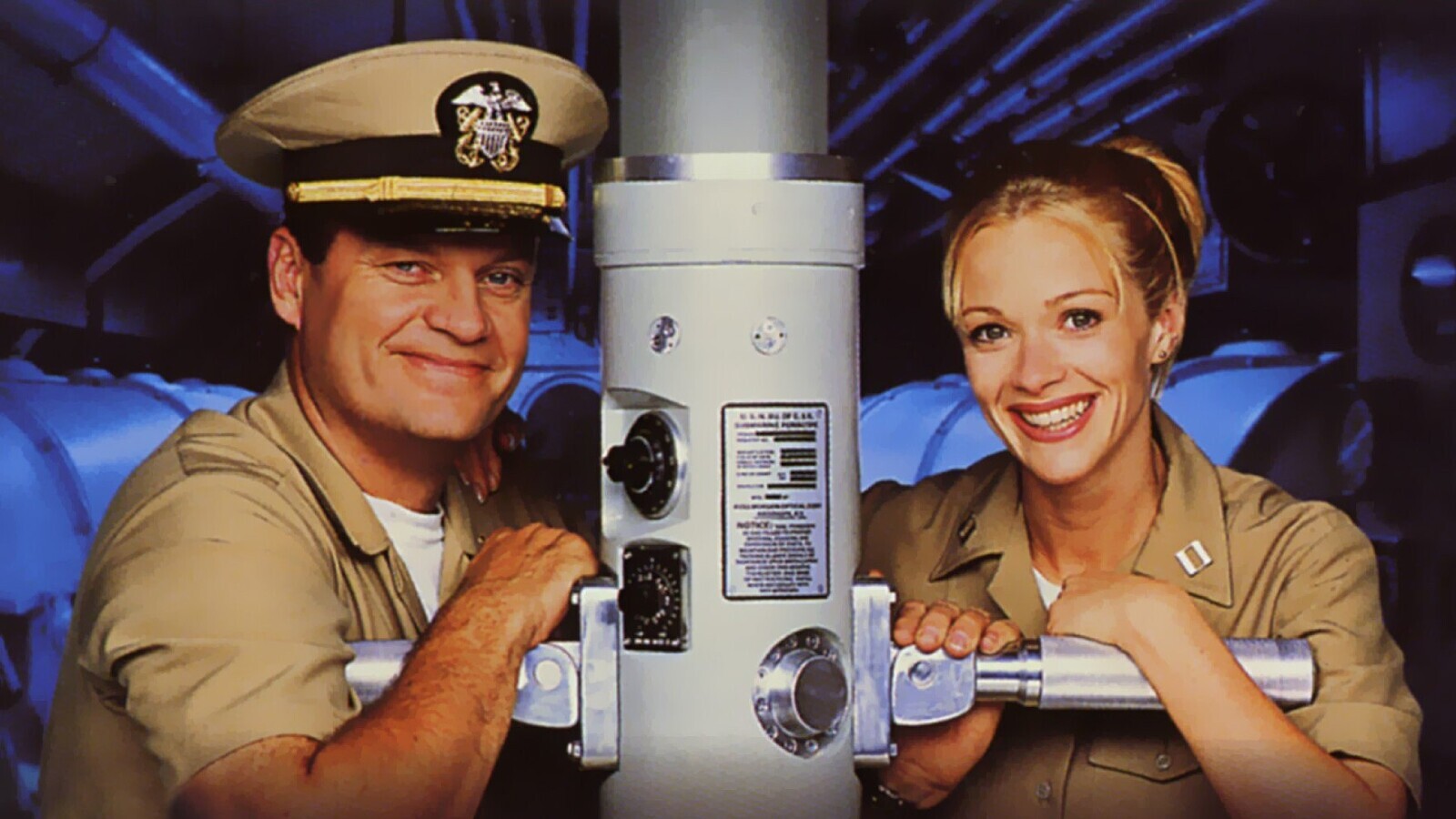
Note: This article is based on publicly reported entertainment coverage, film databases, box office records, reviews, and publicly available comments. Lauren Holly’s remark about Kelsey Grammer is treated as her allegation and not as an independently verified on-set fact.
Hollywood history is packed with legendary behind-the-scenes stories: explosive arguments, impossible stunts, diva behavior, prank wars, and actors who refused to come out of trailers unless someone removed the green candies from a bowl. Then there is the more fragrant category of showbiz lore. That is where Lauren Holly’s now-viral comment about Kelsey Grammer and the 1996 submarine comedy Down Periscope floats to the surface like a very suspicious bubble.
Holly, who co-starred with Grammer in the slapstick spoof, reportedly replied to a social media discussion by saying that Grammer “farted constantly” on the set of Down Periscope. It was a short remark, but the internet did what the internet does best: it grabbed the sentence, saluted it, and sent it out to sea at full comedic speed. Suddenly, a nearly 30-year-old movie about a rusty submarine, a misfit crew, and military-grade foolishness had a new layer of pop-culture oxygen. Or perhaps not oxygen. Let’s move on.
What Did Lauren Holly Say About Kelsey Grammer?
The central claim is simple and wildly memorable: Lauren Holly alleged that Kelsey Grammer was gassy during the making of Down Periscope. The comment gained traction because of its unexpected bluntness, its connection to a recognizable sitcom star, and its perfect match with the movie’s own lowbrow comic energy. After all, Down Periscope is not a delicate chamber drama about grief, memory, and the quiet collapse of the human soul. It is a broad naval comedy where discipline, dignity, and basic submarine maintenance all take repeated torpedo hits.
That is partly why the anecdote landed so strongly. Grammer is best known to many viewers as Dr. Frasier Crane, the opera-loving, sherry-sipping psychiatrist from Cheers and Frasier. The contrast between Frasier’s polished vocabulary and Holly’s bathroom-humor memory is almost too perfect. It is the kind of collision that makes celebrity gossip feel like a deleted scene from a sitcom writers’ room.
Still, the responsible wording matters. Holly’s statement is an allegation and a recollection. Grammer has long had a public career full of acclaimed performances, awards, and memorable roles, and a single social media jab does not define a person or a production. But as a pop-culture moment, the quote is undeniably sticky. Some celebrity stories fade in an afternoon; this one came with its own built-in sound effect.
The Slapstick Spoof in Question: Down Periscope
Released in 1996, Down Periscope stars Kelsey Grammer as Lieutenant Commander Tom Dodge, an unconventional Navy officer who finally gets a shot at command. Unfortunately, his new vessel is not exactly the sleek nuclear submarine of his dreams. It is the USS Stingray, an aging diesel-powered submarine that looks as if it has been held together with rust, prayer, and whatever the Navy equivalent of duct tape is.
The setup is pure 1990s comedy: a maverick leader, a crew of oddballs, a skeptical military establishment, and an impossible mission. Dodge must lead the Stingray and its collection of misfits through a war-game scenario against more advanced naval forces. The movie aims for the same broad, ensemble-driven energy that powered earlier military comedies and sports underdog films. Think less The Hunt for Red October and more “what if the submarine crew brought snacks, bad judgment, and a suspicious smell?”
Lauren Holly’s Role as Lieutenant Emily Lake
Lauren Holly plays Lieutenant Emily Lake, a capable officer assigned to the Stingray as part of the test. Her character is meant to bring competence and tension into a boat full of chaos. In many scenes, Lake is surrounded by men who treat professionalism as a fascinating rumor they once heard in a hallway. That contrast gives Holly the job of reacting, resisting, and sometimes grounding the movie’s sillier instincts.
Holly was already familiar to audiences before Down Periscope. She had appeared in Dragon: The Bruce Lee Story, became widely recognized for Dumb and Dumber, and built a strong television résumé with shows such as Picket Fences and later NCIS. In Down Periscope, she plays the straight-faced professional in a floating clown car. That makes her behind-the-scenes memory even funnier, because her character already spends much of the movie trying to survive male nonsense with her patience intact.
Kelsey Grammer’s Tom Dodge: Frasier Goes Nautical
Kelsey Grammer’s casting was a major hook. By the mid-1990s, he was riding high as Frasier Crane, one of television comedy’s most celebrated characters. In Down Periscope, Grammer traded radio booths and neurotic dinner parties for a naval uniform, a rebellious leadership style, and a submarine that should probably have been inspected by an exorcist.
His Tom Dodge is not an incompetent fool. In fact, the movie repeatedly shows him as clever, experienced, and strategically creative. The comedy comes from the gap between his talent and his total lack of interest in stiff military manners. He is the kind of officer who wins by bending rules, reading people well, and thinking like a pirate. The movie says this proudly, as if “pirate management style” belongs on a LinkedIn profile.
Why This Story Went Viral Years Later
There are three reasons Holly’s remark traveled so quickly. First, it is short. In the age of social media, a perfect celebrity jab must be compact enough to screenshot, repeat, and understand before your coffee cools. Second, it involves a famous actor with a very refined public image. Third, it connects to a comedy that already has a goofy reputation. The story did not need a long explanation. It arrived pre-seasoned.
Celebrity anecdotes also work best when they puncture a polished image without requiring a scandal investigation board. Holly’s comment is not a complex legal claim or a career-ending accusation. It is embarrassing, absurd, and extremely human. People laugh because the story pulls an award-winning actor down from the marble balcony of prestige and places him in the same awkward universe as everyone else who has ever blamed a chair.
There is also nostalgia at work. Down Periscope belongs to a specific era of mid-budget studio comedy, when theaters were full of goofy concepts, character actors, and jokes that were not trying to build a cinematic universe. A resurfaced anecdote gives modern readers an excuse to revisit that era, even if the doorway into memory happens to be, well, drafty.
How Down Periscope Fits Into 1990s Comedy
The 1990s were generous to slapstick, spoof-adjacent comedies, and ragtag-team stories. Audiences got military farces, sports comedies, workplace chaos, buddy movies, and fish-out-of-water plots by the truckload. Down Periscope sits comfortably in that lineup. It is not elegant. It is not subtle. It is the cinematic equivalent of a dad joke wearing a sailor hat.
The movie also borrows from the underdog formula. Dodge is blocked by superior officers who underestimate him. His crew looks useless on paper. The equipment is outdated. The mission is absurd. Naturally, the misfits become a team, the old submarine proves surprisingly effective, and the authority figures learn that sometimes chaos can outmaneuver bureaucracy. It is a familiar dish, but the movie serves it with torpedoes.
The cast gives the film much of its personality. Alongside Grammer and Holly, the ensemble includes Rob Schneider, Bruce Dern, Rip Torn, Harry Dean Stanton, William H. Macy, Harland Williams, Toby Huss, and others. That is a strange and fascinating lineup: sitcom polish, character-actor grit, sketch-comedy energy, and old-school Hollywood vinegar all packed into one vessel. No wonder the submarine feels crowded.
Critical Reception: A Comedy That Critics Mostly Sank
When Down Periscope opened, critics were not exactly throwing roses into the harbor. The movie received largely negative reviews, with many critics arguing that the jokes were too predictable, the characters too thin, and the overall execution too mild for a premise that promised naval lunacy. Its box office was modest as well, earning roughly $37.5 million worldwide against a reported production budget around $31 million.
But audience affection has been more complicated. While critics often dismissed the film as forgettable, some viewers have embraced it as comfort comedy. It is easy to see why. Down Periscope is low-stakes, breezy, and built around a group of oddballs learning to function together. It is not trying to win a Pulitzer Prize for submarine jokes. It wants to be watched on a lazy afternoon while laundry spins in the next room.
That split between critics and casual fans has helped the movie survive. A critically beloved masterpiece can become homework; a critically disliked comedy can become a guilty pleasure. Down Periscope lives in that second category, where viewers defend it not because it is flawless, but because it is friendly, quotable, and unserious in a way many modern comedies are afraid to be.
The Comedy of Confined Spaces
Submarine movies are naturally tense because everyone is trapped in a metal tube underwater. Down Periscope flips that tension into comedy. Tight corridors, shared quarters, malfunctioning equipment, and clashing personalities all become joke machines. A submarine is basically an office, a locker room, a basement, and a pressure cooker welded together and dropped into the ocean. Add slapstick, and suddenly every inconvenience feels bigger.
That is also why Holly’s allegation fits the mythology of the film so neatly. A submarine set already suggests close quarters. The idea of an actor repeatedly breaking the atmosphere in such an environment is funny because the setting does half the joke for us. On a wide-open western, the wind might carry the problem away. On a submarine comedy, there is nowhere to run. Even the periscope seems like it might be looking for fresh air.
Why Gross-Out Humor Still Gets Attention
Bathroom humor is ancient. Long before streaming platforms, prestige TV, and “elevated” everything, audiences laughed at bodies misbehaving. Farts are democratic comedy. They require no film degree, no cultural footnotes, and no character chart. A fart joke says, “We are all ridiculous machines,” and the audience usually agrees, even if it pretends to be above such things.
That does not mean every gross-out joke works. The best ones need timing, surprise, and context. Holly’s remark works because it is not part of a planned routine. It sounds like a blunt memory escaping from the archive. It is the difference between a scripted gag and someone suddenly opening a dusty filing cabinet labeled “Things I Have Apparently Been Waiting Decades To Say.”
The internet rewards that kind of specificity. “He was annoying” would have disappeared. “He farted constantly on the set of Down Periscope” has location, character, rhythm, and a tiny whiff of revenge comedy. It is almost a complete sketch in one sentence.
What the Anecdote Says About Celebrity Image
Celebrity culture depends on contrast. Stars are marketed as glamorous, talented, disciplined, and larger than life. Behind-the-scenes stories remind audiences that movie sets are workplaces, and workplaces are full of boredom, discomfort, snacks, bad chairs, and human bodies doing human things. The magic of cinema may be luminous, but the lunch break is still lunch.
Kelsey Grammer’s career has included Shakespeare, sitcom royalty, voice acting, drama, comedy, and stage work. He is a major performer by any reasonable measure. Lauren Holly’s career has also crossed comedy, drama, film, and television with impressive range. That is what makes the story feel so absurdly charming. It does not involve unknown people behaving badly in a vacuum. It involves familiar actors from shows and movies people actually remember.
In that sense, the story does not really change the legacy of Down Periscope. Instead, it adds a strange footnote. The movie was already a slapstick spoof about a leaky old submarine and a crew nobody believed in. Now it has a behind-the-scenes legend that sounds as if it were written by the same writers after one too many cafeteria burritos.
Experiences Related to This Topic: Watching Down Periscope After the Viral Fart Storm
Rewatching Down Periscope after hearing Lauren Holly’s comment is a very different experience. Before the anecdote, the movie plays like a standard 1990s comedy: broad, goofy, occasionally clunky, and weirdly comforting. After the anecdote, every cramped submarine scene gains an unintended layer of suspense. A character pauses? You wonder. Someone makes a face? You wonder harder. A hatch closes? Suddenly, the stakes feel personal.
That is the funny thing about behind-the-scenes stories. They can permanently alter how we watch a film, even when they have nothing to do with the plot. A viewer might start Down Periscope expecting a silly naval comedy and end up studying the cast’s facial expressions like a detective in a very immature mystery. Was Lauren Holly reacting to the script, the scene, or something less suitable for the ship’s log? Obviously, viewers cannot know. But the possibility becomes part of the entertainment.
Many people have had their own version of this experience in everyday life. Anyone who has worked in a small office, shared a tour bus, sat through a long meeting, or taken a packed elevator knows the social comedy of trapped air and trapped politeness. Nobody wants to be the first person to acknowledge the invisible villain. Everyone silently negotiates blame, innocence, and escape routes. The eyes become courtroom evidence. The nose becomes a witness.
That is why this story connects beyond celebrity gossip. A movie set may sound glamorous, but it can also be a workplace with long hours, tight spaces, hot lights, heavy costumes, and repeated takes. Comedy sets especially can be chaotic because the job is to keep energy high while doing the same ridiculous thing over and over. Add a submarine environment, even a staged one, and the glamour drops faster than an anchor. You can almost imagine the crew trying to stay professional while praying for ventilation.
The anecdote also reminds us why imperfect movies sometimes remain fun. Down Periscope is not remembered as a critical masterpiece, yet people still talk about it, quote it, defend it, and rediscover it. Now, thanks to Holly’s comment, it has gained a second life as a piece of comedy folklore. Some films are preserved by awards. Others are preserved by nostalgia. A select few are preserved by a co-star basically saying, “You have no idea what I survived.”
As a viewing experience, that makes Down Periscope strangely richer. The movie’s humor was always about disorder inside a disciplined institution. The Navy wants rules, polish, and command structure; the Stingray delivers rust, weirdos, rebellion, and bodily chaos. Holly’s alleged memory simply extends that theme offscreen. The result is not elegant, but it is undeniably memorable. And in Hollywood, being memorable is half the battle. The other half is apparently opening a window.
Conclusion: A Weird Little Story That Refloated a Forgotten Comedy
Lauren Holly’s comment about Kelsey Grammer did more than generate a quick laugh. It pushed Down Periscope back into conversation, reminded audiences of a very specific 1990s comedy style, and showed how one blunt behind-the-scenes memory can revive interest in an old movie. Whether readers see the story as gossip, comedy trivia, or simply a bizarre footnote in naval spoof history, it has given the film a new reason to be searched, shared, and rewatched.
Down Periscope may not have conquered critics, but it has achieved something oddly durable: it remains a recognizable cult-adjacent comedy with a cast worth revisiting and a premise that still floats. Holly’s allegation adds a fragrant new chapter to its legacy, one that is funny precisely because it is so human. Hollywood can dress stars in uniforms, place them on carefully built sets, and surround them with cameras, but sometimes the story people remember most is the one that was never in the script.