

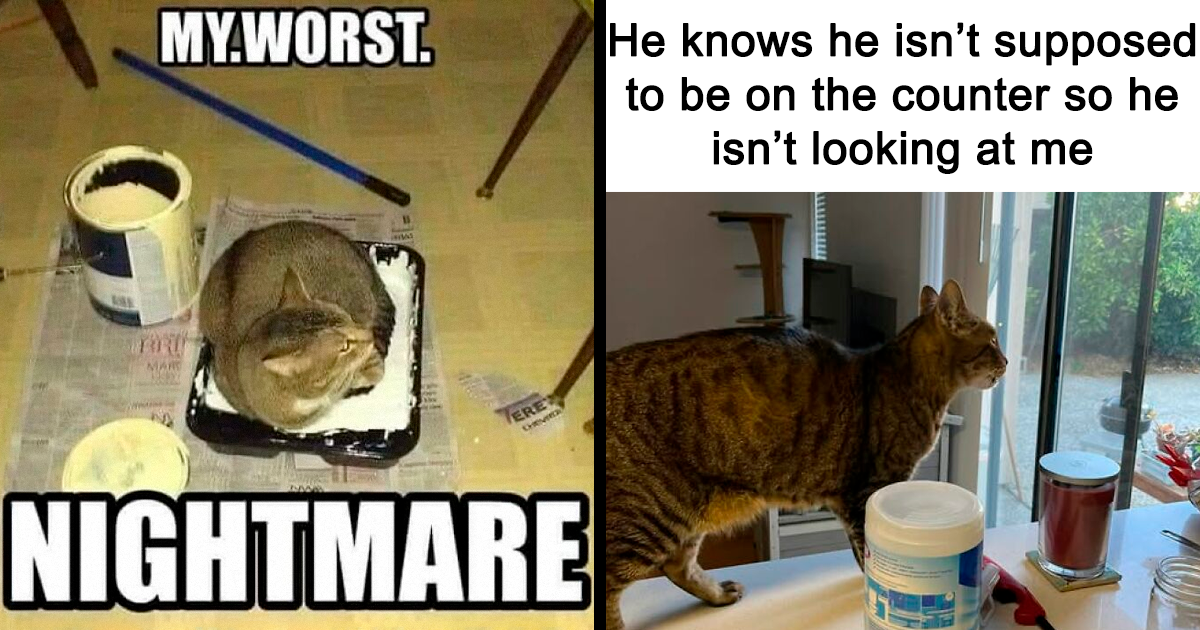
There are two kinds of people in this world: people who walk past a cat and continue living their lives, and people who instantly transform into a strange sidewalk goblin whispering, “pspspspsps.” This article is for the second group. The emotionally committed. The dignity-optional. The ones who see a cat loafing on a windowsill and think, that is not an animal; that is a warm dinner roll with opinions.
A title like “If Not Potato. Then Why All Potato-y” works because it captures the central mystery of the feline universe: cats are elegant predators with razor-sharp reflexes, yet they also resemble overstuffed bakery items, judgmental throw pillows, and tiny landlords collecting rent in the form of treats. That contradiction is exactly why cat memes never go out of style. They take real cat behavior, add one absurd caption, and suddenly the entire internet nods in agreement like, “Yes, this orange cat absolutely looks like he forgot his own email password.”
But funny cat memes do more than earn a quick laugh. They work because they reflect how cats actually move, communicate, and manipulate us with the precision of furry stage actors. Adult cats often meow primarily at humans, not at one another. They trill, chirp, loaf, slow blink, knead, stare into the middle distance like Victorian ghosts, and flick their tails in ways that say either “I love you” or “touch me again and lose a finger.” In other words, cats come with built-in visual comedy and emotional suspense. Memes just add subtitles.
Why Cat Memes Still Rule the Internet
The internet did not invent our obsession with cats. It merely gave it Wi-Fi and a caption generator. Long before reaction images, cats were already cultural stars in art, folklore, and domestic life. Online, though, cats found their perfect medium. Their expressions are exaggerated, their body language is dramatic, and their daily routines swing wildly between regal composure and total nonsense. One second they look like carved marble. The next, they are wedged inside a sneaker.
That range makes cats meme royalty. A dog meme usually says, “I am enthusiastic.” A cat meme can say, “I am ancient,” “I am deeply disappointed in your tax strategy,” or “I have become a loaf because existence is exhausting.” Cats are expressive without trying too hard, which is ideal for internet humor. They look like they understand the joke, resent the joke, and somehow are the joke.
There is also something wonderfully democratic about cat humor. You do not need to own a cat to appreciate the comedy of a tiny creature sitting like a rotisserie chicken on a keyboard while maintaining eye contact. Cat memes are universal because the emotional beats are universal: hunger, attitude, confusion, overconfidence, dramatic fatigue, and the occasional desire to knock something off a table just to see what happens. Frankly, that last one is half of human history too.
The “Potato-y” Theory of Feline Comedy
1. The Loaf Is Real
Let us begin with the potato issue. When a cat tucks in its paws and rounds out its body, it creates the classic cat loaf shape. Animal experts describe this position as relaxed but still alert, which is exactly the sort of mixed signal that cat lovers adore. The cat is resting, but not fully off-duty. It is calm, but prepared to spring into action if the treat bag makes a sound from three rooms away.
This posture is meme gold because it makes cats look edible in the least threatening way possible. Not literally edible, obviously. More like emotionally carb-based. Soft. Round. Toast-adjacent. The loaf shape turns a stealthy hunter into a baked side dish with boundaries, and the contrast is irresistible. If an animal looks that much like a potato, the human brain is contractually obligated to make a joke.
2. Cats Have Unfairly Good Facial Expressions
Cat memes succeed because cats appear to have opinions about everything. A slight squint becomes disapproval. A blank stare becomes existential dread. A half-open mouth becomes “I have seen horrors beyond your comprehension, and one of them was store-brand kibble.” Even when we know we are projecting human thoughts onto them, we still do it, because their faces invite narration.
Research on cat-human communication adds a real behavioral layer to the fun. Cats often use eye narrowing and the famous slow blink as a sign of comfort and positive intent. That means one of the internet’s favorite cat expressions is not just adorable; it is meaningful. The meme version says, “I forgive you, peasant.” The behavioral version says, “I feel safe with you.” Honestly, both are emotionally devastating.
3. Their Physics Are Comedic
Cats are agile enough to leap onto a bookshelf without making a sound, then somehow trip over absolutely nothing while walking across an empty room. This combination of athletic brilliance and random chaos is a cornerstone of funny cat memes. People love animals that are simultaneously majestic and ridiculous. Cats offer both, sometimes in the same five-second clip.
They nap in pretzel shapes. They sit like middle managers after a bad quarter. They flatten into puddles, become footballs under blankets, or stretch into long noodles across sunlit floors. Every position looks like a punchline waiting for a caption. The visual variety alone could power fifty memes before lunch.
Why “Pspsps” People Feel Seen by These Memes
If you are the type who automatically pspsps-es at every cat, you are not just responding to cuteness. You are responding to possibility. Maybe this cat will acknowledge you. Maybe it will blink. Maybe it will walk over. Maybe it will ignore you with such total confidence that you will think about it for three business days. Every cat encounter contains a tiny emotional gamble, and that gamble is weirdly thrilling.
Cat memes capture that exact energy. They understand that loving cats is part affection, part negotiation, part emotional side quest. Dogs often give love like a marching band. Cats tend to deliver it like a limited-release luxury product. When a cat chooses you, follows you, slow blinks at you, chirps from across the room, or settles beside you like a furry comma, it feels earned. That is why cat people go feral over even small signs of approval.
And yes, the sounds matter. Meows are famously versatile, and many experts note that adult cats often use them mainly with humans. Trills and chirps can be social and inviting, almost like a “come here” or “follow me.” That means cat lovers are not hallucinating when they feel they are being managed by a six-pound supervisor. The memes are funny because the relationship is funny. Cats are companions, but they are also tiny directors constantly adjusting the scene.
What the Best Cat Memes Actually Get Right
The Hunger Drama
No creature acts as though it has never been fed more convincingly than a cat standing beside a half-full bowl. Cat memes love this because the performance is elite. The pacing. The yowling. The soulful glance toward the kitchen as if help has not arrived in generations. It is absurd, recognizable, and probably happening in someone’s house right now.
The Mixed Signals
A wagging dog tail is usually straightforward. A cat tail is a graduate seminar. A flick can mean irritation, focus, excitement, or “please stop narrating my life.” Purring can signal contentment, but context matters; it can also happen in moments of stress or self-soothing. This emotional complexity is what makes cat humor sharper than simple slapstick. The audience is always reading the room, and the cat is always changing the room.
The Affection on Their Terms
Cats show love in ways that are subtle enough to feel meaningful: kneading, rubbing, head-butting, sleeping nearby, blinking slowly, or calmly choosing your lap over every other square inch of the house. These behaviors make cat memes sweeter than they first appear. Beneath the jokes about dramatic loafs and orange-cat chaos, there is a real affection economy happening. Cat people are not laughing at cats so much as laughing from deep familiarity.
Why Funny Cat Memes Feel Weirdly Comforting
Humor has a way of lowering the temperature of a hard day, and pet humor is especially effective because it combines surprise with affection. A ridiculous cat photo is not just funny; it is grounding. It reminds you that somewhere in the world, a perfectly serious animal is sitting in a fruit bowl as if that is a reasonable life choice. For many people, that tiny burst of nonsense is a mood reset.
There is also the comfort of recognition. Cat people know the routine: the 4 a.m. hallway sprint, the sudden keyboard occupation, the purr that starts the moment you stop working, the stare that suggests your home is now under new management. Memes turn those private little household moments into a shared language. You laugh because the joke lands, but also because it confirms that other people are living in the same delightful hostage situation.
That social element matters. The internet has long helped cat lovers find one another, swap stories, and turn ordinary pet behavior into collective folklore. From early LOLcat culture to celebrity felines with permanently unimpressed faces, cat content became more than entertainment. It became a corner of the web where weird tenderness and weird humor could coexist. Not a bad legacy for an animal that occasionally sprints out of the litter box like it has seen the end times.
Fifty Memes, One Truth
The real genius of a roundup titled “If Not Potato. Then Why All Potato-y” is that it understands the sacred formula of internet cat humor. First, observe a perfectly normal cat behavior. Second, describe it with completely unserious language. Third, let every cat person in the room feel personally attacked by how accurate it is.
That is why these memes work whether they feature a loaf cat, a bug-eyed gremlin on a staircase, a distinguished senior cat glaring from a blanket fort, or an orange troublemaker who looks like he absolutely tried to microwave a sock. The details change. The emotional truth does not. Cats are funny because they are sincere. They are not trying to be content. They are just living with full commitment to every nap, protest, stare, and inexplicable sprint.
And maybe that is why humans keep coming back. In a world full of polished performances, cats remain gloriously unedited. They are soft and sharp, affectionate and aloof, elegant and shaped like side dishes. They are tiny paradoxes with whiskers. The memes are just our way of documenting the evidence.
Extra Reflections: Life Lessons From People Who Pspsps at Every Cat
If you have ever crossed a street just to say hello to a cat sitting under a parked car, you already know that the experience is never merely “I saw a cat.” It becomes a whole event. First, there is the cautious approach, where you try to look nonthreatening even though you are a full-sized human making tiny clicking noises with your mouth. Then comes the emotional roulette wheel: will the cat blink at you, leave immediately, or remain seated like a neighborhood mayor deciding whether you deserve an audience?
For cat people, these micro-interactions are unforgettable because they feel strangely honest. A cat does not flatter. A cat does not pretend to be interested because it would be socially convenient. If a cat comes closer, that moment feels real in a way that is almost comical. You think, I have been chosen, even if the cat’s actual thought is, this person might have snacks. The magic is that both interpretations can exist at once.
That same emotional texture is why cat memes do not wear out. They are not just random jokes pasted onto furry faces. They are compressed little stories about attention, boundaries, affection, curiosity, and harmless chaos. Anyone who has lived with a cat has seen the entire emotional catalog: the dramatic hunger strike that lasts seven minutes, the offended walk-away after one badly timed pet, the midnight stampede, the unannounced lap visit that makes you cancel every plan to move your legs again. Memes work because they distill those experiences into one image and one line, and suddenly an entire household history snaps into focus.
There is also something deeply funny about how cats make humans behave. Serious adults with jobs, passwords, and quarterly obligations will kneel on a sidewalk and whisper “hi baby” to a stranger’s tabby as if summoned by ancient law. They will show coworkers twenty photos of the same sleeping pose from slightly different angles because one of them is “the roundest.” They will narrate a cat’s internal monologue in a voice that sounds like a tired aristocrat. Cat memes do not create this behavior. They simply validate it.
And maybe that is the biggest reason these memes endure. They let cat people admit, cheerfully and without shame, that cats have rearranged the architecture of their emotions. A loaf on a windowsill can improve a bad afternoon. A tiny chirp from the hallway can feel like a compliment. A sleepy slow blink can somehow be both a joke and a genuine form of trust. Once you understand that, the potato comparisons stop sounding ridiculous and start sounding precise. If not potato, then why so warm, round, comforting, and somehow capable of running the whole household? Exactly.
Conclusion
Cat memes endure because they are built on truth, even when the captions are gloriously stupid. Cats really do loaf like baked goods, communicate in surprisingly nuanced ways, and inspire humans to embarrass themselves in public with zero regret. A strong meme collection does not just show cute cats; it captures the whole cat-person relationship in miniature: the longing, the comedy, the mutual confusion, and the occasional blink of real trust.
So yes, if not potato, then why all potato-y? Because cats are one of the internet’s most perfect subjects: expressive, mysterious, ridiculous, and deeply lovable. Fifty memes later, the answer is still the same. We cannot resist them because they keep giving us new material, new affection, and new reasons to pspsps at creatures who may or may not acknowledge our existence. That, in cat terms, is basically romance.