

Note: This article is written for informational and editorial publishing purposes. It discusses public comedy-history debates, copyright concepts, and well-known allegations without presenting unproven claims as settled fact.
Introduction: When a Punchline Walks Out Wearing Someone Else’s Jacket
A stolen joke is one of comedy’s strangest crimes. Nobody loses a wallet. No getaway car screeches around the corner. The stolen item is usually a sentence, a rhythm, a story, a twist, or a perfectly timed pause. Yet among comedians, joke theft can feel like grand larceny with a two-drink minimum.
The reason is simple: a joke is not just a funny sentence. For a working comedian, it is labor. It is bombing on a Tuesday night in front of twelve people and one suspicious nacho plate. It is rewriting the setup, trimming the punchline, moving one word, adding silence, testing it again, and finally discovering that the laugh arrives exactly where it should. When another performer takes that finished piece and presents it as original, the theft is not merely about words. It is about stolen trial, stolen voice, stolen reputation, and sometimes stolen income.
Joke theft has existed for as long as professional comedy has existed. From vaudeville stages to late-night television, from comedy clubs to Twitter, Instagram, TikTok, podcasts, and meme pages, comedians have argued over who owns a laugh. The history of joke thieves is also a history of changing technology. Every new medium makes comedy easier to share, easier to copy, and harder to police. The punchline travels faster than the person who wrote it, which is excellent for laughter and terrible for credit.
So, what counts as joke theft? Why is it so hard to prove? Why do comedians often punish thieves through reputation instead of lawsuits? And why does the internet seem to treat other people’s jokes like free samples at a grocery store? Let’s dig into the history, law, ethics, and messy human drama behind joke stealing.
What Is Joke Theft?
Joke theft is the use of another person’s comedic material without permission, credit, or meaningful transformation. In stand-up comedy, that may mean copying a punchline, premise, structure, character bit, act-out, or longer routine. In digital culture, it may mean reposting a tweet, meme, caption, sketch, or short video while removing the original creator’s name.
Not every similar joke is theft. Comedy often works through common experiences: dating disasters, family arguments, airline misery, bad bosses, weird food, technology frustration, and the universal suspicion that printers are haunted. Two comedians may independently reach a similar idea because they are observing the same culture. That is parallel thinking, not necessarily plagiarism.
The real question is usually not, “Are these jokes about the same thing?” The better question is, “Are the choices too similar to be coincidence?” If the setup, rhythm, wording, twist, and conclusion line up closely, audiences and comedians become suspicious. If the accused performer was in the room when the original joke was performed, suspicion grows a tiny mustache and starts twirling it.
A Brief History of Joke Thieves
Vaudeville: The Wild West With Better Hats
Long before Netflix specials and podcast clips, American comedians fought over material in vaudeville. Vaudeville was a touring entertainment circuit filled with singers, dancers, magicians, jugglers, comics, novelty acts, and performers who could do something impressive with a chair and a terrifying amount of confidence.
Because performers traveled from city to city, joke stealing was both tempting and dangerous. A comic could hear a strong bit in Chicago, use it in St. Louis, and hope nobody noticed. But the vaudeville world was smaller than it looked. Performers talked. Managers talked. Audiences sometimes remembered. A stolen routine could follow a comic around like a bad smell in a rented tuxedo.
In those days, formal legal protection was limited and expensive. Performers often relied on informal systems. Some deposited written material with trade organizations or industry publications to establish priority. Others depended on reputation. If a comic became known as a joke thief, bookings could dry up. In more colorful stories from comedy history, angry comedians used direct confrontation, public embarrassment, or even physical intimidation. Not exactly a modern HR-approved process, but vaudeville was not famous for its employee wellness seminars.
Radio and Early Television: One Joke, Millions of Ears
Radio changed everything. A joke that once lived in one theater could suddenly reach a national audience. Television multiplied the problem. A performer with access to a major platform could make a borrowed line famous overnight, while the original writer remained unknown.
Early television also created a new class of comedy labor: writers’ rooms. Many jokes were no longer presented as the private property of a single performer. They were created by teams, polished by producers, delivered by hosts, and recycled across formats. That made authorship harder to track. Who owns a monologue joke: the writer, the head writer, the host, the show, or the network? Legally, it often depends on employment and contract terms. Culturally, it depends on who gets the credit and who gets the check.
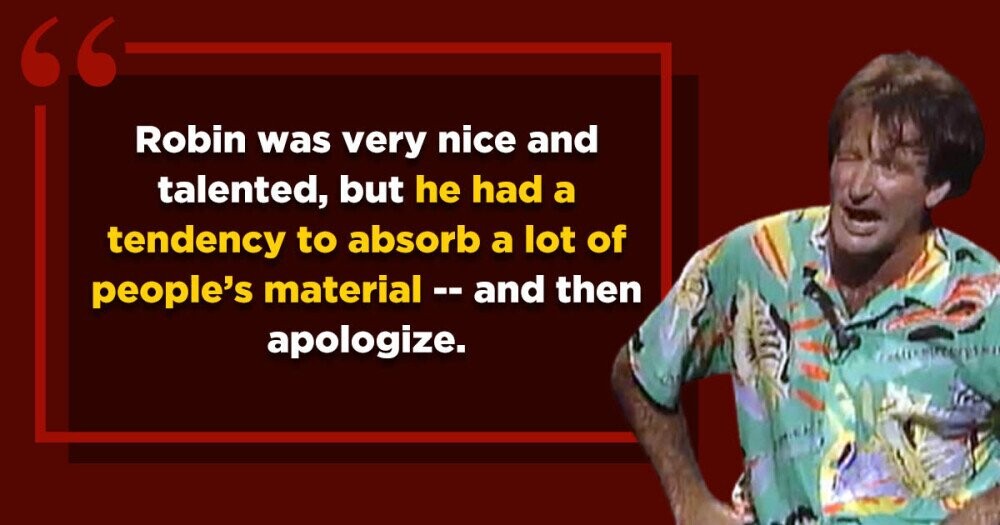
Comedy legends have long been surrounded by rumors of borrowing, lifting, or “absorbing” material. Milton Berle, one of television’s earliest stars, was famously associated with joke stealing accusations. Robin Williams, beloved for his lightning-fast improvisation, was also the subject of long-running industry stories claiming that he sometimes paid comics after using their material. These stories show the strange moral math of comedy: fame can magnify both talent and suspicion.
The Comedy Club Code
Modern stand-up developed its own unwritten law. Comedians may not own every idea in a legal sense, but inside the comedy community, they often treat original material as property. If a comic works out a distinctive bit, other comics are expected to leave it alone.
This code is enforced through social consequences. A suspected joke thief may be confronted backstage, warned by peers, denied stage time, mocked publicly, or quietly avoided. Comedy clubs and bookers may become reluctant to hire someone with a bad reputation. Audiences may not always know what happened, but other comics often do.
This informal system exists because lawsuits are slow, expensive, uncertain, and awkward. Imagine telling a federal judge, “Your Honor, the defendant stole my joke about airport sandwiches.” The judge may understand copyright law perfectly and still wonder how life brought everyone to this fluorescent room.
Community enforcement is faster. It also protects more than copyright law usually does. Copyright protects expression, not broad ideas. Comedy norms, however, may condemn copying a distinctive premise even if the wording changes. Among comics, “I rewrote it” is not always a defense. Sometimes it is just theft wearing a fake mustache.
Joke Theft and Copyright Law
Copyright law can protect original works once they are fixed in a tangible form, such as writing or recording. That matters for comedians. A written routine, recorded set, script, sketch, or published joke may have copyright protection if it contains enough original expression.
But jokes create special problems. Copyright does not protect ideas, concepts, systems, or general premises. It protects the specific expression of an idea. A comic cannot own the broad concept of “dating apps are weird” or “air travel is annoying.” If that were possible, half the comedy industry would need to Venmo a licensing fee before opening its mouth.
Short jokes are especially tricky. Very brief phrases, titles, slogans, and common expressions may not qualify for protection. A longer routine with distinctive wording, structure, characters, and narrative development has a better chance of being protectable. Still, even when copyright technically applies, proving infringement can be difficult. The original comedian must show ownership, access, copying, and substantial similarity. That is a heavy backpack to carry for a punchline.
This is why many joke theft disputes never reach court. The legal system is built for evidence, not vibes. Comedy culture, meanwhile, operates heavily on timing, memory, reputation, and the grim certainty of a comic saying, “I know what I heard.”
Famous Joke Theft Disputes
Carlos Mencia and Joe Rogan
One of the most famous modern joke-theft controversies involved Carlos Mencia and Joe Rogan. In the mid-2000s, Rogan publicly accused Mencia of stealing material from multiple comedians. Their confrontation at The Comedy Store became a major moment in stand-up culture because it moved an inside-comedy accusation into public view.
The controversy raised several important issues. First, it showed that public accusation can be powerful even without a court ruling. Second, it demonstrated how video-sharing platforms could turn a club dispute into a national debate. Third, it revealed the difficulty of proof. Supporters of accused comedians may argue that similar jokes can emerge independently. Accusers may point to patterns, access, and repeated similarities.
Whether audiences see such cases as obvious theft or messy coincidence often depends on how much they trust the people involved. In comedy, credibility is currency. Once audiences believe a comic has stolen material, every future joke may be inspected like a suspicious suitcase at the airport.
Dane Cook and Louis C.K.
The dispute between Dane Cook and Louis C.K. became famous partly because it was later dramatized in an episode of the television series Louie. The real-life controversy centered on allegations that some of Cook’s material resembled earlier bits by Louis C.K. The episode did something unusual: instead of treating joke theft as a simple villain story, it explored ambiguity, resentment, ego, fame, and the uncomfortable possibility that two performers can remember the same conflict differently.
This case matters because it highlights a key problem in comedy: influence can look like theft, and theft can hide behind influence. Comedians absorb rhythms, topics, and attitudes from the performers they admire. That is how artistic traditions work. But when influence becomes too specific, it stops being homage and starts wearing gloves indoors, which is never a good sign.
Amy Schumer and the Social Media Era
Amy Schumer has denied accusations that she stole jokes from other comedians, and some disputes involving her have remained contested. The important point for analysis is not to retry the case in the court of blog content. The important point is that her controversy showed how quickly joke-theft accusations spread in the digital age.
Clips can be edited side by side. Old performances can resurface. Fans can become investigators. Critics can become prosecutors. Sometimes this helps expose real copying. Sometimes it creates overconfident conclusions from incomplete evidence. The internet is excellent at finding similarities and less excellent at patience, context, and saying, “Maybe we need more information.”
Why Joke Theft Is So Emotionally Explosive
Joke stealing hits comedians hard because comedy is personal. A joke may begin as a private embarrassment, family memory, political observation, or strange little thought that crawled into the comic’s head at 2 a.m. When someone steals it, the original performer does not just lose a line. They lose a piece of voice.
There is also an economic reason. Stand-up material helps comedians get better bookings, sell specials, build clips, attract agents, and develop television opportunities. A strong bit can become a signature. If another performer with a bigger platform uses it first, the original comic may look like the copycat. That is the nightmare: not only having your joke stolen, but being accused of stealing your own joke. Comedy, apparently, needed its own version of identity theft.
Joke theft also violates the basic bargain of stand-up. The audience believes the comedian is presenting original observations, or at least original expression. If that trust breaks, the performance feels fake. Laughter depends on surprise. Stolen jokes arrive with a receipt from someone else’s imagination.
The Internet Made Everyone a Comedy Distributor
Social media transformed joke theft from a backstage problem into a global content economy. On platforms built for speed, jokes are copied, screenshotted, reposted, translated, cropped, and recycled within minutes. A funny tweet can appear on Instagram without attribution. A TikTok bit can become a meme. A meme can become a brand caption. A brand caption can become a billboard. Somewhere, the original writer is eating cereal and wondering why their joke is now selling socks.
Online joke theft differs from stand-up theft in several ways. First, it is often literal copying. Second, the thief may not even be a comedian. Third, monetization may come through followers, ads, sponsorships, traffic, or merchandise rather than ticket sales. Fourth, audiences often do not care who wrote the joke as long as they laughed while scrolling.
This creates a moral loophole. People treat the internet as a giant public junk drawer. If a joke appears in their feed, they assume it belongs to everyone. But visibility is not permission. A joke going viral does not mean the author donated it to the Museum of Free Content, located next to the Department of Convenient Excuses.
Borrowing, Influence, Parallel Thinking, and Theft
To analyze joke theft fairly, it helps to separate four categories.
1. Borrowing With Credit
This happens when a comedian clearly attributes a joke or story to its source. It can be acceptable in conversation, tribute, commentary, or historical discussion. Onstage, however, too much borrowed material makes a comic look less like an artist and more like a human playlist.
2. Influence
Every comedian is influenced by someone. A performer may admire Richard Pryor’s honesty, Joan Rivers’ sharpness, George Carlin’s language obsession, Dave Chappelle’s patience, or Maria Bamford’s character work. Influence becomes problematic only when the admirer copies specific material instead of learning broader craft lessons.
3. Parallel Thinking
Parallel thinking occurs when two people independently create similar jokes. This is common with topical humor. If a celebrity does something strange on Monday, hundreds of comedians may write similar jokes by Tuesday. Topical premises can be obvious. The originality often lies in the angle, wording, and performance.
4. Theft
Theft is the unauthorized use of someone else’s distinctive material while presenting it as original. The closer the wording, structure, timing, and context, the stronger the case. Repeated suspicious similarities also matter. One overlap may be coincidence. A pattern starts looking less like lightning and more like someone carrying a stolen weather machine.
How Comedians Protect Their Material
Comedians use several practical strategies to protect their work. Many record sets, save drafts, keep notebooks, email material to themselves, upload private rehearsal files, or maintain dated writing documents. These records can help establish when a bit was created. They also help the comic improve the act, which is the healthier reason to record yourself unless you enjoy watching your own awkward pauses in high definition.
Some performers avoid telling brand-new material around comics they do not trust. Others develop such a personal voice that copying becomes obvious. This is one of the best defenses. A joke built from a comedian’s unique background, rhythm, and perspective is harder to steal because it carries fingerprints.
For online creators, protection may include watermarking videos, posting original content on platforms that show timestamps, keeping drafts, and responding quickly when content is reposted without credit. None of these methods is perfect. The internet moves fast, and content thieves are often shameless enough to steal a joke about stealing jokes.
Why Joke Thieves Usually Lose in the Long Run
Joke thieves may win short-term laughs, but they rarely build lasting respect. Comedy is not only about having funny material. It is about developing a point of view. Stolen jokes can fill five minutes, but they cannot build a real artistic identity. Eventually, the thief runs out of pockets to pick.
Original comedians grow because writing forces them to observe more deeply. They learn what only they can say. Thieves skip that process. They may sound polished for a while, but their act becomes a borrowed suit: impressive at first glance, awkward at the shoulders, and suspiciously full of someone else’s gum.
Audiences are also more informed than ever. Fans compare clips. Comics talk openly on podcasts. Social media keeps receipts. A performer who steals repeatedly risks becoming better known for theft than for comedy. In a profession built on voice, that is a devastating trade.
Experiences and Lessons From the World of Joke Theft
The best way to understand joke theft is to imagine the experience from different sides of the microphone. For a new comedian, the first original joke that works feels magical. After weeks of silence, one line finally lands. The laugh comes back like a warm wave, and for a moment the comic thinks, “Great, I have discovered fire.” Then another performer hears it, repeats it at a different show, and gets a bigger laugh. Suddenly, fire has been shoplifted.
That experience can make young comics paranoid. They may stop sharing ideas, avoid open mics, or assume every similar joke is theft. But paranoia is not the same as protection. Comedy scenes work best when performers can experiment in public without turning every notebook into a crime scene. A healthy scene teaches comics to document their work, communicate directly, and distinguish between real theft and ordinary overlap.
For experienced comedians, the issue becomes more complicated. Veterans know that some premises are common property. Every generation writes jokes about aging, dating, parenting, politics, technology, food, and being broke. A mature comic learns not to declare ownership over the entire topic of “my parents are weird.” Otherwise, comedy would need traffic cops directing everyone away from the same five human experiences.
At the same time, experienced comics also recognize when a bit has been lifted too closely. They hear the rhythm. They know the difference between two people finding the same general idea and one person copying the machinery of the joke. The machinery matters: the setup, the misdirection, the reveal, the exact pressure point where the laugh is released.
For audiences, joke theft can be confusing because most people do not track comedy material like sports statistics. A viewer may hear a joke in a viral clip and assume it belongs to the person delivering it. Later, if the original author complains, the audience may think the dispute is petty. “It’s just a joke,” they say. But that is like telling a chef, “It’s just a recipe,” after someone copies the restaurant’s signature dish and opens a food truck across the street called Totally My Idea Tacos.
Writers and content creators face a similar problem online. A clever caption can take ten seconds to read and two years of practice to write well. When aggregator accounts repost it without credit, they are not merely spreading humor. They are redirecting attention. In the digital economy, attention is money, opportunity, leverage, and reputation. Credit is not decoration. Credit is payment in one of the internet’s most valuable currencies.
One useful lesson is that originality is not always about inventing a never-before-seen subject. It is often about personal angle. A generic joke says, “Airports are stressful.” A stronger original joke says exactly how one specific person experiences airport stress, with details only that comic would notice. The more personal the observation, the harder it is to steal cleanly. Thieves prefer portable jokes. Personal jokes have roots.
Another lesson is that creators should build systems before trouble starts. Keep dated drafts. Record performances. Save files. Post original work under your own name first. When possible, turn small jokes into larger routines, essays, sketches, or videos that show your voice clearly. A single loose punchline is easy to grab. A fully developed comedic perspective is much harder to smuggle out under a coat.
Finally, the comedy world teaches a broader creative truth: reputation is a long game. A stolen joke may get a laugh tonight, but originality builds trust over years. The audience may not know every source, but they can often sense when a performer has a real point of view. Authentic comedy feels lived-in. Stolen comedy feels like a hotel room: clean enough, functional enough, but nobody’s home.
Conclusion: The Laugh Belongs to the Writer Who Earned It
Joke thieves reveal how much work hides behind laughter. A great joke may look effortless, but that effortlessness is usually the final coat of paint over a messy construction site. Comedians test, fail, trim, rewrite, and perform until a thought becomes a weaponized giggle. Taking that work without credit is not harmless. It damages trust, careers, communities, and the creative process itself.
History shows that comedy has always struggled to protect originality. Vaudeville had informal registries and backstage justice. Clubs developed social codes. Copyright law offers some protection but leaves many gray areas. Social media has created new opportunities for exposure and new highways for theft. Through every era, the same principle remains: jokes may be made of words, but they carry labor, identity, and value.
The best comedy does more than repeat what is already funny. It reveals a specific mind at work. That is why joke theft feels so personal. A stolen joke is not just a borrowed laugh. It is somebody else’s fingerprint on your applause.