

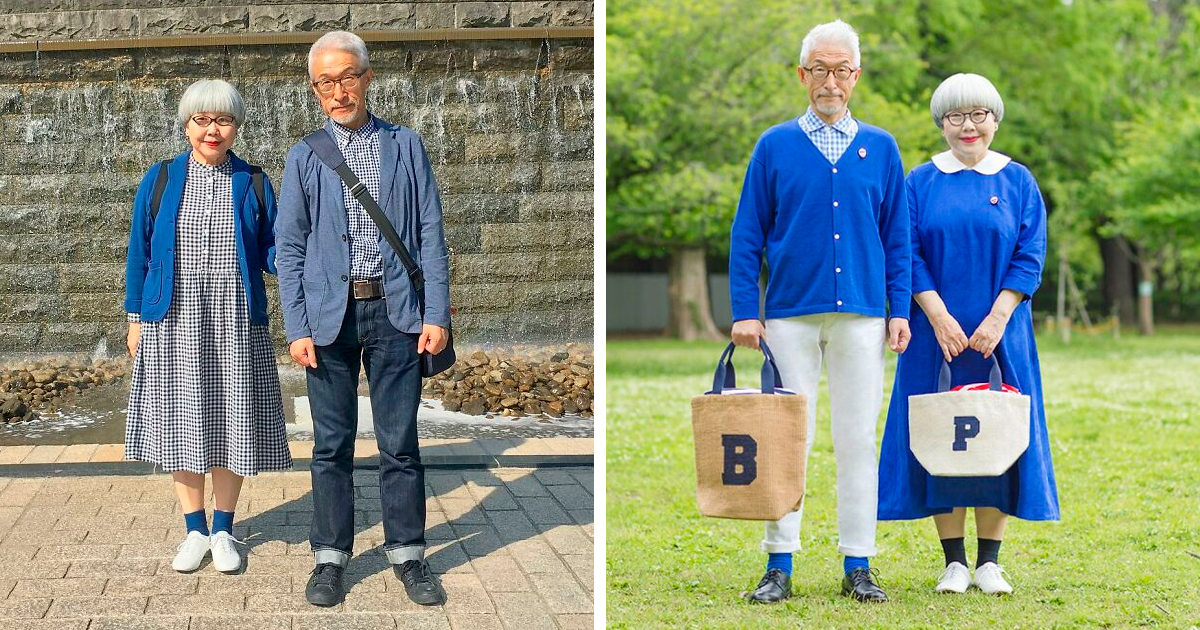
Some couples buy matching mugs. Some buy matching luggage. And then there is Bon and Pon, the older Japanese couple who looked at the entire concept of coordinated dressing and basically said, “Why stop at accessories when we could become a walking color palette?” The result is one of the internet’s most charming style stories: a long-married pair who wear matching outfits every day, not in a cheesy costume-party way, but in a crisp, witty, artful way that makes people smile before they even realize why.
The beauty of their story is that it is not really about clothes. Sure, the outfits are excellent. But the real magic is what those outfits communicate: affection, playfulness, timing, trust, and a shared point of view developed over decades. In a digital world that often treats style as expensive, exclusive, and just a little exhausting, this couple offers a refreshing counterargument. Fashion can still be joyful. It can still be personal. It can still be funny. And apparently, it can still make half the internet whisper, “Okay, fine, couple goals.”
Meet the Couple Behind the Matching-Outfit Phenomenon
The pair most readers know as Bon and Pon built a following by posting daily looks that are coordinated without feeling copy-and-pasted. Their outfits often echo each other through color, pattern, texture, or mood. Think navy meeting navy, plaid talking to plaid, or a splash of red showing up in both outfits like the universe hired a really organized stylist. Their famous handle, bonpon511, nods to their nicknames and wedding date, which only makes the whole story more adorable and slightly unfair to the rest of humanity.
What makes their rise so memorable is how ordinary it began. Their daughter reportedly encouraged them to share their looks online, and what started as a charming family idea turned into a global fascination. People were drawn to the fact that these were not celebrities in a couture showroom. They were a real married couple with gray hair, warm expressions, and a talent for making simple clothes look like a love language.
That detail matters. Their appeal is not based on glamour in the traditional sense. It is based on recognition. Viewers see them and instantly understand the joke, the warmth, and the discipline. Matching every day sounds simple until you realize it requires communication, attention, flexibility, and probably at least one person saying, “No, not that scarf, the other scarf.”
Why the Internet Fell So Hard for Their Style
1. Their outfits feel coordinated, not creepy
There is a fine line between “stylishly synchronized” and “we were assigned the same uniform by a mildly controlling space agency.” Bon and Pon stay on the right side of that line. They are not usually wearing the exact same thing. Instead, they dress in dialogue with each other. One outfit answers the other. One print picks up where another leaves off. It is harmony, not duplication.
That distinction is important in modern couple style. Fashion editors have been saying for years that the best coordinated dressing does not erase individuality. It highlights it. Bon and Pon understand this instinctively. Their clothes say, “We belong together,” not, “We were shrink-wrapped as a set.”
2. They make aging look vivid
One reason this older Japanese couple became so beloved is that they quietly reject the idea that aging should be visually muted. Their wardrobe is not an apology. It is not a retreat into invisibility. It is expressive, playful, and at times surprisingly bold. That lands with force in a culture that too often talks about style as though it expires around the same time as a store coupon.
Instead, Bon and Pon make a stronger point: personal style does not disappear with age. If anything, it can become clearer. By the time you have lived long enough to know what you like, what fits, what flatters, and what makes you laugh, getting dressed can stop being performative and start being honest.
3. Their fashion feels attainable
Another reason their story works so well is that their outfits do not look impossibly remote. The shapes are wearable. The combinations are smart. The colors are bold without being chaotic. The overall effect is polished but not precious. You do not need a red carpet, a stylist, or a trust fund to understand why it works. You just need eyes and maybe a partner willing to cooperate.
That accessibility makes their matching outfits more than just visual candy. They become inspiration. Suddenly, coordinated dressing is not just for celebrity couples photographed outside luxury hotels. It becomes something a married pair could try for brunch, a museum visit, an anniversary trip, or a grocery run that accidentally turns cinematic.
The Secret Formula Behind Their Matching Outfits
Color first, sameness second
Bon and Pon often build a look around shared colors rather than identical garments. That is the trick many stylish couples use, and it is also why their outfits feel modern. Navy with navy. Red accents in both outfits. Beige and black repeated across both silhouettes. This gives the eye a clean visual connection without making the pair look like they lost a bet.
Color coordination is also emotionally effective. It signals intention. Even when viewers cannot explain exactly why the outfits look satisfying, they can feel that visual rhythm. It is a little like good interior design, except the furniture is in love.
Pattern with restraint
Plaid, stripes, checks, and graphic prints show up often in their photos, but usually with enough balance to keep the looks coherent. If one person is going louder, the other often stabilizes the outfit. If both are wearing patterns, there is usually a shared tone or shape holding the whole thing together. This is not accidental. It is style math, but the friendly kind.
The lesson here is useful for any couple trying coordinated dressing: match the energy, not necessarily the exact item. If one partner wears a loud check, the other can echo the color or the mood. Think duet, not photocopy.
Consistency is the magic ingredient
Anyone can coordinate once for a holiday card. Bon and Pon do it daily. That routine is what transforms a cute gimmick into a real aesthetic identity. Over time, the repetition turns their wardrobe into a story. It says this is not a stunt. This is how they move through the world together.
And that consistency is strangely moving. Matching outfits every day becomes a ritual. Ritual becomes language. Language becomes intimacy. By the time you get to that point, a cardigan is no longer just a cardigan. It is practically a wedding vow with buttons.
What Their Story Says About Marriage
Long marriages are often described in giant, dramatic terms: commitment, sacrifice, endurance, loyalty. Bon and Pon suggest another ingredient that deserves more credit: shared delight. Their outfits look like the product of two people who still enjoy each other’s company enough to make getting dressed feel collaborative instead of routine.
There is humor in their style, and humor matters in lasting relationships. Anyone who has spent years with the same person knows that romance is not sustained on candlelight alone. Sometimes it is sustained by inside jokes, snacks, patience, and a mutual willingness to wear red together because it would be funny near a blue wall.
Their wardrobe also reflects mutual respect. Coordinated dressing only works when both people are fully in on the idea. That makes every outfit a tiny negotiation and a tiny act of agreement. It is domestic teamwork with better shoes.
What Their Style Teaches the Rest of Us
Style works better when it is shared
Even people who would never wear matching outfits can appreciate what Bon and Pon model: style as connection. Clothes are one of the easiest ways to communicate mood, intention, and identity without saying a word. When two people coordinate thoughtfully, they signal unity while leaving room for personality.
Fashion does not need to be expensive to be memorable
The internet often tries to convince people that style is purchased in giant chunks. Bon and Pon remind us that style is usually built through editing, repetition, confidence, and point of view. A great look is often less about price than about proportion, palette, and consistency. In other words, less “spend wildly” and more “own a mirror and a plan.”
There is no expiration date on self-expression
Perhaps the biggest lesson is the simplest: getting older does not mean becoming visually anonymous. It can mean becoming more distinct. More relaxed. More certain. More playful. Bon and Pon are compelling because they are not trying to look young. They are trying to look like themselves, together, and that is far more stylish.
Why This Older Japanese Couple Matter Beyond Fashion
The reason this story keeps resurfacing is not that people are desperate for more outfit content. It is that the couple represents something rare online: tenderness without sentimentality. Their photos are polished but not fake. Sweet but not sticky. Aspirational but still human. In a feed full of noise, they offer something surprisingly calming: two people who know who they are and have found a daily way to enjoy it together.
That is why readers return to them. Not just for the coats, scarves, stripes, and checks. Not even for the color stories. They return because Bon and Pon make companionship look creative. They make routine look intentional. They make aging look lively. And they prove that matching outfits every day is not the secret to a happy marriage, but it does not exactly hurt when both of you know how to absolutely nail a navy-and-red moment.
Experiences Related to the Topic: Why Matching Outfits Feel Bigger Than Clothes
Anyone who has ever tried to coordinate with a spouse, partner, or even a very opinionated sibling knows this sounds easier than it is. In real life, shared style usually begins in chaos. One person is ready. The other is still deciding between two jackets. Somebody changes shoes at the last minute. Somebody says, “Wait, are we both wearing stripes?” in the same tone usually reserved for discovering a tiny kitchen fire. And yet, when it works, it changes the entire mood of the day.
That is part of what makes the Bon and Pon story so relatable. Coordinated dressing creates an experience before the outing even begins. It turns getting ready into an event. A coffee run feels more intentional. A walk through a park feels slightly cinematic. A quick snapshot outside the house suddenly looks like it belongs in a lifestyle magazine instead of a family group chat where an uncle responds with a thumbs-up emoji and nothing else.
For many couples, matching does not start as a bold fashion statement. It starts by accident. Maybe both people show up in denim and black. Maybe they both reach for beige on a rainy day. Maybe one partner notices the other is wearing green and changes into a sweater that quietly echoes it. That tiny act of visual teamwork can be surprisingly fun. It says, “We noticed each other.” That is the emotional engine behind coordinated style.
There is also a practical side to the experience. Couples who develop a shared rhythm around clothes often say it simplifies decision-making. Once you know the household palette, the wardrobe gets easier to manage. Neutrals mix better. Accent colors become intentional. Shopping becomes less random. You stop buying things that look exciting in the store but behave like uncooperative theater props at home.
Matching outfits also become memory markers. People remember the rust-and-cream look from the weekend trip, the blue-and-white combination from the museum day, the plaid moment from the holiday market, the all-black ensemble from the anniversary dinner when the restaurant lighting was so dim even the bread looked mysterious. Clothes help organize memory. Shared clothes help organize shared memory.
And then there is the confidence factor. Coordinated dressing can make a couple feel more put together, even when the day itself is messy. You can be late, slightly hungry, and mildly confused about parking, but if both of you are visually in sync, the outside world assumes you are thriving. That is not deception. That is presentation. Fashion has always offered that little miracle.
The deeper experience, though, is emotional. Matching outfits work best when they reflect affection rather than performance. They do not need to scream. They just need to connect. A shared scarf color, similar outerwear, or repeated patterns can create that effect. It becomes a small ritual of paying attention. And over time, those rituals matter. They are the little things that make a life feel shaped, lived, and loved.
That is why stories like this resonate so strongly. People are not just admiring an older Japanese couple in matching outfits every day. They are responding to what the outfits represent: continuity, humor, partnership, and the idea that love can still be visible in ordinary moments. Not loud. Not dramatic. Just visible. Sometimes in plaid. Sometimes in navy. Sometimes in a perfectly timed pop of red.
Conclusion
Bon and Pon are more than a viral fashion curiosity. They are proof that style can be collaborative, aging can be expressive, and daily rituals can become art when they are done with care. Their matching outfits do not merely look good in photos. They tell a story about companionship, creativity, and the subtle power of showing up in sync. In a world where people are constantly told to stand out alone, this older Japanese couple offers a different fantasy: maybe looking great together is its own kind of brilliance.