

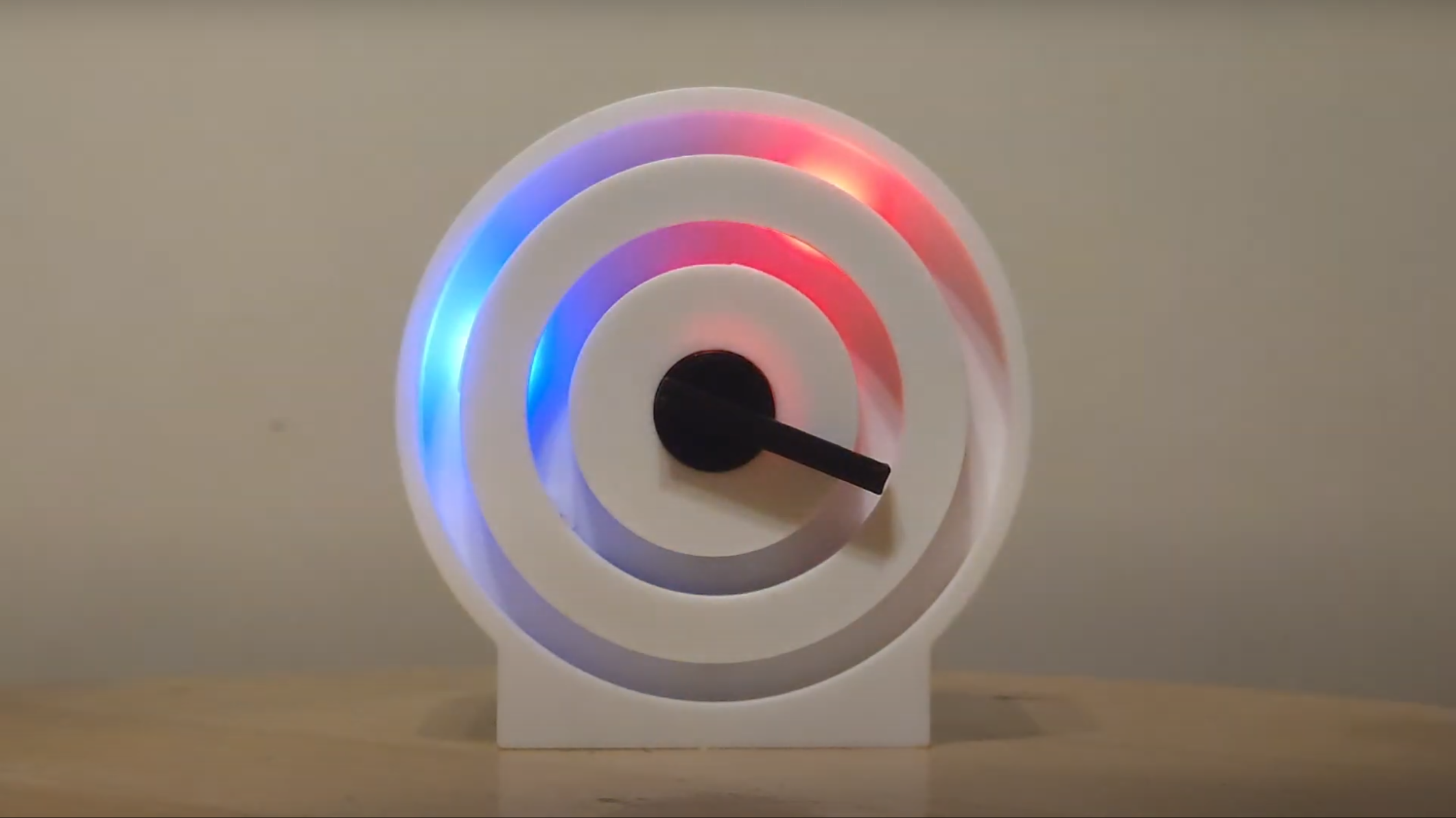
Most clocks do one job: they tell you what time it is, and then they sit there looking smug about it. A concentric clock with multiple modes takes that basic mission and gives it a serious upgrade. Instead of relying on a single face, a single display style, or a one-size-fits-all layout, it uses nested rings, layered information, and switchable views to present time in a way that feels smarter, cleaner, and surprisingly satisfying.
Think of it as a clock for people who want more than a lonely pair of hands sweeping around a dial. A concentric design can show hours, minutes, seconds, date, time zone, timer status, alarm windows, or even focus sessions using separate circular layers. Meanwhile, multiple modes let the same device shift between standard clock mode, world clock mode, countdown mode, alarm mode, night mode, or productivity mode without becoming a chaotic mess. That balance is the magic trick: more information, less visual drama.
There is a practical reason this idea works so well. Timekeeping in the modern world is not simple. Official U.S. time is tied to highly accurate atomic standards, civil time is based on UTC, and local time must account for time zones and daylight saving rules. That means a modern clock is no longer just a pretty face with a battery. It is often part design object, part information interface, and part tiny time-management assistant. A concentric clock with multiple modes embraces that reality instead of pretending your life still runs on one bell and a grandfather clock in the hallway.
What Is a Concentric Clock, Exactly?
A concentric clock is built around rings that share the same center point. Rather than placing all information on one dial, it organizes data into circles that expand outward or inward. One ring might handle hours, another minutes, another seconds, and another date or mode indicators. In more advanced versions, one layer can also highlight world time, UTC offset, alarm status, or session progress.
This layout is clever because circular information naturally suggests cycles. Hours repeat. Minutes repeat. Days repeat. Timers count down in loops. A ring-based display feels intuitive because it mirrors the rhythm of time itself. You do not need to read a manual the size of a toaster oven to understand what the clock is trying to tell you.
That is also why concentric clocks can feel both futuristic and oddly familiar. They borrow the emotional comfort of traditional clock faces while adding the logic of modern interfaces. In one glance, they can feel decorative enough for a living room and functional enough for a workspace.
Why Multiple Modes Make the Design Better
A beautiful clock is nice. A useful clock is better. A beautiful clock that adapts to what you are doing is where things get interesting.
Standard Time Mode
This is the everyday setting. The clock presents the current local time in the clearest possible way. A well-designed concentric clock keeps the primary time ring dominant, while secondary details stay visible without shouting for attention like an over-caffeinated intern.
World Time Mode
For remote workers, travelers, traders, and anyone whose family group chat spans continents, world time mode is a gift. A concentric layout can devote one ring to local time and another to UTC or a second city. That makes it easier to compare zones visually instead of doing mental math and accidentally calling someone at 3:12 a.m. Not a relationship builder.
Timer and Countdown Mode
This is where the ring format really shines. A countdown shown as a shrinking or progressing circle is instantly readable. You do not have to process numbers first. You can feel the time disappearing, which is both motivating and slightly rude.
Alarm and Schedule Mode
Instead of burying alarms in tiny menus, a multi-mode concentric clock can display them as arcs or segments around the main dial. That means upcoming events become visual landmarks rather than hidden settings. One quick look tells you whether your morning is calm, packed, or about to turn into an Olympic sprint.
Night or Minimal Mode
Not every moment needs maximum information density. A good multi-mode clock knows when to quiet down. Minimal mode can dim secondary rings, simplify motion, reduce brightness, and show only the essential time display. In a bedroom, studio, or low-light office, that restraint matters just as much as the clock’s smart features.
Why the Concentric Layout Works So Well
Part of the answer is history. Clocks have always shaped how people think about time, and over the last few centuries they have moved from purely functional instruments into cultural objects and design statements. But the more modern answer is interface design. People scan information fast. They respond to hierarchy, grouping, and pattern recognition. A concentric clock succeeds because it can separate information into layers without scattering it across the screen.
That matters. If every time feature is presented at once with equal weight, the display becomes cluttered. If the layout establishes clear hierarchy, the eye naturally lands on the most important ring first and then moves outward to supporting information. The result feels organized instead of crowded.
This is also why a concentric display often outperforms a plain digital block of numbers. A standard digital clock tells you the time, but it does not always communicate context. A ring-based clock can show progress, duration, relationship, and status. It answers more than one question at once: What time is it? How much time is left? What mode am I in? What comes next?
The Technology Behind a Smart Multi-Mode Clock
Under the hood, a truly capable clock usually depends on more than one time source. That is not overkill. That is realism.
RTC: The Reliable Everyday Backbone
A real-time clock, or RTC, is the part that keeps time running when the main system sleeps or loses internet access. It is the quiet hero of local timekeeping. For a concentric clock, an RTC provides continuity. Your hours, minutes, alarms, and schedules do not vanish every time the power flickers or the Wi-Fi decides to take an emotional break.
NTP: Internet-Synced Accuracy
Network Time Protocol, better known as NTP, lets a connected clock sync with highly accurate time sources over the internet. That is one reason many modern DIY and commercial clocks stay remarkably precise. For a multi-mode design, this matters because every ring depends on correct base time. If the source is wrong, the whole visual symphony turns into a polite disaster.
GPS and Radio Time Signals
Some clocks go a step further and synchronize with GPS or radio time signals. GPS-based timekeeping is especially useful when you want a clock that can self-correct with minimal user input. Radio-controlled designs can also automatically set themselves based on transmitted time codes. In plain English: fewer settings, fewer mistakes, and fewer household debates that begin with, “Well, my phone says…”
Time Zones and DST Rules
Any clock that promises multiple modes has to respect the messiness of real-world time. Time zones, daylight saving changes, and local rules complicate everything. A good concentric clock should not just display time; it should manage time correctly. That means handling UTC as a stable reference, then translating that into local time with current zone and daylight saving adjustments. It is not glamorous, but neither is being one hour late to a meeting because your “smart” clock was feeling creative.
Design Principles That Make the Clock Feel Premium
The best concentric clocks do not just stack rings and hope for the best. They use thoughtful design choices that improve readability and comfort.
1. Clear Information Hierarchy
The main time display should dominate. Secondary information like date, timer progress, or a second time zone should support the core message, not wrestle it to the ground. When the user has to think too hard, the design has already lost.
2. Strong Visual Grouping
Each ring should have a purpose. Hours belong in one layer, minutes in another, alerts in another. When categories are grouped cleanly, the user learns the interface faster and trusts it more.
3. Motion With Restraint
Animation can make a concentric clock feel alive, but too much movement turns it into a slot machine for punctual people. Smooth progress, subtle transitions, and predictable behavior are better than flashy motion that steals attention from the actual time.
4. Good Contrast and Legibility
A gorgeous clock that becomes unreadable from six feet away is not a premium object. It is wall art with ambitions. Great designs balance aesthetics with readability in daylight, at night, and at quick-glance angles.
5. Mode Switching That Feels Natural
Multiple modes should feel like useful variations, not secret levels in a video game. The user should be able to move from standard time to timer or world clock mode without a learning curve worthy of pilot school.
Where a Concentric Clock Fits Best
This type of clock is especially appealing in places where time is more than a number on a wall.
Home office: It can show local time, UTC, a timer for focused work, and your next reminder without opening another app.
Creative studio: The layered display adds personality while still serving a practical role during projects, deadlines, and recording sessions.
Kitchen: Timer mode becomes more intuitive when progress is visible as a ring instead of a tiny countdown buried in small text.
Shared workspace: World clock and quiet night mode are useful when teams span multiple time zones.
Bedroom: A restrained minimal mode can keep the design elegant without blasting unnecessary information into your eyeballs at 2 a.m.
Why This Clock Appeals to Modern Users
People want products that are both useful and intentional. A concentric clock with multiple modes checks both boxes. It acknowledges that modern life involves remote work, flexible schedules, digital coordination, and constant context-switching. At the same time, it delivers that information in a format that feels calm instead of frantic.
That last point matters more than it sounds. Many digital tools overload users with alerts, menus, and data. A good clock should do the opposite. It should reduce friction. It should help people orient themselves quickly. It should create confidence, not clutter. A concentric design has a real advantage here because it can present complexity in an orderly, glanceable format.
In other words, this is not just a clock for design lovers. It is a clock for anyone tired of ugly interfaces pretending to be smart. It gives structure to time while still looking like it belongs in the real world.
Final Thoughts
A concentric clock with multiple modes is more than a quirky timepiece concept. It is a smart response to how people actually live now. It combines the circular logic of traditional timekeeping with the flexibility of digital interfaces. It can show the present moment, the next event, the other time zone, the countdown in progress, and the calm version of itself when the room goes dark.
The best part is that this design does not have to choose between function and style. It can do both. It can be decorative, practical, modern, and intuitive all at once. That is a rare trick in product design. Usually, one side wins and the other gets politely escorted out of the building.
If you are designing, buying, or writing about clocks, this is one of the most compelling formats to watch. The concentric multi-mode clock turns time from a flat readout into a layered experience. And honestly, time was always dramatic enough to deserve a better stage.
Experience: Living With a Concentric Clock With Multiple Modes
Living with a concentric clock with multiple modes feels different from living with an ordinary clock in ways that are hard to appreciate until one is actually in the room. At first, it seems like a design upgrade. You notice the rings, the structure, the way the display feels deliberate instead of generic. Then, after a few days, you realize the bigger shift is behavioral. You stop checking time the same way.
With a regular digital clock, you read a number and move on. With a concentric clock, you absorb context. You see where you are in the hour, how close you are to the next meeting, whether a timer is halfway done, and whether another time zone is entering work hours or heading to bed. It turns out that context is the difference between knowing the time and understanding it. That sounds philosophical, but it is really just practical life wearing nicer shoes.
In a work setting, the clock becomes unexpectedly helpful. During focused tasks, timer mode can make a session feel more tangible because you can watch a ring shrink or fill. That visual progress changes your relationship with deadlines. Ten minutes left does not feel like an abstract number. It feels visible. It feels real. Sometimes it feels a little judgmental, but in a productive way.
In the evening, the experience changes again. Minimal mode softens the display and removes the noise. The clock stops acting like a dashboard and starts behaving like part of the room. That shift matters because a good object should adapt to your pace. Not every moment needs maximum information density. Sometimes you just want a quiet confirmation that it is late enough to stop answering emails and early enough to pretend you will go to bed on time.
There is also something satisfying about the physical calm of a concentric display. The rings make the information feel organized, even when the day itself is not. On hectic mornings, that subtle order can be oddly reassuring. The clock is not solving your schedule, but it is presenting time in a way that feels less chaotic. That alone gives it more emotional value than a plain rectangle of glowing digits.
After a while, the multi-mode design stops feeling like a feature list and starts feeling like good manners. World time mode respects remote relationships. Timer mode respects focus. Night mode respects sleep. Alarm visualization respects the fact that people are less likely to miss information they can see as part of the whole display. The experience is not flashy for the sake of being flashy. It is thoughtful.
That is probably the strongest argument for this kind of clock. It earns its place. It is not just decoration, and it is not just utility. It sits right in the sweet spot between the two, which is where the best home and office objects tend to live. A concentric clock with multiple modes does not merely tell time. It improves how time feels in the space around you.