

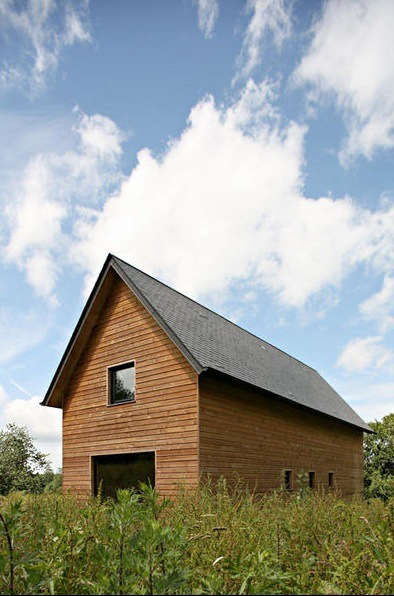
Some houses enter a landscape like they are wearing tap shoes. Others arrive quietly, sit down at the edge of a field, and somehow make the whole place look more poetic. Lode Architecture’s small Normandy retreat near Honfleur belongs to the second group. It is modest, sharply considered, and charming in that very French way that says, “Yes, I am simple,” while secretly being more carefully tailored than a Parisian coat.
The project often discussed under the title Architect Visit: Lode Architecture in Normandy is a compact weekend house designed by Jérôme Vinçon of Lode Architecture. At first glance, it nods to the familiar rural cottages of Normandy: a pitched roof, timber presence, and a shape that feels comfortable among fields, orchards, old barns, and gray northern skies. But this is not a nostalgic replica. It is more like a contemporary cousin of the Norman barn: quieter, cleaner, leaner, and far less interested in collecting decorative clutter.
That is what makes the house so appealing for readers of Gardenista-style design stories. It is architecture that understands the garden is not a backdrop. The garden is the room around the room. The house does not try to defeat the landscape; it listens to it, borrows from it, and then adds just enough modern confidence to keep things interesting.
Why This Normandy House Still Feels Fresh
Normandy has a long architectural memory. The region is famous for half-timbered houses, steep roofs, slate, thatch, limewashed walls, and villages that look as if they were assembled by someone with excellent taste and a relaxed attitude toward straight lines. In historic towns such as Honfleur, Rouen, and Pont-Audemer, traditional timber-framed buildings give the region a deeply recognizable character.
Lode Architecture’s Normandy retreat does not copy those details literally. Instead, it extracts the useful lessons: build simply, respect scale, use honest materials, and let the roofline do some of the talking. The result is a house that feels local without becoming a costume. That distinction matters. A modern country house can quickly become either too precious or too aggressive. This one walks the middle path with muddy boots and excellent posture.
The structure has been described as a “deluxe shed,” which may be one of the most accurate and delightful labels in modern residential architecture. A shed is practical. A deluxe shed is practical but knows where the good coffee is kept. It suggests a building made for weekends, garden meals, reading, weather-watching, and walking back inside with grass on your shoes.
Lode Architecture: Small Buildings, Big Discipline
Lode Architecture was founded in Paris in 2002 by Arnaud Lacoste and Jérôme Vinçon, with a body of work that includes custom houses, renovations, offices, interiors, and timber-focused residential projects. The studio’s projects often show a strong interest in compact volume, site-specific design, and the relationship between structure and landscape.
That attitude is visible in the Normandy house. Instead of making the house bigger to feel more impressive, the design makes restraint feel luxurious. The footprint is modest. The form is direct. The materials do not shout. Every decision seems to ask: What does this place actually need?
That question is more radical than it sounds. Many weekend houses are designed as miniature resorts, which means they quickly acquire too many things: too many rooms, too much glass, too many gestures, and occasionally a bathtub with a view that makes guests wonder where they are supposed to put their towel. Lode’s approach is calmer. It treats the retreat as a tool for living lightly, not as a trophy to be displayed to the nearest sheep.
The Power of the Simple Pitched Roof
A pitched roof may seem ordinary, but in Normandy it carries cultural weight. It recalls barns, cottages, farmhouses, and weather-tested rural shelters. In this Lode Architecture project, the pitched roof gives the building an instantly legible silhouette. You understand it before you study it. That is part of its strength.
Yet the house avoids looking old-fashioned. The roof and wall surfaces are handled with contemporary precision. The familiar outline is stripped of unnecessary decoration, allowing proportion, texture, and shadow to do the work. The building becomes both recognizable and new, which is the sweet spot for rural modern architecture.
A Modern Cabin Without the Cabin Clichés
Many modern cabins now come with a predictable checklist: black exterior, huge window, wood stove, dramatic photograph of fog, and possibly a chair that looks comfortable only to architects. This Normandy retreat has a quieter personality. It is not trying to become a viral cabin mood board. It is rooted in the logic of its site.
The house’s timber frame and cladding connect it to agricultural buildings, while the clean interior organization supports the easy rhythm of weekend life. It is a place for arrival, unwinding, cooking, sleeping, stepping outside, coming back in, and doing almost nothing with great seriousness.
Materials That Belong to the Landscape
One of the project’s strongest lessons is its use of natural and regionally appropriate materials. Normandy’s traditional buildings often relied on resources close at hand: oak, clay, limestone, brick, reeds, straw, flint, and slate. The Lode house continues that conversation through timber construction and a roof language that feels at ease in the northern French countryside.
Wood is especially important here. It gives warmth to a compact building and helps soften the sharpness of a modern form. Used well, timber makes a house feel less like an object placed on land and more like something grown into the site. Of course, timber also needs careful detailing, weather protection, and maintenance. Rustic charm is wonderful, but rot is not a design feature, no matter how poetic the brochure sounds.
The best small rural houses use materials in a way that allows them to age gracefully. Normandy’s weather is not shy. Rain, mist, wind, and salt air near the coast can test a building over time. A good design must look beautiful on day one and still make sense after years of weathering. Lode Architecture’s restrained palette supports that long-term view.
How the Garden Shapes the House
For Gardenista readers, the most interesting part of this project may be the house’s relationship to the outdoors. The building is not merely surrounded by landscape; it is organized by it. A weekend retreat in Normandy is not about sealing oneself away from nature. It is about adjusting to nature’s tempo: wet grass in the morning, low light in the afternoon, sudden weather, birdsong, and the very real possibility that your shoes will become part of the mud community.
The garden around a house like this should not be overdesigned. A formal garden with too many clipped shapes might feel stiff beside such a modest structure. Instead, the best approach is one that echoes the architecture: simple, edited, and textural. Think meadow grasses, native hedges, fruit trees, gravel paths, herbs near the kitchen, and planting that moves with the wind.
Planting Ideas Inspired by Normandy
A Normandy-inspired garden can combine utility and softness. Apple trees are a natural reference, since the region is known for orchards and cider culture. Hydrangeas thrive in many cool, moist climates and bring the generous floral presence often associated with northern French gardens. Lavender, rosemary, thyme, and sage can work near sunny entries or terraces, especially in well-drained soil. Ferns, foxgloves, and shade-loving perennials can soften edges where the house meets damp ground or tree cover.
The goal is not to recreate Normandy like a theme park. The goal is to borrow the mood: relaxed, weather-aware, layered, and practical. A good garden should look beautiful even when nobody remembered to fluff it for the camera.
Interior Lessons: Small Space, Clear Purpose
The interior of a weekend house must work harder than its square footage suggests. It needs to support cooking, lounging, sleeping, storage, and the emotional ceremony of escape. In a compact retreat, clutter becomes architecture’s annoying roommate. The solution is not more space, but better decisions.
Lode Architecture’s work often favors custom solutions, and that mindset is essential in small houses. Built-in storage, efficient circulation, flexible rooms, and careful furniture choices can make a modest house feel generous. The best small interiors avoid the temptation to miniature everything. A tiny sofa, tiny table, and tiny lamp can make a room feel like a dollhouse with Wi-Fi. Instead, a few well-scaled pieces create calm and confidence.
Natural wood interiors are especially effective in rural retreats because they bring warmth without visual noise. When paired with simple white walls, durable floors, and good daylight, timber can create an atmosphere that feels both minimal and welcoming. It is the difference between “empty” and “peaceful,” which is a very important difference when you are trying to relax and not feel like you accidentally booked a monk’s storage unit.
Why the House Works as a Weekend Retreat
A successful weekend house should change your behavior. It should make you cook slower, read longer, notice weather, and stop checking your phone every twelve seconds like it owes you money. Lode Architecture’s Normandy project encourages that shift through its scale and simplicity.
Because the house is not oversized, the outdoors becomes part of daily living. The terrace, garden, field, and sky become extensions of the interior. This is a powerful idea for modern homeowners. Luxury does not always mean adding more indoor rooms. Sometimes it means designing a smaller house that opens more intelligently to the land around it.
Compact Design as a Form of Luxury
There is a growing appreciation for compact, efficient houses that offer quality rather than quantity. The Normandy retreat fits neatly into that conversation. It does not need a grand staircase or a marble island the size of a regional airport. Its luxury is found in proportion, silence, material texture, and the feeling that every element has been considered.
This is especially relevant for homeowners planning guest houses, garden studios, cabins, or rural renovations. A small building can feel extraordinary when it has a strong relationship to light, view, and landscape. The trick is to edit until only the useful and beautiful remain.
Design Takeaways for Homeowners
You do not need a plot near Honfleur to learn from this project. The design principles can travel surprisingly well, even if your own “estate” is a backyard where the recycling bin currently enjoys the best view.
- Respect the local form: Use familiar shapes such as pitched roofs, simple volumes, and practical openings, but interpret them with restraint.
- Choose materials that age well: Timber, slate, lime, stone, brick, and gravel can develop character over time when properly detailed.
- Let the garden lead: Position windows, doors, terraces, and paths to make outdoor life part of the daily routine.
- Keep the footprint disciplined: A smaller house can feel more generous when storage, circulation, and furniture are thoughtfully planned.
- Avoid fake nostalgia: Referencing tradition is elegant. Pretending a new house is 300 years old is where things get suspicious.
Gardenista Appeal: Why Design Lovers Keep Returning to Projects Like This
Gardenista-style architecture stories are not just about buildings. They are about the complete atmosphere of living: the door, the path, the herb pot, the bench, the rain chain, the muddy boots, the linen curtain, the view from the kitchen sink. Lode Architecture’s Normandy house fits that world beautifully because it understands that architecture and garden design are not separate hobbies. They are one conversation.
The house feels edited, but not cold. Rural, but not sentimental. Modern, but not allergic to history. It makes a strong case for architecture that behaves politely in the landscape while still having a point of view. In other words, it has manners and a spine.
Experience Notes: Living With the Idea of a Normandy Retreat
To understand the emotional pull of a house like Lode Architecture’s Normandy retreat, imagine arriving late on a Friday afternoon. The road narrows. The sky is gray in the cinematic way that makes everything look more expensive. There are fields on either side, a few wind-tossed trees, and the quiet sense that the weekend has already begun without asking your permission.
The house does not overwhelm you. It does not announce itself with a gate, a fountain, or a driveway long enough to require emotional preparation. Instead, it appears as a compact, pitched-roof form that seems to know exactly why it is there. You park, step out, and immediately notice the shift in scale. The house is human-sized. The garden is close. The weather is part of the greeting committee.
Inside, the experience of a well-designed small retreat is less about decoration and more about relief. There is a place for your coat. There is a view toward the garden. There is enough room to cook but not enough room to host a banquet for people you only invited out of guilt. The architecture edits your plans for you. It says: make soup, open wine, read a book, go outside, come back in, repeat.
In the morning, the garden becomes the main room. Dew collects on grasses. Gravel makes that satisfying crunch that instantly improves one’s mood by at least 14 percent. The house frames small rituals: coffee near the door, herbs clipped for eggs, a walk along the edge of the property, the discovery that doing nothing outdoors feels much more respectable than doing nothing indoors.
What stands out most is the balance between shelter and exposure. A rural retreat should protect you from weather without cutting you off from it. You want to hear rain on the roof, see wind in the trees, and feel the temperature change when you open the door. Lode Architecture’s approach suggests that comfort does not require isolation. The best country houses are not sealed bubbles; they are instruments tuned to the site.
That lesson applies far beyond Normandy. A backyard studio in Oregon, a lakeside cabin in Michigan, a guest house in Vermont, or a small garden office in California can borrow the same attitude. Start with the land. Keep the form simple. Use materials honestly. Let the garden soften the edges. Build only what is needed, then make what is needed beautiful.
In a design culture often obsessed with spectacle, this kind of house feels almost rebellious. It reminds us that architecture does not have to perform acrobatics to be memorable. Sometimes the most powerful gesture is a modest roofline, a warm timber wall, a good window, and a garden allowed to breathe. Add coffee, a wool sweater, and a slightly muddy path, and frankly, you have most of civilization’s problems solved.
Conclusion: The Quiet Genius of Lode Architecture in Normandy
Architect Visit: Lode Architecture in Normandy – Gardenista is more than a tour of a pretty rural house. It is a study in restraint, proportion, and landscape intelligence. The project shows how a small weekend retreat can feel deeply rooted without becoming old-fashioned, modern without becoming cold, and practical without losing poetry.
For homeowners, designers, gardeners, and architecture lovers, the lesson is wonderfully clear: build with the site, not against it. Let tradition guide the outline, let modern life shape the interior, and let the garden do what gardens do bestmake everything feel alive. Lode Architecture’s Normandy retreat proves that the most memorable houses are not always the loudest. Sometimes they are the ones that know when to whisper.
Note: This article is written as original, publication-ready HTML content based on real architectural information, regional Normandy design context, and publicly available design coverage. Source links and citation artifacts have been intentionally omitted for clean web publishing.