

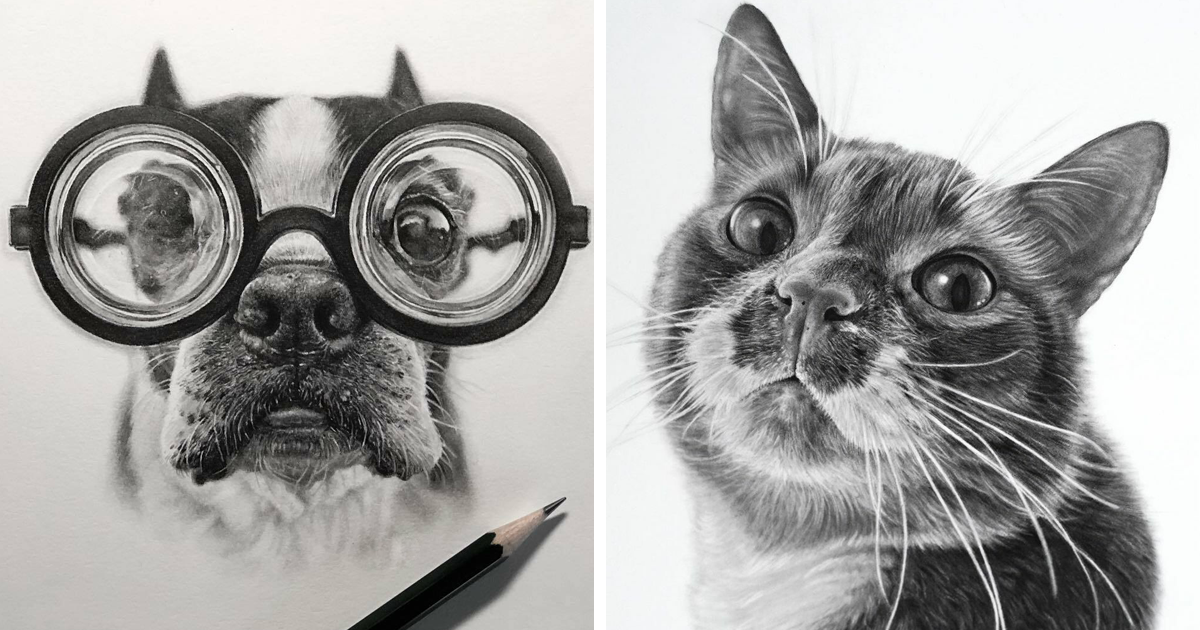
Some pet portraits are cute. Some are charming. And then there are the kind that make you lean toward the screen, squint suspiciously, and whisper, “Wait… that is not a photograph?” That is the magic behind realistic pencil pet portraits: they take the simplest tool most of us used to survive math class and turn it into something emotionally powerful enough to make a dog parent tear up before breakfast.
The artist behind these lifelike works, Helen Violet, has become known for hyperrealistic animal art that captures not only fur, whiskers, noses, and eyes, but the tiny personality details that make each pet feel like a complete character. Her pencil drawings have the clean drama of black-and-white photography, yet every shadow, highlight, and soft hair is created by hand. No camera shortcut. No “add realism” button. Just graphite, patience, and the kind of focus that makes the rest of us feel proud when we draw a decent circle.
This collection of 49 realistic pet portraits shows why pencil art still matters in an age of instant photos and AI-generated images. A hand-drawn portrait slows everything down. It studies the animal. It notices the lopsided ear, the wise old eyes, the silly little mouth, the “I definitely did not eat the couch cushion” expression. In other words, it captures the pet, not just the pose.
Why Realistic Pencil Pet Portraits Feel So Personal
A great pet portrait is not simply a drawing of an animal. It is a drawing of a relationship. That is why people respond so strongly to hyperrealistic pet art. A dog’s cloudy senior eyes, a cat’s regal stare, or a rabbit’s soft nose can carry years of memories. The portrait becomes a visual time capsuleless dramatic than a museum masterpiece, perhaps, but much more likely to be stared at lovingly while someone says, “That was exactly his face when he wanted snacks.”
In Helen Violet’s work, realism is not cold or mechanical. The pencil detail is precise, but the emotional effect is warm. The best pieces do not merely prove that she can draw fur. They prove that she can make fur feel soft, eyes feel wet, and tiny expressions feel familiar. That is the difference between technical skill and artistic storytelling.
Pet owners know their animals in microscopic detail. They know which ear folds first, which eye looks more mischievous, and which angle makes the family cat look like a tiny landlord collecting rent. A successful custom pet portrait has to respect that knowledge. It needs accuracy, but it also needs personality. Helen’s portraits succeed because they balance both: the anatomy feels right, the textures are convincing, and the animals still look like beloved companions rather than biology textbook models with better lighting.
The Power of One Pencil: How Graphite Creates Realism
At first glance, “using only a pencil” sounds almost too simple. But graphite is a surprisingly flexible medium. With different pressure, layering, erasing, and blending, an artist can create everything from pale silver highlights to deep velvet shadows. In realistic pencil pet portraits, that range is essential. A shiny black dog, a fluffy white cat, and a striped tabby all require different value control.
Light, Shadow, and the Illusion of Fur
Fur is one of the hardest textures to draw convincingly. If every hair is drawn with the same pressure, the animal begins to look stiff, like it was assembled from pipe cleaners. Real fur has clumps, direction, softness, shine, and little chaotic surprises. The artist must decide where to draw individual hairs and where to suggest texture with tone. Too little detail, and the portrait looks flat. Too much detail, and the pet starts to resemble a furry topographic map.
The strongest portraits in this 49-work collection use contrast beautifully. Dark backgrounds make pale fur glow. Bright eye reflections give life to the face. Soft shading around the muzzle keeps the portrait from becoming harsh. Graphite may be gray, but in the hands of a skilled artist, it can feel rich, dramatic, and surprisingly colorful in mood.
The Eyes Are the Emotional Center
In realistic pet drawings, the eyes do most of the emotional heavy lifting. Viewers instinctively look there first. If the eyes are wrong, the whole portrait feels off, even if every whisker is placed perfectly. Helen Violet’s best pet portraits show careful attention to reflections, eyelids, moisture, and the subtle asymmetry that makes a living face feel alive.
This is especially important for memorial pet portraits. When someone commissions or admires a portrait of a pet that has passed away, the drawing often becomes more than decoration. It becomes a way to keep the animal present. The eyes need to feel familiar. Not generically “dog-like” or “cat-like,” but specifically that dog, that cat, that little companion who once claimed the couch as a constitutional right.
What Makes These 49 Works Stand Out?
The best works in this collection are not impressive only because they look realistic. Many artists can chase photographic accuracy. What makes these pet portraits memorable is how each one seems to honor a different personality. Some animals look calm and wise. Some look alert and playful. Some have the deeply suspicious expression of a pet who has heard the word “bath.”
Dogs With Big Personality
Dog portraits are especially expressive because dogs wear their feelings loudly. Their eyebrows, ears, noses, and mouths can shift an entire mood. In the strongest dog drawings, the pencil work captures the character of each breed and each individual pet. A fluffy dog requires airy, layered texture. A short-haired dog needs smooth shading and crisp highlights. A wrinkled breed demands careful folds and shadows without turning the face into a crumpled napkin.
The most charming dog portraits in the set feel ready to move. You can almost imagine the tail wagging just outside the frame. That sense of life comes from tiny details: a wet nose catching the light, a relaxed lower lip, a focused stare, or the soft transition between the muzzle and cheek. These are not random pencil marks. They are decisions, and good decisions are what separate hyperrealism from “I tried my best and now the dog looks like a potato.”
Cats That Look Like Royalty
Cats are a different artistic challenge. Dogs often invite emotional exaggeration, but cats demand dignity. Even the goofy ones. A realistic cat portrait has to capture sleek fur, reflective eyes, delicate whiskers, and that mysterious expression that says, “I know exactly what you did, and I will judge you after my nap.”
Helen’s cat portraits stand out because the faces are calm but never blank. The eyes hold depth, and the fur patterns are carefully controlled. Stripes, patches, and long hair can easily overwhelm a drawing, but in skilled pencil work they become part of the animal’s identity. A tabby’s markings guide the viewer around the face. A long-haired cat’s soft edges create elegance. A dark cat’s highlights reveal form without losing the richness of the coat.
Small Pets, Big Impact
Realistic pet portrait art is not only for dogs and cats. Small animals can be just as emotionally meaningfuland sometimes even more technically demanding. A rabbit’s fur, a guinea pig’s roundness, or a bird’s tiny features require close observation. Smaller pets often have subtler expressions, so the artist must rely on posture, texture, and delicate value changes to create personality.
When pencil portraits of small pets work well, they remind viewers that love does not depend on size. A hamster may not take up much space on the couch, but it can take up a surprisingly large space in someone’s heart. And possibly in the snack budget.
Hyperrealism Without Losing Heart
Hyperrealistic art can sometimes feel like a technical contest: who can draw the most pores, the sharpest reflection, the most microscopic strand of hair? That kind of skill is impressive, but pet portraiture needs more than technical fireworks. A pet portrait has to feel affectionate. It should not look like a scientific scan of a creature who accidentally wandered into an art studio.
Helen Violet’s work avoids that trap by keeping emotion at the center. Her portraits are detailed, but they do not feel sterile. The animals feel loved. This matters because viewers are not only asking, “How did she draw that?” They are also asking, “Why does this feel so familiar?”
The answer lies in observation. Realism is not simply copying a photo. It is understanding what to emphasize, what to soften, and what to leave quiet. A camera captures everything at once. An artist chooses what matters. In pet portraits, those choices shape the viewer’s emotional response.
Why Pencil Art Still Wins in a Digital World
We live in a time when images are everywhere. Phones can take sharp photos in seconds. Filters can turn pets into cartoons, astronauts, oil paintings, or tiny Renaissance nobles who look like they own land. So why do people still care about pencil drawings?
Because handmade art carries evidence of time. Every layer of shading says someone looked carefully. Every highlight lifted with an eraser says someone made a decision. Every strand of fur says, “Yes, this took patience, and no, the artist probably did not have a normal relationship with sleep during the final stretch.”
A pencil portrait also has a quiet elegance. Without color, the viewer focuses on shape, tone, expression, and texture. Black-and-white art removes distractions. It turns the pet into a study of light and personality. That is why a graphite portrait can feel timeless, even when the reference photo came from a phone full of blurry pictures titled “dog doing weird thing again.”
How Artists Turn Pet Photos Into Realistic Portraits
Most realistic pet portraits begin with a reference photo. That may sound simple, but the quality of the photo matters enormously. A blurry image taken from across the room while the dog is sprinting toward a sandwich will not give an artist much to work with. The best reference photos show clear eyes, natural lighting, and the pet’s face from an angle that reflects its personality.
Many artists use a light sketch or grid system to map proportions accurately before building values. This stage is crucial because a small mistake in spacing can change the entire expression. Move an eye slightly too high, and a sweet cat becomes mildly haunted. Shift the nose too far, and the dog suddenly looks like it is trying to remember where it parked.
After the outline is established, the artist slowly builds tone. Light layers come first. Dark areas are deepened gradually. Highlights may be preserved from the beginning or lifted later with precision erasers. The process can take many hours, especially when the portrait includes complex fur patterns or multiple pets.
Why These Portraits Connect With Viewers
People love realistic pet portraits because pets are part of daily life in a deeply personal way. They are there for morning routines, quiet evenings, chaotic snack negotiations, and emotional moments that do not need words. A handmade portrait recognizes that bond. It says the animal mattered enough to be studied carefully and remembered beautifully.
The 49 works in this collection succeed because they invite viewers to slow down. Instead of scrolling past yet another cute pet photo, you stop and look. You notice the pencil strokes. You notice the patience. You notice the animal’s expression. And then, because humans are predictable and pets are irresistible, you probably think about your own pet.
That is the secret power of this art. It is not only about admiration for the artist. It is about recognition. Every portrait becomes a doorway to someone’s memory: the dog who greeted them at the door, the cat who slept on the keyboard, the bunny who ruled the living room, the senior pet whose face became softer with age.
What Pet Owners Can Learn From These Works
For anyone considering a custom pencil pet portrait, this collection offers a useful lesson: choose a reference photo with emotion, not just clarity. A technically sharp photo is helpful, but the best portrait comes from an image that feels true. Maybe it is the head tilt. Maybe it is the sleepy eyes. Maybe it is the dramatic side stare after being denied a second dinner.
Pet owners should also think about composition. A close-up portrait can feel intimate and powerful. A full-body pose can show personality, markings, or posture. A dark background can create drama, while a clean white background keeps the focus gentle and simple. There is no single correct choice. The best choice is the one that reflects the pet’s spirit.
And yes, patience is part of the process. Hyperrealistic pencil portraits are not fast art. They are slow art. That is exactly why they feel valuable. A handmade portrait is not just a product; it is hours of attention transformed into something permanent.
Experience: Looking at Realistic Pencil Pet Portraits Like a Pet Owner
The first experience most people have with realistic pencil pet portraits is disbelief. You see the image, assume it is a photo, and then discover it was drawn by hand. The brain needs a moment to reboot. It is a little like finding out your quiet neighbor casually builds violins on the weekend. Impressive, unexpected, and suddenly you feel like you should develop a hobby beyond reorganizing phone apps.
But after the surprise wears off, a second reaction appears: emotion. Realistic pet portraits hit differently because they are not just about artistic accuracy. They remind us how closely we know our animals. A pet owner can recognize a familiar look instantly. The slightly raised brow. The soft tired eyes after a walk. The intense snack-focused stare that could probably move furniture if hunger provided legal authority.
When viewing Helen Violet’s pencil portraits, the most enjoyable experience is noticing how much personality can exist in a black-and-white drawing. Without color, everything depends on tone and expression. The shine on a nose, the direction of fur, and the shape of the eyes become the whole story. That simplicity makes the portraits feel calm and intimate. They do not shout for attention; they quietly earn it.
For someone who has ever tried to draw a pet, the admiration becomes even stronger. Animals are not easy subjects. They rarely sit still, they change expression constantly, and their fur has more directions than a confusing airport terminal. Even working from a photo, the artist has to translate texture into marks. Long fur needs softness. Short fur needs smooth control. White fur cannot simply be left blank, and black fur cannot become a shapeless shadow. Every coat requires its own strategy.
There is also a touching side to these portraits for people who have lost pets. A realistic drawing can become a memorial without feeling heavy or overly formal. It can show the pet as alert, gentle, funny, or peaceful. That matters because grief often attaches itself to small details: the ears, the eyes, the resting face, the silly expression that appeared right before trouble. A well-made portrait preserves those details in a way that feels personal and respectful.
The experience of seeing 49 works together also highlights variety. Not every pet is conventionally “majestic.” Some are goofy. Some look sleepy. Some look like they have strong opinions about the household schedule. That range makes the collection more lovable. It celebrates animals as individuals, not accessories. The best portraits are not trying to turn pets into perfect models. They are trying to show why each animal is unforgettable.
In the end, realistic pencil pet portraits are powerful because they combine patience, skill, and affection. They remind us that a pencil can do much more than sketch an outline. In the right hands, it can hold a memory, preserve a personality, and make thousands of viewers collectively say, “Please tell that good boy I love him.”
Conclusion
Helen Violet’s realistic pet portraits show how much can be achieved with one pencil and extraordinary attention to detail. The best 49 works are more than technical demonstrations; they are emotional studies of beloved animals. Each portrait captures texture, light, and likeness, but the real achievement is personality. These pets do not look like generic animals. They look known.
That is why hyperrealistic pencil pet portraits continue to fascinate viewers. They combine the precision of photography with the warmth of handmade art. They celebrate pets as family, companions, comedians, comforters, and occasional destroyers of slippers. Most importantly, they prove that even in a digital world, a simple pencil can still create something unforgettable.
Note: This article is written for web publication and synthesizes public information about realistic pencil pet portraits, graphite drawing techniques, hyperrealism, pet-owner culture, and the known work of Helen Violet. It is original, rewritten in a natural editorial style, and contains no copied captions or unnecessary source-code artifacts.