

Hip bursitis has a special talent for making ordinary activities feel strangely ambitious.r rolling over in bed can suddenly seem like events requiring a training montage. Fortunately, the right hip bursitis exercises can reduce irritation, rebuild strength, and help you return to normal movement without declaring war on your hip.
The condition commonly causes pain over the bony outside portion of the hip, known as the greater trochanter. However, what many people call trochanteric bursitis is often part of a broader condition called greater trochanteric pain syndrome, or GTPS. This may involve the nearby bursae, gluteal tendons, or both. That distinction matters because effective rehabilitation usually requires more than stretching the sore areait also requires gradually strengthening the muscles that stabilize the pelvis.
What Does Hip Bursitis Feel Like?
Hip bursitis typically causes tenderness or aching on the outside of the hip. The discomfort may spread down the outer thigh but usually does not travel below the knee. Symptoms often become more noticeable when you:
- Lie on the painful side
- Climb stairs or walk uphill
- Stand on one leg
- Rise from a low chair
- Walk or run longer than usual
- Cross your legs or “hang” your weight on one hip
Pain in the groin, numbness, significant weakness, or symptoms that travel from the lower back into the foot may point to another condition. Hip arthritis, lumbar nerve irritation, stress fractures, tendon tears, and other problems can imitate bursitis, which is why persistent or unusual pain deserves a proper examination.
Why Exercise Helps Hip Bursitis
Rest can calm a flare, but complete inactivity is rarely a satisfying long-term strategy. After all, your hip’s job description includes supporting your body every time you stand, walk, or negotiate a staircase while carrying groceries.
Appropriate exercises strengthen the gluteal muscles, improve pelvic control, and increase the hip’s ability to tolerate everyday loads. Research on gluteal tendinopathy found that education combined with a progressive exercise program produced better long-term improvement than simply waiting for the problem to resolve. It also produced better global improvement than a corticosteroid injection at the one-year follow-up. A 2024 systematic review likewise supported exercise as a first-line treatment for clinically diagnosed GTPS.
The secret is dosage. Exercise should challenge the muscles without repeatedly aggravating the sensitive tissue. Doing fifty heroic leg lifts on day one is not rehabilitation; it is an excellent way to make day two unpleasant.
Before You Begin: The Pain-Monitoring Rule
Use discomfort as feedback rather than treating it as an enemy to defeat. Mild muscular effort is expected, but sharp, pinching, burning, or steadily increasing outer-hip pain is a signal to stop or modify the movement.
Your symptoms should settle after the session and return close to their previous level by the following morning. If pain remains clearly worse the next day, reduce the number of repetitions, resistance, range of motion, or exercise frequency. Rehabilitation should progress gradually rather than operating under the motivational slogan, “No pain, no functioning hip.”
A physical therapist can adjust exercise selection based on your gait, hip strength, balance, spinal mobility, and daily activities. Individualized physical therapy is particularly useful when symptoms are persistent or when several conditions may be contributing to the pain.
Eight Hip Bursitis Exercises for Pain Relief
1. Seated Hip Abduction Isometric
This gentle exercise activates the side-buttock muscles without requiring you to lie on the painful hip.
- Sit upright in a sturdy chair with both feet flat on the floor.
- Place a resistance loop around your thighs, just above the knees.
- Keeping your feet planted, press your knees outward into the band.
- Hold for 10 to 30 seconds while breathing normally.
- Relax slowly.
Begin with three to five holds. Use light resistance and keep your pelvis level. You should feel the muscles at the sides of the hips working without a sharp pain over the bony area.
2. Glute Bridge
Bridges strengthen the gluteus maximus and supporting trunk muscles while keeping direct pressure off the outer hip.
- Lie on your back with your knees bent and feet hip-width apart.
- Gently tighten your abdominal muscles.
- Squeeze your buttocks and lift your hips until your shoulders, hips, and knees form a comfortable line.
- Pause for two or three seconds.
- Lower your hips slowly rather than dropping them like a trapdoor.
Perform one or two sets of 8 to 12 repetitions. Avoid arching your lower back. As the exercise becomes easier, add repetitions or place a light resistance band above your knees. Hip-conditioning programs commonly use bridges and other progressive strengthening movements to improve hip support and stability.
3. Standing Hip Abduction
This movement trains the muscles that help keep your pelvis level while walking.
- Stand beside a counter or sturdy chair for balance.
- Keep your torso upright and both feet pointing forward.
- Move the affected leg a short distance out to the side.
- Pause briefly, then return slowly.
Complete 8 to 12 repetitions. Do not lean your trunk in the opposite direction or swing the leg. A small, controlled movement is more useful than a dramatic one that resembles an unsuccessful attempt at interpretive dance.
4. Clamshell
The clamshell strengthens the hip’s external rotators and abductors.
- Lie on your comfortable side with the painful hip on top.
- Bend both knees slightly and keep your hips stacked.
- Keep your feet together as you lift the top knee.
- Stop before your pelvis rolls backward.
- Lower the knee slowly.
Try one or two sets of 8 to 12 repetitions. Place a pillow between your waist and the floor for support. If lying on either side irritates your symptoms, skip this exercise and use seated or standing hip abduction instead. Side-lying leg lifts and related gluteal exercises may be useful, but positioning should be adjusted to avoid compressing a sensitive hip.
5. Sit-to-Stand
This practical exercise strengthens the hips and thighs for a movement you perform throughout the day.
- Sit near the front of a firm chair.
- Place your feet about hip-width apart.
- Lean forward slightly from the hips.
- Press through both feet and stand.
- Push your hips back and lower yourself slowly to the chair.
Start with 5 to 10 repetitions. Use a taller chair or your hands for assistance when necessary. Keep your knees aligned over your feet rather than allowing them to collapse inward.
6. Supported Single-Leg Balance
Single-leg balance helps retrain the gluteal muscles for walking, stair climbing, and other weight-bearing activities.
- Stand beside a counter and hold it lightly.
- Shift your weight onto the affected leg.
- Lift the opposite foot an inch or two from the floor.
- Keep your pelvis level and your trunk upright.
- Hold for 10 to 20 seconds.
Repeat three times. Begin with both hands on the counter if needed. Stop if the exercise produces significant outer-hip pain or causes you to lean heavily over the supporting leg.
7. Resistance-Band Side Steps
This is a later-stage exercise for people who can perform basic movements without a meaningful flare.
- Place a light resistance loop above your knees.
- Bend your knees slightly and move your hips backward.
- Take five small steps to one side.
- Return in the opposite direction.
- Keep your toes facing forward and maintain tension in the band.
Complete one to three rounds. Progress by adding steps before using a stronger band. Controlled side-stepping is commonly used to strengthen the gluteal muscles and improve lower-limb alignment.
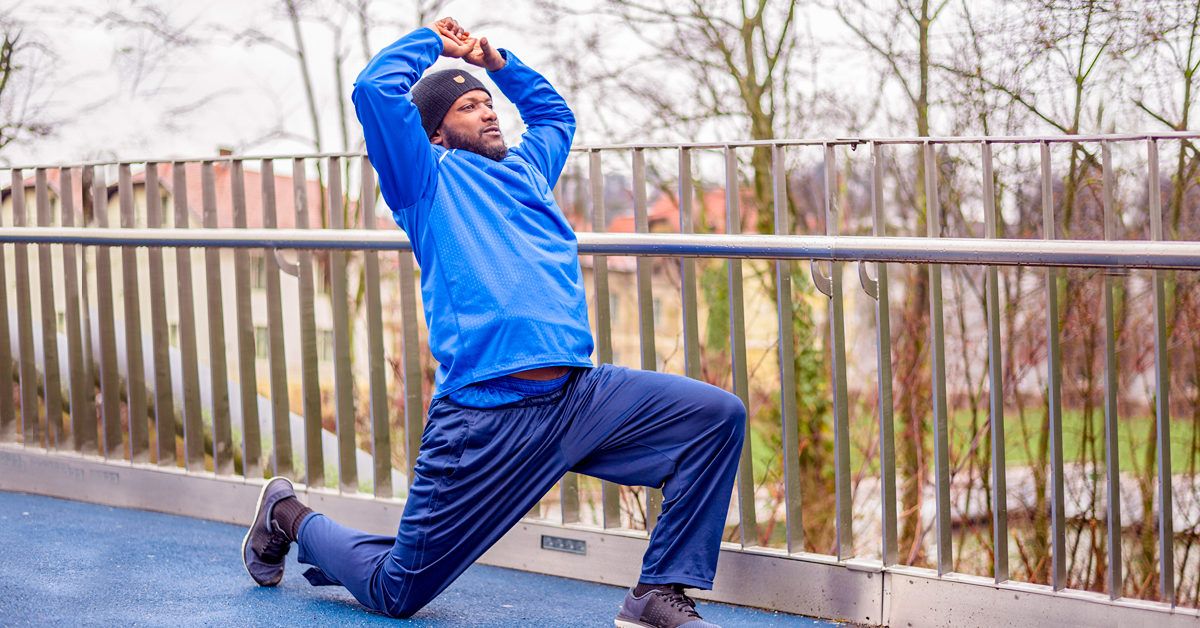
8. Gentle Hip-Flexor Stretch
A gentle hip-flexor stretch may reduce stiffness at the front of the hip without pulling aggressively across the painful outer tissues.
- Stand in a short staggered stance, holding a counter.
- Place the affected leg behind you.
- Gently tuck your pelvis as though bringing your belt buckle upward.
- Shift forward slightly until you feel a mild stretch at the front of the rear hip.
- Hold for 20 to 30 seconds.
Repeat two or three times. Keep the movement small and pain-free. Warm muscles generally tolerate mobility work better, so consider stretching after a few minutes of easy walking. Medical organizations commonly recommend gentle range-of-motion work and gradual strengthening rather than prolonged immobilization.
A Simple Weekly Exercise Plan
A beginner-friendly program might look like this:
- Daily: Seated hip abduction holds and gentle hip-flexor stretching
- Three days per week: Bridges, standing hip abduction, and sit-to-stand exercises
- After symptoms improve: Add supported balance and resistance-band side steps
- For cardiovascular exercise: Try short, level walks, swimming, or another activity that does not increase symptoms
Start with fewer repetitions than you believe you can perform. Add one variable at a timerepetitions, resistance, distance, or frequencyrather than increasing everything during the same week. MedlinePlus advises against raising exercise distance, intensity, and duration simultaneously and recommends lower-impact alternatives when running aggravates lateral hip pain.
Movements That May Aggravate Hip Bursitis
During an active flare, reduce positions that place prolonged pressure or compression over the outside of the hip. Common troublemakers include:
- Sleeping directly on the painful side
- Crossing one leg tightly over the other
- Standing with most of your weight hanging on one hip
- Long downhill walks or runs
- Suddenly increasing mileage or stair workouts
- Deep stretches that pull the painful leg far across the body
- Aggressive foam rolling directly over the greater trochanter
Older advice often emphasized forceful iliotibial-band stretching for every case of “hip bursitis.” Modern approaches are more selective because extreme hip adduction can increase compression over irritated gluteal tendons. Gentle mobility may help some people, but stretching should not reproduce familiar lateral hip pain.
At night, sleep on your back or on the comfortable side with a pillow between your knees. Cushioned, supportive shoes may also reduce aggravating loads during the day.
Other Ways to Relieve Hip Bursitis Pain
Exercise works best when paired with sensible activity modification. During a flare, temporarily reduce the activity that triggered the pain instead of abandoning movement altogether. Applying wrapped ice for short periods may help after aggravating activity. Never place ice directly against the skin.
Over-the-counter pain relievers may be appropriate for some adults, but they are not safe for everyone. Kidney disease, stomach ulcers, blood-thinning medication, cardiovascular conditions, pregnancy, and other factors can affect which products are suitable. Ask a healthcare professional or pharmacist before using medication regularly.
When symptoms do not improve with activity modification and rehabilitation, clinicians may consider supervised physical therapy, diagnostic imaging, or a corticosteroid injection. Surgery is rarely required for uncomplicated hip bursitis.
When Should You See a Healthcare Professional?
Schedule an evaluation when pain lasts more than a few weeks, repeatedly returns, or limits your ability to walk and sleep. Seek care sooner if you experience:
- Severe pain after a fall or collision
- Inability to bear weight
- Visible deformity or rapid swelling
- Fever, warmth, redness, or drainage near the hip
- Progressive weakness or numbness
- Unexplained weight loss or persistent nighttime pain
- Pain that begins after hip surgery or joint replacement
These symptoms may indicate an injury, infection, nerve problem, or another condition requiring more than a home exercise program.
What Hip Bursitis Recovery Often Feels Like: A Composite Experience
The following is a composite scenario based on common rehabilitation patterns. It is not one person’s medical history and should not be treated as a guaranteed timeline.
At first, the pain may seem oddly inconsistent. A person can walk around the grocery store with minimal discomfort, then wake up at 2 a.m. because they rolled onto the affected side. The natural reaction is often to stretch the hip repeatedly, massage the tender spot, and test it every fifteen minutes. Unfortunately, a sensitive lateral hip rarely appreciates being treated like a door hinge under inspection.
During the first week of a better-planned recovery, the biggest improvement may come from changing daily positions rather than performing impressive exercises. The person stops crossing their legs at the desk, avoids leaning onto one hip while cooking, and sleeps with a pillow between the knees. Long walks are divided into shorter outings. The pain is not gone, but it becomes less unpredictable.
Next come the deceptively simple strengthening exercises. Seated hip-abduction holds may not look athletic, yet the outer gluteal muscles begin working without the sore hip being pressed into the floor. Bridges and controlled sit-to-stands follow. During the first few sessions, the person wants to add a heavy resistance band because the exercises appear too easy. Resisting that urge turns out to be one of the smartest parts of the program.
By the second or third week, standing and walking may feel steadier. Stairs can still produce an ache, especially after a busy day, but the discomfort settles more quickly. The person begins to understand that recovery is not a perfectly straight line. One excellent day may be followed by a grumpy-hip day after too much gardening, shopping, or enthusiastic house cleaning.
Instead of declaring that the program has failed, the person adjusts the next workout. Resistance is reduced, but movement continues. This is an important change in mindset: a temporary flare becomes information, not a catastrophe.
As strength improves, supported single-leg balance and side steps are added. Walking distance increases gradually. The person tracks how the hip feels later that evening and the following morning rather than judging success only during the workout. Eventually, getting out of a car or climbing a flight of stairs requires less thought.
The final stage is not necessarily the complete disappearance of every sensation. It is restoring confidence and capacity. The person can walk farther, sleep more comfortably, and manage occasional irritation before it becomes a major setback. A brief maintenance routineperhaps bridges, side steps, and sit-to-stands two or three times per weekbecomes the unglamorous but dependable hero of the story.
The most useful lesson is that recovery usually comes from consistency, sensible loading, and patience rather than one magical stretch. Muscles and tendons adapt slowly. They are dependable employees, but they do not respond well to being given three months of work on a single Saturday.
Conclusion
The best bursitis hip exercises combine gentle muscle activation, progressive gluteal strengthening, balance work, and thoughtful activity modification. Begin with movements such as seated hip-abduction holds, bridges, and controlled sit-to-stands. Add standing hip abduction, balance drills, and resistance-band side steps as your tolerance improves.
Avoid repeatedly compressing the painful outer hip, especially through prolonged side-lying, crossed-leg positions, or aggressive stretching. Most importantly, let your symptoms guide the pace. A small program performed consistently is far more valuable than an intense workout followed by a week of limping.
Note: Hip pain has many possible causes. These exercises are not a substitute for diagnosis or personalized treatment. Stop any movement that causes sharp or worsening pain, and consult a qualified healthcare professional when symptoms are severe, persistent, or associated with injury, fever, weakness, or difficulty bearing weight.