

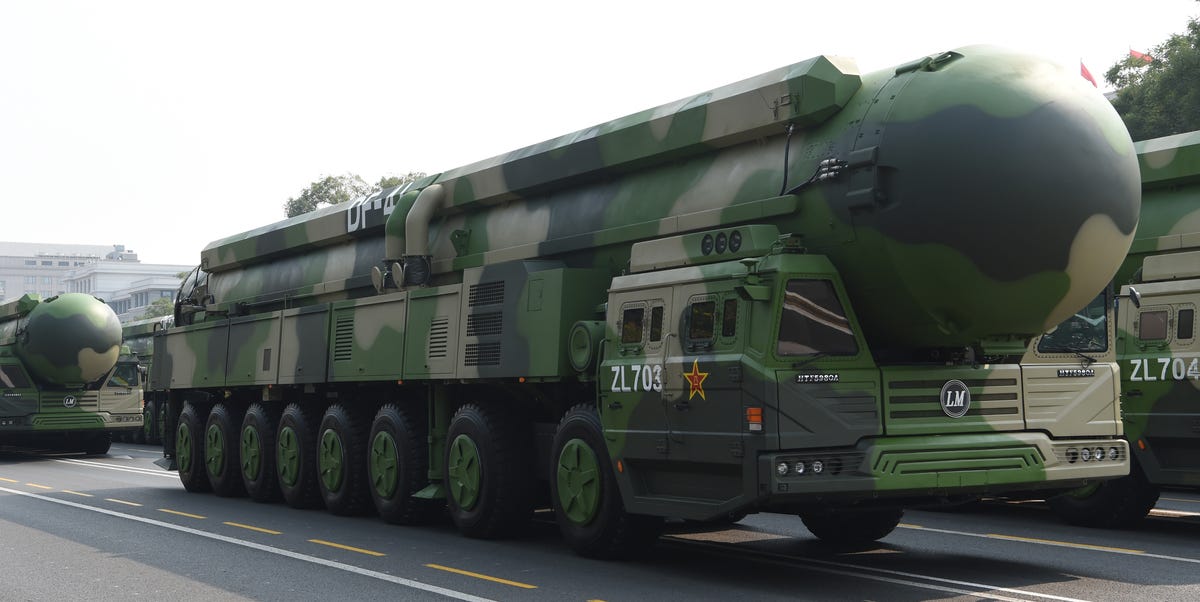
China’s nuclear missile silos have become one of the most closely watched military developments in the world. A decade ago, the conversation about China’s nuclear arsenal was fairly simple: Beijing had a smaller, mostly retaliatory force designed to survive an attack and respond. Today, that sentence needs a seat belt. China is expanding its nuclear forces, building new missile silos, improving mobile launchers, strengthening submarine-based deterrence, and pushing toward a more credible nuclear triad.
So, how many nukes does China have? Public estimates vary because China does not publish a transparent nuclear inventory. Still, the best open-source assessments generally place China’s arsenal at roughly 600-plus nuclear warheads, with U.S. defense assessments projecting that it could exceed 1,000 operational warheads by 2030 if current trends continue. That does not make China equal to the United States or Russia, which still possess much larger total arsenals, but it does mark the fastest and most consequential nuclear expansion by any major power today.
The big headline is not only the number of warheads. It is the infrastructure. Satellite imagery and expert analysis have identified hundreds of new missile silos in remote areas of northern and western China. These silos suggest that Beijing is moving away from a very small “minimum deterrent” posture and toward a larger, more survivable, and more flexible nuclear force. In plain English: China is adding more chess pieces to the board, and everyone else is now trying to figure out the strategy.
What Are China’s Nuclear Missile Silos?
A nuclear missile silo is an underground launch facility designed to house and protect an intercontinental ballistic missile, or ICBM. Unlike road-mobile launchers, which can move around, silos are fixed. That might sound like a disadvantage, but silos can be hardened, dispersed, and used to complicate an adversary’s targeting calculations. In nuclear strategy, making the other side uncertain is often half the point.
China’s new silo fields are believed to be linked mainly to solid-fuel ICBMs, which can be launched more quickly than older liquid-fuel missiles. Public reports have identified three major silo fields associated with areas such as Yumen, Hami, and Ordos. Analysts have also discussed additional silo construction in mountainous regions for older liquid-fuel systems. The exact number of completed, loaded, or operational silos remains uncertain, but open-source estimates commonly describe roughly 300 to 350 new silo-related facilities.
The important distinction is this: a silo does not automatically equal a missile, and a missile does not automatically equal a nuclear warhead installed and ready to fire. Some silos may be empty. Some may be used as decoys. Some may be intended for future missiles. Others may already be operational. This ambiguity is not a bug in nuclear strategy; it is a feature. It forces other countries to plan for several possibilities at once.
How Many Nuclear Weapons Does China Have?
The most credible public estimates put China’s nuclear stockpile at around 600 nuclear warheads or slightly more. Some open-source researchers estimate that only a small portion of these warheads are deployed on launchers at any given time, while most are kept in storage under centralized control. That means China’s total stockpile and its immediately deployed arsenal are not the same thing.
U.S. defense assessments have stated that China surpassed 600 operational nuclear warheads by mid-2024 and could have more than 1,000 by 2030. Other research organizations have placed China at about 600 warheads in 2025 and noted that the arsenal has been growing rapidly, possibly by around 100 warheads per year in recent years. A reasonable public answer, therefore, is this: China likely has roughly 600-plus nuclear warheads today, but the number is rising and may cross 1,000 by the end of the decade.
Why Estimates Differ
Nuclear counting is not like counting parked cars at a grocery store. Analysts must estimate warhead production, delivery systems, fissile material, missile deployments, submarine patrols, bomber capability, and command-and-control practices. China’s secrecy makes the job even harder. Unlike the United States, which publishes substantial information about parts of its nuclear force, China reveals very little.
That is why you may see slightly different numbers: 500, 600, 620, or “more than 600.” These are not necessarily contradictions. They reflect different dates, definitions, and assumptions. One source may count total stockpiled warheads. Another may focus on operational warheads. Another may include projected warheads for future delivery systems. The safest phrasing for a public article is “roughly 600-plus nuclear warheads, with rapid growth underway.”
Why Is China Building So Many Missile Silos?
China’s silo construction appears to serve several strategic purposes. First, it improves survivability. A larger and more dispersed missile force is harder to destroy in a first strike. Second, it creates uncertainty. If an adversary cannot know which silos are loaded, empty, or decoys, it must assume the worst. Third, it supports a larger future arsenal. Building silos before filling all of them would allow China to expand gradually without starting from scratch each time.
There is also a political signal. Nuclear weapons are not only military tools; they are symbols of great-power status. By expanding its nuclear infrastructure, China signals that it wants to be treated as a central player in strategic competition, not as a secondary nuclear power standing in the back row of the global security photo.
The “Shell Game” Theory
Some analysts compare China’s new silo fields to a nuclear shell game. If there are more silos than missiles, China can move missiles among them or leave some empty, making it harder for an adversary to know which targets matter most. This strategy resembles concepts used during the Cold War, though China’s exact doctrine remains unclear.
Think of it like hiding a very dangerous needle in a very large haystack, then adding extra haystacks just to ruin everyone’s afternoon. The goal is not necessarily to launch first. The goal is to make sure the other side cannot confidently eliminate China’s ability to retaliate.
China’s Nuclear Triad: Land, Sea, and Air
China is building a more complete nuclear triad, meaning it can deliver nuclear weapons from land-based missiles, submarines, and aircraft. The land leg remains the strongest and most developed. This includes silo-based ICBMs and road-mobile missile systems. The sea leg includes ballistic missile submarines, especially the Type 094 class, with future improvements expected. The air leg is less mature but has grown with the H-6N bomber and possible air-launched ballistic missile capability.
A nuclear triad improves survivability because it gives a country multiple ways to retaliate. If land-based missiles are threatened, submarines may survive. If submarines are tracked, mobile missiles may remain hidden. If one leg is weak, the others can compensate. For China, the triad is still not as advanced as the U.S. triad, but it is clearly becoming more capable.
Does China Have a “No First Use” Policy?
China officially maintains a “no first use” policy, meaning it says it will not use nuclear weapons first in a conflict. Beijing also says its nuclear strategy is defensive and that it keeps its arsenal at the minimum level needed for national security. This policy has been a central part of China’s nuclear messaging for decades.
However, outside analysts debate how China’s rapid nuclear expansion fits with that traditional posture. A larger silo force, more warheads, better early-warning systems, and more advanced delivery platforms could still support a retaliatory strategy. But they could also give China more options in a crisis. That uncertainty is exactly why the buildup has attracted so much attention.
How Does China Compare With the United States and Russia?
China’s nuclear arsenal is now widely considered the world’s third largest, but it remains much smaller than those of the United States and Russia. Washington and Moscow each hold several thousand nuclear warheads when total stockpiles are counted. Together, they still account for the overwhelming majority of the world’s nuclear weapons.
That said, China does not need numerical parity to change the strategic balance. If China reaches 1,000 or more warheads, expands its ICBM force, and improves submarine patrols, the United States will face a more complex two-peer nuclear environment involving both Russia and China. That is a major shift from the post-Cold War era, when U.S. nuclear planning focused mostly on Russia as the only comparable nuclear power.
What Types of Missiles Are Involved?
China’s nuclear missile force includes several systems, but the most important names often discussed are the DF-5, DF-31, and DF-41 families. The DF-5 is an older liquid-fuel ICBM associated with silo basing. The DF-31 family includes road-mobile and possibly silo-based variants. The DF-41 is a newer solid-fuel ICBM believed to be capable of carrying multiple warheads, depending on configuration.
China also fields intermediate-range and regional missiles that may be nuclear-capable, though not all are necessarily assigned nuclear missions. At sea, China’s ballistic missile submarines carry submarine-launched ballistic missiles, with newer systems improving range and survivability. In the air, China is working to strengthen its bomber-based nuclear capability, though this remains the least mature part of the triad.
Why the Missile Silo Expansion Matters
The silo expansion matters because it changes assumptions. For many years, China appeared comfortable with a relatively small arsenal designed mainly to guarantee retaliation. The new silo fields suggest a shift toward a larger and more ready force. That does not automatically mean China plans to fight a nuclear war. Nobody sane puts that on a vision board. But it does mean China wants a stronger deterrent, more options, and greater leverage in a crisis.
This matters especially in scenarios involving Taiwan, the South China Sea, or a direct U.S.-China confrontation. A larger Chinese nuclear force could make U.S. decision-makers more cautious during a conventional conflict. It could also increase pressure on U.S. allies in Asia, including Japan, South Korea, Australia, and the Philippines, all of whom depend in different ways on American extended deterrence.
Arms Control Becomes Harder
China has historically resisted joining U.S.-Russia nuclear arms control agreements, arguing that its arsenal is far smaller. That argument becomes harder to maintain as China’s stockpile grows. At the same time, Beijing may still say that the United States and Russia must make deeper cuts first because their arsenals remain much larger. The result is a diplomatic traffic jam: everyone sees the danger, but nobody wants to merge first.
Common Myths About China’s Nuclear Arsenal
Myth 1: Every Silo Contains a Missile
Not necessarily. Some silos may be empty, incomplete, reserved for future missiles, or used as decoys. Counting silos is useful, but it is not the same as counting deployed missiles.
Myth 2: China Is Already Equal to the U.S. and Russia
No. China’s arsenal is growing quickly, but it remains much smaller than the total U.S. and Russian stockpiles. The concern is not current equality; it is the speed and direction of the expansion.
Myth 3: Nuclear Growth Means War Is Inevitable
Also no. Nuclear buildups are dangerous, but they are usually intended to deter war, not start one. The risk is that larger arsenals, shorter warning times, and political tension can increase the chance of miscalculation.
What Should Readers Watch Next?
The key indicators to watch are not only warhead estimates. Pay attention to how many silos appear active, whether China loads more missiles into them, how often its ballistic missile submarines patrol, whether its bomber force gains a clearer nuclear role, and whether Beijing enters any serious arms control dialogue. Also watch U.S. and allied responses, because nuclear competition is never a solo performance. It is more like a very expensive, extremely stressful group project.
Another major question is whether China changes its operational posture. If most warheads remain separated from missiles and stored under central control, the risk profile is different from a force kept at higher readiness. Public evidence still suggests that much of China’s arsenal is not deployed in the same way as U.S. and Russian strategic forces, but that could evolve as early-warning systems, command networks, and silo deployments mature.
Experience-Based Perspective: How to Understand This Topic Without Getting Lost
For readers trying to understand China’s nuclear missile silos for the first time, the most useful experience is learning to separate three things: warheads, missiles, and launchers. News headlines often blur them together, which creates confusion. A country can have more launchers than missiles. It can have more missiles than deployed warheads. It can also have warheads in storage that are not sitting on missiles. Once you separate those categories, the topic becomes much less mysterious.
A helpful way to read reports about China’s nuclear arsenal is to ask, “What exactly is being counted?” If an article says China has around 600 nuclear weapons, it is usually talking about warheads. If it says China has hundreds of silos, it is talking about launch infrastructure. If it says China could have over 1,000 warheads by 2030, that is a projection based on production trends, missile deployments, and assumptions about future force structure. Those are related, but they are not identical.
Another practical lesson is to avoid emotional whiplash. One day, a headline may sound like China is already matching the United States. The next day, another report may say China is still far behind. Both can contain truth depending on the metric. China may have more ICBM launchers in some categories, while still having fewer total warheads than the United States. It may have hundreds of silos, while only some are believed to contain missiles. Nuclear analysis rewards patience, not panic.
It also helps to understand why secrecy is part of the strategy. China does not need the world to know exactly how many missiles are loaded or where every warhead is stored. Ambiguity can strengthen deterrence by making adversaries uncertain. This is frustrating for analysts and readers, but from Beijing’s perspective, uncertainty may be useful. In nuclear strategy, the unknown can be almost as powerful as the known.
From a public-information standpoint, the best approach is to rely on patterns rather than single numbers. The pattern is clear: China’s arsenal is growing, its silo infrastructure has expanded dramatically, its missile force is becoming more diverse, and its nuclear posture is becoming more central to great-power competition. Whether the current number is 600, 620, or another nearby estimate matters less than the direction of travel.
The final experience-based takeaway is simple: do not treat nuclear weapons like ordinary military equipment. A new tank, ship, or aircraft changes battlefield capability. A larger nuclear force changes political psychology. It affects crisis behavior, alliance confidence, arms control, military planning, and the way leaders interpret risk. China’s missile silos are not just holes in the desert. They are signals, insurance policies, bargaining chips, and warning signs all at once.
Conclusion
China likely has roughly 600-plus nuclear warheads today, and its arsenal is expanding faster than any other major nuclear power. The construction of hundreds of missile silos marks a major change in China’s nuclear posture, even if not every silo is currently loaded with a missile. Beijing continues to describe its nuclear strategy as defensive and based on no first use, but the scale of its modernization has raised serious questions in Washington, among U.S. allies, and across the global arms control community.
The best answer to “How many nukes does China have?” is not a single frozen number. It is a moving estimate: around 600-plus now, potentially more than 1,000 by 2030, and possibly more after that depending on political decisions, missile production, fissile material availability, and strategic competition with the United States and Russia. In other words, the nuclear scoreboard is changing, and China is no longer sitting quietly in the corner with a small deterrent. It is building a bigger, more survivable, and more complicated forceone silo field at a time.
Note: This article is based on publicly available, non-classified U.S. government, research, defense-analysis, and nuclear-security sources. Exact silo coordinates, targeting details, and operational instructions are intentionally excluded.