

At sunset, the Australian desert performs one at loosens its grip, Uluru darkens into a monumental silhouette, and stars begin crowding the sky. Then, across the red earth nearby, more than 50,000 points of light quietly awaken.
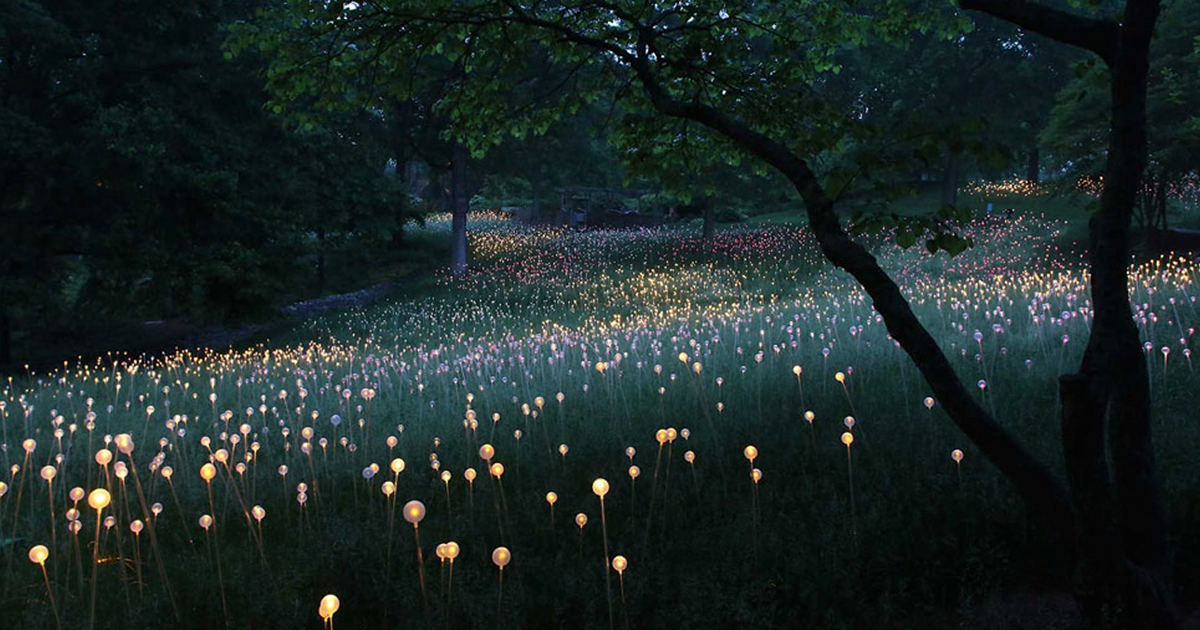
This is Field of Light Uluru, Bruce Munro’s immersive installation near Uluru in Australia’s Northern Territory. Slender stems crowned with frosted spheres glow in ocher, violet, blue, and soft white. They do not flash like a stadium scoreboard. They drift and pulse, turning the desert into a garden from another planetone with excellent lighting and absolutely no watering schedule.
The spectacle is also the result of a 24-year creative journey, off-grid engineering, and a carefully staged meeting between artificial light and an ancient landscape.
What Is Field of Light Uluru?
Field of Light Uluru is a large-scale, site-responsive artwork installed on desert land near Ayers Rock Resort, outside Uluru-Kata Tjuta National Park. Visitors walk along designated paths through more than 50,000 illuminated stems while Uluru rises in the distance.
The installation covers more than seven football fields. Each slender stem supports a frosted sphere connected through fiber-optic technology to solar-powered equipment. After sunset, the field moves through colors drawn from the surrounding landscape. From above, it resembles a desert bloom after rain. From inside, it feels less like viewing a sculpture and more like entering one. n>
From a 1992 Sketchbook Idea to a 2016 Reality
The Desert Planted the Concept
Munro conceived the idea during a 1992 journey through central Australia with his future wife. Camping near Uluru, he felt an intense connection to the desert’s heat, brightness, scale, and energy. He recorded an idea for illuminated stems that would appear to bloom at dusk like dormant seeds responding to rain.
The vision was poetic but impractical. Thousands of delicate lights would have to survive heat, dust, wind, and long transport routes. They would also need power in a remote landscape where the nearest convenient outlet was, to use the technical term, nowhere.
Persistence Turned the Dream Into Art
Munro developed the concept through smaller experiments, including an early field behind his family home in Wiltshire, England. Related installations at gardens and cultural venues helped him refine the repetition of stems, glass forms, fiber optics, and slowly changing color.
In April 2016, 24 years after the original inspiration, the artwork finally opened near Uluru. It was planned as a one-year exhibition, but strong public interest led to repeated extensions. The long delay became part of its appeal: Field of Light is proof that some ideas need time to grow roots before they can glow. n>
How 50,000 Desert Lights Work
Simple Forms, Enormous Complexity
The artwork looks effortless, but its construction is anything but simple. It contains roughly 300,000 components and more than 380 kilometersabout 236 milesof optical fiber. Frosted spheres diffuse the light into soft halos, while the narrow stems keep the visible forms delicate and plantlike.
The field is divided into sections that change color gradually. Waves of ocher, deep violet, blue, and white travel across the ground without turning the desert into a giant dance club. The slow pace matters: the lights appear to breathe rather than perform.
Powered by Daylight
The installation operates off-grid using solar power. Energy collected during the day is stored and used after sunset, giving the engineering a poetic logic: daylight is gathered, then returned as a nighttime bloom.
Central Australia is hard on equipment. Extreme temperatures, dust, and remote maintenance demand durable materials and ongoing care. A major refurbishment replaced aging luminous and fiber-optic elements, allowing the artwork to continue after years in the open desert. Solar power does not erase the environmental footprint of materials and transportation, but it is a practical response to the location and central to the work’s day-to-night cycle. n>
Why the Surreal Effect Feels So Powerful
The magic comes from contrast. The desert is ancient, dry, and immense; the lights are modern, delicate, and individually tiny. The land appears still while colors move through gentle rhythms. Above, real stars fill the sky. Below, human-made stars hover just above the soil.
The installation also reveals itself slowly. Visitors often arrive around sunset, as Uluru changes color and shadows lengthen. The artificial field becomes visible only as natural light fades, creating an emotional transition rather than a simple “lights on” moment.
Photographs flatten the work into a colorful carpet. Walking through it reveals curving paths, small rises, hidden sections, and changing viewpoints. Each person encounters a slightly different compositionespecially those who can resist checking their phone every twelve seconds. n>
Art Beside a Living Cultural Landscape
Uluru is not merely a dramatic backdrop. It is a sacred place within the living cultural landscape of the Anangu, the Traditional Owners of Uluru-Kata Tjuta National Park. Anangu culture, law, stories, and responsibilities to Country long predate modern tourism and contemporary art.
The installation stands on resort land near the park rather than on Uluru itself. Anangu gave it the Pitjantjatjara name Tili Wiru Tjuta Nyakutjaku, commonly translated as “looking at lots of beautiful lights.” The name does not make Munro’s work Indigenous art, and his personal response to the landscape should not be confused with Anangu cultural knowledge.
Visitors should stay on marked paths, follow local photography guidance, and approach the wider destination respectfully. A luminous field may draw the eye, but learning why the surrounding landscape matters adds depth that no camera setting can supply. n>
From Temporary Exhibition to Desert Landmark
Field of Light Uluru opened on April 1, 2016, expecting to remain for one year. By its 10th anniversary in 2026, it had welcomed more than 750,000 visitors and was extended through 2029. A temporary experiment had become one of the region’s best-known nighttime experiences.
Its success strengthened Munro’s global reputation and inspired site-specific versions in other landscapes. At Sensorio in Paso Robles, California, tens of thousands of glowing stems roll across wine-country hills. Earlier American presentations at Longwood Gardens and the Desert Botanical Garden showed how the same central idea changes with terrain, vegetation, and viewing distance.
That adaptability matters. Munro does not merely copy and paste a sculpture into a new location. Each field responds to the contours and atmosphere of its site. The Uluru version remains uniquely important because it returned the idea to the landscape that first inspired it. n>
Is Field of Light Art, Attraction, or Instagram Magnet?
The honest answer is all three. It is a serious installation about light, memory, repetition, and place. It is also a ticketed tourism experience with transfers and dining packages. And yes, it is so photogenic that smartphones practically leap from pockets by themselves.
Those roles do not automatically cancel one another. Popular art can still be thoughtful. The risk comes when the spectacle becomes the entire story. Seen only as a selfie background, the work shrinks. Seen in relation to darkness, cultural landscape, renewable power, and a decades-long creative process, it expands again.
The best approach is simple: take the photograph, then put the camera away. Let your eyes adjust. Watch individual lights disappear into a wider pattern. Look at the real stars. Give the artwork a few minutes before asking it to become content.
A 500-Word Field of Light Experience: What the Evening Feels Like
The experience begins before the lights become the main event. Late-afternoon heat still hangs over the desert, but the hard glare of midday has softened. Uluru stands in the distance, shifting from rusty orange to deeper red as the sun lowers. People speak more quietly than they did on the bus. The landscape seems to request a lower volume.
At first, the installation is almost invisible. Stems blend into the ocher ground, and a few pale spheres catch the remaining daylight. Then one point glows. Another follows. Soon there are hundreds, then thousands, although no single moment announces that the field is officially “on.” It gathers presence gradually, like stars appearing in an evening sky.
From an elevated viewpoint, the lights form broad pools of color. Violet drifts into blue. White glimmers in one section while warm ocher rises elsewhere. The changes are slow enough to feel organic. Nothing races or explodes. Anyone expecting laser cannons, smoke machines, and a heroic movie soundtrack may be disappointed, which is probably healthy for them.
Walking into the field changes the scale. From above, the installation resembles a glowing map. Inside it, every frosted sphere becomes distinct. Narrow paths curve through the stems, turning each bend into a new composition. A low rise can hide thousands of lights; a few steps later, the view opens and the field stretches toward the horizon again.
The atmosphere is surprisingly intimate despite the enormous footprint. Small clusters surround visitors while other sections disappear from sight. Gentle color changes make the lights seem responsive, as though the desert is breathing through them. The spheres look soft enough to touch, but touching would damage both equipment and illusiona very efficient way to ruin the magic.
Photography becomes a lesson in restraint. Phones capture color but struggle with the vast darkness around it. Better images usually come from holding the camera steady, reducing exposure, and allowing silhouettes to remain silhouettes. Flash flattens the mood and annoys nearby visitors, achieving two failures with one button.
Then there is the sky. On a clear night, central Australia offers a density of stars rarely visible from cities. The installation creates a double horizon: electric lights below and celestial lights above. The eye moves between them, comparing human design with cosmic scale. The artwork is beautiful, but the stars remain undefeated.
Near the end of the walk, Uluru is no longer a bright image but a dark, immense presence. The field looks different from every angle, and colors that dominated earlier have faded into quieter tones. The lights are artificial, yet the memory becomes tied to land, temperature, silence, and sky.
That is the installation’s greatest achievement. It does not imitate a real garden; it creates the emotional suggestion of onea desert bloom made from patience, engineering, and light. For an hour, the ground seems to hold its own constellation. Then visitors leave, the night continues, and the desert returns to being larger than anything placed beside it.
Conclusion: A Fairytale Built from Memory, Technology, and Place
Bruce Munro’s Field of Light Uluru transforms more than 50,000 illuminated stems into an experience that feels futuristic and strangely natural. Its power comes not from overpowering the desert but from working with darkness, distance, color, and sunset.
The journey from a 1992 sketchbook idea to a 2016 opening and a decade of visitors also proves that ambitious creative work rarely arrives fully formed. Sometimes an idea needs years of testing, hundreds of miles of fiber optics, and one extremely patient family.
Most importantly, Uluru is a living cultural landscape, not a stage set. When wonder is paired with respect, Field of Light becomes more than a surreal fairytale. It becomes a reminder that technology can be most moving when it helps people look more carefully at the world already around them.