

Editor’s note: The design atelier’s official name is Cappelen Dimyr. The supplied headline spelling has been retained, while the correct brand name is used throughout this article.
Floral rugs have spent enough time being treated like the decorative equivalent of a visiting aunt’s potpourri bowl. Cappelen Dimyr’s Flower Chapter collection gives them a persuasive new identity: quieter, earthier, more sculptural, and considerably less interested in matching the curtains.
Based in Copenhagen, Cappelen Dimyr approaches floor coverings as textile artworks rather than background accessories. Its floral designs combine Scandinavian heritage motifs, natural wool, irregular textures, and restrained neutral colors. The results feel romantic without becoming sugary and traditional without looking trapped in a formal parlor.
The collection includes elongated runners, large area rugs, flat-woven foundations, raised hand-knotted details, and an interpretation of the French lily. Together, these pieces demonstrate how floral interior design can feel modern when pattern, material, and scale are carefully controlled.
What Is Cappelen Dimyr’s Flower Chapter?
The Flower Chapter is a series of contemporary artisanal rugs inspired by historic European floral ornament. Some designs reference ancient Scandinavian tulip patterns once used on porcelain, curtains, carpets, and other household objects. Another prominent design interprets the fleur-de-lis, or French lily, through an irregular textile surface and embroidered floral forms.
These are not botanical illustrations with every leaf carefully outlined. The motifs are simplified, enlarged, and sometimes softened until they resemble memories of flowers rather than literal bouquets. That abstraction is important. It allows the rugs to work with contemporary furniture, antique pieces, sculptural lighting, and minimalist architecture without making the room resemble a garden center during a seasonal promotion.
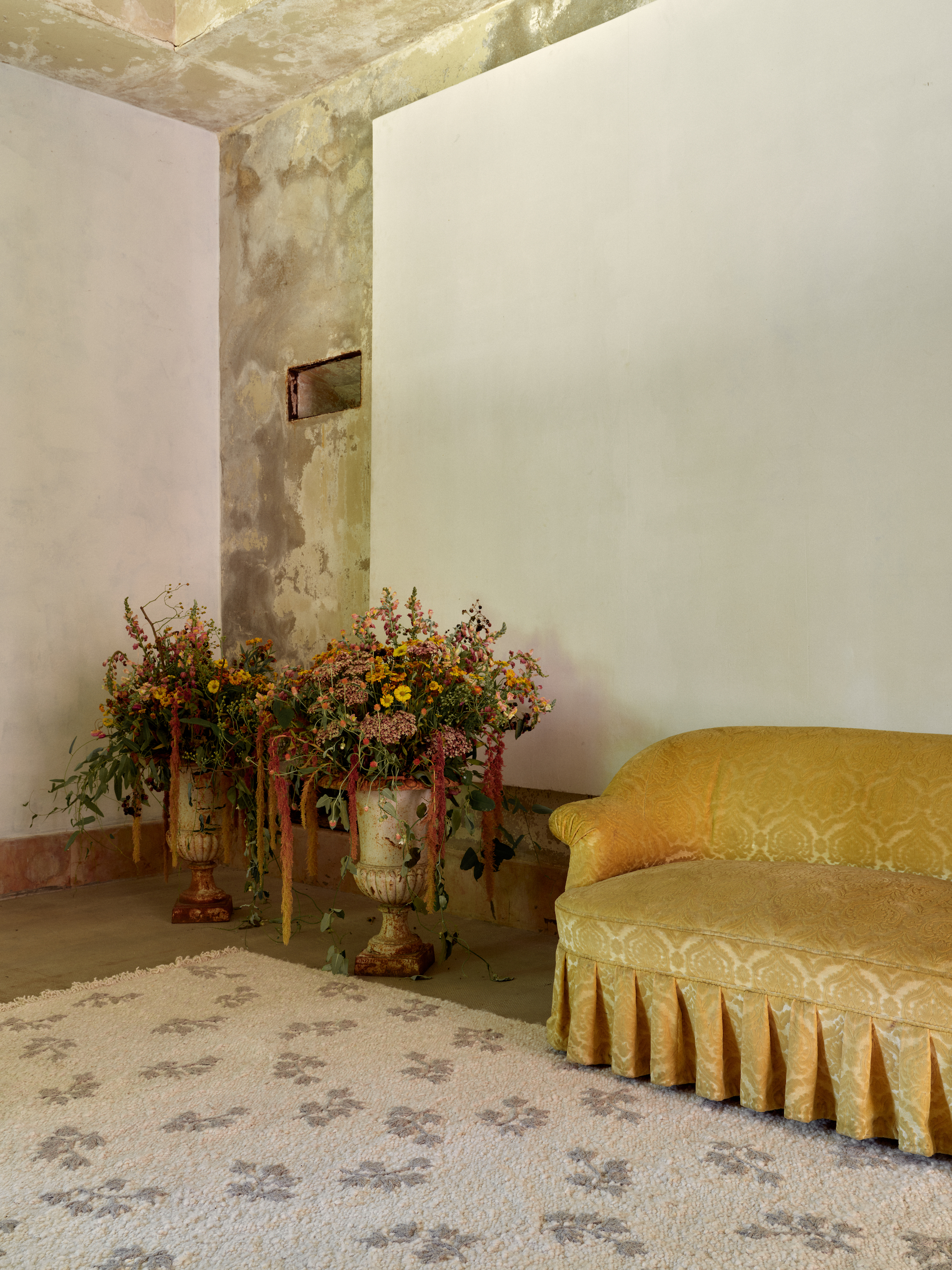
The original collection imagery was photographed by Florian Touzet at Villa Magnan in Biarritz, France. The historic setting emphasized the rugs’ ability to move between Nordic restraint and relaxed European romance. Against aged walls, wood furniture, and filtered natural light, their soft colors appeared less like decoration and more like part of the architecture.
A Copenhagen Atelier with a Warm Approach to Minimalism
Cappelen Dimyr emerged around the turn of the 2020s as a Copenhagen-based creative collective focused on rugs, tapestries, and soft interior objects. Cofounders Maja and Ellen Dixdotter developed an aesthetic that balances Scandinavian simplicity with rustic texture, bohemian irregularity, and a touch of 1970s freedom. The sisters have described rugs as a form of clothing for interiorsa useful comparison because a rug can change the mood of a room as decisively as a coat changes an outfit.
The brand’s interiors rarely feel cold or clinically minimal. Instead, neutral shades are animated by long fibers, braided edges, raised motifs, imperfect outlines, and variations created during hand production. The underlying philosophy might be called eclectic minimalism: use fewer objects, but make each one tactile, expressive, and worth noticing.
This approach is especially effective in Copenhagen-style interiors, where pale walls, natural light, honest materials, and functional furniture often provide the foundation. A textured floral rug supplies warmth without interrupting the calm. It is the design equivalent of someone entering a quiet room in an excellent coatnot shouting, but definitely noticed.
The Rugs That Define the Floral Collection
Colonnade No.08: The Light and Airy Runner
Colonnade No.08 is a flat-woven natural-wool runner with a mid-beige foundation and soft-brown flowers. Its tulip-inspired pattern is arranged with enough breathing room to preserve the rug’s light appearance. A narrow fringe adds movement along the edges without distracting from the motif.
This design is particularly suitable for hallways, beside a bed, behind a sofa, or in a narrow dining area. Its elongated shape naturally guides the eye through a room. The modest contrast between the beige field and brown flowers also makes it easier to combine with oak, walnut, travertine, aged brass, linen, and off-white upholstery.
Although the pattern is historical in origin, its sparse arrangement feels graphic and current. Each tulip functions almost like a symbol or hand-drawn icon. The rug offers floral character without the visual density associated with traditional garden-pattern carpets.
Colonnade No.09: Raised Flowers and Deeper Contrast
Colonnade No.09 uses a gray-brown flat-woven base with light beige hand-knotted flowers. The difference between the foundation and the raised motifs produces a subtle high-low effect, allowing the pattern to be experienced through touch as well as sight.
The darker ground gives this version more visual weight than No.08. It can anchor a pale entryway, introduce depth to a neutral bedroom, or provide contrast beneath a light wood bench. Because the flowers are dimensional, they respond differently as daylight moves across the surface. In the morning, the pattern may appear soft and quiet; under directional evening light, the shadows make it more pronounced.
This textural variation demonstrates why handcrafted rugs are difficult to judge from color alone. Pile height, yarn thickness, and the direction of light can influence their appearance almost as much as the pattern itself.
No.16: A French Lily with an Unpolished Edge
No.16 introduces a French influence through an interpretation of the fleur-de-lis. It features hand-spun slub yarn, an irregular foundation, and embroidered flowers. Rather than rendering the lily as a sharp heraldic emblem, the design softens it into something loose, tactile, and pleasantly imperfect. Product listings commonly identify its composition as 85% wool and 15% cotton.
The slub texture gives the surface natural changes in thickness. Those variations prevent the rug from feeling machine-perfect and help each floral form appear slightly different. The design therefore occupies an interesting middle ground between formal French symbolism and relaxed Scandinavian craftsmanship.
No.16 can carry a larger room because its pattern has a stronger decorative presence. It works especially well where the surrounding furniture is simple: beneath a low sofa, in a spacious bedroom, or under a table with a clean silhouette.
Why These Floral Rugs Feel Contemporary
The Palette Is Calm
Traditional floral rugs often depend on numerous saturated colors. Cappelen Dimyr takes the opposite approach. Beige, sand, clay, gray-brown, cream, and undyed wool tones create a low-contrast foundation. The flower becomes noticeable through shape and texture rather than a riot of red, blue, green, gold, and whatever other color happened to wander into the loom.
This quieter palette makes the collection compatible with modern spaces. It can soften concrete, steel, glass, and angular furniture while remaining understated enough for small rooms.
The Flowers Are Oversized and Simplified
Scale changes the personality of a floral pattern. Tiny repeated blossoms can appear delicate or busy. Large, widely spaced flowers feel bolder and more architectural. Cappelen Dimyr’s motifs are readable from across a room, yet they retain enough irregularity to avoid looking digitally stamped.
The simplified forms also leave negative space around each flower. That open background prevents the eye from becoming tired and gives furniture room to sit on the rug without concealing the entire design.
Texture Does Part of the Decorating
Flat weaving, hand knotting, embroidery, fringe, and slub yarn introduce depth without requiring additional colors. Raised flowers can catch light, create tiny shadows, and make the rug more engaging at close range. This tactile quality is central to the brand’s identity and to the broader appeal of handmade textiles.
Traditional Craft and Natural Materials
Cappelen Dimyr designs its collections in Scandinavia and works with skilled makers in India who use established weaving and knotting techniques. The brand emphasizes natural fibers, including wool, cotton, and linen, as well as hand finishing. Retailers describe production steps that may include trimming by hand, washing with natural soap, and drying in the sun.
Handmade production means minor differences in dimensions, color, yarn, pile, and detailing are expected. These should not automatically be interpreted as defects. They are evidence that the rug has passed through human hands rather than emerging as one of several thousand identical rectangles.
Wool is particularly well suited to textured rugs because its fibers provide softness, resilience, and visual depth. However, new wool rugs can shed, especially when they include long pile or shaggy sections. Cappelen Dimyr recommends regular vacuuming during the initial period, cutting an individual projecting tuft rather than pulling it, and occasionally moving heavy furniture to reduce lasting impressions.
How to Style a Cappelen Dimyr Floral Rug
Let the Rug Set the Room’s Temperature
A beige floral rug can warm a white room without introducing a dominant color. Repeat one or two of its tones elsewhere through linen curtains, pottery, a wool throw, or a wooden side table. Exact matching is unnecessary. Slight tonal differences usually create a more relaxed and collected interior.
Combine It with Plain Upholstery
Textured floral rugs already provide movement, so solid-color sofas and chairs offer useful balance. Cream bouclé, tobacco leather, brown velvet, charcoal linen, or pale gray wool can all work. One patterned pillow is charming; nine competing floral cushions may cause the rug to quietly request a transfer.
Use Vintage Furniture for Contrast
The rugs’ historic references pair naturally with antiques and vintage furniture. A worn pine table, Swedish cabinet, sculptural midcentury chair, or time-softened leather bench can reinforce the sense that the room evolved gradually.
Maja Dixdotter’s own country home illustrates this collected approach, combining Cappelen Dimyr rugs with antiques, old wood, personal objects, and purposeful activity zones rather than following one rigid decorative style.
Choose the Correct Scale
For a living room, the rug should generally connect the main seating pieces rather than float alone beneath the coffee table. At minimum, the front legs of the sofa and chairs should rest on it. In a dining room, allow enough extra surface for chairs to remain on the rug when pulled away from the table.
Runners should leave a visible border of flooring on both sides. This makes the placement feel intentional and allows the floral outline to be seen clearly.
Why the Collection Matters in Modern Interior Design
The Flower Chapter reflects a broader shift away from anonymous minimalism. Homeowners still appreciate simplicity, but many now want rooms with texture, memory, craft, and personality. A perfectly empty beige room may photograph beautifully, yet living in one can feel like occupying a very expensive bowl of oatmeal.
Cappelen Dimyr demonstrates that adding personality does not require abandoning restraint. A room can remain calm while including an eccentric flower, an uneven fringe, or a visibly hand-worked surface. The collection offers a practical lesson: minimalism becomes more inviting when it includes evidence of nature and human touch.
It also shows how heritage patterns can be redesigned rather than merely reproduced. Scandinavian tulips and French lilies are not presented as museum copies. They are enlarged, simplified, recolored, and translated into tactile contemporary objects.
What to Consider Before Buying
These rugs are handcrafted design pieces, so buyers should evaluate more than pattern alone. Confirm the exact dimensions and measure the intended area with painter’s tape. Consider door clearance, furniture placement, walking routes, and whether the pile height suits the room.
Ask for a material sample when available. Neutral shades can change significantly under cool LEDs, warm lamps, and direct sunlight. A gray-brown rug may look earthy in one room and noticeably cooler in another.
Households with pets or young children should also consider maintenance. Flat-woven pieces are generally easier to vacuum than deep, shaggy rugs, while raised embroidery may require more careful treatment. A rug pad can improve stability, add cushioning, and reduce unnecessary movement.
Finally, accept that a handmade wool rug will not behave like a printed synthetic mat. Initial shedding, small irregularities, and subtle color variation are part of the ownership experience. The reward is a textile with depth and individualitysomething that becomes part of the room rather than merely covering the floor.
The Experience of Living with a Floral Rug
Imagine introducing a Cappelen Dimyr floral rug into a living room that already contains a cream sofa, an oak coffee table, two vintage chairs, and pale walls. Before the rug arrives, the room may be pleasant but visually unresolved. The furniture looks like a group of polite strangers waiting for someone to begin the conversation.
Once the rug is placed beneath the seating area, the arrangement gains a center. Its warm beige or gray-brown foundation connects the wood, upholstery, and floor, while the floral motifs introduce a rhythm that was previously missing. The room does not suddenly become colorful in the conventional sense. Instead, it becomes more expressive through texture.
The experience changes throughout the day. Morning light can flatten the contrast and make the rug appear soft and almost monochromatic. By afternoon, angled sunlight reveals raised flowers, hand-knotted areas, and irregular yarn. At night, a low floor lamp casts small shadows across the pile, giving the motifs a stronger sculptural quality.
There is also a tactile component. Walking barefoot across alternating flat and raised sections creates a subtle physical awareness of the design. The pattern is not simply printed where it can only be seen; it is built into the surface. This can make an everyday actioncrossing the room for coffeefeel surprisingly luxurious.
A runner creates a different experience. In a hallway, Colonnade No.08 or No.09 turns a transitional area into a designed space. The repeated tulips encourage movement down the corridor, almost like understated directional markers. Add a small bench, a ceramic lamp, and one framed artwork, and the hallway begins to feel like a room rather than a route to somewhere more interesting.
In a bedroom, a floral rug can soften the first and final moments of the day. Positioned partly beneath the bed, it creates a warm landing place for bare feet and introduces pattern without requiring floral wallpaper or decorated bedding. Plain linen sheets and a simple wooden headboard allow the rug to remain the expressive element.
Living with natural wool also teaches patience. During the first weeks, some shedding may appear, particularly in higher-pile areas. Regular, gentle vacuuming gradually manages the loose fibers. Owners accustomed to perfectly uniform factory-made products may initially notice every irregular line. Over time, those differences often become the details that make the rug feel personal.
The most successful experience comes from resisting the urge to make everything coordinate. A Cappelen Dimyr rug does not require a matching floral chair, floral curtain, and floral lampshade. Its strength lies in contrast. Pair it with clean furniture, imperfect antiques, handmade ceramics, or modern art. Let the rug introduce the flowers while the rest of the room supplies the soil, sunlight, and occasional sense of humor.
This is ultimately why the Flower Chapter feels livable. It offers romance without fussiness, history without stiffness, and decoration without overwhelming the room. The rugs can make a space feel warmer on the first day, yet their subtle colors and handcrafted surfaces provide enough complexity to remain interesting for years.
Conclusion
Cappelen Dimyr’s floral rugs prove that flower patterns do not need bright colors or intricate realism to make an impact. Through Scandinavian tulips, French lily references, natural wool, hand-worked textures, and earthy colors, the Copenhagen atelier transforms familiar motifs into modern textile art.
The Flower Chapter is especially appealing for interiors that need warmth but not clutter. Each design can anchor furniture, introduce heritage, and soften modern architecture while maintaining a calm visual atmosphere. More importantly, the collection demonstrates that contemporary minimalism does not have to be empty or impersonal. Sometimes it simply needs a few flowers underfoot.