

Note: This article is an original, publish-ready synthesis based on publicly documented information about Hackaday, Red Bull Creation, maker competitions, and the 2013 Brooklyn build event.
When Makers, Music, and Mayhem Share One Stopwatch
There are ordinary building projects, and then there are build challenges where a team has 72 hours, a vague theme, a noisy public venue, a pile of parts, and the cheerful knowledge that everything must work in front of humans who can smell fear. That was the magic of Hackaday at the Redbull Creation Challenge, especially the moment when the teams began to build and the event transformed from a clever idea into a loud, solder-scented reality show for people who think “prototype” is a lifestyle.
The Red Bull Creation Challenge was not a sit-down brainstorming seminar with name tags and polite coffee. It was a full-contact maker competition: hackers, builders, artists, programmers, welders, and mechanically optimistic humans racing to design physical inventions under intense time pressure. In 2013, the challenge landed in Brooklyn, New York, during the Northside Festival, where six teams were asked to create original musical instruments that could be played live by the public. In other words, the assignment was not simply “make something cool.” It was “make something cool, musical, interactive, safe enough for strangers, and finished before the clock eats your soul.”
Hackaday’s coverage captured exactly why events like this matter. The best maker competitions are not just about winning. They are about watching ideas become hardware in real time, with all the glorious friction that process involves. A plan that looked brilliant at midnight may require a grinder, three zip ties, an Arduino reset, and one team member whispering, “Nobody panic,” at 3:17 a.m. That is not failure. That is fabrication with character.
The Red Bull Creation Challenge: A Playground With a Deadline
The Red Bull Creation Challenge became known for its 72-hour format, themed prompts, custom electronics, and public-facing builds. Earlier versions featured remote workshop participation and custom Arduino-based boards such as the Bullduino or TurBull Encabulator, giving teams a shared technical ingredient while leaving the final project wildly open-ended. That balance of constraint and freedom is the secret sauce of a great hackathon. Too many rules, and everyone makes the same beige box. Too few rules, and someone spends three days arguing whether fog machines count as user interface.
In the 2013 edition, the prompt pushed teams toward musical invention. The teams were not asked to build another app, another blinking LED cube, or another device that tells your phone your toast is emotionally unavailable. They had to build physical instruments for public performance. That requirement forced the makers to think beyond circuit diagrams. A successful project needed sound, structure, interaction, durability, and stage presence. It had to invite people in. It had to survive hands, weather, vibration, confusion, curiosity, and possibly a child who believes every button is a drum.
That is why the moment when the teams began to build was so important. At the start, every team has confidence. Sketches are clean. Materials seem cooperative. Time feels abundant. Then the real world arrives wearing steel-toed boots. Sensors misread distance. Welds take longer than expected. Public spaces are louder than lab benches. A musical concept may sound beautiful in theory and like a haunted fax machine in practice. The Red Bull Creation Challenge made that uncertainty visible, which is precisely why maker audiences loved it.
Hackaday’s Eye for the Beautifully Unfinished
Hackaday has always been at its best when celebrating the practical messiness of invention. Its coverage of the Red Bull Creation Challenge did not treat the teams like polished product-launch presenters. Instead, it showed them as real builders in the heat of competition: cutting, wiring, adjusting, testing, and occasionally discovering that physics had not read the project brief.
Caleb Kraft’s Hackaday reporting from the 2013 event gave readers the sense of walking through a busy build area. There were teams already deep into their concepts, rushing to complete musical instruments before time expired. There were tools, live feeds, video recaps, loud workspaces, and the kind of environmental noise that makes interviews feel like they are being conducted inside a mechanical dragon. That roughness was part of the charm. A maker event without noise is either not working yet or being held in a library by mistake.
Hackaday’s audience understood the language of half-built mechanisms. A dangling wire was not merely a problem; it was foreshadowing. A team member leaning over a table with a laptop, a sensor, and a suspicious expression was not “stuck”; they were negotiating with the universe. The best maker journalism recognizes that invention is not a straight line. It is a zigzag through budget limits, heat shrink, caffeine, and optimism.
Six Teams, One Theme, and a Lot of Noise
The 2013 Red Bull Creation Challenge featured six teams working to build new musical instruments for public interaction. This format encouraged a rare combination of engineering and performance art. A musical instrument is not only a machine; it is an invitation. It needs an input people understand and an output people enjoy. That means teams had to design for both the circuit board and the passerby.
MB Labs and the Autoloop
One of the standout projects was Autoloop, created by Chicago-based MB Labs. The project functioned as a giant electronic drum sequencer, using a robotic drum kit and visual control surfaces where users could adjust rhythm and melody by moving objects such as marbles and shapes. It was kinetic, musical, and wonderfully tactile. Instead of hiding computation behind a screen, Autoloop put the logic in front of people. You could see the rhythm being shaped. That visibility made the technology feel less like software and more like a toy designed by a jazz drummer who had spent too much time in a machine shop.
Autoloop eventually won the grand prize, and it is easy to see why. It matched the theme, welcomed public interaction, and looked like something that belonged at the intersection of a science museum, a concert, and a garage where every drawer contains at least one mystery bearing.
North Street Labs and the Treequencer
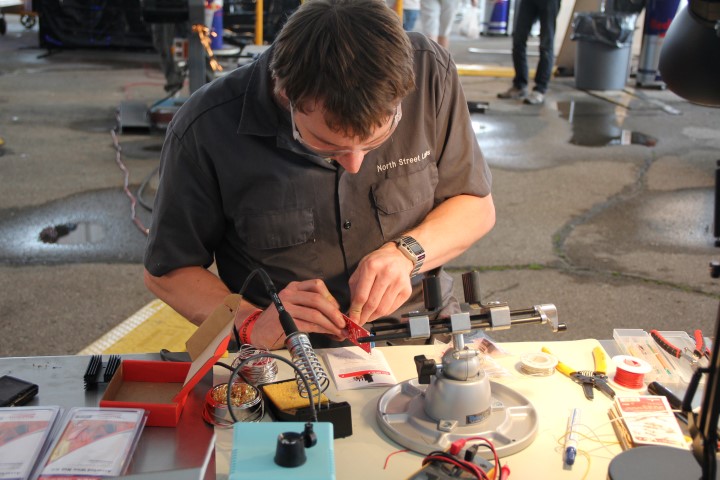
Another memorable project was the Treequencer by North Street Labs, a team from Portsmouth, Virginia. The Treequencer was an interactive musical tree made with steel pipe, sensors, electronics, and a speaker system. People could move around it, and their proximity or motion would trigger sounds and rhythms. The idea was elegant: turn human movement into music without requiring users to know how to play an instrument.
The Treequencer showed how public technology can feel magical when the interface is physical and intuitive. You do not need a manual to dance near a tree. You do not need a login screen to wave your hand and hear sound respond. In an era when many devices demand passwords, updates, and suspiciously long terms of service, a musical tree that reacts to people feels refreshingly honest.
1.21 Jigawatts and the Art of Translating Graffiti
The Minneapolis team 1.21 Jigawatts developed a graffiti-inspired sound machine often described as a decoder or translator. Users could create colorful marks, and sensors would scan visual information to trigger musical elements. This project reflected one of the strongest ideas in maker culture: information can move between forms. A mark can become a note. A color can become a signal. A roll of paper can become a score.
That type of project is especially powerful in a public festival setting because it lowers the barrier to participation. Not everyone wants to perform onstage, but many people will happily draw, press a button, or feed paper into a strange machine just to see what happens. Curiosity is the world’s most reliable power supply.
Skullduggery Systems and the Joy of Almost Working
Skullduggery Systems attempted an ambitious water-based jug instrument that changed pitch as water moved in and out. It did not fully behave as intended, but it produced a sound that reportedly resembled audio feedback closely enough to confuse nearby sound crews during the Northside Festival. This is the kind of detail that makes maker history worth reading. Was it a perfect instrument? Not exactly. Was it memorable? Absolutely. Sometimes the machine that almost works teaches more than the one that politely behaves.
That project also illustrates a hard truth about time-limited builds: ambition is both fuel and trap. A simple project can finish cleanly but feel forgettable. A difficult project can fail dramatically but open new ideas. The best teams learn how to aim high without designing themselves into a corner guarded by angry plumbing.
Why Time Pressure Makes Better Stories
The 72-hour deadline was not a gimmick. It was the engine of the entire challenge. Time pressure forces decisions. Teams cannot spend two weeks comparing hinge options or debating the philosophical meaning of “interactive.” They must choose, cut, assemble, test, and improve. This creates an environment where skill matters, but so do improvisation and teamwork.
In a normal product development cycle, hidden failures disappear before the public sees them. In a live maker competition, the failures are part of the drama. A sensor glitch becomes a puzzle. A structural wobble becomes a group meeting with power tools. A missing part becomes a scavenger hunt. This is why the Red Bull Creation Challenge appealed to the Hackaday community: it showed engineering as a living process, not a glossy brochure.
The format also encouraged modular thinking. Successful teams often divide work into mechanical structure, electronics, software, power, sound, and user interaction. Each module must advance independently, then survive integration. Integration is where optimism goes to be tested. The code works on the bench. The sensor works in your hand. The frame stands upright. Then everything meets, and suddenly the speaker hums, the sensor reads the stage lighting, and the frame needs one more brace. This is not chaos. This is Tuesday in hardware development.
Public Interaction Changes Everything
Building for a public audience is very different from building for judges alone. A judge may appreciate technical cleverness. A festival visitor wants to know where to touch, what happens next, and whether the machine will bite. That forces makers to consider affordances: handles, buttons, movement cues, visible feedback, and immediate rewards.
The musical-instrument theme made this especially important. Music is emotional and social. If a project produces sound but users do not understand how their actions shape that sound, the experience becomes confusing. The strongest projects created a visible connection between action and result. Move an object, hear a rhythm change. Step near a sensor, trigger a tone. Draw a line, hear the machine interpret it. These interactions made the machines feel alive.
This is a lesson for any modern maker, startup founder, museum designer, or hardware developer: the interface is not the screen. The interface is the entire relationship between human intention and machine response. A good public build makes that relationship obvious, playful, and forgiving.
The Tools Behind the Theater
Behind the spectacle were familiar maker technologies: Arduino-compatible microcontrollers, sensors, MIDI interfaces, motors, cameras, welded frames, conduit, LEDs, power supplies, and improvised mechanical assemblies. These are not exotic ingredients on their own. What made them exciting was how teams combined them under pressure.
The event also showed why open hardware and accessible fabrication tools matter. Microcontrollers let artists add behavior to objects. Sensors let sculptures respond to people. Affordable electronics let small teams build interactive systems once reserved for professional exhibit designers. A hackerspace with a welder, a drill press, and a parts bin can become a temporary invention factory.
Red Bull’s custom boards in earlier Creation events helped unify the field, but the true platform was the maker mindset. The mindset says: try it, test it, improve it, and do not be afraid to use a part for something its manufacturer never imagined. Somewhere in the world, a product manager is horrified. Somewhere else, a maker is smiling.
What the Teams Beginning to Build Really Represents
The phrase “the teams begin to build” sounds simple, but it captures the most exciting moment in any creative challenge. Before the build begins, everything is potential. After it begins, ideas become accountable. Materials push back. The clock becomes a character. Team dynamics reveal themselves. The quiet planner, the fearless welder, the debugging wizard, the person who can find a missing bolt in a disaster zoneeveryone’s role becomes clear.
This moment also reveals the culture of making at its best. Teams compete, but they often share advice. People admire each other’s clever solutions. A good mechanism earns respect even from rivals. Tools get borrowed. Ideas cross-pollinate. The competition creates urgency, but the community creates meaning.
That is why Hackaday’s coverage still feels relevant. It was not merely reporting on a branded event. It was documenting a snapshot of American maker culture in the 2010s, when hackerspaces, Arduino projects, public fabrication, and DIY electronics were becoming more visible. Red Bull Creation put that culture on a stage. Hackaday translated it for the people who wanted to know not just who won, but how the machines came together.
Lessons for Today’s Makers and Hardware Teams
Modern builders can still learn from the Red Bull Creation Challenge. First, constraints are not enemies. A theme, a time limit, and a required public interaction can sharpen creativity. Second, prototypes should be tested in conditions that resemble reality. A musical instrument that works in a quiet workshop may behave differently in a hot, crowded festival environment. Third, interaction should be simple enough for strangers. If the user needs a lecture before touching the project, the design may be too clever for its own good.
Fourth, documentation matters. Hackaday’s posts, videos, photos, and recaps helped preserve projects that might otherwise have vanished after the event. In maker culture, documentation is not just publicity; it is community memory. It lets others learn from your successes, your mistakes, and your delightfully questionable late-night decisions.
Finally, ambitious builds should leave room for graceful imperfection. A 72-hour project will rarely become a polished commercial product. That is fine. The goal is to prove an idea, entertain an audience, and discover what the next version should become. Sometimes the best outcome of a prototype is not the prototype itself, but the sentence, “Now we know how to build the real one.”
Experience Section: What It Feels Like When the Build Begins
Anyone who has spent time around a serious maker challenge knows the first hour has a special electricity. The tables are clean, the parts are sorted, and every team believes it has a plan. Someone has a notebook. Someone else has a CAD file. A third person is already holding a tool and making the universal facial expression of “I can probably modify this.” The air smells like plywood, metal, cable insulation, and heroic overconfidence.
Then the build begins, and the room changes. Conversations become shorter. The whiteboard fills with arrows, measurements, and phrases like “backup sensor?” and “do not mount here.” Teams move from theory to triage. The first cut is made. The first wire is stripped. The first unexpected problem appears, usually wearing the innocent disguise of “this should only take five minutes.” Experienced builders know that sentence is cursed. It is the hardware equivalent of opening a basement door in a horror movie.
At an event like the Red Bull Creation Challenge, the pressure is magnified by the public setting. You are not quietly failing in a garage. You are failing educationally in front of spectators. That changes how you work. You become part engineer, part performer, part crisis manager. When a mechanism jams, you do not get to disappear for a week and return with version two. You fix it now, ideally while looking calm enough that nobody asks whether the smoke is normal.
The best teams develop a rhythm. One person owns the mechanical frame. Another handles electronics. Someone writes code with headphones on and the haunted stare of a person who has just discovered an undocumented library issue. Another team member becomes the runner, sourcing hardware, tape, food, and morale. In great teams, nobody treats cleanup, cable management, or labeling as beneath them. In bad teams, everyone wants to be the genius and nobody wants to find the 10-millimeter wrench.
What makes these events unforgettable is the emotional swing. You can go from despair to victory in ten minutes. A sensor that refused to behave suddenly works after one changed resistor. A wobbly frame becomes solid with a diagonal brace. A sound that seemed annoying becomes musical when the timing changes. The machine begins to respond, and suddenly everyone stands a little taller. This is the moment builders chase: the first sign that the pile of parts has become a thing.
There is also a strange intimacy in shared deadlines. Teams learn how people think under stress. Some people get quiet. Some joke more. Some become intensely practical. Someone will eventually say, “We are not adding any more features,” and that person should be protected, hydrated, and perhaps given a small crown. Feature creep is how prototypes become furniture.
By the final hours, the project has a personality. It has scars, hacks, compromises, and at least one part installed upside down for reasons that are now historically important. The public sees an interactive instrument. The team sees every decision hidden inside it: the late-night redesign, the emergency bracket, the code comment that says “temporary” but is now load-bearing. That hidden story is the soul of maker culture.
That is why “Hackaday At The Redbull Creation Challenge: The Teams Begin To Build” remains such a rich topic. It is not only about one event in Brooklyn. It is about the moment when imagination signs a contract with reality. It is about people brave enough to build loudly, quickly, publicly, and imperfectly. It is about turning tools into instruments, strangers into collaborators, and a deadline into a spark. And yes, it is also about the eternal maker truth: if all else fails, add more zip tiesbut call them “structural tension management” if the judges are nearby.
Conclusion: The Music of Making Under Pressure
The Red Bull Creation Challenge showed that invention can be competitive without becoming cold, technical without becoming dull, and chaotic without losing purpose. Hackaday’s coverage of the teams beginning to build captured the heartbeat of the event: people making real things in real time, surrounded by noise, deadlines, tools, and the possibility of public embarrassment. Naturally, it was wonderful.
From Autoloop’s robotic rhythms to the Treequencer’s motion-triggered sounds, the 2013 challenge proved that musical invention does not have to look like a traditional instrument. It can be a tree, a sequencer, a scanner, a jug, or something that begins life as a sketch and ends life as a crowd magnet. The best projects did more than make noise. They made participation feel natural.
For makers today, the lesson is clear: build boldly, test early, document everything, and design for the human standing in front of the machine. The clock will always be too short. The parts will never be perfect. The first version will always need work. But when the machine finally responds and the crowd leans in, all the chaos becomes music.