

Note: This article is written as a web-ready feature based on publicly available information about Hackaday Belgrade, Hackaday.io, Hackaday livestream culture, hardware conference programming, badge hacking, and the broader open hardware community.
Good news for anyone who loves hardware hacking but cannot teleport to Serbia: the Hackaday Belgrade talks will live stream Saturday. That means makers, embedded engineers, badge hackers, electronics fans, retrocomputing romantics, and people who own at least three soldering irons “just in case” can follow the action from wherever they are.
Hackaday Belgrade was never designed to be just another sit-down-and-nod technology event. It mixed serious technical talks with hands-on workshops, a custom conference badge, community chat, live music, and the kind of creative chaos that makes hardware people suddenly say things like, “What if we put an accelerometer in it?” The livestream announcement mattered because the in-person talks had already sold out, turning the stream into the next best seat in the house.
For the global Hackaday audience, this was more than a convenience. It was a signal. The event showed that hardware culture does not need to stay locked inside one room, one city, or one timezone. A good talk about open source electronics, a strange badge hack, or an old projector system can travel just fine through a video feed. Sure, the livestream cannot hand you a conference badge or a suspiciously strong cup of event coffee, but it can still deliver the ideas.
Why the Hackaday Belgrade Livestream Mattered
The main keyword here is simple: Hackaday Belgrade talks live stream. But the bigger story is about access. Hardware conferences often attract a very specific crowd: engineers, designers, hackers, students, artists, tinkerers, and inventors who learn best by seeing how other people solve problems. When the talks went live online, the event expanded from a sold-out local gathering into a worldwide classroom with a chat window.
That is exactly the kind of thing Hackaday does well. The site has long celebrated practical experimentation: tear something down, understand it, improve it, document the mess, and share the result. The Belgrade livestream followed the same spirit. It allowed viewers to hear from people working on projection technology, modular laptops, open source medical devices, interactive storytelling, polarization experiments, badge design, and embedded systems without needing a plane ticket.
In other words, the livestream turned “wish I could be there” into “I can at least watch, learn, and make comments in my pajamas.” For a hardware community, that is not a small upgrade. That is basically adding Wi-Fi to a toaster and pretending it was always part of the plan.
The Event Was Built for Hardware People
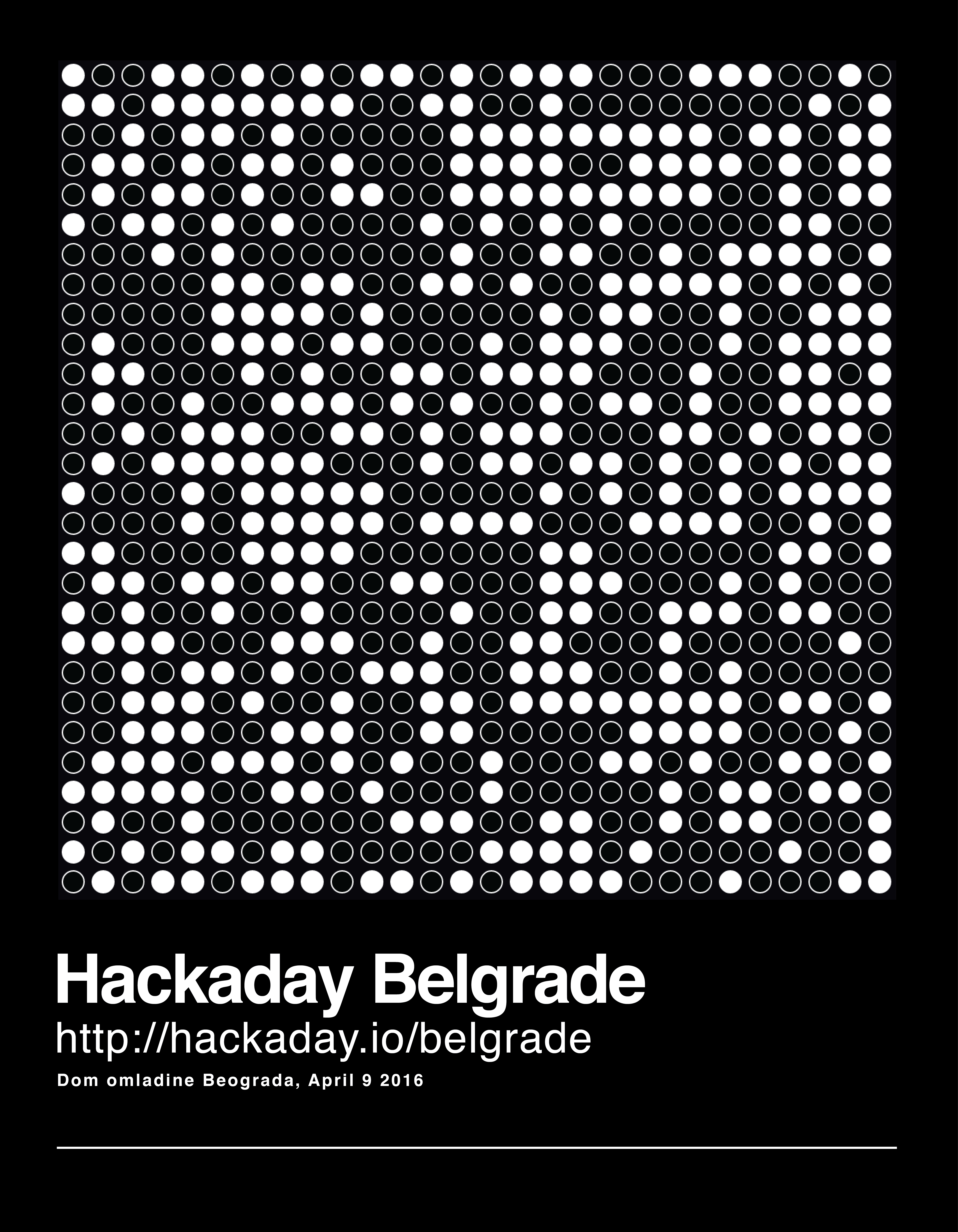
Hackaday Belgrade took place at Dom omladine Beograda and ran as an all-day event with workshops, conference talks, a badge hacking competition, evening concerts, and community activities. The schedule leaned heavily into what makes Hackaday events different: they are not purely academic, not purely commercial, and definitely not allergic to blinking LEDs.
A Conference Badge Worth Talking About
One major draw was the custom Hackaday Belgrade badge designed by Voja Antonic, a name familiar to many in the retrocomputing and electronics world. Conference badges at maker events are rarely just name tags. They are puzzles, development boards, art objects, social icebreakers, and occasionally tiny machines that seem determined to drain batteries at dramatic speed.
The Belgrade badge included enough technical depth to deserve its own talk. It involved an LED matrix, keyboard input, power management, infrared communication, and an accelerometer. In classic Hackaday fashion, attendees and remote participants were encouraged to hack the badge, experiment with code, and compete for prizes. Even those without the physical hardware could try ideas through an emulator, which made the livestream audience feel less like spectators and more like remote accomplices.
Talks With Real Range
The speaker lineup was unusually broad. Mike Harrison explored the engineering behind Eidophor video projection systems, a technology that sounds like it belongs in a museum basement guarded by a retired broadcast engineer with strong opinions. Dejan Ristanovic discussed Serbia’s long road to the internet, connecting technology history with regional experience. Chris Gammell covered top-down electronics, while Sophi Kravitz presented experimental work involving polarized light and fabrication.
Other talks moved through open source ECG development, modular laptop design, interactive storytelling systems, laser light synths, homebrew clusters, and even the challenge of 3D printing burger selfies with mayonnaise. That last topic may sound unserious until you remember that non-Newtonian condiments are still fluids, and fluids are never unserious when they are near machinery.
This diversity made the livestream valuable. Viewers did not get one narrow technical lane. They got a full hardware buffet: embedded systems, art, medical devices, retro technology, software design, community history, and a reminder that invention often begins with someone asking a ridiculous question in a very serious tone.
What Viewers Could Expect From the Livestream
The Hackaday Belgrade livestream was meant to carry the talks to people outside the venue. The conference page and Hackaday.io project page served as hubs for updates, stream links, and community interaction. Viewers were also encouraged to join the online chat, turning the event into a shared experience rather than a one-way broadcast.
Watch, Chat, Hack, Repeat
The best livestreams are not passive. They give remote viewers something to do. Hackaday Belgrade did that by pairing talks with chat and badge hacking. A viewer could listen to a presentation, discuss it with others, inspect project details, and try code in the badge emulator. That feedback loop is powerful because hardware people rarely want to simply consume information. They want to poke it with a multimeter.
The livestream also helped preserve the talks. After the event, Hackaday published recordings and gathered the presentations into playlists, allowing people to revisit individual sessions later. That archival value is easy to underestimate. A live conference inspires people for a day; a recorded talk can inspire someone years later when they finally find the right weekend, the right parts bin, and the right excuse to build something wonderfully unnecessary.
Why Hackaday Events Work So Well Online
Hackaday events translate well to livestreams because the community already lives online. Hackaday.com publishes projects and stories daily. Hackaday.io gives builders a place to document projects, post logs, share files, and follow other makers. YouTube playlists preserve conference talks. Community chats keep conversations alive while the stream is running. The system is not perfect, but it is deeply compatible with how hardware people learn.
Unlike glossy corporate tech launches, Hackaday talks often show the seams. Speakers talk about failures, weird parts, design compromises, late nights, and the tiny detail that ruined everything until someone found the right pull-up resistor. That honesty works beautifully on a livestream. It feels less like marketing and more like being invited behind the bench.
Remote viewers can also pause, rewatch, research parts, open documentation, and follow related projects. That is a major advantage for technical content. Nobody absorbs a full day of hardware talks perfectly in real time. By hour seven, even the strongest engineer may begin to confuse VHDL with lunch. Recordings and livestream replays solve that problem.
Belgrade Was the Right Stage
Belgrade added character to the event. The city has a layered technology history, a strong regional maker culture, and a community that knows how to mix serious engineering with social energy. Hackaday Belgrade was not just a conference exported from somewhere else; it became a local gathering with international reach.
The event project page pointed to workshops, informal meetups, a hacking competition, concerts, and the official schedule. That matters because great hardware events are not only about the talks. They are about hallway conversations, demo tables, accidental collaborations, and someone saying, “I brought a spare PCB,” which is the maker equivalent of offering a magic sword.
The livestream could not replicate every physical detail, but it did carry the heart of the event: the ideas. For people who could not attend, that was enough to participate in the wider Hackaday Belgrade moment.
SEO Takeaway: Why This Topic Still Has Search Value
From an SEO perspective, “Hackaday Belgrade Talks Will Live Stream Saturday” has long-tail search value because it combines a named event, a specific action, and a time-based viewing intent. Related keywords include Hackaday Belgrade livestream, Hackaday hardware talks, Hackaday conference badge, open source hardware event, badge hacking, and maker conference livestream.
The topic also connects to evergreen reader interest. People still search for old Hackaday conference talks, badge designs, open hardware presentations, and maker event recordings. A well-structured article can serve both users who want event history and users who want to understand why Hackaday conferences are important to the open hardware community.
The best angle is not merely “a livestream happened.” The stronger angle is this: the Hackaday Belgrade livestream showed how a sold-out hardware event could become globally accessible while still preserving the weird, generous, hands-on culture that makes Hackaday worth following.
Experience Notes: Watching a Hardware Livestream Like Hackaday Belgrade
Watching a hardware livestream such as Hackaday Belgrade is a different experience from watching a software keynote or a product reveal. A software keynote often moves in polished slides, controlled demos, and phrases like “seamless cloud-native productivity experience,” which may or may not mean anything after lunch. A Hackaday-style livestream feels more like looking over someone’s shoulder while they explain how a device came alive, caught fire metaphorically, behaved badly, and eventually became useful.
The first experience is discovery. You start watching for one topic, maybe the badge talk or an embedded systems session, and then suddenly you are listening to a presentation about vintage projection technology. Ten minutes later, you are searching for old service manuals. This is the classic Hackaday trap: curiosity expands faster than available free time. It is dangerous, but at least it is educational.
The second experience is community. Even when watching remotely, the chat gives the event a sense of presence. Someone recognizes a chip. Someone asks whether the code is available. Someone else makes a joke so niche it requires three datasheets and a childhood spent near surplus electronics. This kind of interaction keeps the livestream from feeling lonely. You are not just watching a video; you are temporarily sitting at the world’s largest folding table full of makers.
The third experience is practical inspiration. Hardware talks often leave viewers with concrete ideas: a circuit to test, a fabrication technique to try, a design mistake to avoid, or a project log to document. The Belgrade badge hacking element made this especially strong because it gave people something active to do while the event unfolded. Even without the badge in hand, the emulator lowered the barrier to participation. That is a clever move: it says, “You are not here physically, but you can still break things responsibly.”
The fourth experience is patience. Livestreams from technical events can have uneven audio, camera changes, delays, or the occasional moment when technology decides to demonstrate humility. But in a maker context, imperfections can feel oddly appropriate. The audience understands that real systems are assembled from cables, adapters, software, humans, and hope. When it works, it feels great. When it glitches, at least everyone learns something.
Finally, there is the after-effect. A good Hackaday livestream does not end when the video stops. It lingers. You bookmark a talk. You follow a project. You dig through a parts drawer. You begin a build log with absurd confidence. That is the real value of events like Hackaday Belgrade: they do not simply present finished work. They invite people to begin their own.
Conclusion
The Hackaday Belgrade talks livestream was more than a broadcast of a sold-out hardware conference. It was an open door into a community built on documentation, experimentation, humor, and practical engineering. From badge hacking and workshops to talks about projection systems, open source medical devices, embedded design, and regional internet history, the event captured the variety that makes Hackaday special.
For remote viewers, the livestream delivered access. For the broader maker community, it preserved knowledge. For searchers today, it remains a useful snapshot of how hardware conferences can blend local energy with global participation. And for anyone still wondering whether a Saturday spent watching hardware talks is a good idea: yes, absolutely. Just keep a notebook nearby, because your weekend project list is about to become unreasonable.