

Every student who has ever stared down an SAT math section knows the feeling: the clock is sprinting, your calculator suddenly feels like a decorative brick, and one tiny word in a problem seems to be wearing a villain cape. But in May 2019, one SAT math problem did something rare. It did not simply confuse students. It confused the official answer key.
The now-famous case often gets described as the hardest math problem the College Board got wrong. Technically, the math itself was not impossible. It was not a monster equation, a secret calculus trap, or a geometry diagram that looked like it had been drawn during an earthquake. It was a median question based on a histogram. The real difficulty came from something more subtle: the problem asked for “a possible value,” and the answer key failed to accept every possible correct value.
That small oversight mattered. Students who gave valid decimal answers, such as 12.5, were initially marked wrong. After the issue was challenged, the College Board acknowledged the mistake and adjusted scores for affected students. In other words, some test takers walked into the SAT, did the math correctly, got marked incorrect, and later discovered that the math gods had filed an appeal on their behalf.
What Was the SAT Math Problem?
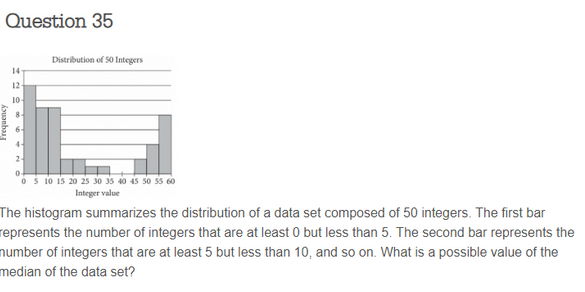
The problem appeared on the May 2019 SAT, in the Math with Calculator section. It involved a histogram representing a data set made up of 50 integers. The bars grouped the numbers into intervals: at least 0 but less than 5, at least 5 but less than 10, at least 10 but less than 15, and so on. Students were asked:
What is a possible value of the median of the data set?
This was a student-produced response question, sometimes called a grid-in style question. Unlike multiple-choice questions, students had to generate their own answer. That format is important because student-produced response questions can have more than one correct answer. When a question asks for “a possible value,” the test maker has to be extremely careful. It must accept every valid answer, not just the answers that look neat in a spreadsheet.
The College Board initially accepted only the integer values 10, 11, 12, 13, and 14. The problem? The median of an even-numbered data set can be a decimal. Since the data set contained 50 integers, the median would be the average of the 25th and 26th values after the data were arranged in order.
Why the Original Answer Key Was Wrong
To understand the mistake, start with the definition of median. If a data set has an odd number of values, the median is the middle value. If a data set has an even number of values, the median is the average of the two middle values. That rule is not an obscure math footnote hiding in a dusty textbook basement. It is standard statistics.
In this SAT problem, there were 50 integers. That means the median depends on the 25th and 26th numbers in the ordered list. Based on the histogram counts, those two middle positions had to fall in the interval from 10 to 14. The individual values could be 10, 11, 12, 13, or 14. But the two middle values did not have to be the same.
For example, the 25th value could be 12 and the 26th value could be 13. The median would then be:
(12 + 13) / 2 = 12.5
That is a perfectly valid median. The data set is still made of integers. The median, however, does not have to be an integer. This is the part of the problem where many students were sharper than the answer key. Somewhere, a decimal point was sitting quietly in the corner saying, “I belong here too.”
All the Possible Median Values
Since the two middle values could be any two integers from 10 through 14, the possible averages include both whole numbers and half values. Correct possible medians include:
- 10
- 10.5
- 11
- 11.5
- 12
- 12.5
- 13
- 13.5
- 14
The official key originally accepted only the whole numbers. That was the scoring error. The question did not say the median had to be an integer. It said the data set consisted of integers. Those are not the same thing, and on a test where a few points can affect scholarship eligibility, college applications, and a teenager’s blood pressure, that distinction matters.
Why This Became the “Hardest Math Problem” Story
Was this truly the hardest SAT math problem ever? Probably not in the dramatic sense. Nobody needed differential equations. Nobody had to prove Fermat’s Last Theorem while balancing a granola bar on one knee. But it was hard in a very SAT-specific way.
The hardest SAT math problems are often not the ones with the longest calculations. They are the ones that test precision. They ask whether you noticed a word like “possible,” “integer,” “median,” “at least,” or “less than.” They punish assumptions. They reward slow, careful thinking, which is slightly rude when the test is timed and your brain is running on two hours of sleep and vending machine crackers.
This question also appeared late in the Math with Calculator section, near the end of a long exam. Placement matters. A question that seems manageable on a quiet Tuesday afternoon can feel like a final boss when it shows up after hours of reading passages, grammar rules, algebra, and nervous page flipping.
The Role of the Histogram
Histograms are great for showing the shape of a distribution. They help readers quickly see where values cluster and how spread out the data may be. But histograms can be awkward when a question asks about exact individual data points. A bar might tell you how many values fall in an interval, but it does not reveal the exact values inside that interval.
In this problem, that uncertainty was the whole game. The histogram told students where the 25th and 26th values had to fall. It did not force those two values to be identical. That is why multiple medians were possible.
The question was clever because it tested whether students understood what a histogram can and cannot tell them. It was flawed because the scoring failed to honor the full set of correct outcomes created by that same uncertainty.
How the Error Was Discovered
After the May 2019 SAT, students could review released test materials through the Question-and-Answer Service. One student, working with a tutor, noticed that an answer such as 12.5 had been marked wrong even though the reasoning was mathematically sound.
The issue was raised through Compass Education Group, and the College Board eventually acknowledged that the answer key had failed to include all valid responses. Reports at the time noted that scores were corrected for affected students. Some students reportedly saw meaningful increases, which makes sense because one raw point on the SAT Math section can sometimes shift a scaled score by more than a tiny amount.
The correction did not lower anyone else’s score. It simply gave credit to students whose answers should have been counted in the first place. That is how scoring corrections should work: no drama, no scoreboard sabotage, just math getting its shoes tied properly.
What This Says About Standardized Testing
This incident became bigger than one median question because the SAT is a high-stakes exam. Students use SAT scores for college admissions, scholarships, placement, and personal goals. Even when colleges adopt test-optional policies, strong scores can still help students stand out in certain situations.
Standardized tests depend on trust. Students trust that the directions are precise. Families trust that the scoring is accurate. Colleges trust that a score from one test date can be compared fairly with a score from another. When a scoring mistake happens, even a rare one, it reminds everyone that standardized testing is built by humans. Smart humans, yes. But still humans. Humans occasionally forget decimal points. Humans also occasionally put cereal in the refrigerator. We contain multitudes.
The positive side is that the error was challenged and corrected. That matters. A fair testing system must have a process for review. Students should not assume every official answer is wrong, but they also should not ignore clear mathematical evidence when something does not add up.
Lessons Students Can Learn from the SAT Median Mistake
1. Read the Exact Wording
The phrase “a possible value” was the key. The problem did not ask for the most likely median or the only median. It asked for any value that could work. SAT math questions often hide the main idea in ordinary language. Underline mentally. Circle carefully. Do not let one small phrase sneak past you wearing camouflage.
2. Know the Median Rule Cold
For an even number of data points, the median is the average of the two middle values. That average can be a decimal even when all numbers in the original data set are integers. This rule appears simple, but the 2019 SAT incident proves that simple rules can have big consequences.
3. Understand the Limits of Graphs
A histogram shows intervals, not every individual value. When solving histogram problems, ask yourself what information is fixed and what information is flexible. The fixed information tells you what must be true. The flexible information tells you what could be true.
4. Do Not Panic When Your Answer Looks “Unfriendly”
Students sometimes mistrust answers like 10.5 or 12.5 because they look less tidy than whole numbers. But math does not grade based on vibes. A decimal answer can be correct, elegant, and completely legal. If the reasoning is solid, do not reject an answer just because it is not wearing a tuxedo.
A Simple Example Similar to the Problem
Imagine a data set with 8 values:
2, 3, 5, 10, 11, 18, 19, 20
There are 8 values, so the median is the average of the 4th and 5th values. Those values are 10 and 11.
(10 + 11) / 2 = 10.5
Notice that every value in the data set is an integer. The median is not. This is exactly the kind of idea that mattered in the College Board scoring error. The data can be integer-only while the median politely refuses to be.
Why “Hard” SAT Math Is Often About Logic, Not Huge Calculations
Many students prepare for SAT Math by drilling equations, formulas, and calculator tricks. Those skills help, but the hardest SAT math problems often test logic more than raw computation. The SAT wants to know whether you can interpret conditions, connect concepts, and avoid tempting assumptions.
In the 2019 median problem, the calculation itself was tiny. Add two numbers and divide by 2. The challenge was recognizing that the two middle numbers could differ. That is not a calculator issue. That is a reasoning issue.
This is why strong SAT prep should include more than speed practice. Students should review missed questions carefully, explain why wrong answers are wrong, and practice translating word problems into precise mathematical conditions. In other words, do not just ask, “What is the answer?” Ask, “What must be true, what could be true, and what am I assuming because my brain wants lunch?”
What the Digital SAT Changes and What It Does Not
Today’s SAT is digital and adaptive. The Math section is divided into modules, and the second module can vary in difficulty depending on performance in the first. The test still includes multiple-choice questions and student-produced response questions. It still covers algebra, advanced math, problem-solving and data analysis, and geometry and trigonometry.
The digital format changes how the test is delivered and scored, but it does not remove the need for exact answer keys, careful wording, and strong review systems. In fact, because digital testing can involve adaptive scoring and different question paths, clarity may matter more than ever.
The old median mistake remains relevant because it highlights a timeless testing principle: a question is only as good as its scoring rules. If a prompt allows multiple correct answers, the scoring system must be ready for them all. A test cannot invite students to think flexibly and then punish them for doing exactly that.
How to Approach the Hardest SAT Math Problems
If you want to perform well on difficult SAT math questions, start with patience. The fastest solver is not always the best solver. Sometimes the student who pauses for five seconds to read the condition carefully saves two minutes of messy correction later.
Next, organize the information. For statistics problems, write down the total number of values, identify the middle position, and check whether the data count is odd or even. For graph problems, separate what the graph directly states from what you are inferring.
Finally, test your answer against the wording. If the question asks for a possible value, your job is not to prove uniqueness. Your job is to produce one valid example. If the question asks for the value, then you need something definite. That difference is small in grammar and huge in math.
Experience Section: What This SAT Math Mistake Feels Like from a Student’s Point of View
Anyone who has prepared for the SAT long enough knows that strange emotional weather appears during practice. One minute you are confident. The next minute you are arguing with a triangle. The story of the College Board getting an SAT math answer wrong captures that experience perfectly because students often believe the official answer key is untouchable. If the book says you are wrong, surely you are wrong. Right? Usually, yes. But not always.
Picture a student reviewing the May 2019 test. They reach the median question and remember their reasoning clearly. There are 50 values, so the median must be the average of the 25th and 26th values. Those values can sit in the same histogram interval but still be different numbers. The student enters 12.5. The answer key says no. At that moment, the student probably experiences the classic academic spiral: “Did I misunderstand the question? Did I forget the median rule? Did decimals get banned while I was eating breakfast?”
That moment is familiar to many test takers. Sometimes you miss a question because you rushed. Sometimes you miss it because you did not know the concept. And sometimes, very rarely, you miss it because the answer key is incomplete. The danger is that students may stop trusting their own reasoning too quickly. Good test prep should teach humility, but it should not teach blind surrender.
The best review habit is to rebuild the solution from scratch. Do not simply stare at the official answer and nod like it is a royal decree. Ask why. For the SAT median problem, a careful student could create a sample data set where the 25th value is 12 and the 26th value is 13. That makes the median 12.5. Once you can construct an example that satisfies the conditions, your answer has evidence.
This experience also teaches students not to fear “messy” answers. On the SAT, correct answers are not always pretty. A fraction, decimal, or unusual value can be right if it follows from the question. Students who automatically reject decimals in statistics problems may lose points unnecessarily. Math is not a beauty contest. The median does not need to be photogenic.
For tutors, teachers, and parents, the incident is a reminder to encourage explanation over memorization. When students can explain their reasoning, they are better equipped to catch mistakes, whether those mistakes are their own or hidden in the materials. A student who merely memorizes “median means middle” may miss the even-number rule. A student who understands why the median is averaged for even data sets can defend an answer like 12.5 with confidence.
Most importantly, this story makes SAT preparation feel a little more human. The College Board is a major testing organization, but no organization is magically immune to error. The goal for students is not to become suspicious of every answer key. That would be exhausting, and honestly, nobody has enough snacks for that lifestyle. The goal is to build reasoning strong enough to notice when something truly does not make sense.
In that way, the hardest SAT math problem was not only about medians. It was about intellectual confidence. The students who questioned the scoring did something every strong math student eventually learns to do: they trusted proof over authority. That is a powerful lesson, and unlike a calculator battery, it will not die halfway through test day.
Conclusion
The story behind “Hardest Math Problem – College Board Gets SAT Math Problem Wrong” is more than a funny testing scandal with a decimal point punchline. It is a useful lesson in precision, statistics, and academic confidence. The May 2019 SAT median problem showed that even a professionally written exam can stumble when a question allows multiple correct answers and the scoring key does not account for all of them.
For students, the takeaway is clear: read carefully, understand definitions deeply, and do not panic when a correct answer looks unconventional. For educators, the lesson is equally clear: strong reasoning matters more than answer-key worship. The SAT may be standardized, but math is still math. If the 25th and 26th values average to 12.5, then 12.5 deserves its seat at the table.